🧠 Data Lake vs Data Warehouse vs Data Mart: Know the Differences Like a Pro!
🧠 Data Lake vs Data Warehouse vs Data Mart: Know the Differences Like a Pro!
In the data-driven world we live in, terms like Data Lake, Data Warehouse, and Data Mart pop up all the time. But what do they actually mean? 🤔 How are they different? And when should you use which one?
Let’s break them down in a simple, practical, and visual way — with real-world examples 🚀
📘 What is a Data Lake?
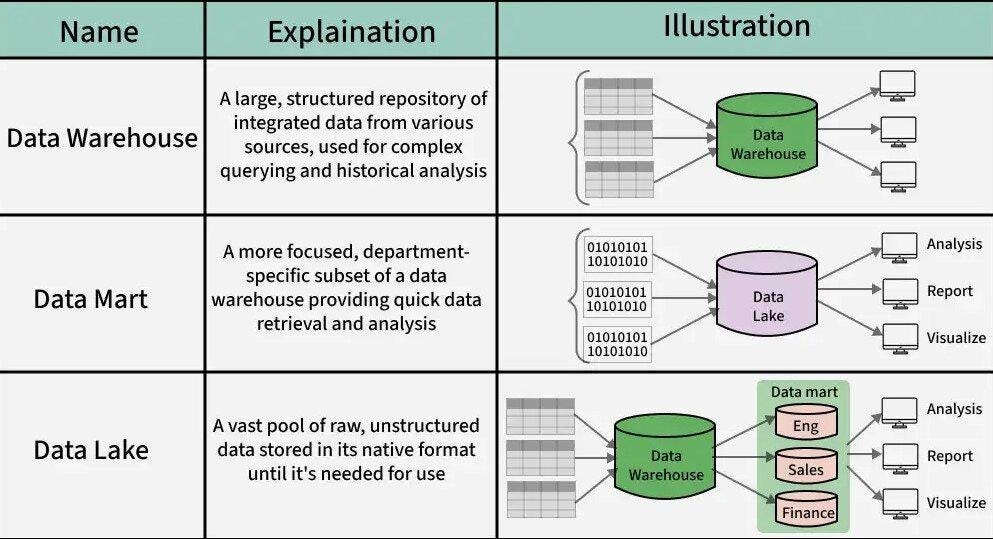
A Data Lake is a vast pool of raw, unstructured, semi-structured, and structured data — all stored in its native format. Think of it as a huge data dump with no schema-on-write restriction.
🔍 Key Features:
- Stores raw data (CSV, JSON, video, logs, etc.)
- Schema-on-read (define schema when reading)
- Highly scalable (built on Hadoop, S3, Azure Blob, etc.)
- Ideal for Big Data & Machine Learning
✅ Best For:
- Data Scientists 🧪
- Machine Learning Pipelines 🤖
- Real-Time Analytics 🌐
- Companies dealing with high-volume diverse data
🧾 Example:
Imagine Netflix stores all raw logs of what people are watching, pausing, rewinding, and rating. All this raw, unstructured data goes into a Data Lake like AWS S3.
🏢 What is a Data Warehouse?
A Data Warehouse is a centralized repository of structured and processed data that is optimized for reporting and analysis 📊.
🔍 Key Features:
- Stores structured data (from relational databases, etc.)
- Schema-on-write
- Great for business intelligence (BI) tools
- Time-consuming ETL process before storage
✅ Best For:
- Business Analysts 📈
- Dashboards & Reporting 📊
- Strategic Decision-Making 🧑💼
🧾 Example:
Amazon processes all transactions and stores daily sales, returns, customer orders into Redshift or Snowflake as clean structured tables for BI analysis.
🧩 What is a Data Mart?
A Data Mart is a subset of a Data Warehouse focused on a specific business unit like Sales, Marketing, or HR.
🔍 Key Features:
- Smaller in size and scope
- Built for specific departments
- Can be dependent or independent from a warehouse
- Faster query performance due to narrow focus
✅ Best For:
- Department-Specific Analysis 🎯
- Quick Insights & Dashboards 💡
🧾 Example:
The Marketing team at Flipkart has a Data Mart that only contains customer campaign performance, click-through rates, and conversion data from the main data warehouse.
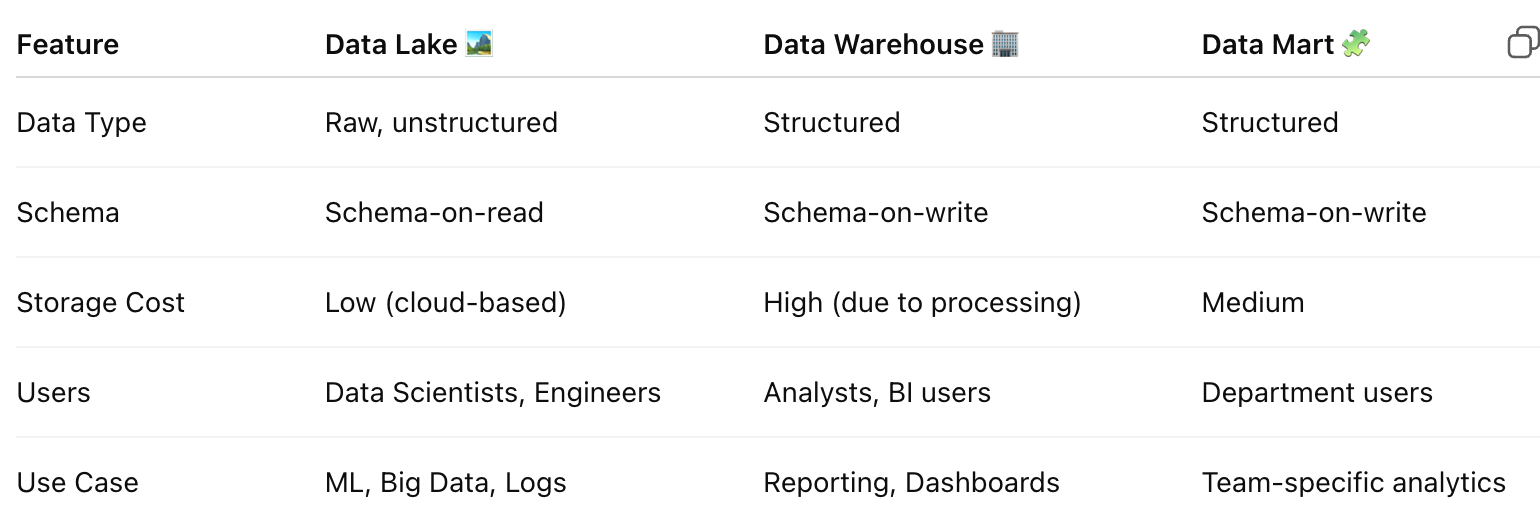
📊 Tabular Comparison:
🧠 When to Use What?
✅ Use a Data Lake when:
- You have a variety of raw data (text, images, logs, etc.)
- You want to store it cost-effectively at scale
- You plan to use data for AI/ML models later
✅ Use a Data Warehouse when:
- You need structured data for regular reports
- Your team uses BI tools like Tableau, Power BI
- You have well-defined KPIs and metrics
✅ Use a Data Mart when:
- A team or department needs faster access to relevant data
- You want to customize data views for a domain (Sales, HR)
- Your warehouse is too large for focused queries
💡 Best Practices for Building a Data Ecosystem
- Start with a Data Lake for raw ingestion 📥
- Use ETL or ELT pipelines to clean, transform data 🧹
- Store structured data into a Data Warehouse for analysis 🏗️
- Create Data Marts for team-specific consumption 🧪
🔚 Final Thoughts
Choosing between Data Lake, Data Warehouse, and Data Mart isn’t about which is best — it’s about using the right tool for the right job. Many modern data architectures actually use all three together!
So, whether you’re building a Netflix-like recommendation system or analyzing monthly sales, understanding this trio is your first step toward mastering data engineering 💻📊
🔗 Let’s Connect!
👉 If you liked this blog, follow me on LinkedIn and check out more insights on my blog or Medium!


Comments
Post a Comment