🏗️ Data Warehouses Explained: The Backbone of Data-Driven Decisions 🚀
🏗️ Data Warehouses Explained: The Backbone of Data-Driven Decisions 🚀
In today’s data-first world, companies don’t just collect data — they transform it into insights.
That’s where Data Warehouses come in 🧠📊
This blog will walk you through:
✅ What a Data Warehouse is
✅ Types of Data Warehouses
✅ Core Principles
✅ Popular Tools
✅ Real-world examples
— all explained in simple language with emojis 👇
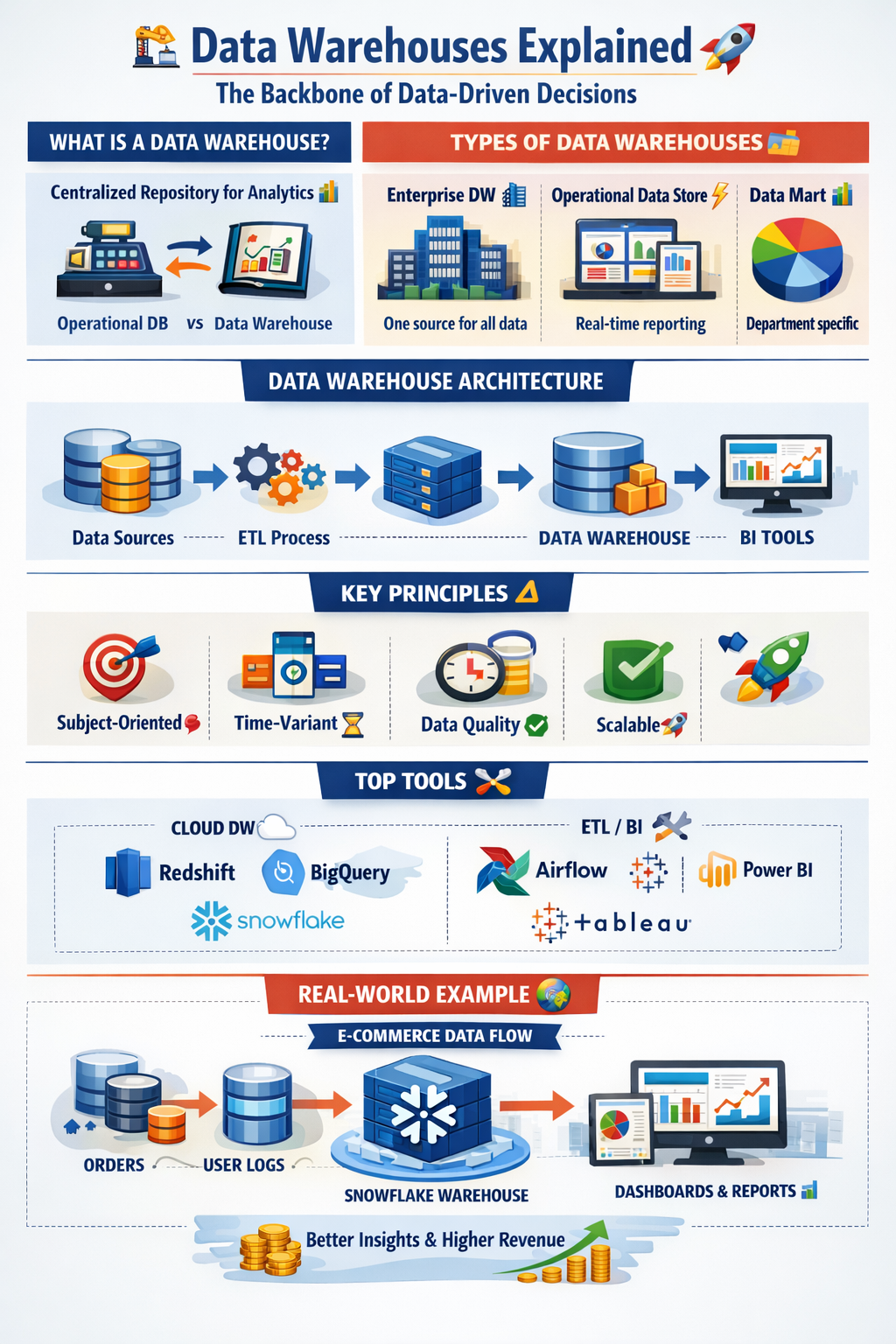
🔍 What is a Data Warehouse?
A Data Warehouse is a centralized system that stores structured, cleaned, and historical data from multiple sources for analytics and reporting.
👉 Unlike operational databases (used for day-to-day work), data warehouses are built for analysis, trends, and decision-making.
📌 Simple analogy:
Operational DB = Cash counter
Data Warehouse = Account books for yearly analysis 📘
🧱 Key Characteristics of a Data Warehouse
A classic definition (by Bill Inmon) includes four traits:
1️⃣ Subject-Oriented 🎯
Data is organized around business subjects
📊 Sales, Customers, Revenue, Marketing
2️⃣ Integrated 🔗
Data comes from multiple sources but follows consistent formats
- Same date formats
- Same currency
- Same naming conventions
3️⃣ Time-Variant ⏳
Stores historical data
📅 Sales from last 5–10 years for trend analysis
4️⃣ Non-Volatile 🔒
Data is read-only
✔️ No updates or deletes
✔️ Only inserts
🗂️ Types of Data Warehouses
1️⃣ Enterprise Data Warehouse (EDW) 🏢
A central warehouse for the entire organization.
🔹 Covers all departments
🔹 Single source of truth
🔹 Highly scalable
📌 Example:
A retail company analyzing:
- Sales
- Inventory
- Customer behavior
— all from one warehouse
🛠️ Used by large enterprises
2️⃣ Operational Data Store (ODS) ⚡
Used for near real-time reporting.
🔹 Updated frequently
🔹 Short-term data
🔹 Supports operational decisions
📌 Example:
Bank dashboard showing today’s transactions
3️⃣ Data Mart 🧩
A smaller, department-specific warehouse.
🔹 Focused on a single business unit
🔹 Faster and cheaper
🔹 Derived from EDW
📌 Example:
- Marketing Data Mart
- Finance Data Mart
🧠 Data Warehouse Architecture (High Level)
Data Sources ➜ ETL ➜ Data Warehouse ➜ BI Tools🔹 Data Sources
- Databases (MySQL, PostgreSQL)
- APIs
- Logs
- CRM, ERP systems
🔹 ETL (Extract, Transform, Load) 🔄
Data is:
- Extracted
- Cleaned & transformed
- Loaded into the warehouse
📐 Core Data Warehouse Principles
1️⃣ Schema Design 📊
⭐ Star Schema
- Central Fact Table
- Multiple Dimension Tables
📌 Best for performance
❄️ Snowflake Schema
- Normalized dimensions
- More complex but space-efficient
2️⃣ Fact vs Dimension Tables
Table Type Description Fact Table Metrics (Sales, Revenue) Dimension Table Context (Date, Customer, Product)
📌 Example:
- Fact:
total_sales - Dimension:
date,region,customer
3️⃣ Data Quality First ✅
Bad data = bad decisions ❌
✔️ Deduplication
✔️ Validation
✔️ Standardization
4️⃣ Scalability & Performance 🚀
- Partitioning
- Indexing
- Columnar storage
🛠️ Popular Data Warehouse Tools
☁️ Cloud Data Warehouses (Most Popular Today)
1️⃣ Amazon Redshift
✔️ Scalable
✔️ AWS ecosystem
✔️ Columnar storage
📌 Used by startups to enterprises
2️⃣ Google BigQuery ⚡
✔️ Serverless
✔️ Extremely fast
✔️ SQL-based
📌 Great for huge datasets
3️⃣ Snowflake ❄️
✔️ Separate compute & storage
✔️ Multi-cloud
✔️ Easy scaling
📌 Loved by data teams
4️⃣ Azure Synapse
✔️ Microsoft ecosystem
✔️ Integrated analytics
✔️ Enterprise-friendly
🔄 ETL / ELT Tools
- Apache Airflow 🌀
- Talend
- AWS Glue
- dbt
📊 BI & Visualization Tools
- Tableau 📈
- Power BI
- Looker
- Metabase
🌍 Real-World Example
🛒 E-Commerce Company
Data Sources
- Orders DB
- User activity logs
- Payment gateway
Process
- ETL cleans & merges data
- Stored in Snowflake
- Tableau dashboards show:
- Daily sales
- Conversion rate
- Customer lifetime value
📊 Result: Better marketing & higher revenue
❌ Common Mistakes to Avoid
🚫 Mixing OLTP & Analytics
🚫 Poor schema design
🚫 Ignoring data quality
🚫 Over-engineering too early
🚀 Why Data Warehouses Matter
✅ Faster decisions
✅ Historical insights
✅ Business intelligence
✅ Competitive advantage
💡 “Without a data warehouse, data is just noise.”
🎯 Final Thoughts
A Data Warehouse is the brain of modern analytics 🧠
Whether you’re a developer, data engineer, analyst, or tech leader, understanding data warehouses is non-negotiable in 2025 and beyond.
If you liked this blog, share it with your data-loving friends 📤😊
Happy querying! 🚀📊


Comments
Post a Comment