🧠✨ Dynamic Programming Explained: The Superpower Behind Smart Algorithms, Rails Optimization & AI/ML Breakthroughs 🚀
🧠✨ Dynamic Programming Explained: The Superpower Behind Smart Algorithms, Rails Optimization & AI/ML Breakthroughs 🚀
Have you ever faced a problem where the same calculations repeat again and again?
Like:
- Finding the shortest path
- Predicting the best outcome
- Optimizing resources
- Training AI models
- Solving complex interview questions
That’s exactly where Dynamic Programming (DP) becomes a game-changer. 💥
Dynamic Programming is not just a coding technique…
It is a mindset for solving big problems efficiently — and it powers everything from web apps to Machine Learning systems.
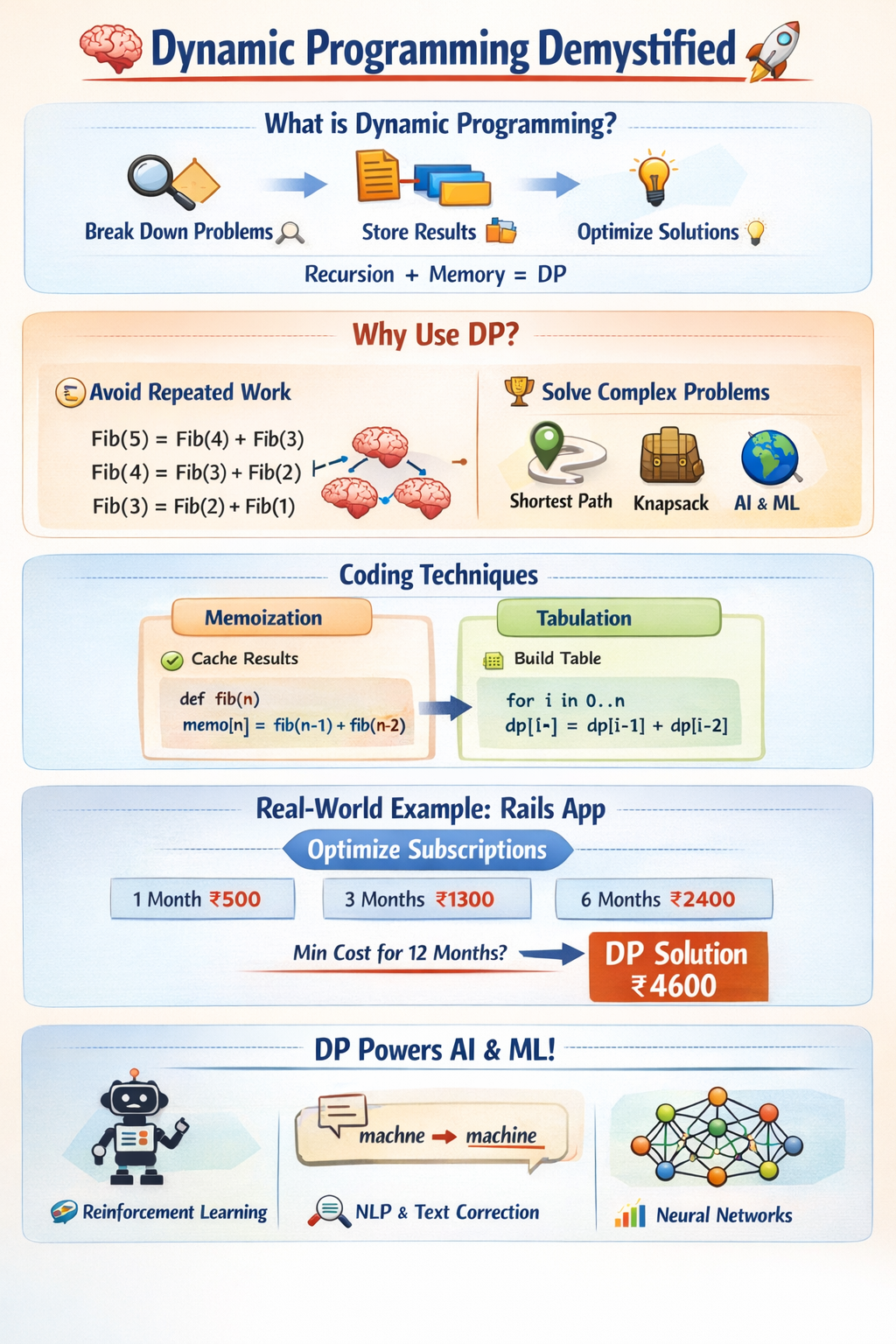
Let’s dive deep 🔥
🌟 What is Dynamic Programming?
Dynamic Programming is an algorithmic technique used to solve problems by:
✅ Breaking them into smaller overlapping subproblems
✅ Solving each subproblem only once
✅ Storing results to avoid repeated work
📌 In simple words:
DP = Recursion + Memory (Optimization)
🤔 Why Do We Need Dynamic Programming?
Imagine this…
You are calculating Fibonacci numbers:
fib(5) = fib(4) + fib(3)
fib(4) = fib(3) + fib(2)
fib(3) = fib(2) + fib(1)
Notice something?
👉 fib(3) and fib(2) are calculated multiple times.
That wastes time ⏳
Dynamic Programming solves this by storing results.
⚡ When Should You Use Dynamic Programming?
Dynamic Programming is useful when a problem has:
1️⃣ Overlapping Subproblems 🔁
Same smaller problems appear repeatedly.
2️⃣ Optimal Substructure 🏗️
The solution of the big problem depends on optimal solutions of smaller parts.
Example:
- Shortest path
- Maximum profit
- Best decision-making
🧩 Core Concepts of Dynamic Programming
Let’s understand DP like a pro.
✅ 1. Memoization (Top-Down Approach)
This is recursion + caching.
📌 Solve problem recursively and store results.
Example: Fibonacci with Memoization
def fib(n, memo = {})
  return n if n <= 1
  return memo[n] if memo[n]

  memo[n] = fib(n - 1, memo) + fib(n - 2, memo)
end

puts fib(10)
✨ Faster because we avoid repeated calculations.
✅ 2. Tabulation (Bottom-Up Approach)
Instead of recursion, we build solutions iteratively.
Fibonacci with Tabulation
def fib(n)
  dp = Array.new(n + 1, 0)
  dp[1] = 1

  (2..n).each do |i|
    dp[i] = dp[i - 1] + dp[i - 2]
  end
  dp[n]
end

puts fib(10)
🔥 More efficient and avoids recursion depth issues.
🏆 Classic Dynamic Programming Problems
Dynamic Programming appears everywhere:
✅ Knapsack Problem 🎒
✅ Longest Common Subsequence 🧬
✅ Minimum Path Sum 🛣️
✅ Edit Distance ✍️
✅ Coin Change 💰
✅ Matrix Multiplication Optimization 🧮
💎 Dynamic Programming in Ruby on Rails (Real-Life Use Case)
You might think:
DP is only for competitive programming…
Nope ❌
Rails developers use DP mindset in many real-world scenarios.
🚀 Example: Optimizing Pricing Plans (Subscription Logic)
Suppose your Rails app offers multiple plans:
- 1 month → ₹500
- 3 months → ₹1300
- 6 months → ₹2400
User wants subscription for N months at minimum cost.
That is a perfect DP problem.
Rails Service Using DP
class SubscriptionOptimizer
  def initialize(plans)
    @plans = plans
  end

  def min_cost(n)
    dp = Array.new(n + 1, Float::INFINITY)
    dp[0] = 0
    (1..n).each do |i|
      @plans.each do |duration, cost|
        if i - duration >= 0
          dp[i] = [dp[i], dp[i - duration] + cost].min
        end
      end
    end
    dp[n]
  end
end
Usage in Rails Controller
plans = [[1, 500], [3, 1300], [6, 2400]]
optimizer = SubscriptionOptimizer.new(plans)

puts optimizer.min_cost(12)
✅ This gives the cheapest way to subscribe for 12 months.
🤖 Why Dynamic Programming is Critical for AI & ML?
Now comes the exciting part…
Dynamic Programming is one of the foundations of AI.
🧠 1. Reinforcement Learning (RL)
AI agents learn by maximizing rewards.
Example:
- Robots 🤖
- Self-driving cars 🚗
- Game AI 🎮
DP is used in:
✅ Value Iteration
✅ Policy Iteration
Bellman Equation is DP-based:
Best future decision depends on best current decision.
📌 2. Neural Networks Optimization
Training deep learning models requires:
- minimizing loss
- optimizing weights
Dynamic programming helps in:
✅ Backpropagation computations
✅ Efficient gradient updates
🧬 3. Natural Language Processing (NLP)
Tasks like:
- Speech recognition 🎙️
- Machine translation 🌍
- Text correction ✍️
Use DP algorithms like:
- Viterbi Algorithm
- Edit Distance
🎯 AI Example: Edit Distance for Spell Correction
Suppose AI wants to correct:
“machne” → “machine”
DP calculates minimum edits:
def edit_distance(word1, word2)
  m, n = word1.length, word2.length
  dp = Array.new(m+1) { Array.new(n+1, 0) }

  (0..m).each { |i| dp[i][0] = i }
  (0..n).each { |j| dp[0][j] = j }

  (1..m).each do |i|
    (1..n).each do |j|
      if word1[i-1] == word2[j-1]
        dp[i][j] = dp[i-1][j-1]
      else
        dp[i][j] = [
          dp[i-1][j],     # delete
          dp[i][j-1],     # insert
          dp[i-1][j-1]    # replace
        ].min + 1
      end
    end
  end
  dp[m][n]
end

puts edit_distance("machne", "machine")
✨ This powers autocorrect and AI language systems.
🌈 Final Thoughts: DP is the Brain of Optimization
Dynamic Programming is not just an interview topic…
It is a real-world tool that drives:
🚀 Efficient software
🧠 Smart AI decisions
📊 Optimized ML models
💻 Better Rails applications
If you master DP, you master the art of solving problems intelligently.
✅ Quick Summary
📌 DP solves problems efficiently by storing sub-results
📌 Two approaches: Memoization + Tabulation
📌 Used in Rails for optimization and cost planning
📌 Core foundation of AI, ML, NLP, Reinforcement Learning
📌 Makes impossible problems possible 🔥
💬 Quote to Remember
“Dynamic Programming is not about code…
It’s about thinking smarter, not harder.” 💡


Comments
Post a Comment