🤖✨ Machine Learning in Depth: The Ultimate Guide to Concepts, Tools, Terminologies & Daily-Life Uses
🤖✨ Machine Learning in Depth: The Ultimate Guide to Concepts, Tools, Terminologies & Daily-Life Uses
Machine Learning (ML) is no longer just a buzzword — it’s the invisible engine running modern life.
From Netflix recommendations 🎬 to fraud detection 💳 to self-driving cars 🚗, ML is everywhere.
But what exactly is Machine Learning?
How does it work?
What are its terminologies, tools, and real-world daily uses?
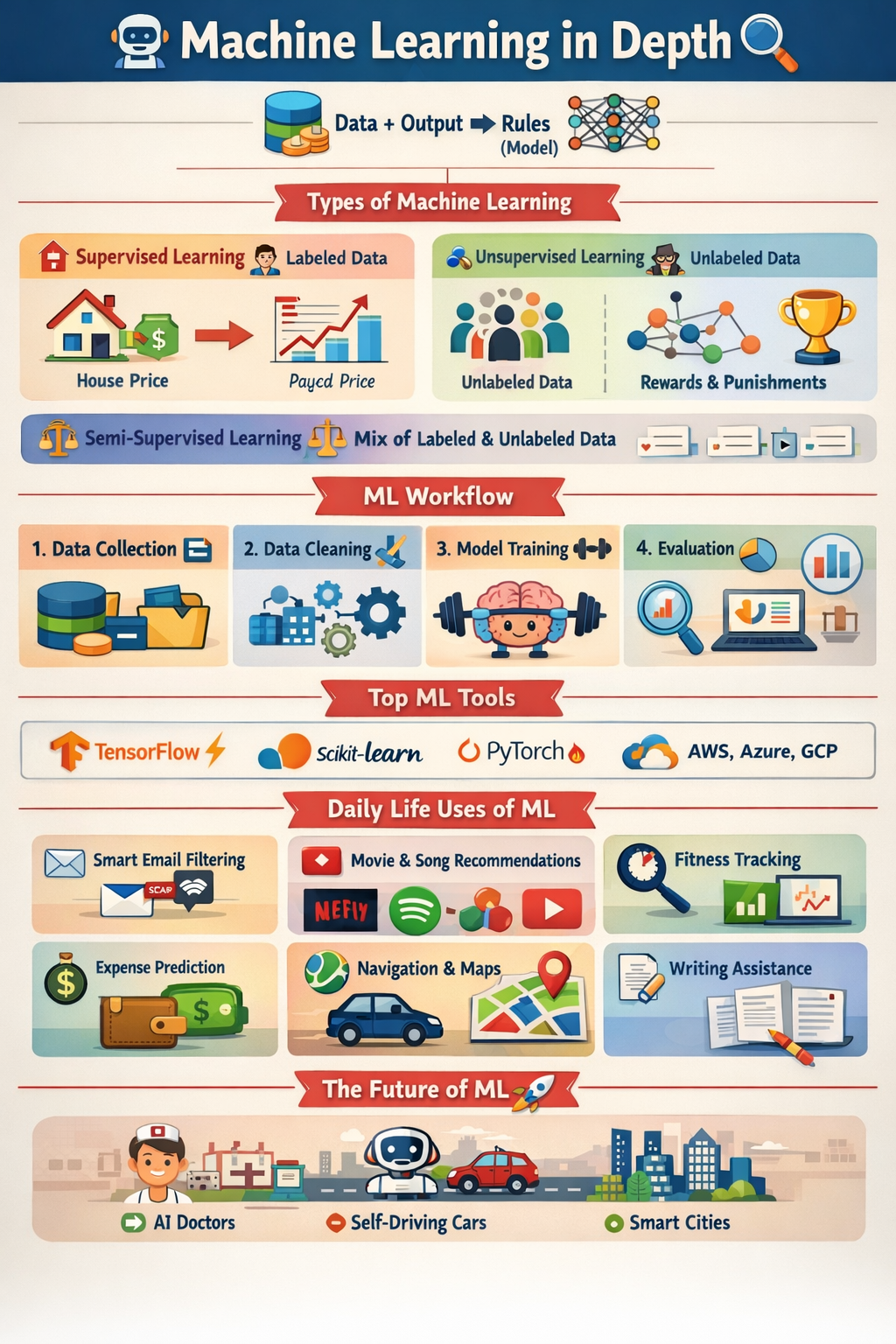
Let’s dive deep — step by step — in the most practical and beginner-friendly way possible 🚀
🌍 What is Machine Learning?
Machine Learning is a subset of Artificial Intelligence (AI) that allows computers to learn patterns from data instead of being explicitly programmed.
✅ Traditional Programming:
Rules + Data → Output✅ Machine Learning:
Data + Output → Rules (Model)So instead of writing rules manually, ML discovers them automatically 🔥
🧠 Why Machine Learning is Powerful?
Machine Learning is useful when:
- Rules are too complex to write manually
- Data is huge and constantly changing
- Predictions and automation are needed
- Patterns are hidden inside information
Example:
It’s impossible to manually code rules for spam emails 📩, but ML can learn from millions of examples.
🏗️ Core Terminologies in Machine Learning
Understanding ML starts with its language:
📌 Dataset
A dataset is the collection of data used for learning.
Example:

📌 Features (Input Variables)
Features are the inputs used to predict something.
Example:
Age, Salary → Features
📌 Label (Target Output)
Label is what the model predicts.
Example:
Bought Car → Label
📌 Model
A model is the learned mathematical representation of patterns.
Example:
A model learns:
Higher salary increases chances of buying a car 🚘
📌 Training
Training is the process where the model learns from data.
📌 Testing
Testing checks how well the model performs on unseen data.
📌 Prediction
Using the trained model to make future decisions.
📌 Overfitting 🎭
When the model memorizes training data but fails on new data.
Example:
- Perfect score in training
- Poor score in real world
📌 Underfitting 😴
When the model is too simple and fails even on training data.
🧩 Types of Machine Learning
Machine Learning is mainly divided into 4 major categories:
1️⃣ Supervised Learning 👨🏫
The model learns from labeled data.
Example:
- Input: House size
- Output: House price
📌 Algorithms:
- Linear Regression
- Logistic Regression
- Decision Trees
- Random Forest
- Support Vector Machines
Example Use:
📈 Predicting stock prices
🏥 Detecting diseases
2️⃣ Unsupervised Learning 🕵️
The model learns from unlabeled data.
Example:
Grouping customers based on behavior.
📌 Algorithms:
- K-Means Clustering
- Hierarchical Clustering
- PCA (Dimensionality Reduction)
Example Use:
🛍️ Customer segmentation
📊 Discovering hidden patterns
3️⃣ Reinforcement Learning 🎮
The model learns through rewards and punishments.
Example:
A robot learns walking by trial and error 🤖
📌 Used in:
- Self-driving cars 🚗
- Game AI (Chess, AlphaGo) ♟️
- Robotics
4️⃣ Semi-Supervised Learning ⚖️
A mix of:
- Small labeled data
- Large unlabeled data
Example:
Medical imaging where labeling is expensive.
🏛️ Machine Learning Workflow (Step-by-Step)
ML projects follow a structured pipeline:
Step 1: Data Collection 📥
Sources:
- Databases
- Sensors
- APIs
- Web scraping
Step 2: Data Cleaning 🧹
Fixing:
- Missing values
- Duplicate records
- Incorrect formatting
Step 3: Feature Engineering ⚙️
Transforming raw data into meaningful inputs.
Example:
Date → Extract month, day, weekday
Step 4: Model Selection 🧠
Choosing algorithm based on problem type.
Regression → Linear Regression
Classification → Random Forest
Clustering → K-Means
Step 5: Training the Model 🏋️
Feeding data into algorithm.
Step 6: Evaluation 📊
Metrics:
- Accuracy
- Precision
- Recall
- F1 Score
- RMSE
Step 7: Deployment 🚀
Using the model in real applications:
- Web apps
- Mobile apps
- Cloud APIs
🛠️ Best Tools & Libraries for Machine Learning
🐍 Python Libraries
Most popular ML ecosystem:
- NumPy → Math operations
- Pandas → Data analysis
- Matplotlib → Visualization
- Scikit-learn → ML algorithms
- TensorFlow → Deep learning
- PyTorch → Neural networks
- XGBoost → High-performance ML
☁️ Cloud ML Platforms
- AWS SageMaker
- Google Vertex AI
- Microsoft Azure ML
📊 Visualization Tools
- Power BI
- Tableau
- Plotly
🧪 Experiment Tracking
- MLflow
- Weights & Biases
🤖 Deep Learning vs Machine Learning
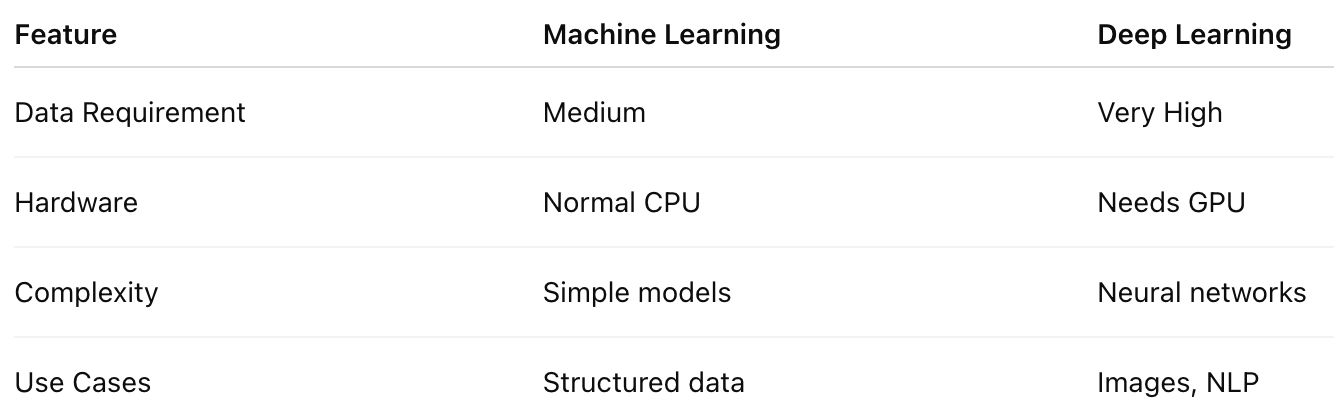
Example:
- ML → Predict sales
- DL → Recognize faces 📸
🌟 Best Daily-Life Uses of Machine Learning
Machine Learning can boost your day-to-day productivity massively:
📩 Smart Email Filtering
Gmail detects spam automatically.
📝 Writing & Grammar Assistance
Tools like Grammarly use ML for:
- Sentence improvement
- Tone correction
- Auto suggestions
🎧 Personalized Recommendations
Netflix, Spotify, YouTube suggest content based on behavior.
💰 Expense Tracking & Budget Prediction
ML apps can detect spending habits and suggest savings.
🏋️ Fitness & Health Monitoring
Smartwatches use ML to track:
- Heart rate
- Sleep cycles
- Activity predictions
🛍️ Shopping Assistance
Amazon predicts:
- What you might buy next
- Best deals for you
🧑💻 Productivity Automation
ML can help automate tasks like:
- Sorting files
- Detecting duplicate photos
- Scheduling reminders
🚗 Travel & Navigation
Google Maps predicts:
- Traffic congestion
- Best route
- Travel time
🚀 Real Example: Simple ML Prediction
Problem: Predict if a student will pass based on study hours
from sklearn.linear_model import LinearRegression

X = [[1], [2], [3], [4]]  # Hours studied
y = [35, 50, 65, 80]      # Marks

model = LinearRegression()
model.fit(X, y)

print(model.predict([[5]]))
Output:
✅ Predicted marks for 5 hours study
🎯 Best Practices for Machine Learning
To become great at ML:
✅ Start with small datasets
✅ Focus on understanding data
✅ Learn evaluation metrics
✅ Avoid overfitting
✅ Deploy real-world projects
✅ Keep learning continuously 📚
🌈 Future of Machine Learning
Coming innovations include:
- AI Doctors 🏥
- Fully autonomous cars 🚗
- Personalized education 📘
- Smart cities 🌆
- AI-powered software development 👨💻
Machine Learning is shaping the future faster than ever.
🏁 Final Thoughts
Machine Learning is not magic — it’s mathematics + data + learning.
If you understand:
- Concepts
- Terminologies
- Tools
- Daily applications
You can build systems that truly impact the world 🌍✨
🔥 Quick Takeaway
Machine Learning helps machines learn from data to:
✅ Predict
✅ Automate
✅ Recommend
✅ Detect
✅ Improve decisions
And it’s already improving your daily life every moment 🚀


Comments
Post a Comment