🚀 Mastering Action Controller in Ruby on Rails
🚀 Mastering Action Controller in Ruby on Rails
The Brain Behind Your Web Requests 🧠⚡
When you hit a URL in a Rails app, magic happens. But that “magic” is actually powered by one of the most important components of Rails — Action Controller.
If you’re serious about building scalable, clean, and high-performance Rails apps, mastering Action Controller is non-negotiable. Let’s break it down deeply with examples, hacks, performance tips, and common mistakes to avoid. 💎
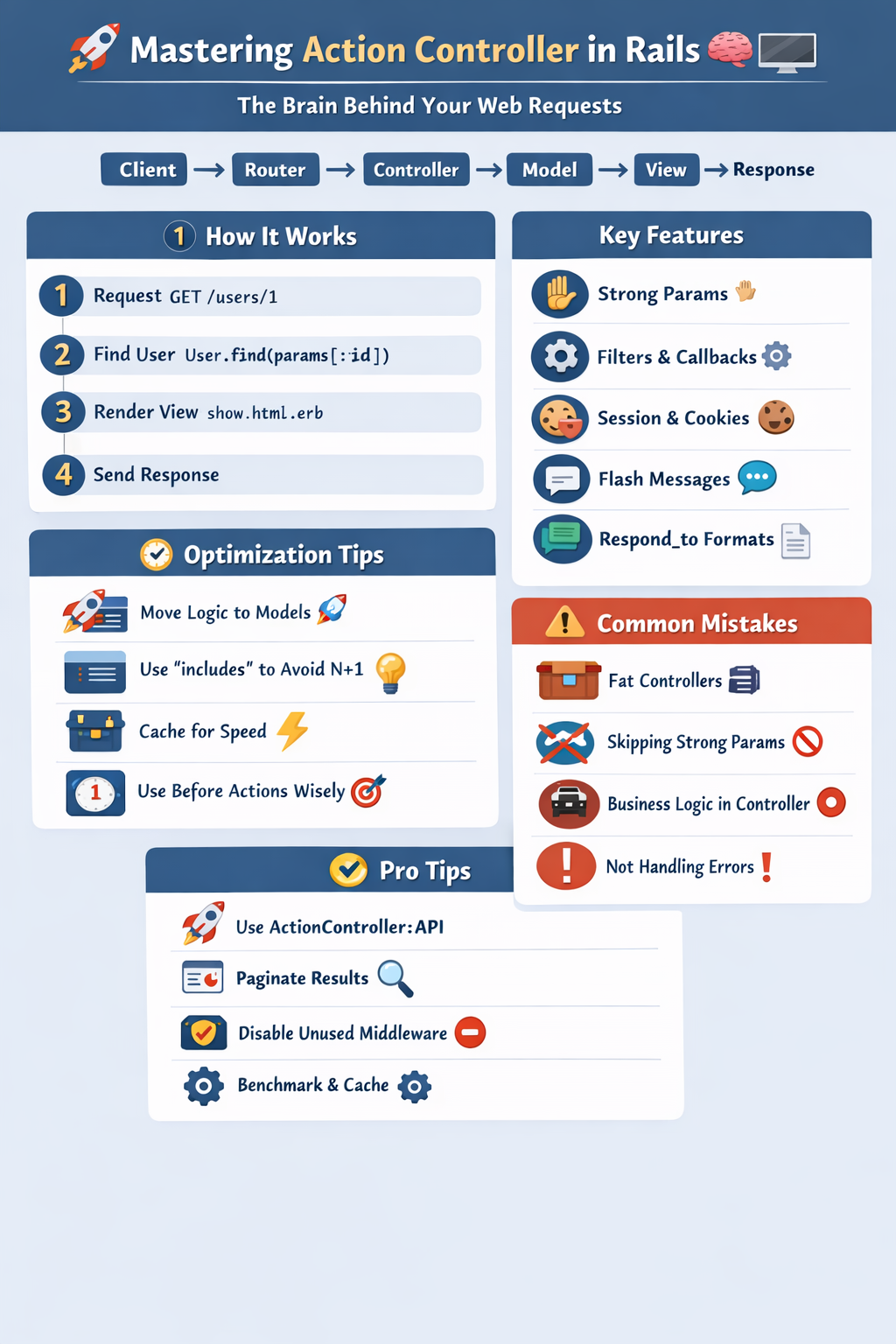
📌 What is Action Controller?
In Ruby on Rails, Action Controller is the component that:
- Receives HTTP requests 🌐
- Processes parameters 📥
- Interacts with models 🗄️
- Renders responses (HTML, JSON, XML, etc.) 📤
It lives between the router and the view layer.
Client → Router → Controller → Model → View → ResponseIt follows the MVC (Model-View-Controller) architecture — where the Controller acts as the traffic manager 🚦.
🔥 How Action Controller Works (Step-by-Step)
Let’s walk through a request lifecycle:
1️⃣ User hits URL
GET /users/12️⃣ Router maps it
get '/users/:id', to: 'users#show'3️⃣ Controller action executes
class UsersController < ApplicationController
  def show
    @user = User.find(params[:id])
  end
end
4️⃣ View renders automatically
app/views/users/show.html.erb5️⃣ Response sent back 🎯
Rails automatically renders the view matching the action unless told otherwise.
🧠 Core Responsibilities of Action Controller
1️⃣ Parameters Handling
params[:id]
params[:user][:email]
Strong Parameters for security:
def user_params
  params.require(:user).permit(:name, :email)
end
👉 Prevents mass assignment vulnerabilities.
2️⃣ Rendering & Redirecting
Render explicitly
render :edit
render json: @user
render status: 422
Redirect
redirect_to users_path
redirect_to @user
💡 Hack: Use head :ok when no body is needed.
3️⃣ Filters (Callbacks) 🎛️
Filters help execute code before/after actions.
before_action :authenticate_user
after_action :log_activity
around_action :wrap_transaction
Example:
before_action :set_user, only: [:show, :edit, :update]

def set_user
  @user = User.find(params[:id])
end
4️⃣ Sessions & Cookies 🍪
session[:user_id] = @user.id
cookies[:theme] = "dark"
Encrypted cookies:
cookies.encrypted[:user_id] = @user.id5️⃣ Flash Messages 💬
flash[:notice] = "User created successfully!"
flash[:alert] = "Something went wrong."
6️⃣ Responding to Multiple Formats
respond_to do |format|
  format.html
  format.json { render json: @user }
  format.xml  { render xml: @user }
end
Perfect for APIs + Web in same controller.
⚡ Hidden Features & Powerful Tricks
🔥 1. helper_method
Expose controller methods to views:
helper_method :current_user🔥 2. rescue_from
Centralized error handling:
rescue_from ActiveRecord::RecordNotFound, with: :not_found

def not_found
  render file: 'public/404.html', status: :not_found
end
Clean & production-ready 💎
🔥 3. skip_before_action
skip_before_action :authenticate_user, only: [:index]🔥 4. Custom Responders
You can override default behavior:
def create
  @user = User.new(user_params)
  if @user.save
    render_success
  else
    render_error
  end
end
🔥 5. Use concerns in Controllers
module Trackable
  extend ActiveSupport::Concern

  included do
    before_action :track_user
  end
end
Clean reusable logic 💡
🚀 Performance Optimization Techniques
⚡ 1. Avoid Heavy Logic in Controllers
❌ Bad:
def index
  users = User.all.select { |u| u.active? }
end
✅ Good:
def index
  @users = User.active
end
Move logic to model.
⚡ 2. Use includes to Avoid N+1 Queries
@users = User.includes(:posts)Huge performance boost for APIs 📈
⚡ 3. Use before_action wisely
Don’t load data unnecessarily.
❌ Avoid:
before_action :set_user(for all actions)
⚡ 4. Use Streaming for Large Responses
include ActionController::LiveFor CSV exports or large responses.
⚡ 5. Use Caching 🧠
caches_action :indexOr fragment caching in views.
🧨 Common Mistakes to Avoid
❌ 1. Fat Controllers
If your controller exceeds 200+ lines — danger zone 🚨
👉 Move logic to:
- Models
- Service Objects
- Concerns
❌ 2. Skipping Strong Params
Never do:
User.create(params[:user])Security risk 🔥
❌ 3. Business Logic in Controller
Controllers should orchestrate, not calculate.
❌ 4. Too Many Instance Variables
Keep views clean. Use presenters if needed.
❌ 5. Not Handling Errors Properly
Always handle:
- 404
- 422
- 500
Use rescue_from.
🎯 Advanced Example (Clean Controller Design)
class UsersController < ApplicationController
  before_action :set_user, only: %i[show update destroy]

  def index
    @users = User.active.includes(:posts)
  end

  def create
    @user = Users::CreateService.call(user_params)
    if @user.persisted?
      redirect_to @user, notice: "User created!"
    else
      render :new, status: :unprocessable_entity
    end
  end

  private
  def set_user
    @user = User.find(params[:id])
  end

  def user_params
    params.require(:user).permit(:name, :email)
  end
end
🔥 Thin
🔥 Secure
🔥 Performant
🔥 Scalable
🧠 Pro-Level Optimization Strategy
If you’re building APIs or high-traffic apps:
- Use
ActionController::APIinstead of full stack - Disable unused middleware
- Use pagination (Kaminari / Pagy)
- Cache JSON responses
- Use background jobs for heavy work
- Benchmark using rack-mini-profiler
📌 Final Thoughts
Action Controller is not just a file where you write CRUD actions.
It is:
✔ The request brain
✔ The security gatekeeper
✔ The response builder
✔ The traffic controller
Master it — and your Rails apps become cleaner, faster, and more professional. 💎


Comments
Post a Comment