🐍 Python’s Hidden Superpowers: Secret Methods That Will Surprise You! 🚀
🐍 Python’s Hidden Superpowers: Secret Methods That Will Surprise You! 🚀
Python looks simple on the surface — but behind the scenes, it hides powerful “magic methods” (also called dunder methods — double underscore methods) that control how objects behave.
These hidden gems allow you to customize operators, comparisons, printing, iteration, and performance optimizations in ways that many developers overlook. Let’s explore some of the most surprising Python hidden methods with clear examples! ✨
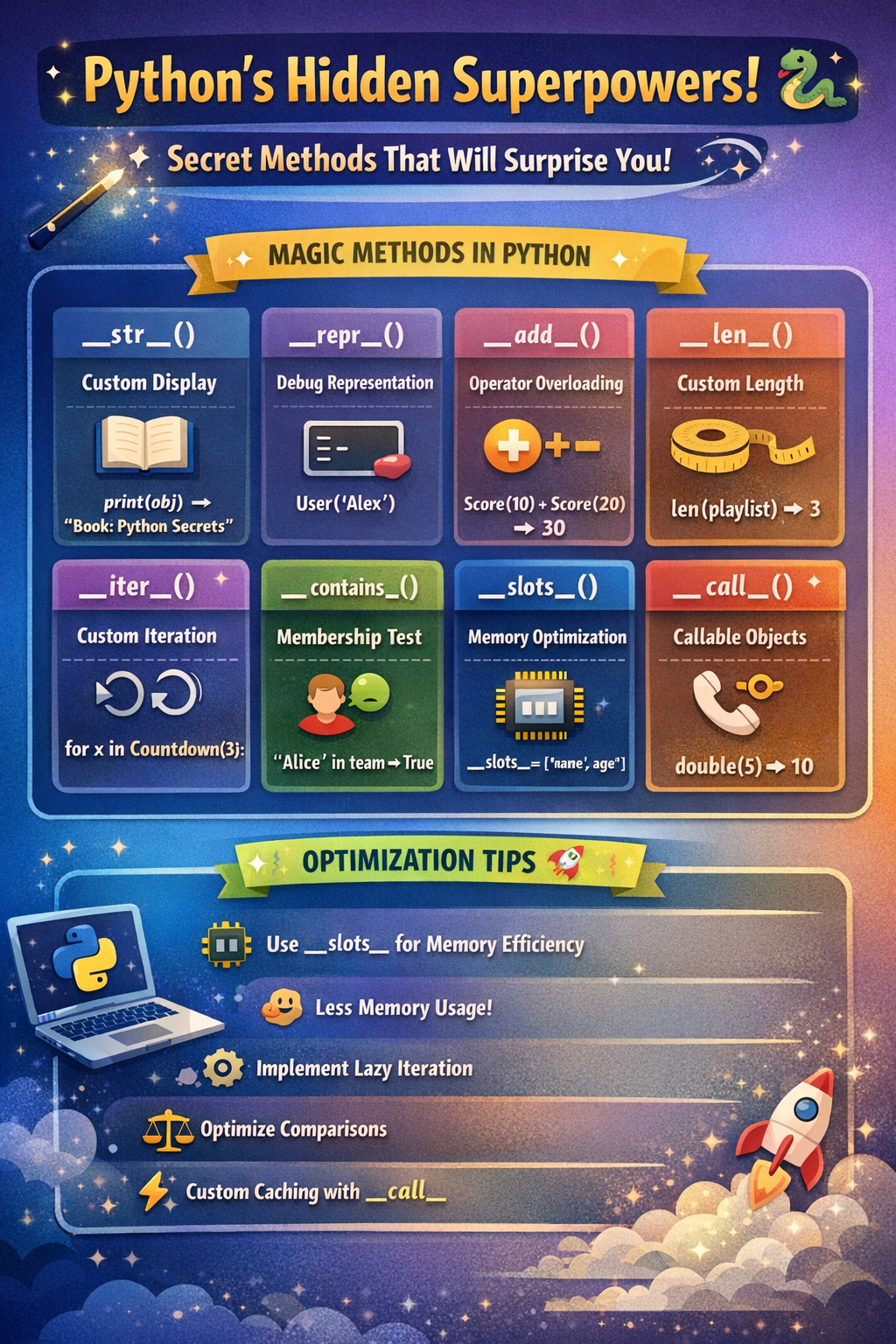
🔮 What Are Python Hidden (Magic) Methods?
Magic methods are special methods surrounded by double underscores (e.g., __str__, __len__). They allow your objects to integrate seamlessly with Python’s built-in features.
They power things like:
✅ Printing objects
✅ Using operators (+, ==, <)
✅ Iteration and containers
✅ Performance optimizations
✅ Object lifecycle management
⚡ 1. __str__() — Custom Object Display
This method controls how your object appears when printed.
✅ Example:
class Book:
    def __init__(self, title):
        self.title = title

    def __str__(self):
        return f"📘 Book: {self.title}"

b = Book("Python Secrets")
print(b)
👉 Output:
📘 Book: Python Secrets🎯 Why it’s powerful: Makes debugging and logging cleaner.
🧠 2. __repr__() — Developer-Friendly Representation
__repr__() is used for debugging and should ideally recreate the object.
✅ Example:
class User:
    def __init__(self, name):
        self.name = name

    def __repr__(self):
        return f"User('{self.name}')"

u = User("Lakhveer")
print(u)
🎯 Best practice: Make it unambiguous and informative.
➕ 3. __add__() — Operator Overloading
You can define how objects behave with the + operator.
✅ Example:
class Score:
    def __init__(self, value):
        self.value = value

    def __add__(self, other):
        return Score(self.value + other.value)

s1 = Score(10)
s2 = Score(20)
print((s1 + s2).value)
👉 Output: 30
🎯 Use case: Mathematical models, vectors, or custom calculations.
📏 4. __len__() — Custom Length Behavior
Defines what len() returns.
✅ Example:
class Playlist:
    def __init__(self, songs):
        self.songs = songs

    def __len__(self):
        return len(self.songs)

p = Playlist(["song1", "song2", "song3"])
print(len(p))
👉 Output: 3
🎯 Useful for: Collections and containers.
🔁 5. __iter__() — Custom Iteration
Allows objects to be iterable.
✅ Example:
class Countdown:
    def __init__(self, start):
        self.start = start

    def __iter__(self):
        for i in range(self.start, 0, -1):
            yield i

for num in Countdown(5):
    print(num)
🎯 Perfect for: Generators and lazy evaluation.
🔍 6. __contains__() — Membership Testing
Controls behavior of the in keyword.
✅ Example:
class Team:
    def __init__(self, members):
        self.members = members

    def __contains__(self, item):
        return item in self.members

team = Team(["Alice", "Bob"])
print("Alice" in team)
👉 Output: True
🎯 Great for: Custom search logic.
⚙️ 7. __slots__() — Memory Optimization Trick
Restricts attributes and reduces memory usage.
✅ Example:
class FastUser:
    __slots__ = ['name', 'age']
def __init__(self, name, age):
self.name = name
self.age = age
🎯 Benefit: Saves memory in large object collections.
🧩 8. __call__() — Make Objects Callable
Turns objects into callable functions.
✅ Example:
class Multiplier:
    def __init__(self, factor):
        self.factor = factor

    def __call__(self, x):
        return x * self.factor


double = Multiplier(2)
print(double(5))
👉 Output: 10
🎯 Useful for: Functional-style programming.
🚀 Optimization Techniques Using Hidden Methods
Here are some pro-level performance tricks using these methods:
⚡ 1. Use __slots__ for Memory Efficiency
Reduces RAM usage in large-scale applications.
👉 Ideal for: Data-heavy apps, ML models
⚡ 2. Implement Lazy Iteration with __iter__
Use generators instead of storing large lists.
def __iter__(self):
    yield from range(1_000_000)
👉 Saves memory & improves performance.
⚡ 3. Optimize Comparisons with __eq__ and __hash__
Helps objects work efficiently in sets/dictionaries.
def __eq__(self, other):
    return self.id == other.id

def __hash__(self):
    return hash(self.id)
👉 Faster lookups and caching.
⚡ 4. Custom Caching with __call__
Combine with memoization for speed boosts.
👉 Ideal for repeated computations.
🎯 Final Thoughts
Python’s hidden methods are like secret switches that unlock advanced object behavior. Mastering them helps you:
✅ Write cleaner and smarter code
✅ Optimize performance
✅ Create Pythonic APIs
✅ Build scalable systems
These methods are widely used in frameworks like Django and NumPy, proving their real-world power. 💡


Comments
Post a Comment