🏛️ The Master Strokes of Politics Across Time
🏛️ The Master Strokes of Politics Across Time
Decisions That Redefined Nations, Power, and Human Destiny 🌍♟️
Politics is often misunderstood as mere governance or leadership. In reality, it is a complex strategic game of power, timing, psychology, and vision. Across history, certain decisions stand out — not because they were obvious, but because they were bold, calculated, and transformative.
These are the master strokes — moves that didn’t just solve problems but redefined the future.
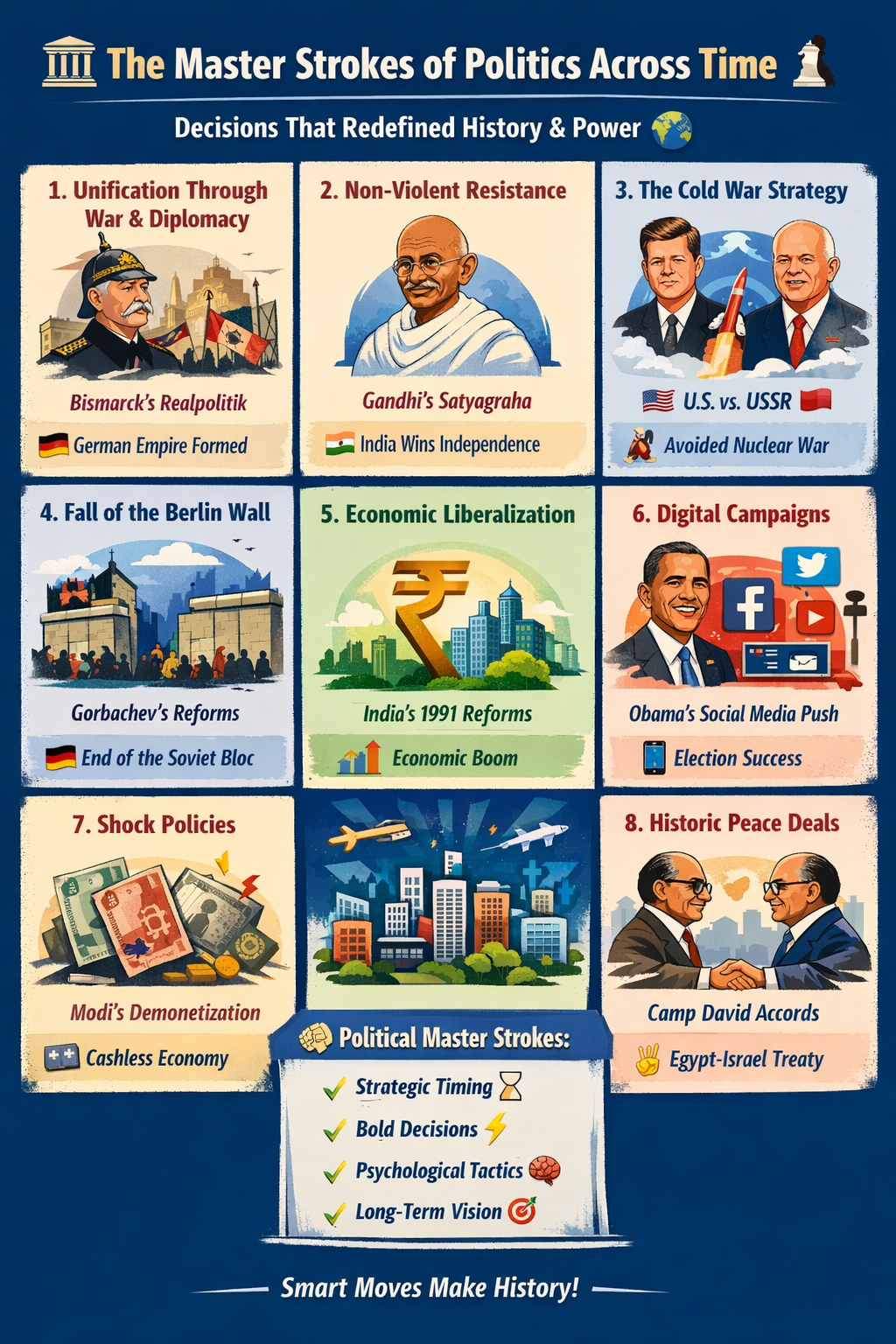
Let’s explore these deeply: how they happened, why leaders took such risks, and what they ultimately achieved 🔍
⚔️ 1. Strategic Unification Through War & Diplomacy
🧠 Mastermind: Otto von Bismarck
🔍 What Happened?
In the mid-19th century, Germany wasn’t a unified country but a collection of independent states. Bismarck, the Prime Minister of Prussia, executed a series of calculated wars:
- Danish War (1864)
- Austro-Prussian War (1866)
- Franco-Prussian War (1870–71)
But these were not random conflicts — they were pre-planned diplomatic maneuvers.
🤔 Why?
Bismarck understood a key political truth:
👉 “Unity requires a common enemy.”
He isolated each opponent diplomatically before engaging militarily:
- Ensured Austria stayed neutral before fighting France
- Manipulated alliances so Prussia was never outnumbered
🏆 What Was Achieved?
- Creation of the German Empire in 1871 🇩🇪
- Prussia emerged as the dominant European power
- Established a long-lasting diplomatic balance in Europe
💡 Deep Insight:
Bismarck’s strategy is often called Realpolitik — a system where practical goals outweigh ideology.
👉 Master Stroke: Control the geopolitical environment before making your move.
🕊️ 2. Non-Violence as Strategic Resistance
🧠 Mastermind: Mahatma Gandhi
🔍 What Happened?
Instead of leading an armed revolution, Gandhi introduced:
- Satyagraha (truth-force)
- Civil disobedience movements
- Boycotts like the Swadeshi Movement
Events like the Salt March (1930) became symbolic acts of resistance.
🤔 Why?
Gandhi recognized:
- The British Empire thrived on moral legitimacy and economic control
- Violent rebellion would justify harsher crackdowns
So he attacked the system where it was weakest:
👉 Its moral image and global reputation
🏆 What Was Achieved?
- India gained independence in 1947 🇮🇳
- British authority weakened globally
- Inspired leaders like Martin Luther King Jr.
💡 Deep Insight:
Gandhi turned weakness into strength by shifting the battlefield from physical to moral.
👉 Master Stroke: Redefine the rules of the game so you don’t have to play by your opponent’s strengths.
🌍 3. The Cold War — Winning Without Fighting
🧠 Key Figures: John F. Kennedy & Nikita Khrushchev
🔍 What Happened?
During the Cold War, the USA and USSR engaged in:
- Nuclear arms race ☢️
- Space race 🚀
- Proxy wars (Vietnam, Korea)
The most dangerous moment came during the Cuban Missile Crisis (1962).
🤔 Why?
Both nations understood:
👉 A direct war = Mutual destruction
So instead, they:
- Used indirect influence
- Competed economically and technologically
- Maintained deterrence through fear
🏆 What Was Achieved?
- Avoidance of World War III
- Massive scientific progress (moon landing 🌕)
- Emergence of the USA as a global superpower
💡 Deep Insight:
The Cold War was a masterclass in psychological warfare and strategic restraint.
👉 Master Stroke: Sometimes the strongest move is controlled inaction.
🧱 4. Collapse of the Soviet Bloc — Reform Over Force
🧠 Key Leader: Mikhail Gorbachev
🔍 What Happened?
Gorbachev introduced:
- Glasnost (openness)
- Perestroika (economic restructuring)
These reforms unintentionally weakened centralized control, leading to events like the fall of the Berlin Wall (1989).
🤔 Why?
The Soviet Union was:
- Economically stagnant
- Politically rigid
- Losing global influence
Reform was necessary to survive.
🏆 What Was Achieved?
- End of the Cold War
- Dissolution of the USSR (1991)
- Rise of democratic movements in Eastern Europe
💡 Deep Insight:
Gorbachev chose reform over repression — a rare move in authoritarian regimes.
👉 Master Stroke: Knowing when to loosen control can be more powerful than holding it.
💼 5. Economic Liberalization — Reinventing a Nation
🧠 Leader: P. V. Narasimha Rao
🔍 What Happened?
In 1991, India faced a severe financial crisis:
- Foreign reserves were nearly exhausted
- Inflation was high
The government introduced:
- Privatization
- Global trade openness
- Reduced government control
🤔 Why?
India needed:
👉 Immediate economic stabilization
👉 Long-term global competitiveness
🏆 What Was Achieved?
- Emergence of India as an economic power 📈
- Growth of IT hubs like Bangalore 💻
- Rise of middle-class prosperity
💡 Deep Insight:
This was not just an economic reform — it was a mental shift from control to opportunity.
👉 Master Stroke: Change the system, not just the symptoms.
🗳️ 6. Digital Political Revolution
🧠 Pioneer: Barack Obama
🔍 What Happened?
In the 2008 election, Obama used:
- Social media platforms 📱
- Data analytics
- Micro-targeting voters
🤔 Why?
Traditional campaigns were:
- Expensive
- Limited in reach
Digital platforms allowed:
👉 Direct voter engagement
👉 Personalized messaging
🏆 What Was Achieved?
- Historic election victory
- Set a global trend in political campaigning
💡 Deep Insight:
Politics shifted from mass communication → personalized influence
👉 Master Stroke: Control data, and you control democracy.
⚡ 7. Shock Policies — Disruption as Strategy
🧠 Example: Narendra Modi
🔍 What Happened?
The Demonetization in India 2016 invalidated ₹500 and ₹1000 notes overnight.
🤔 Why?
- Target black money 💰
- Reduce counterfeit currency
- Push digital economy
🏆 What Was Achieved?
- Rapid growth in digital payments 💳
- Increased formalization of the economy
- Massive political and economic debate
💡 Deep Insight:
Shock decisions create:
👉 Immediate disruption
👉 Long-term structural shifts
👉 Master Stroke: Disrupt the system to rebuild it stronger.
🌐 8. Peace Agreements — Courage Over Conflict
🧠 Leaders: Anwar Sadat & Menachem Begin
🔍 What Happened?
The Camp David Accords ended decades of hostility between Egypt and Israel.
🤔 Why?
- Continuous wars drained resources
- Regional instability was unsustainable
🏆 What Was Achieved?
- Long-term peace treaty ✌️
- Stability in the Middle East
- Nobel Peace Prize recognition
💡 Deep Insight:
Peace often requires more courage than war.
👉 Master Stroke: Choose long-term stability over short-term pride.
🧠 Final Reflection: The DNA of Political Mastery
Across all these master strokes, a pattern emerges:
🔑 Core Principles:
- Timing is everything ⏳
- Perception shapes reality 👁️
- Boldness beats hesitation ⚡
- Strategy outweighs strength ♟️
🚀 The Ultimate Takeaway
💡 Great leaders don’t just react to history — they design it.
Whether you’re:
- A developer 💻
- A leader 👔
- A creator 🎯
You can apply these lessons:
✔️ Think long-term
✔️ Understand systems deeply
✔️ Act decisively when it matters
🔥 Because in politics — and in life —
👉 The biggest wins come from the smartest moves, not the loudest actions.


Comments
Post a Comment