🚀 Mastering Data Structures & Algorithms (DSA): The Brain Behind Every Powerful Software 💡
🚀 Mastering Data Structures & Algorithms (DSA): The Brain Behind Every Powerful Software 💡
“Good code is not just written… it’s structured.” 🔥
Whether you’re building scalable web apps in Ruby on Rails 🧩, optimizing APIs ⚡, or cracking coding interviews 💼 — Data Structures & Algorithms (DSA) are your ultimate superpower.
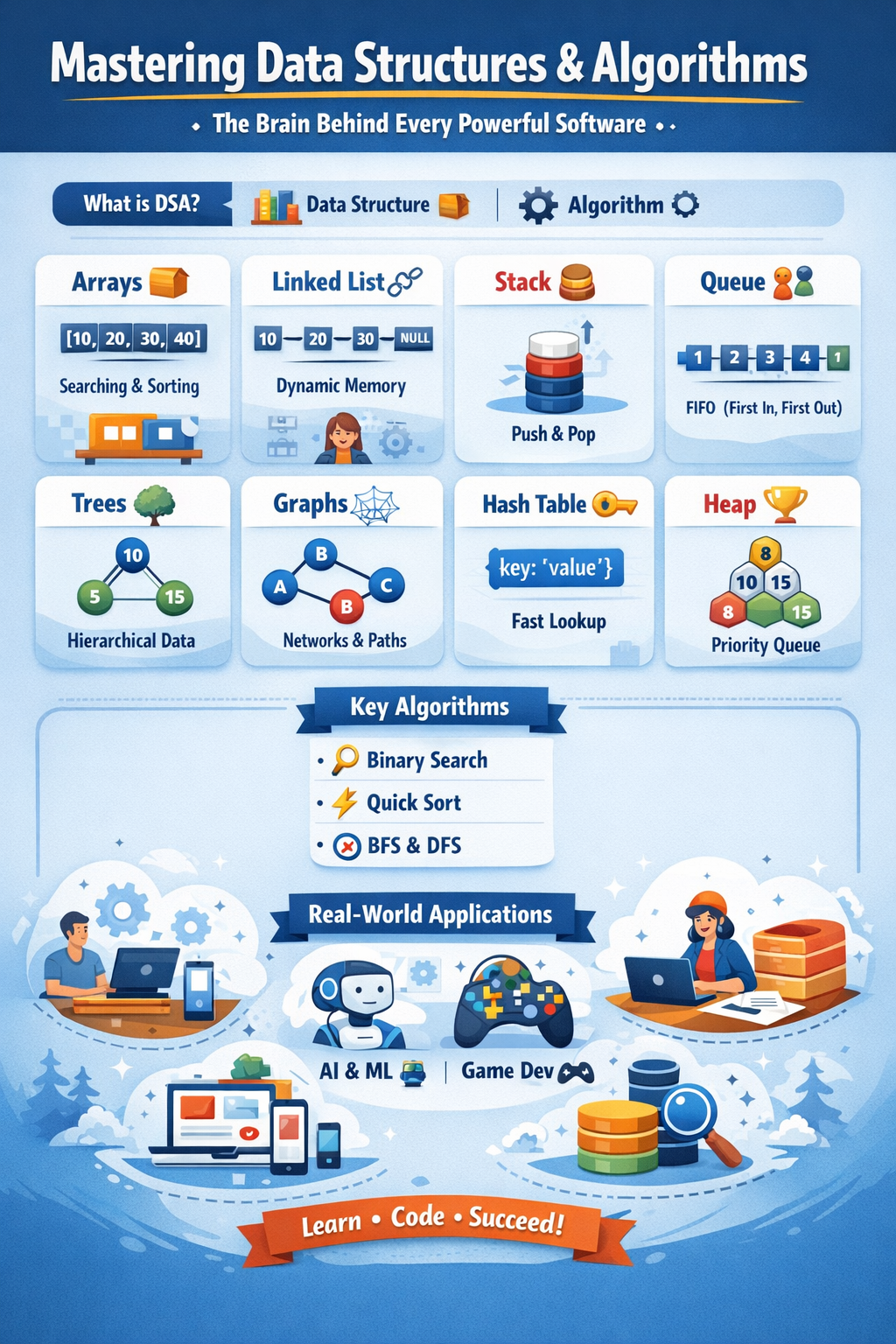
Let’s break everything down from basics to mastery — with examples, algorithms, and real-world applications 🌍👇
🧠 What are Data Structures?
A Data Structure is a way of organizing and storing data so it can be used efficiently.
👉 Think of it like:
- 📚 Library shelves (organized books)
- 🧺 Shopping cart (items arranged for easy checkout)
- 🧭 Google Maps (data structured for quick navigation)
⚙️ What are Algorithms?
An Algorithm is a step-by-step procedure to solve a problem.
👉 Example:
- Searching a contact 📱
- Sorting numbers 🔢
- Finding shortest route 🚗
🧩 Why DSA Matters?
✅ Faster applications
✅ Efficient memory usage
✅ Scalable systems
✅ Crack top tech interviews 💼
🔥 1. Arrays — The Foundation 📦
📌 What is an Array?
A collection of elements stored in contiguous memory.
arr = [10, 20, 30, 40]⚡ Types
- 1D Array
- 2D Array (Matrix)
- Dynamic Array (like Ruby Array)
⚙️ Algorithms
- Traversal → O(n)
- Searching (Linear / Binary)
- Sorting (Quick, Merge)
🧠 Example
Find max:
arr.max🌍 Real-life Use
- Image pixels 🖼️
- Leaderboards 🏆
🔗 2. Linked List — Dynamic Memory Chain ⛓️
📌 What is it?
A sequence of nodes where each node points to the next.
⚡ Types
- Singly Linked List
- Doubly Linked List
- Circular Linked List
⚙️ Algorithms
- Insertion (O(1))
- Deletion
- Traversal
🧠 Example
10 → 20 → 30 → NULL🌍 Real-life Use
- Music playlist 🎵
- Browser history 🌐
📚 3. Stack — LIFO (Last In First Out) 🥞
📌 Concept
Last added element is removed first.
⚙️ Operations
- Push
- Pop
- Peek
🧠 Example
stack = []
stack.push(1)
stack.pop
⚙️ Algorithms
- Expression evaluation
- Backtracking
🌍 Real-life Use
- Undo/Redo ↩️
- Function calls 📞
🧾 4. Queue — FIFO (First In First Out) 🚶♂️
📌 Concept
First element added is removed first.
⚡ Types
- Simple Queue
- Circular Queue
- Priority Queue
⚙️ Algorithms
- Enqueue
- Dequeue
🧠 Example
queue = []
queue.push(1)
queue.shift
🌍 Real-life Use
- Ticket booking 🎟️
- Task scheduling 🖥️
🌳 5. Trees — Hierarchical Data 🌲
📌 What is a Tree?
A structure with nodes connected in hierarchy.
⚡ Types
- Binary Tree
- Binary Search Tree (BST)
- AVL Tree
- Heap
⚙️ Algorithms
- Traversals:
- Inorder
- Preorder
- Postorder
- Search (BST)
🧠 Example
10
     /  \
    5   15
🌍 Real-life Use
- File systems 📁
- Databases indexing 🗂️
🌐 6. Graphs — Network Representation 🕸️
📌 What is a Graph?
A set of nodes (vertices) connected by edges.
⚡ Types
- Directed / Undirected
- Weighted / Unweighted
⚙️ Algorithms
- BFS (Breadth First Search)
- DFS (Depth First Search)
- Dijkstra (Shortest Path)
🧠 Example
A → B → C🌍 Real-life Use
- Social networks 👥
- Google Maps 🗺️
🔑 7. Hash Tables — Fast Lookup ⚡
📌 Concept
Key-value pair storage using hashing.
hash = {name: "Rajput", age: 25}⚙️ Algorithms
- Hashing function
- Collision handling
🌍 Real-life Use
- Caching 🧠
- Databases 🔍
🏗️ 8. Heap — Priority Management 🏆
📌 Concept
Special tree for priority-based operations.
⚡ Types
- Min Heap
- Max Heap
⚙️ Algorithms
- Heapify
- Insert / Delete
🌍 Real-life Use
- Task scheduling 🗓️
- Priority queues 🚨
⚡ Most Important Algorithms (Must Know) 🔥
🔍 Searching Algorithms
- Linear Search → O(n)
- Binary Search → O(log n)
🔄 Sorting Algorithms
- Bubble Sort 🫧
- Merge Sort ⚡
- Quick Sort 🚀
🧭 Graph Algorithms
- BFS / DFS
- Dijkstra
🧠 Dynamic Programming
- Fibonacci
- Knapsack Problem
🧪 Example: Binary Search 🚀
def binary_search(arr, target)
  left = 0
  right = arr.length - 1

  while left <= right
    mid = (left + right) / 2
    return mid if arr[mid] == target
    if arr[mid] < target
      left = mid + 1
    else
      right = mid - 1
    end
  end
  -1
end
🌍 Real-World Applications of DSA
💻 Web Development (Rails, APIs)
📱 Mobile Apps
🎮 Game Development
🤖 AI & Machine Learning
📊 Data Analytics
🌐 Distributed Systems
🎯 How to Master DSA?
✅ Start with basics (Arrays, Strings)
✅ Practice daily (LeetCode, HackerRank)
✅ Learn patterns (Sliding Window, Recursion)
✅ Build real projects 💡
✅ Teach others (best way to learn!)
💥 Final Thoughts
DSA is not just for interviews…
👉 It’s the foundation of every efficient system.
“The better your data structures, the smarter your code becomes.” 🧠⚡


Comments
Post a Comment