🚀 Ruby on Rails Uncovered: How Every Class, Method & Helper Works Like Magic ✨
🚀 Ruby on Rails Uncovered: How Every Class, Method & Helper Works Like Magic ✨
Ruby on Rails (RoR) is not just a framework — it’s a well-orchestrated symphony of classes, methods, modules, and helpers working together to build powerful web applications effortlessly 💎
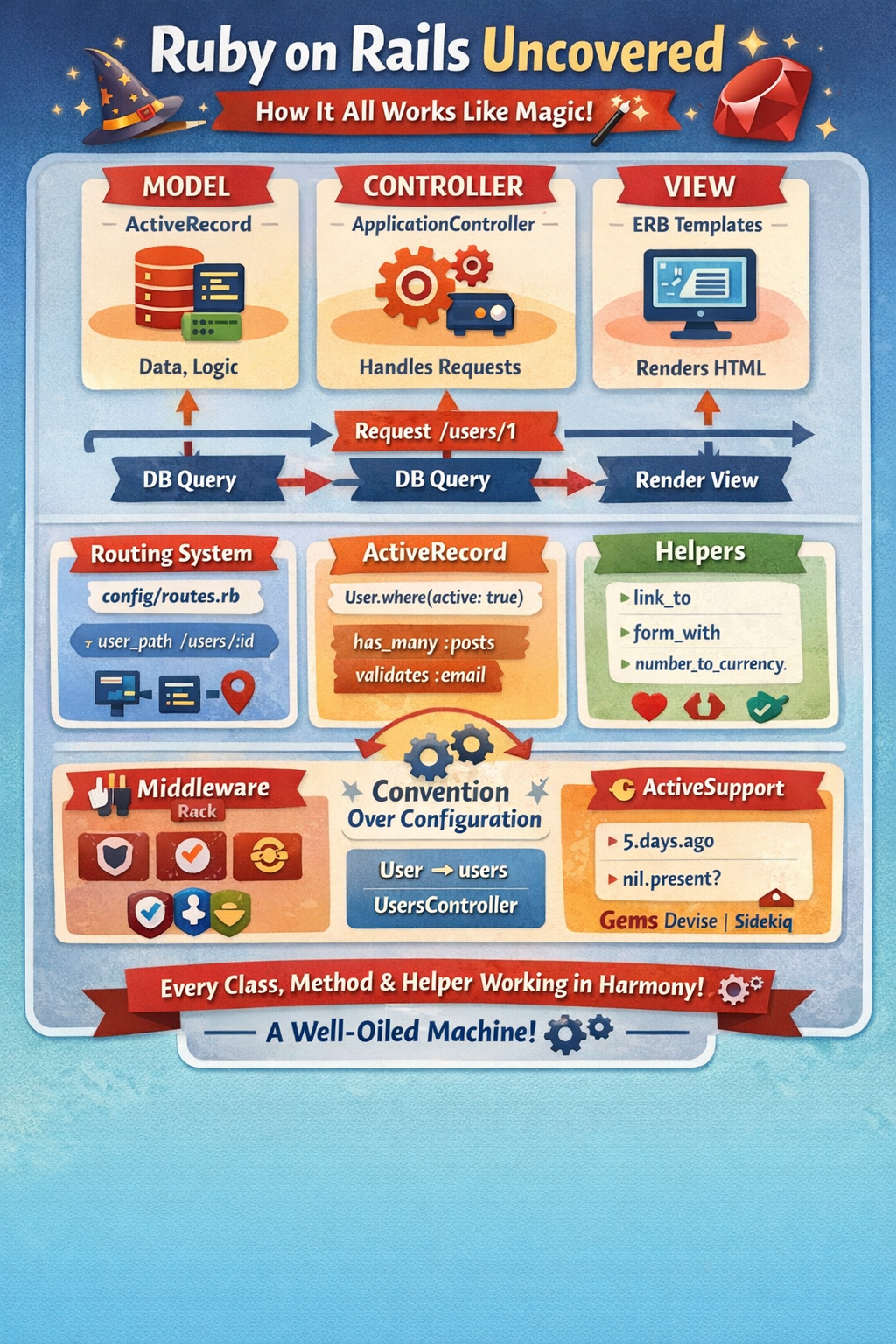
But have you ever wondered what’s really happening behind the scenes? 🤔
Let’s dive deep into how Rails actually works and why it feels so smooth and “magical” 🧙♂️
🏗️ 1. The Foundation: MVC Architecture
Rails follows the MVC (Model-View-Controller) pattern:
📦 Model
- Handles data + business logic
- Built using
ActiveRecord
🎨 View
- Responsible for UI rendering
- Uses embedded Ruby (
.erb)
🎮 Controller
- Acts as the middleman
- Handles requests & responses
👉 Together, they create a clean separation of concerns, making apps scalable and maintainable 🚀
🔁 2. Request Lifecycle: What Happens Step-by-Step?
Let’s say a user hits:
👉 https://yourapp.com/users/1
Flow 🔄
- 🌐 Request hits Router
- 🎯 Routed to
UsersController#show - 🧠 Controller calls Model (
User.find) - 📦 Model fetches data from DB
- 🎨 View renders HTML
- 🚀 Response sent back
🧭 3. Routing System: The Traffic Manager 🚦
Rails routing is handled by:
config/routes.rbExample:
resources :usersWhat happens internally?
- Creates multiple routes (
index,show,create, etc.) - Maps URLs to controller actions
👉 Uses classes like:
ActionDispatch::Routing- Route helpers like
user_path,users_path
🎮 4. Controllers: The Decision Makers
Controllers inherit from:
ApplicationController < ActionController::BaseExample:
def show
  @user = User.find(params[:id])
end
Behind the scenes:
params→ Extracted from requestrender→ Calls viewredirect_to→ Redirects user
👉 Key classes/modules:
ActionController::BaseStrongParametersCallbacks(before_action)
🧠 5. Models & ActiveRecord: The Brain 🧬
Models inherit from:
ApplicationRecord < ActiveRecord::BaseExample:
class User < ApplicationRecord
  validates :email, presence: true
end
Magic happening:
- Maps Ruby objects ↔ Database tables
- Provides ORM (Object Relational Mapping)
Key Features:
- 🔍 Query Interface:
User.where(active: true)- 🔗 Associations:
has_many :posts- ✅ Validations:
validates :name, presence: true👉 Core classes:
ActiveRecord::BaseActiveModel::ValidationsActiveRecord::Associations
🎨 6. Views: Turning Data into UI ✨
Rails views use Embedded Ruby (ERB):
<h1><%= @user.name %></h1>How it works:
- Ruby code inside
<%= %>gets executed - Output is converted into HTML
👉 Powered by:
ActionView::Base- Template handlers (
ERB,Builder)
🧩 7. Helpers: Small Methods, Big Impact 💡
Helpers make views clean and reusable.
Example:
module UsersHelper
  def formatted_name(user)
    user.name.titleize
  end
end
Built-in Helpers:
link_toform_withnumber_to_currency
👉 Core modules:
ActionView::HelpersUrlHelperFormHelper
⚙️ 8. ActiveSupport: The Hidden Superpower 💪
Rails enhances Ruby with ActiveSupport:
Examples:
5.days.ago
"hello".titleize
nil.present?
👉 Adds:
- Core extensions
- Utility methods
- Time helpers
🔌 9. Middleware Stack: Silent Workers 🛠️
Before reaching Rails app, request passes through middleware:
Examples:
- Authentication
- Logging
- Session handling
👉 Managed by:
Rack(Rails is built on it)
📦 10. Gems & Modules: Extending Rails 🔥
Rails is highly modular:
Common Gems:
Devise→ AuthenticationPundit→ AuthorizationSidekiq→ Background jobs
👉 Rails loads gems using:
Bundlerrequiremechanism
🔄 11. Callbacks: Automatic Hooks ⏱️
Rails allows hooks in lifecycle:
Example:
before_save :normalize_name👉 Types:
before_action(Controller)before_save(Model)
⚡ 12. Convention Over Configuration 🎯
Rails works magically because of:
Rules:
- Model:
User→ Table:users - Controller:
UsersController - View folder:
views/users
👉 No need for extra config = faster development 🚀
🧠 13. Autoloading & Zeitwerk 📂
Rails automatically loads classes:
- No need to manually
require - Uses Zeitwerk loader
👉 Example:
app/models/user.rb → User class auto-loaded🧪 14. Testing Framework Built-in ✅
Rails includes:
Minitest- Fixtures
- Integration tests
👉 Ensures reliability and stability
🧩 15. How Everything Works Together 🤝
Here’s the real magic:
- Routing directs traffic 🚦
- Controllers process logic 🎮
- Models handle data 🧠
- Views display output 🎨
- Helpers simplify UI 💡
- ActiveSupport enhances Ruby 💪
- Middleware ensures smooth flow 🛠️
👉 Every class, method, and module acts like a gear in a well-oiled machine ⚙️
🎯 Final Thoughts
Ruby on Rails isn’t just a framework — it’s a developer productivity engine 🚀
✨ With:
- Smart conventions
- Powerful abstractions
- Rich helper methods
It allows you to focus on building features instead of writing boilerplate code.
💬 Pro Tip for Developers
👉 To truly master Rails:
- Read source code (
rails/railsrepo) - Explore modules like
ActiveSupport - Build small projects and experiment
🚀 Keep Building. Keep Learning.
Rails teaches you not just coding — but how to think like a clean architect 🧠✨


Comments
Post a Comment