☁️ AWS S3 Explained: The Ultimate Practical Guide to Cloud Storage 🚀
☁️ AWS S3 Explained: The Ultimate Practical Guide to Cloud Storage 🚀
Amazon S3 (Simple Storage Service) is one of the most powerful, scalable, and widely used cloud storage services in the world 🌍. From hosting static websites to backing up petabytes of data, S3 silently powers a huge part of the internet.
In this guide, we’ll deep-dive into AWS S3 — covering:
- Core concepts & terminologies 🧠
- Features that make S3 unstoppable ⚡
- Step-by-step setup guide 🛠️
- Practical examples 📦
- Best solutions, tricks & hacks 💡
Let’s master S3 once and for all! 😎
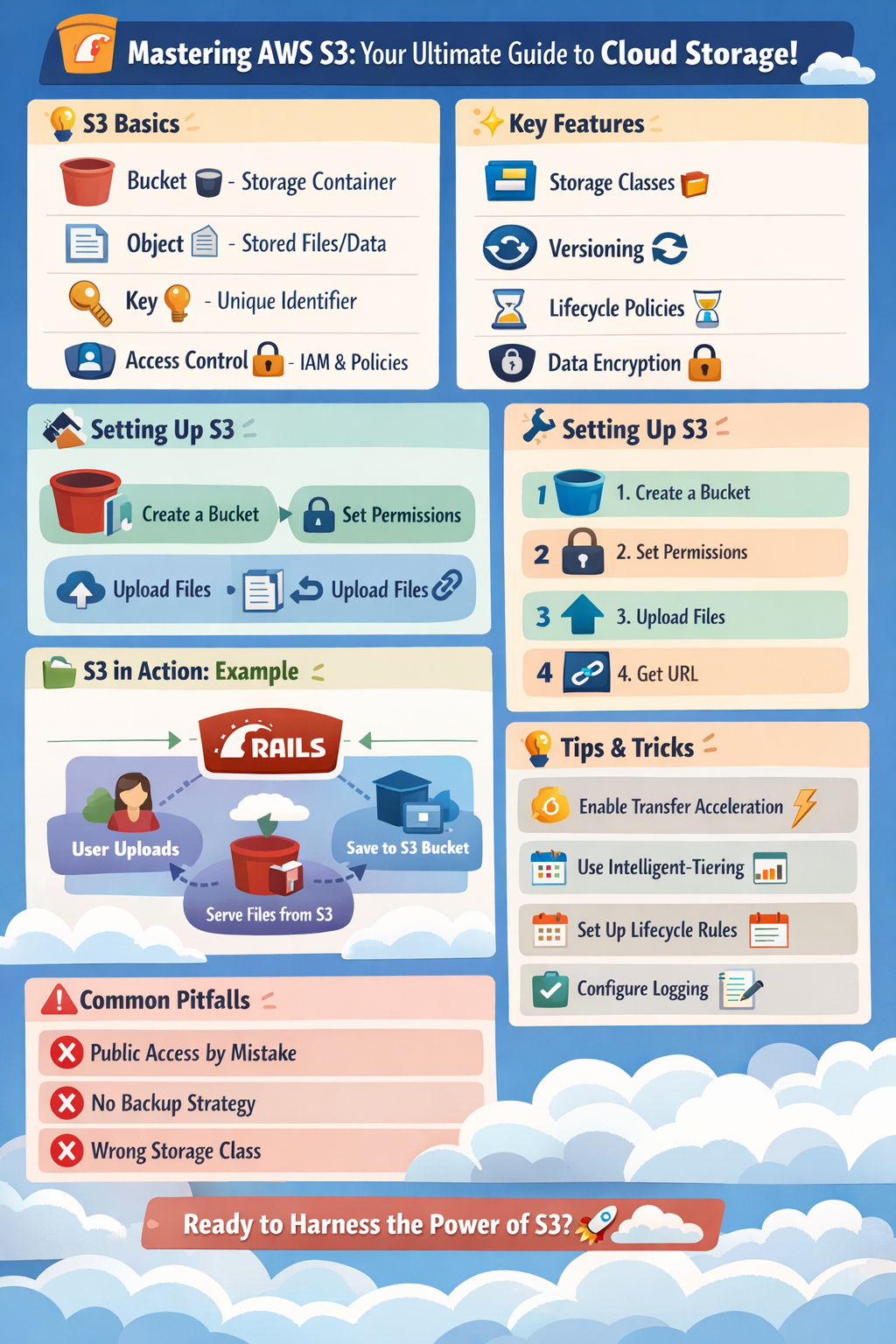
🔍 What is AWS S3?
Amazon S3 is an object storage service designed to store and retrieve any amount of data, from anywhere, at any time.
📌 Key highlights:
- Virtually unlimited storage
- 99.999999999% (11 9’s) durability
- Highly secure & scalable
- Pay only for what you use 💰
🧠 Core S3 Terminologies (Must Know!)
🪣 1. Bucket
A bucket is a container for objects in S3.
- Globally unique name
- Created in a specific AWS Region
Example:
my-app-uploads-bucket📄 2. Object
An object is the actual file stored in S3.
- File data
- Metadata
- Unique key (file path)
Example:
images/profile/user1.png🗂️ 3. Key
The key is the full path of the object inside a bucket.
logs/2026/01/server.log🧾 4. Metadata
Extra information about objects:
- Content-Type
- Size
- Custom metadata (x-amz-meta-*)
🔐 5. IAM (Identity & Access Management)
Controls who can access what in S3.
- Users
- Roles
- Policies
🧱 6. Bucket Policy
JSON-based access rules applied at bucket level.
Example:
{
  "Effect": "Allow",
  "Principal": "*",
  "Action": "s3:GetObject",
  "Resource": "arn:aws:s3:::my-bucket/*"
}
⚡ Powerful Features of AWS S3
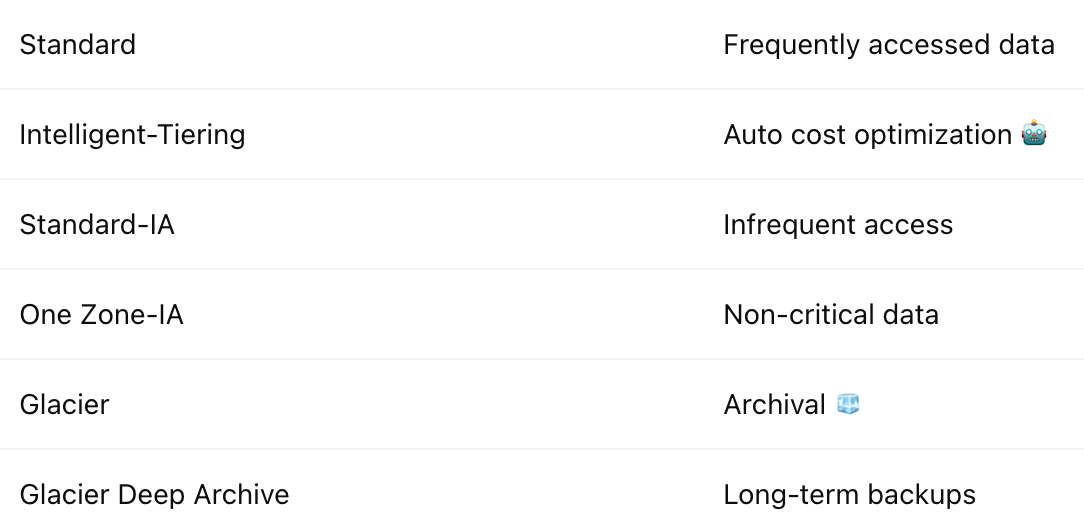
🌍 1. Storage Classes (Cost Optimization)
🔄 2. Versioning
Keeps multiple versions of the same object.
✅ Protects from accidental deletes
🔐 3. Encryption
- At Rest: SSE-S3, SSE-KMS, SSE-C
- In Transit: HTTPS
Security by default 🔒
🔁 4. Replication
- Cross-Region Replication (CRR)
- Same-Region Replication (SRR)
Perfect for disaster recovery 🌪️
🌐 5. Static Website Hosting
Host static websites directly from S3.
Example:
index.html
error.html
📊 6. Storage Analytics & Metrics
- S3 Storage Lens
- CloudWatch metrics
Track usage & optimize costs 📉
🛠️ Step-by-Step S3 Setup Guide
✅ Step 1: Create a Bucket
1. Go to AWS Console → S3
2. Click Create Bucket
3. Choose:
- Bucket name
- Region
4. Disable public access (recommended)
5. Create bucket 🎉
✅ Step 2: Upload an Object
- Open bucket
- Click Upload
- Select files
- Upload 🚀
✅ Step 3: Set Permissions
Choose who can:
- Read
- Write
- Delete
Use IAM roles instead of public access 🔐
✅ Step 4: Enable Versioning (Recommended)
Bucket → Properties → Versioning → Enable
📦 Practical Example: Rails App + S3 Uploads
🔗 Use Case: File uploads in a Rails app
Steps:
- Create S3 bucket
- Create IAM user/role
- Configure credentials
- Use
aws-sdk-s3
Benefits:
- No local storage
- Highly scalable
- Secure & fast ⚡
🧩 Best Solutions Powered by AWS S3
📸 1. Media Storage (Images, Videos)
Used by:
- Social media apps
- Streaming platforms
🗄️ 2. Backup & Disaster Recovery
- Database backups
- Server snapshots
- Log storage
🌍 3. Data Lake Foundation
S3 + Athena + Glue + Redshift = 🔥
📡 4. Static Website + CDN
S3 + CloudFront = Super fast websites ⚡
💡 S3 Tricks, Hacks & Pro Tips
🚀 1. Use Intelligent-Tiering
Automatically saves money without performance loss 💰
🧠 2. Prefix Optimization
Use random prefixes to improve performance:
❌ /logs/2026/01/
✅ /logs/a1/2026/01/
🔐 3. Block Public Access by Default
Avoid costly security breaches ❌
🧊 4. Lifecycle Policies (Must Use!)
Automatically move data to cheaper storage:
Standard → IA → Glacier → Deep Archive⚡ 5. Multipart Uploads
For large files (>100MB):
- Faster uploads
- Resume on failure
🧪 6. Pre-Signed URLs
Secure, temporary access to objects:
Perfect for:
- Uploads
- Downloads
- Private content sharing 🔑
🚫 Common Mistakes to Avoid
❌ Making buckets public
❌ Ignoring lifecycle rules
❌ Not enabling versioning
❌ Hardcoding AWS credentials
❌ Using S3 as a database 😅
🏁 Final Thoughts
AWS S3 is simple on the surface, but incredibly powerful underneath 🧠⚡
If you learn S3 properly, you unlock:
- Scalable architectures
- Secure storage
- Massive cost savings
💬 “Master S3 once — use it everywhere.”
Happy Cloud Building! ☁️🚀
🔖 Did you enjoy this guide?
Follow for more deep-dive blogs on AWS, DevOps, Ruby on Rails & System Design 🔥


Comments
Post a Comment