🚀 Best SQL Functions for Performance Optimization (With Real Examples!) ⚡
🚀 Best SQL Functions for Performance Optimization (With Real Examples!) ⚡
Write faster queries, reduce load, and scale like a pro 💻🔥
In today’s data-driven world, SQL performance can make or break your application. Even a small optimization in queries can save seconds, server cost, and user frustration 😤➡️😄
This blog covers the most powerful SQL functions for optimization, explained clearly with examples, followed by pro tips & tricks to supercharge your queries 🚀
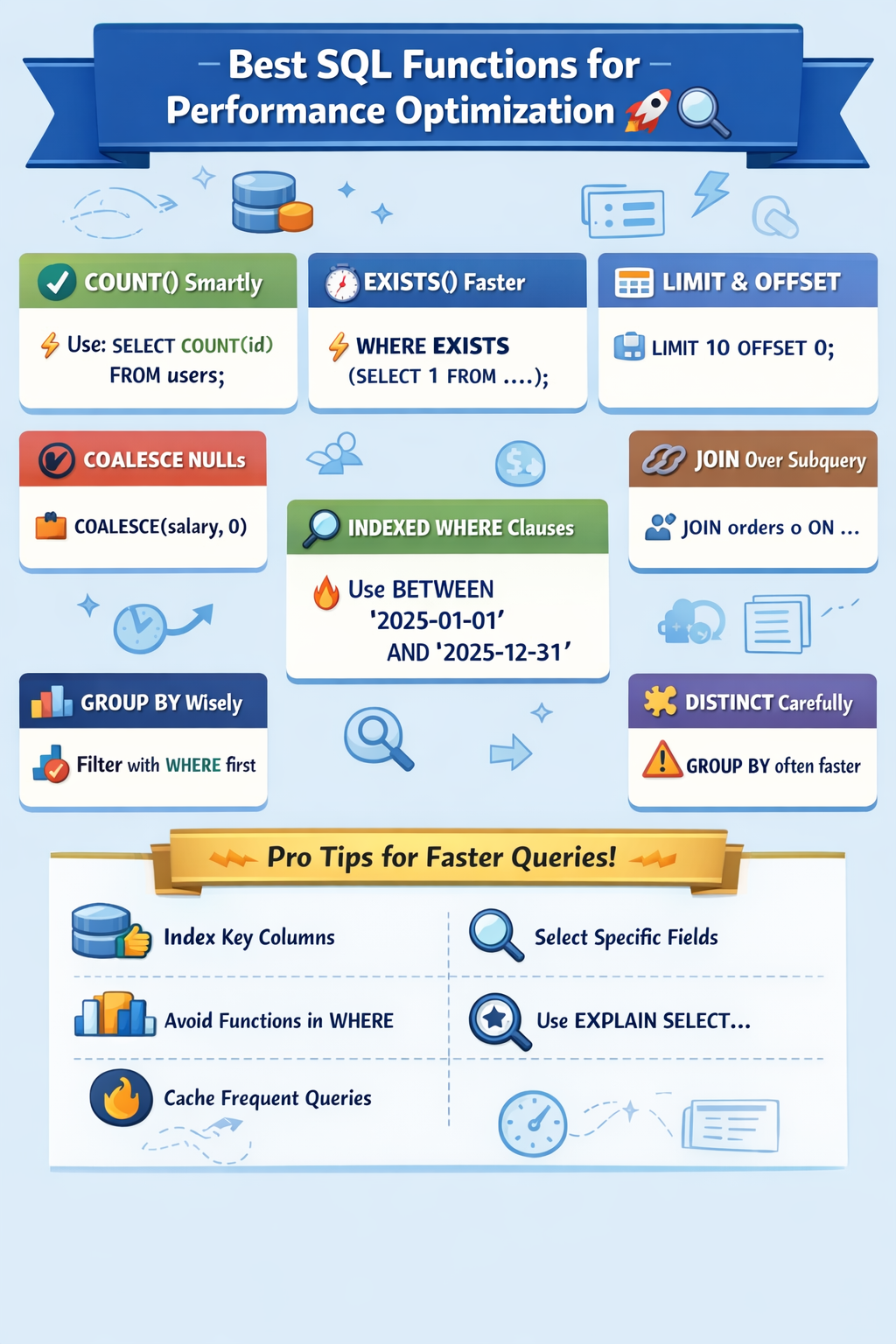
🧠 Why SQL Optimization Matters?
- ⚡ Faster response times
- 💰 Reduced database cost
- 📈 Better scalability
- 😌 Happier users
“A slow query is like a traffic jam — everyone waits.” 🚗🚗🚗
🔥 Best SQL Functions for Optimization
1️⃣ COUNT() — Count Smartly, Not Expensively
Used to count rows efficiently when used correctly.
❌ Bad Practice
SELECT COUNT(*) FROM users;✅ Optimized
SELECT COUNT(id) FROM users;✔ If id is indexed, this performs much faster
✔ Avoid COUNT(*) on large tables unless required
📌 Use Case: Analytics, pagination, dashboards
2️⃣ EXISTS() — Faster Than IN()
Stops execution as soon as a match is found 🔥
❌ Slow
SELECT * FROM orders
WHERE user_id IN (SELECT id FROM users WHERE active = 1);
✅ Optimized
SELECT * FROM orders o
WHERE EXISTS (
  SELECT 1 FROM users u
  WHERE u.id = o.user_id AND u.active = 1
);
🚀 Why Faster?
EXISTSexits early- Uses indexes efficiently
3️⃣ LIMIT / OFFSET — Control Data Flow
Never fetch unnecessary rows ❌
❌ Dangerous
SELECT * FROM logs;✅ Optimized
SELECT * FROM logs
ORDER BY created_at DESC
LIMIT 10 OFFSET 0;
📌 Ideal for:
- Pagination
- Infinite scroll
- API responses
4️⃣ COALESCE() — Handle NULLs Efficiently
Avoid complex CASE statements.
❌ Verbose
CASE WHEN salary IS NULL THEN 0 ELSE salary END✅ Optimized
COALESCE(salary, 0)⚡ Cleaner
⚡ Faster
⚡ Readable
5️⃣ INDEXED WHERE Clauses
Functions inside WHERE clauses can break index usage 😬
❌ Bad
SELECT * FROM users WHERE YEAR(created_at) = 2025;✅ Optimized
SELECT * FROM users
WHERE created_at BETWEEN '2025-01-01' AND '2025-12-31';
🔥 This allows index scanning, not full table scanning.
6️⃣ GROUP BY + HAVING (Use Wisely)
Filter before grouping whenever possible.
❌ Slow
SELECT department, COUNT(*)
FROM employees
GROUP BY department
HAVING department = 'IT';
✅ Optimized
SELECT department, COUNT(*)
FROM employees
WHERE department = 'IT'
GROUP BY department;
✔ Reduces rows before aggregation
✔ Faster execution
7️⃣ JOIN Instead of Subqueries
Joins are usually more optimized than nested queries.
❌ Slower
SELECT name FROM users
WHERE id = (SELECT user_id FROM orders WHERE total > 500);
✅ Optimized
SELECT u.name
FROM users u
JOIN orders o ON o.user_id = u.id
WHERE o.total > 500;
🔥 Better optimizer planning
🔥 Better index usage
8️⃣ DISTINCT — Use Only When Needed
DISTINCT is expensive on large datasets ⚠️
❌ Overkill
SELECT DISTINCT user_id FROM orders;✅ Optimized
SELECT user_id FROM orders GROUP BY user_id;👉 Sometimes GROUP BY performs better (depends on DB engine)
9️⃣ CASE WHEN — Optimize Conditional Logic
Avoid unnecessary complexity.
Example
SELECT name,
CASE
  WHEN score >= 90 THEN 'A'
  WHEN score >= 75 THEN 'B'
  ELSE 'C'
END AS grade
FROM students;
✔ Better than handling logic in application
✔ Reduces data transfer
🔟 EXPLAIN — Your Best Optimization Tool
Before optimizing blindly, EXPLAIN the query 🔍
EXPLAIN SELECT * FROM users WHERE email = 'test@gmail.com';It reveals:
- Index usage
- Table scans
- Cost estimation
📌 Golden Rule: Never optimize without EXPLAIN.
🧩 SQL Optimization Tips & Tricks (PRO LEVEL) 🏆
⚡ Index Smartly
- Index columns used in
WHERE,JOIN,ORDER BY - Avoid over-indexing ❌
⚡ Select Only What You Need
❌
SELECT * FROM users;✅
SELECT id, name FROM users;⚡ Avoid Functions in WHERE Clause
Functions disable indexes 🚫
⚡ Use Proper Data Types
- INT instead of VARCHAR for IDs
- DATE instead of TEXT
⚡ Batch Inserts & Updates
❌ Single row inserts
✅ Bulk inserts
⚡ Cache Frequently Used Queries
Use Redis / Memcached for repeated reads 🔥
🧠 Final Thoughts
SQL optimization is not magic ✨
It’s a habit of writing smarter queries.
“Fast databases don’t happen by chance, they are designed.” 💡
Master these SQL functions, combine them with EXPLAIN + indexing, and your queries will fly 🚀⚡
🔔 If you found this useful
- 👍 Share with fellow developers
- 💬 Comment your favorite SQL trick
- 🔁 Bookmark for interview prep
Happy Querying! 🧑💻🔥


Comments
Post a Comment