🚀 Crack the Code: Advanced Python Interview Questions (With Deep Explanations & Examples) 🐍🔥
🚀 Crack the Code: Advanced Python Interview Questions (With Deep Explanations & Examples) 🐍🔥
Python interviews at a senior / advanced level don’t test syntax — they test how you think.
This guide will help you stand out by mastering advanced concepts, real-world examples, and interview-winning tricks 💡
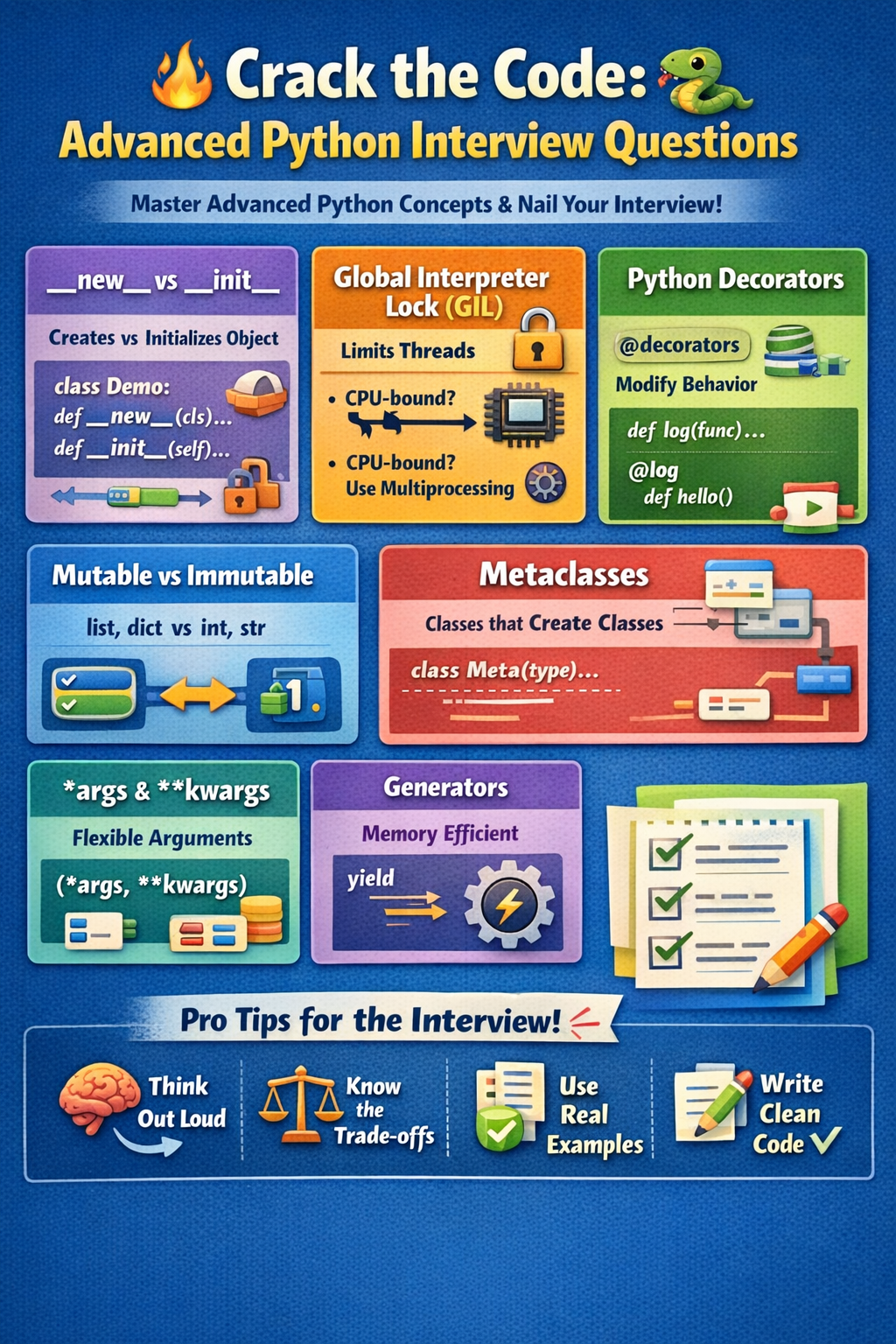
🧠 1. What is the difference between__new__()and__init__()?
🔍 Explanation
__new__()creates the object__init__()initializes the object
__new__() is called before __init__().
🧪 Example
class Demo:
    def __new__(cls):
        print("Creating instance")
        return super().__new__(cls)

    def __init__(self):
        print("Initializing instance")

obj = Demo()
✅ Output
Creating instance
Initializing instance
📌 Used in: Singletons, immutable objects
🧠 2. Explain Python’s Global Interpreter Lock (GIL)
🔍 Explanation
The GIL allows only one thread to execute Python bytecode at a time.
❌ Problem
- CPU-bound multithreading doesn’t scale well
✅ Solution
- Use multiprocessing for CPU-bound tasks
- Use async / threading for I/O-bound tasks
🧪 Example
import threading

def task():
    print("Running task")

threading.Thread(target=task).start()
🧠 Interview Tip:
👉 Python threads ≠ true parallelism (for CPU tasks)
🧠 3. What are Python Decorators? How do they work internally?
🔍 Explanation
Decorators wrap functions to modify behavior without changing original code.
🧪 Example
def log(func):
    def wrapper():
        print("Before execution")
        func()
        print("After execution")
    return wrapper

@log
def hello():
    print("Hello World")

hello()
✅ Output
Before execution
Hello World
After execution
📌 Used in: Authentication, logging, caching, rate-limiting
🧠 4. Explain Mutable vs Immutable Objects
🔍 Explanation
Mutable — — — — — Immutable
Can — — — — — — — change Cannot change
list, dict, set — — — int, tuple, str
🧪 Example
a = [1, 2]
b = a
b.append(3)
print(a)
✅ Output
[1, 2, 3]⚠️ Common Interview Trap
🧠 5. What is Python’s Memory Management?
🔍 Explanation
Python uses:
- Reference Counting
- Garbage Collection (GC) for cyclic references
🧪 Example
import sys

x = []
print(sys.getrefcount(x))
📌 GC handles cycles like:
a = []
b = []
a.append(b)
b.append(a)
🧠 6. What are Metaclasses?
🔍 Explanation
Metaclasses define how classes behave
“Classes are objects too!”
🧪 Example
class Meta(type):
    def __new__(cls, name, bases, dct):
        dct["version"] = 1.0
        return super().__new__(cls, name, bases, dct)

class App(metaclass=Meta):
    pass

print(App.version)
📌 Used in: ORMs, frameworks like Django
🧠 7. What is Monkey Patching?
🔍 Explanation
Changing a class or module at runtime
🧪 Example
class A:
    def greet(self):
        return "Hello"

def new_greet(self):
    return "Hi"

A.greet = new_greet
print(A().greet())
⚠️ Avoid in production unless absolutely required
🧠 8. Explain*argsand**kwargsin Depth
🔍 Explanation
*args→ Variable positional arguments**kwargs→ Variable keyword arguments
🧪 Example
def demo(*args, **kwargs):
    print(args)
    print(kwargs)

demo(1, 2, a=10, b=20)
📌 Used in: APIs, decorators, extensible functions
🧠 9. What are Generators and Why Are They Memory Efficient?
🔍 Explanation
Generators yield values one at a time, saving memory.
🧪 Example
def count_up(n):
    for i in range(n):
        yield i

gen = count_up(1000000)
🔥 Huge performance boost for large datasets
🧠 10. Difference Between Deep Copy and Shallow Copy
🔍 Explanation
- Shallow Copy → References
- Deep Copy → New objects
🧪 Example
import copy

a = [[1, 2]]
b = copy.copy(a)
c = copy.deepcopy(a)
a[0].append(3)

print(b)
print(c)
🧠 11. What is Python’s __slots__?🔍 Explanation
Reduces memory usage by preventing dynamic attribute creation.
🧪 Example
class User:
    __slots__ = ["name", "age"]

u = User()
u.name = "Alex"
📌 Used in: Performance-critical systems
🧠 12. Explain Async/Await in Python
🔍 Explanation
Used for non-blocking I/O
🧪 Example
import asyncio

async def main():
    await asyncio.sleep(1)
    print("Done")

asyncio.run(main())
⚡ Faster than threading for I/O tasks
🎯 Interview Tips & Tricks (Must Read!) 🔥
✅ 1. Think Out Loud
Interviewers care about reasoning, not just answers 🧠
✅ 2. Use Real-World Examples
Relate answers to APIs, background jobs, data processing
✅ 3. Know Trade-offs
Always explain pros vs cons ⚖️
✅ 4. Master These Topics
- OOP & Design Patterns
- Memory Management
- Concurrency
- Data Structures
- Performance Optimization
✅ 5. Write Clean Code
Readable > Clever 🧼
✨ Final Words
💬 “Python rewards clarity of thought more than clever tricks.”
Master these advanced Python concepts, and you’ll walk into any interview with confidence & clarity 🚀🐍


Comments
Post a Comment