🚀 How to Optimize Your Servers Like a Pro (Speed, Stability & Scale)
🚀 How to Optimize Your Servers Like a Pro (Speed, Stability & Scale)
Slow servers kill user trust. Optimized servers build unstoppable products. ⚡
Whether you’re running a startup app, a SaaS platform, or a high-traffic website — server optimization is non-negotiable.
In this complete, practical guide, you’ll learn:
✅ Core principles of server optimization
✅ Proven techniques with real examples
✅ Best tools and their features
✅ Common mistakes to avoid ❌
Let’s dive in 👇
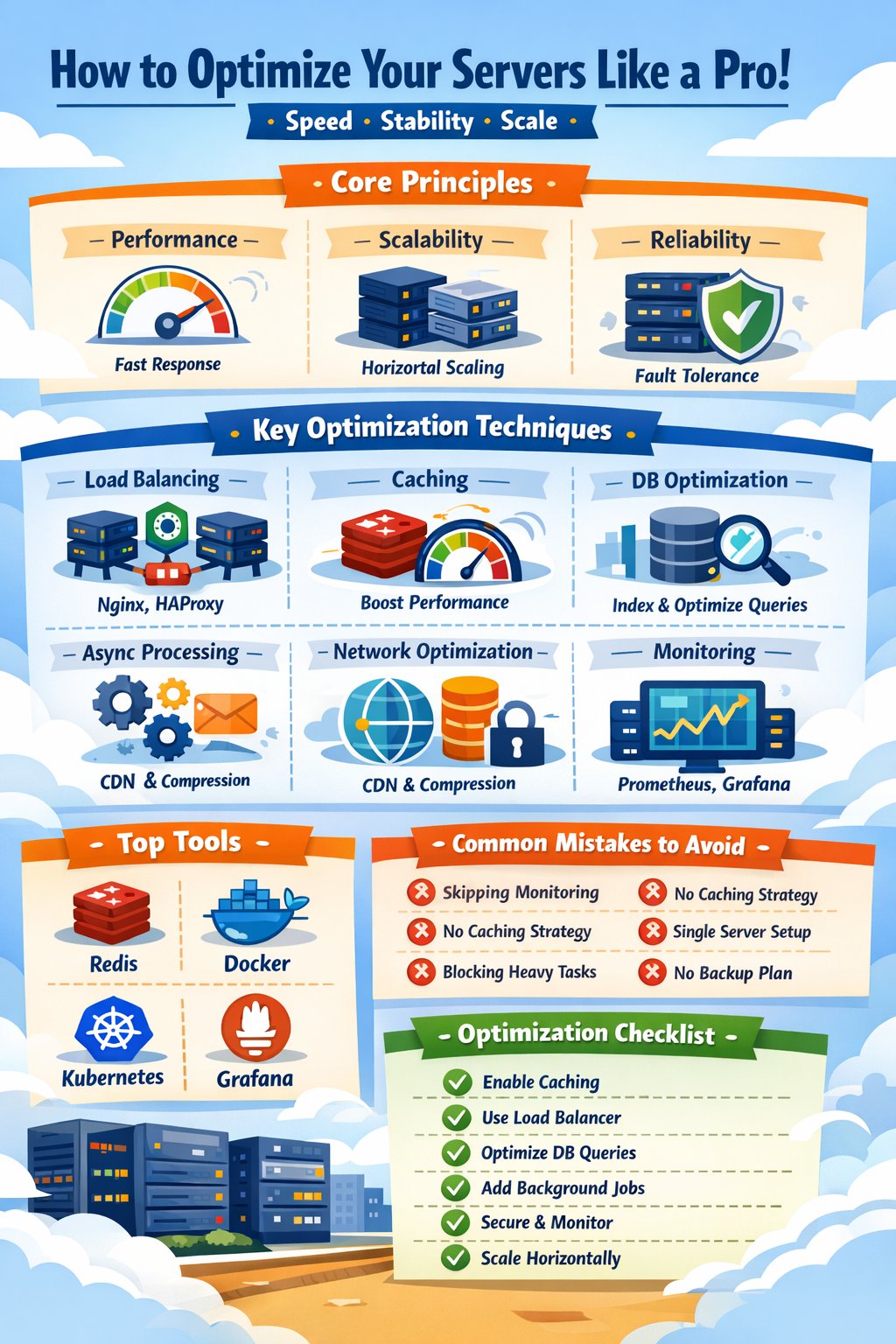
🧠 1. Core Principles of Server Optimization
🔹 1.1 Performance First, Always
Your server must respond fast under load.
Key metrics 📊
- Response Time (TTFB)
- Throughput (requests/sec)
- Latency
- Error Rate
💡 Rule: You can’t optimize what you don’t measure.
🔹 1.2 Scalability Over Raw Power
A bigger server ≠ better system.
- Vertical Scaling ➕ (bigger CPU/RAM)
- Horizontal Scaling ➕➕ (more servers)
✅ Modern systems favor horizontal scaling with load balancers.
🔹 1.3 Reliability & Fault Tolerance
Servers should fail gracefully, not catastrophically.
- Redundancy
- Health checks
- Auto-restart services
💡 Assume servers will fail — design for it.
⚙️ 2. Server Optimization Techniques (With Examples)
🧱 2.1 Infrastructure Optimization
🔸 Choose the Right Server Type
- VPS → small apps
- Dedicated → heavy workloads
- Cloud (AWS/GCP/Azure) → scalable systems ☁️
Example:
👉 A Rails app on AWS EC2 with Auto Scaling handles traffic spikes smoothly.
🔸 Use SSDs Instead of HDDs
SSDs drastically improve:
- Database queries
- File reads/writes
⚡ Up to 10x faster I/O.
🔄 2.2 Load Balancing
Distribute traffic across multiple servers.
🔧 Tools:
- Nginx
- HAProxy
- AWS ELB
Example (Nginx):
upstream backend {
  server app1;
  server app2;
}

server {
  location / {
    proxy_pass http://backend;
  }
}
🎯 Benefits:
- High availability
- Better response time
🧠 2.3 Caching (BIGGEST Performance Booster) 🚀
🔸 Types of Caching:
- Page Cache
- Fragment Cache
- Database Cache
- Object Cache
🔧 Tools:
- Redis 🔥
- Memcached
- Varnish
Example (Redis):
Rails.cache.fetch("users_count", expires_in: 10.minutes) do
  User.count
end
💡 Caching reduces server load by 70–90%.
🗄️ 2.4 Database Optimization
🔸 Indexing
CREATE INDEX idx_users_email ON users(email);🔸 Query Optimization
- Avoid
SELECT * - Use pagination
- Remove N+1 queries
🔧 Tools:
- PostgreSQL EXPLAIN
- MySQL Slow Query Log
📉 Optimized queries = faster servers.
🧵 2.5 Concurrency & Async Processing
🔸 Use Background Jobs
Move heavy tasks out of request cycle.
🔧 Tools:
- Sidekiq (Ruby)
- Celery (Python)
- Bull (Node.js)
Example:
HardJob.perform_async(user.id)🚀 Users get instant responses.
🌐 2.6 Network Optimization
🔸 Enable Compression
gzip on;
gzip_types text/plain application/json;
🔸 Use CDN
- Cloudflare
- AWS CloudFront
📍 Content delivered closer to users.
🔐 2.7 Security Optimization (Performance + Safety)
🔸 Use Firewalls & Rate Limiting
limit_req zone=one burst=10 nodelay;🔧 Tools:
- Fail2Ban
- Cloudflare WAF
⚠️ Attacks waste server resources — block early.
📊 2.8 Monitoring & Observability
🔧 Must-Have Tools:
- Prometheus → metrics
- Grafana → dashboards 📈
- New Relic / Datadog → APM
- htop / top → real-time usage
💡 Monitoring is optimization’s best friend.
🐳 2.9 Containerization & Orchestration
🔸 Docker
- Consistent environments
- Faster deployments
🔸 Kubernetes
- Auto-scaling
- Self-healing pods
🎯 Modern server optimization is incomplete without containers.
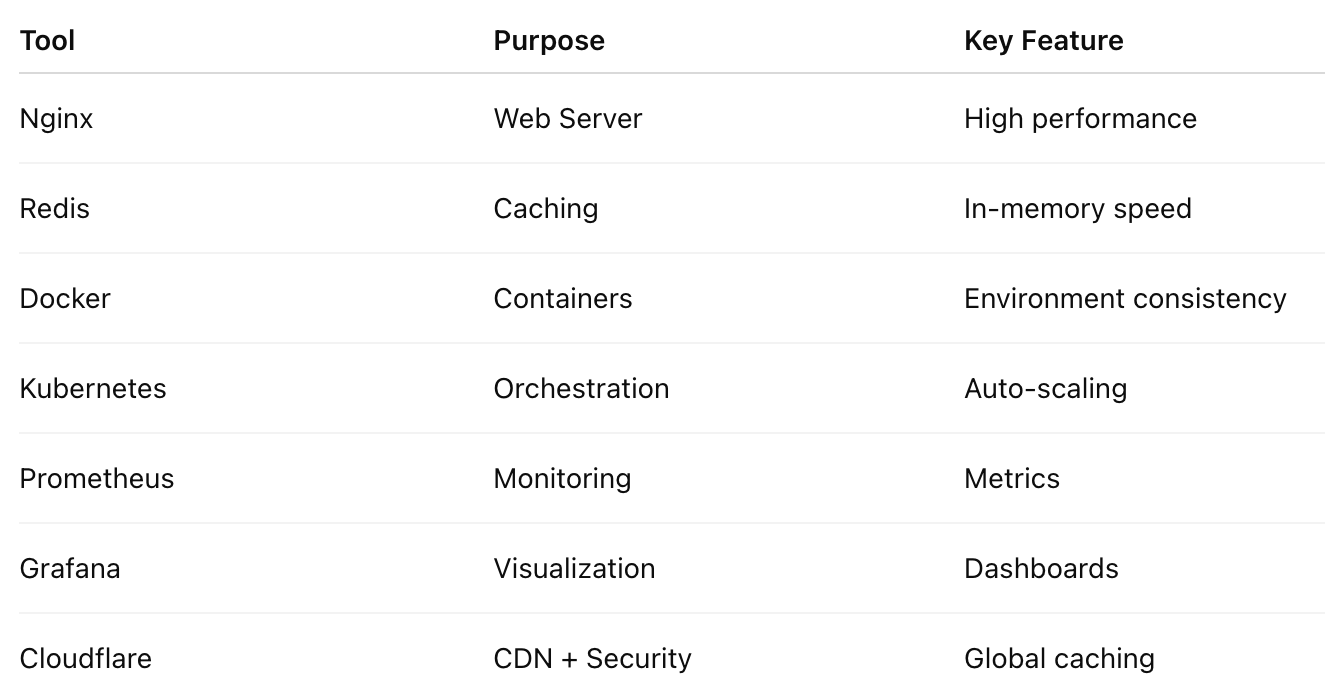
🛠️ 3. Popular Server Optimization Tools & Features
❌ 4. Common Mistakes to Avoid
🚫 Ignoring Monitoring
🚫 Over-optimizing too early
🚫 No caching strategy
🚫 Running everything on one server
🚫 Blocking requests with heavy tasks
🚫 No backup & failover plan
🚫 Not updating OS & dependencies
💥 These mistakes silently kill performance.
🧩 5. Simple Server Optimization Checklist ✅
✔ Enable caching
✔ Use load balancer
✔ Optimize DB queries
✔ Add background jobs
✔ Monitor everything
✔ Secure your server
✔ Scale horizontally
🎯 Final Thoughts
Server optimization isn’t a one-time task — it’s a continuous mindset. 🧠⚙️
Start small:
👉 Monitor
👉 Cache
👉 Optimize queries
👉 Scale smart
Do this consistently, and your servers will stay fast, stable, and future-ready 🚀


Comments
Post a Comment