🐍 Python Mastery: 12 Core Principles Every Developer Must Know (With Pro-Level Examples) 🚀
🐍 Python Mastery: 12 Core Principles Every Developer Must Know (With Pro-Level Examples) 🚀
If you want to write powerful, clean & scalable Python code, understanding Python’s core principles is a MUST. These aren’t just syntax rules — they are mindsets that make you a 10x Python developer. Let’s dive in 👇

🎯 1️⃣ Zen of Python — The Guiding Philosophy
Python has 19 commandments (PEP-20) that help you write cleaner code.
import this📌 Key Zen rules:
- Simple is better than complex.
- Readability counts.
- If the implementation is easy to explain, it may be a good idea.
🧠 Why it matters: Write code ANY developer can understand in seconds.
🧱 2️⃣ DRY — Don’t Repeat Yourself
Avoid duplicate logic. Extract repetitive code into reusable functions.
❌ Bad:
print("Hello Alex")
print("Hello John")
print("Hello Maria")
✔️ Pro Code:
def greet(name):
    print(f"Hello {name}")

for user in ["Alex", "John", "Maria"]:
    greet(user)
🎭 3️⃣ EAFP — Easy to Ask Forgiveness than Permission
Instead of checking everything… just do it & handle failure.
try:
    value = int(input)
except ValueError:
    value = 0
🧠 Pythonic > Defensive Programming — This is faster & cleaner.
🔍 4️⃣ Duck Typing — If It Walks Like a Duck, It’s a Duck
Python doesn’t care about type, but behavior.
def make_sound(animal):
    animal.sound()

class Dog:
    def sound(self): print("🐶 Woof!")

class Cat:
    def sound(self): print("🐱 Meow!")

make_sound(Dog())
make_sound(Cat())
⚡ 5️⃣ List Comprehension — The Python Power Move
Replace loops with expressive one-liners.
✔️ Example:
squares = [x*x for x in range(10)]Pro Trick:
filtered = [x for x in range(50) if x % 5 == 0]🧩 6️⃣ Use Generators for Memory Efficiency
Don’t store large datasets — stream them.
def numbers():
    for i in range(1_000_000):
        yield i

for num in numbers():
    print(num)
📌 Saves RAM — perfect for ML datasets, logs, API streaming.
🧊 7️⃣ Immutable vs Mutable Awareness
Avoid unexpected bugs 💥
def add(item, bucket=[]):
    bucket.append(item)
    return bucket

add(1)  # [1]
add(2)  # [1,2]  <-- BUG!
✔️ Fix:
def add(item, bucket=None):
    bucket = bucket or []
    bucket.append(item)
    return bucket
🧠 8️⃣ OOP Principles — Encapsulation / Inheritance / Polymorphism
Python supports full OOP 🚀
class Vehicle:
    def run(self): print("Running!")

class Car(Vehicle):
    def run(self): print("Car 🚗 Running Fast!")

Car().run()
🪄 9️⃣ Metaprogramming: Code That Writes Code 🤯
Using decorators to modify behaviors.
def log(fn):
    def wrapper(*a, **k):
        print("Function Executed:", fn.__name__)
        return fn(*a, **k)
    return wrapper

@log

def greet():
    print("Hello!")

greet()
🔄 🔟 Functional Programming — Map, Filter, Lambda
Be a minimalist where needed.
nums = [1,2,3,4,5]
double = list(map(lambda x: x*2, nums))
evens = list(filter(lambda x: x%2==0, nums))
🧷 1️⃣1️⃣ Context Managers — Clean Resource Handling
with open("file.txt") as f:
    data = f.read()
📌 Auto closes file (No memory leak)
Custom:
class MyManager:
    def __enter__(self): print("Start")
    def __exit__(self, *args): print("End")

with MyManager():
    print("Inside")
🛡 1️⃣2️⃣ Type Hinting — Write Future-Proof Code
def add(a: int, b: int) -> int:
    return a + b
🧠 Helps avoid bugs in large codebases.
🧰 PRO Python Hacks & Tricks (That Separate Juniors from Pros) 🚀
🪶 1️⃣ Swap Variables Without Temp
a, b = b, a🔥 2️⃣ Inline If
msg = "Even" if n % 2 == 0 else "Odd"⚙️ 3️⃣ Merge Two Dicts
merged = {**a, **b}🧠 4️⃣ One-Line File Reader
data = open("log.txt").read().splitlines()🌪 5️⃣ Smart Debug Printing
print(f"{var = }")🎁 Bonus: Clean Code Tips for Pythonists 🧽
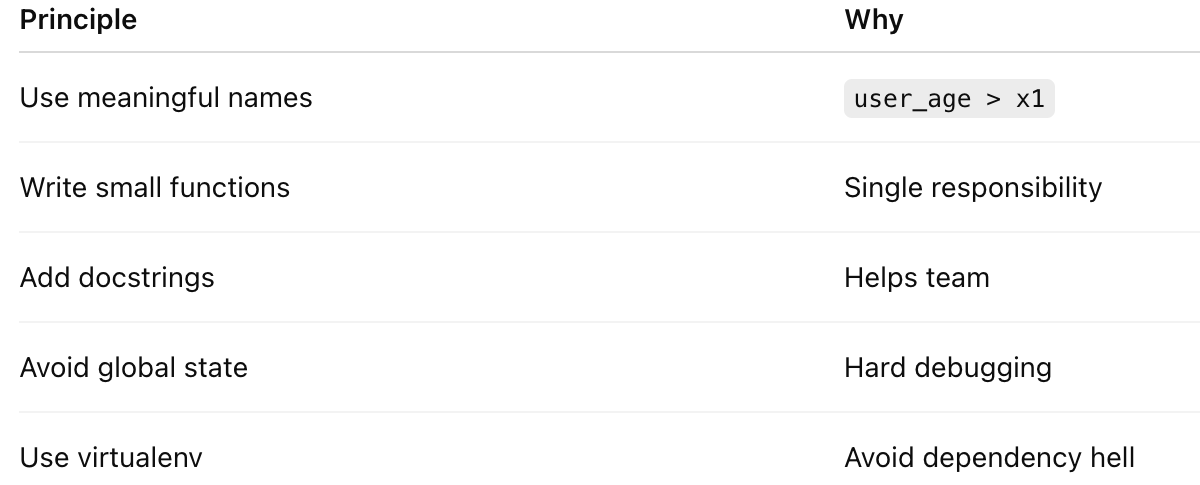
🏁 Final Words — Become a Python Pro 🚀
Great Python developers are not defined by syntax knowledge, but by:
✔ understanding principles
✔ writing readable scalable code
✔ using tricks & optimizations
👉 Bookmark this guide & share it with your coding friends 🔥


Comments
Post a Comment