🎯 Mastering Design Patterns: The Secret Blueprint of Legendary Software Architecture 🚀
🎯 Mastering Design Patterns: The Secret Blueprint of Legendary Software Architecture 🚀
When you build applications in Ruby on Rails, React, Microservices, or DevOps systems, you eventually face the same problem:
“How do I structure this code so it’s scalable, reusable, and clean?” 🤔
That’s where Design Patterns come in.
Design patterns are proven solutions to recurring software design problems. They are not code snippets — they are architectural thinking models 🧠.
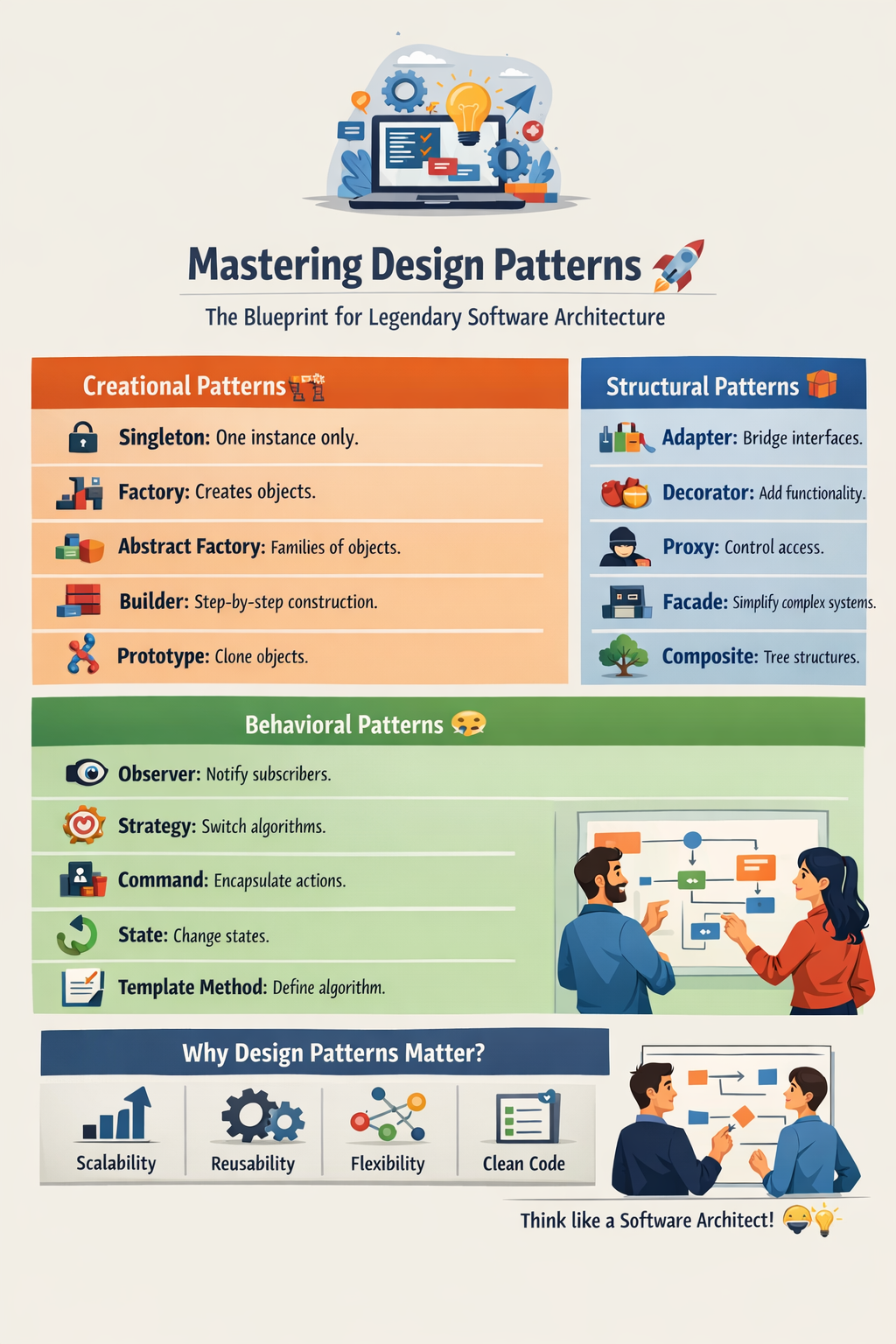
Let’s break them down deeply — with concepts, features, and practical examples.
🏗️ 1. Creational Design Patterns
These patterns deal with object creation mechanisms.
They help make systems flexible and independent of how objects are created.
1️⃣ Singleton Pattern 🔒
📌 Concept
Ensures that a class has only one instance and provides a global access point to it.
💡 When to Use?
- Logging system
- Configuration manager
- Database connection pool
✨ Features
- Controlled access to a single instance
- Lazy initialization possible
- Saves memory resources
🧑💻 Ruby Example
require 'singleton'

class LoggerService
  include Singleton
  def log(message)
    puts "Log: #{message}"
  end
end
LoggerService.instance.log("Application started")
🚨 Mistake to Avoid
Overusing Singleton can create hidden global dependencies.
2️⃣ Factory Pattern 🏭
📌 Concept
Creates objects without exposing the instantiation logic to the client.
💡 Use Case
When object creation is complex or varies by condition.
✨ Features
- Loose coupling
- Centralized object creation
- Easy extension
🧑💻 Example
class PaymentFactory
  def self.create(method)
    case method
    when :upi then UpiPayment.new
    when :card then CardPayment.new
    else raise "Invalid method"
    end
  end
end
Perfect for payment gateways, notification systems, parsers.
3️⃣ Abstract Factory 🏗️
📌 Concept
Creates families of related objects without specifying their concrete classes.
Used when multiple related objects must work together.
Example: UI themes (Dark mode / Light mode).
4️⃣ Builder Pattern 🧱
📌 Concept
Separates object construction from its representation.
Used when:
- Object has many optional parameters
- Construction requires multiple steps
Example: Building a complex HTTP request.
5️⃣ Prototype Pattern 🧬
📌 Concept
Creates new objects by copying an existing object.
Useful when:
- Object creation is expensive
- Cloning improves performance
🧱 2. Structural Design Patterns
These patterns focus on how classes and objects are composed.
6️⃣ Adapter Pattern 🔌
📌 Concept
Allows incompatible interfaces to work together.
💡 Real Example
Integrating a third-party payment API with your existing system.
class OldPaymentSystem
  def make_payment
    "Paid using old system"
  end
end

class Adapter
  def initialize(system)
    @system = system
  end
  def pay
    @system.make_payment
  end
end
7️⃣ Decorator Pattern 🎁
📌 Concept
Adds new functionality dynamically without modifying the original class.
💡 Example
Adding caching or logging to a service.
8️⃣ Proxy Pattern 🕵️
📌 Concept
Provides a placeholder to control access to an object.
Used for:
- Lazy loading
- Security
- Access control
Rails ActiveRecord uses Proxy internally 👀
9️⃣ Facade Pattern 🏢
📌 Concept
Provides a simplified interface to a complex subsystem.
Example:
A PaymentService that internally calls:
- Fraud Detection
- Notification
- Ledger update
Client only calls one method.
🔟 Composite Pattern 🌳
📌 Concept
Treats individual objects and compositions uniformly.
Used in:
- Tree structures
- File systems
- Menu hierarchies
🧠 3. Behavioral Design Patterns
These patterns focus on communication between objects.
1️⃣1️⃣ Observer Pattern 👀
📌 Concept
Defines one-to-many dependency.
When one object changes state → all observers are notified.
💡 Example
- Event listeners
- Rails ActiveSupport callbacks
- Pub/Sub systems
1️⃣2️⃣ Strategy Pattern 🎯
📌 Concept
Encapsulates interchangeable algorithms.
💡 Example
Different sorting or pricing algorithms.
class DiscountStrategy
  def calculate(price); end
end

class FestivalDiscount < DiscountStrategy
  def calculate(price)
    price * 0.8
  end
end
1️⃣3️⃣ Command Pattern 🎮
📌 Concept
Encapsulates a request as an object.
Used in:
- Job queues
- Undo/Redo functionality
- Background workers
1️⃣4️⃣ State Pattern 🔄
📌 Concept
Allows object behavior to change when internal state changes.
Example:
Order → Pending → Shipped → Delivered
1️⃣5️⃣ Template Method 📝
📌 Concept
Defines skeleton of algorithm, but allows subclasses to override steps.
Common in framework design.
🏆 Why Design Patterns Matter?
✅ Improve scalability
✅ Encourage clean architecture
✅ Promote SOLID principles
✅ Reduce technical debt
✅ Make you think like a Software Architect
🚀 Real-World Example (Rails Context)
Imagine building an e-commerce system:
- Singleton → App configuration
- Factory → Payment creation
- Strategy → Discount logic
- Observer → Order event notifications
- Facade → CheckoutService
That’s real architectural thinking 💡
🧠 Advanced Insight: Patterns + SOLID
Most patterns exist to support:
- Open/Closed Principle
- Dependency Inversion
- Single Responsibility
Patterns are not about memorizing 23 GoF patterns.
They’re about understanding why they exist.
⚠️ Common Mistakes Developers Make
❌ Overengineering simple problems
❌ Using patterns without understanding
❌ Confusing patterns with frameworks
❌ Forcing patterns into small projects
🔥 Final Thought
“Design patterns are not rules. They are wisdom collected from decades of software engineering.”
If you master design patterns, you don’t just write code…
You design systems. 🏗️✨


Comments
Post a Comment