⚛️ Mastering ReactJS: Principles Every Pro Developer Must Know 🚀
⚛️ Mastering ReactJS: Principles Every Pro Developer Must Know 🚀
React isn’t just a library — it’s a way of thinking about building user interfaces. If you truly understand its core principles, you move from writing React code… to engineering scalable frontend systems. 💡
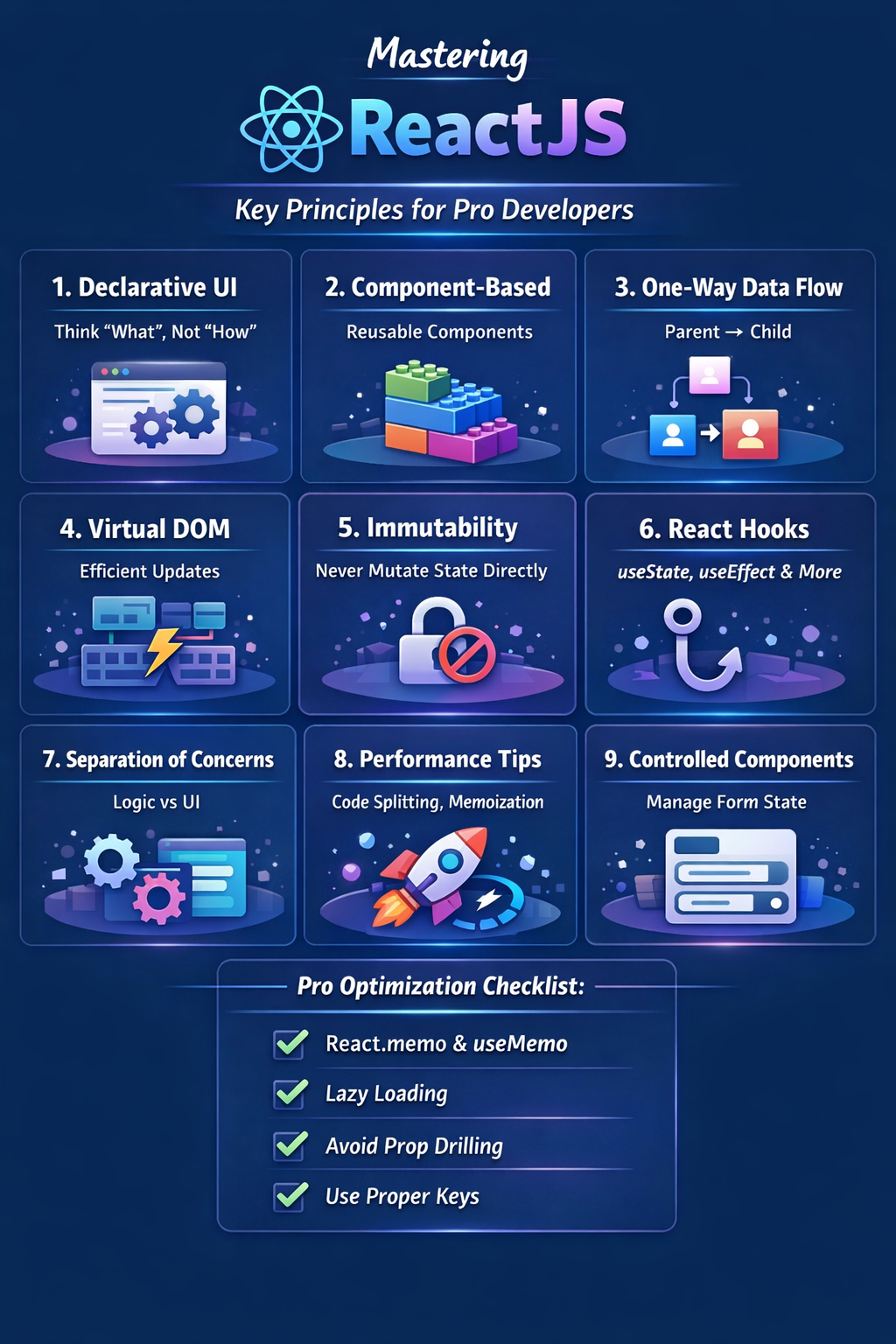
Let’s break down the fundamental ReactJS principles every pro developer should master — with deep explanations, examples, and optimization tips.
1️⃣ Declarative UI — Think “What”, Not “How” 🧠
React is declarative, meaning you describe what the UI should look like based on state — not how to manually update the DOM.
Instead of:
- Finding elements
- Changing properties
- Updating classes manually
You simply describe UI based on state.
❌ Imperative (Vanilla JS mindset)
if (isLoggedIn) {
  showDashboard();
} else {
  showLogin();
}
✅ Declarative (React way)
function App({ isLoggedIn }) {
  return (
    <div>
      {isLoggedIn ? <Dashboard /> : <Login />}
    </div>
  );
}
✨ React handles DOM updates efficiently using the Virtual DOM.
🧠 Why This Matters
- Easier debugging
- Predictable UI
- Fewer DOM bugs
- Better maintainability
2️⃣ Component-Based Architecture 🧩
React applications are built using reusable components.
Think of components like LEGO blocks.
Example
function Button({ label }) {
  return <button>{label}</button>;
}

function App() {
  return (
    <div>
      <Button label="Login" />
      <Button label="Register" />
    </div>
  );
}
💡 Pro Insight
- Small components = Better scalability
- Follow Single Responsibility Principle (SRP)
- Co-locate related files (CSS, test, logic)
⚡ Optimization Tip
- Use
React.memo()for pure components to prevent unnecessary re-renders.
3️⃣ One-Way Data Flow 🔄
React follows unidirectional data flow.
Data flows:
Parent → Child
Never child → parent directly.
Example
function Parent() {
  const [count, setCount] = React.useState(0);

  return <Child count={count} />;
}

function Child({ count }) {
  return <h1>{count}</h1>;
}
🧠 Why It’s Powerful
- Predictable state management
- Easier debugging
- Better traceability
💡 Advanced Tip
Use:
- Context API
- Redux
- Zustand
When prop drilling becomes complex.
4️⃣ Virtual DOM & Reconciliation ⚡
React uses a Virtual DOM to optimize updates.
Process:
- State changes
- React creates new Virtual DOM
- Compares with old (diffing)
- Updates only changed parts
🎯 Why This Matters
- Faster rendering
- Efficient UI updates
- Reduced browser repaint
⚡ Optimization Tip
Avoid:
key={index}Always use stable unique keys:
key={item.id}Keys help React identify elements correctly during reconciliation.
5️⃣ State & Immutability 🔒
State should always be treated as immutable.
❌ Wrong
state.user.name = "John";✅ Correct
setUser({ ...user, name: "John" });🧠 Why?
React relies on reference comparison.
If you mutate state directly, React may not re-render.
⚡ Pro Tips
- Use functional updates:
setCount(prev => prev + 1);- Use libraries like Immer for complex state logic.
6️⃣ Hooks Philosophy 🎣
Hooks changed everything in React.
Core hooks:
useStateuseEffectuseMemouseCallbackuseRef
Example
function Counter() {
  const [count, setCount] = React.useState(0);

   React.useEffect(() => {
    console.log("Updated");
  }, [count]);
  return (
    <button onClick={() => setCount(count + 1)}>
      {count}
    </button>
  );
}
💡 Pro Understanding
- Hooks follow rules:
- Only call at top level
- Only inside React functions
⚡ Optimization Tip
Use:
useMemo()for expensive calculationsuseCallback()to memoize functionsuseRef()to avoid re-renders
7️⃣ Separation of Concerns (Logic vs UI) 🏗️
Keep:
- UI Components (Presentation)
- Business Logic (Custom Hooks / Services)
Separate.
Example
function useCounter() {
  const [count, setCount] = React.useState(0);
  const increment = () => setCount(c => c + 1);
  return { count, increment };
}

function Counter() {
  const { count, increment } = useCounter();
  return <button onClick={increment}>{count}</button>;
}
🔥 Now logic is reusable anywhere.
8️⃣ Performance Optimization Principles 🚀
Pro developers think about performance early.
🔹 Code Splitting
const Dashboard = React.lazy(() => import("./Dashboard"));Use with:
<Suspense fallback={<Loader />}>
  <Dashboard />
</Suspense>
🔹 Avoid Re-render Storms
- Memoize components
- Split large components
- Avoid inline object creation
❌
<Component style={{ color: "red" }} />✅
const style = { color: "red" };
<Component style={style} />
9️⃣ Controlled vs Uncontrolled Components 🎛️
Controlled
React manages state.
<input value={value} onChange={e => setValue(e.target.value)} />Uncontrolled
DOM manages state.
<input ref={inputRef} />💡 Pro Tip:
Use controlled inputs for:
- Forms
- Validation
- Predictable behavior
🔟 Thinking in React 🧠⚛️
The ultimate principle:
- Break UI into components
- Identify minimal state
- Determine where state should live
- Pass data down via props
- Add interactivity
This mindset separates beginners from pros.
🔥 Advanced Optimization Checklist
✅ Use React.memo
✅ Use useMemo for heavy calculations
✅ Use useCallback for stable references
✅ Avoid unnecessary context re-renders
✅ Lazy load large components
✅ Use production build
✅ Use key properly
✅ Profile with React DevTools
✅ Avoid deep prop drilling
✅ Normalize large state structures
💡 Final Thoughts
React is simple on the surface, but deep in philosophy.
Master:
- Declarative mindset
- Component architecture
- Unidirectional data flow
- Immutability
- Performance principles
And you won’t just write React…
You’ll architect frontend systems. ⚛️🔥


Comments
Post a Comment