🚀 The Perfect Plan for Feature Release
🚀 The Perfect Plan for Feature Release
From Idea 💡 to Impact 📈 — A Complete Developer’s Blueprint
Releasing a feature is not just about writing code.
It’s about planning, precision, collaboration, quality, and continuous improvement.
A poorly planned release creates bugs 🐞, customer frustration 😤, and technical debt 💣.
A well-planned release builds trust, scalability, and long-term success 💎.
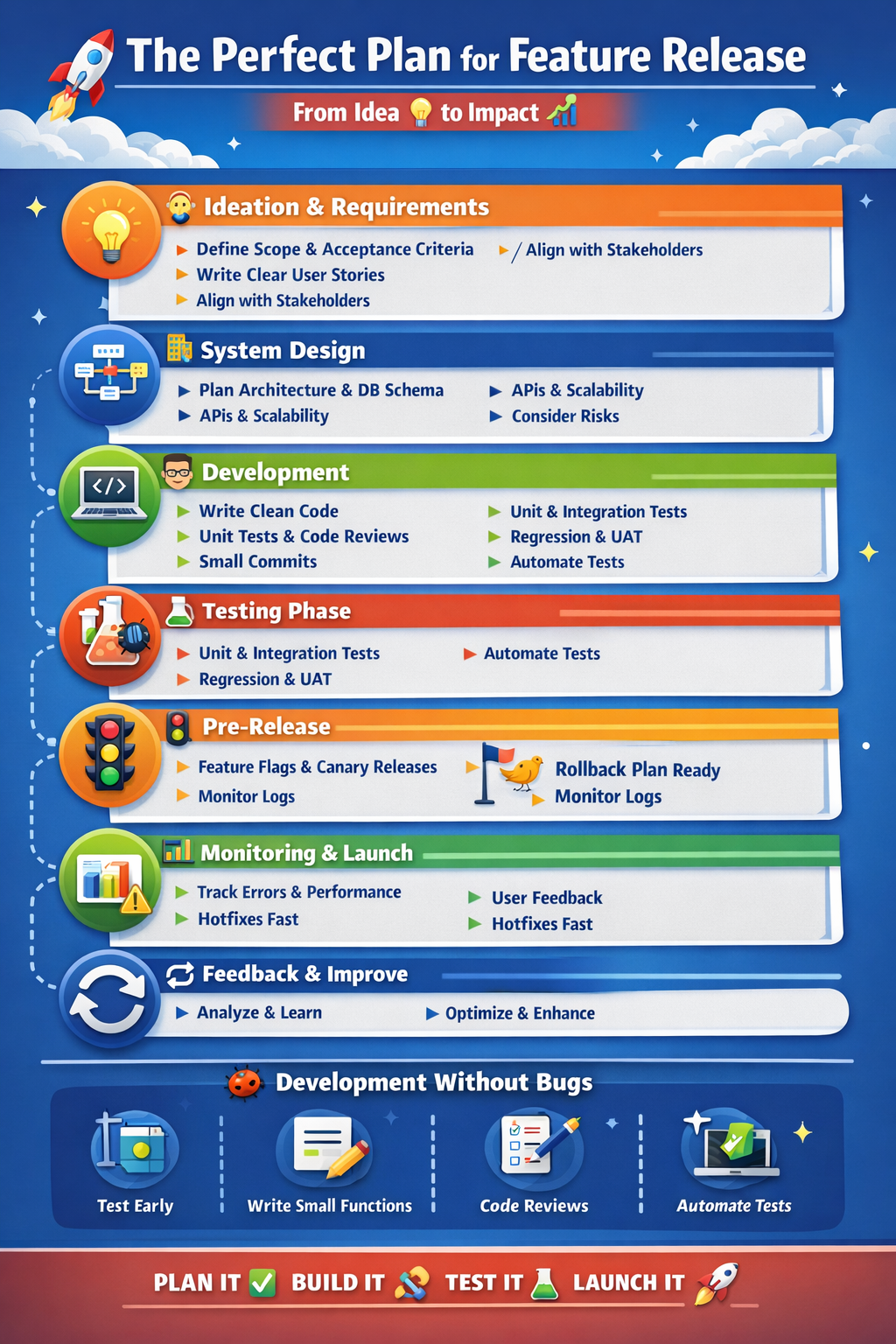
Let’s break down the complete feature development lifecycle, step by step — including terminologies, principles, mistakes to avoid, and strategies for development without bugs.
🧠 1. Ideation & Requirement Gathering
🎯 Goal:
Understand what problem we are solving and why it matters.
🔑 Key Terminologies
- Business Requirement (BRD) — High-level business goal.
- Functional Requirement (FRD) — What the system should do.
- Non-Functional Requirement (NFR) — Performance, scalability, security, etc.
- Acceptance Criteria — Conditions that must be satisfied for approval.
- User Stories — Short feature descriptions from user perspective.
- Stakeholders — People impacted (Product, QA, Dev, Client).
🛠 Process
- Identify user pain point.
- Define scope (avoid feature creep 🚫).
- Write clear user stories.
- Define acceptance criteria.
- Get stakeholder alignment.
🧠 Principles
- Clarity > Speed
- Solve root problem, not symptoms
- Keep MVP small
❌ Mistakes to Avoid
- Vague requirements.
- No written acceptance criteria.
- Starting development without understanding edge cases.
🏗 2. System Design & Architecture Planning
🎯 Goal:
Design how the feature integrates into existing architecture.
🔑 Key Terminologies
- HLD (High-Level Design) — Big-picture architecture.
- LLD (Low-Level Design) — Code-level implementation details.
- API Contract — Defined request/response structure.
- Database Schema Design
- Scalability & Performance Considerations
- Backward Compatibility
🛠 Process
- Draw flow diagrams.
- Identify impacted modules.
- Plan database migrations.
- Define API changes.
- Evaluate risks.
🧠 Principles
- SOLID principles
- DRY (Don’t Repeat Yourself)
- KISS (Keep It Simple, Stupid)
- Loose Coupling
- High Cohesion
❌ Mistakes to Avoid
- Ignoring existing architecture.
- Tight coupling between modules.
- Not planning for scaling.
- Breaking backward compatibility.
🧑💻 3. Development Phase
🎯 Goal:
Write clean, maintainable, testable code.
🔑 Important Terminologies
- Branching Strategy (Git Flow, Trunk-Based)
- Pull Request (PR)
- Code Review
- Refactoring
- Technical Debt
- Linting & Formatting
- CI Pipeline
🛠 Process
- Create feature branch.
- Implement in small commits.
- Write unit tests.
- Refactor.
- Push PR.
- Address review comments.
🧠 Principles
- Write code for humans 👨💻.
- Self-documenting code.
- Small, testable methods.
- Fail fast, validate early.
❌ Mistakes to Avoid
- Large unreviewable PRs.
- Skipping unit tests.
- Mixing refactoring with feature changes.
- Ignoring code review feedback.
🧪 4. Testing Cycle (Quality Assurance)
🎯 Goal:
Ensure the feature works in all scenarios.
🔑 Types of Testing
- Unit Testing — Test individual components.
- Integration Testing — Modules working together.
- Regression Testing — Ensure old features still work.
- UAT (User Acceptance Testing)
- Smoke Testing
- Load Testing
🧠 Principles
- Test early (Shift Left Testing).
- Automate repetitive tests.
- Cover edge cases.
- Test negative scenarios.
❌ Mistakes to Avoid
- Relying only on manual testing.
- Not testing boundary conditions.
- Ignoring performance impact.
🚦 5. Pre-Release Strategy
🎯 Goal:
Release safely without impacting production users.
🔑 Important Terminologies
- Feature Flag
- Canary Release
- Blue-Green Deployment
- Rollback Strategy
- Hotfix
- Release Notes
🛠 Deployment Strategies
🔹 Feature Flags
Deploy code but hide functionality until ready.
🔹 Canary Release
Release to small % of users first.
🔹 Blue-Green Deployment
Two environments — switch traffic when stable.
❌ Mistakes to Avoid
- Deploying without rollback plan.
- Not monitoring logs.
- No communication with stakeholders.
📊 6. Monitoring & Post-Release
🎯 Goal:
Ensure production stability.
🔑 Metrics to Monitor
- Error rates
- Response time
- CPU/Memory usage
- Database queries
- User engagement
🧠 Principles
- Observability > Guesswork
- Log everything meaningful
- Measure what matters
❌ Mistakes to Avoid
- No monitoring alerts.
- Ignoring small anomalies.
- Delayed hotfixes.
🧘 Development Without Bugs 🐞❌
Let’s be realistic:
Zero bugs is a mindset, not a guarantee.
But we can reduce 90% of bugs by following these strategies:
✅ 1. Write Tests Before or With Code (TDD)
- Red → Green → Refactor
- Think about edge cases early
✅ 2. Defensive Programming
- Validate inputs.
- Handle nulls.
- Fail gracefully.
- Avoid assumptions.
✅ 3. Keep Methods Small
Small methods =
✔ Easier to test
✔ Easier to debug
✔ Less complexity
✅ 4. Avoid Over-Engineering
Simple systems break less.
✅ 5. Continuous Code Review Culture
Second brain always helps 🧠.
✅ 6. Automate Everything
- Linting
- Formatting
- Testing
- Security checks
- Deployment
✅ 7. Root Cause Analysis (RCA)
When bug occurs:
- Identify root cause.
- Add test case.
- Fix properly.
- Prevent recurrence.
🔄 The Complete Feature Release Cycle (Summary)
- 🧠 Requirement Clarity
- 🏗 Architecture Planning
- 👨💻 Clean Development
- 🧪 Multi-level Testing
- 🚀 Safe Deployment
- 📊 Continuous Monitoring
- 🔁 Feedback & Improvement
💎 Golden Rules for Perfect Feature Release
✔ Define scope clearly
✔ Design before coding
✔ Automate testing
✔ Review thoroughly
✔ Deploy safely
✔ Monitor aggressively
✔ Improve continuously
🔥 Final Thought
A feature release is not an event.
It is a discipline.
Great teams don’t release fast.
They release right.
When planning meets precision,
quality becomes predictable.


Comments
Post a Comment