🤖🚀 AI Models for Developers: The Ultimate Guide to Building the Future in 2026
🤖🚀 AI Models for Developers: The Ultimate Guide to Building the Future in 2026
Artificial Intelligence is no longer optional — it’s a core development skill 💡
From chatbots and copilots to medical diagnosis and autonomous systems, AI models are powering modern software products.
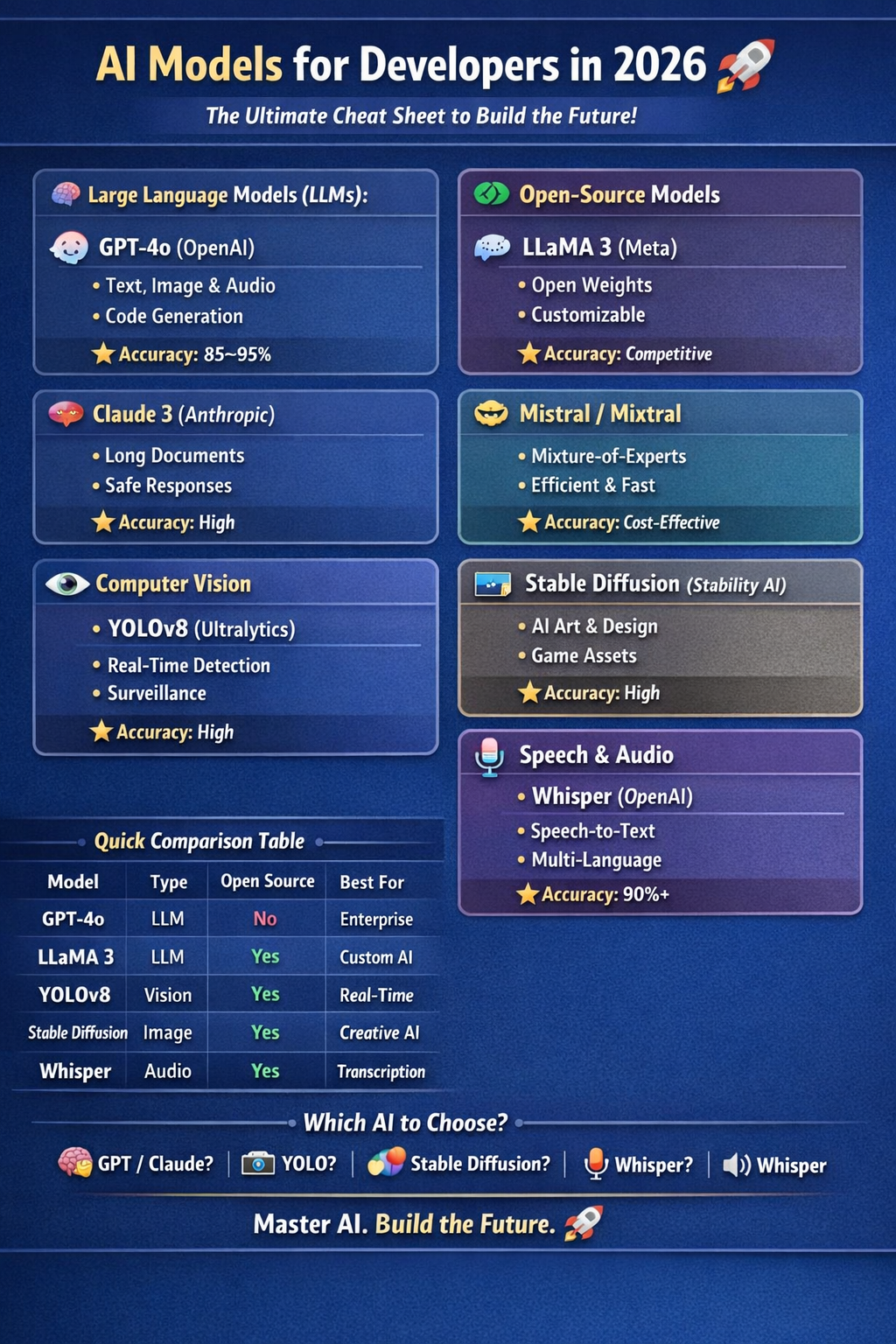
In this blog, we’ll explore:
- 🔹 Types of AI Models
- 🔹 Popular AI Models in 2026
- 🔹 Features & Specialties
- 🔹 Best Programming Languages
- 🔹 Accuracy & Performance Insights
- 🔹 When to Use What
Let’s dive in 👇
🧠 1️⃣ Large Language Models (LLMs)
These models understand and generate human-like text.
🌟 GPT-4o — by OpenAI
🔥 Features:
- Multimodal (Text + Image + Audio)
- Advanced reasoning
- Code generation
- Long context handling
🎯 Specialties:
- Chatbots
- Coding assistants
- Content creation
- AI SaaS integrations
💻 Best Languages:
- Python 🐍
- JavaScript (Node.js)
- Ruby (via APIs)
- Go
📊 Accuracy:
- 85–95% reasoning accuracy (task dependent)
- Excellent contextual understanding
🌟 Claude 3 — by Anthropic
🔥 Features:
- Very long context window
- Strong safety alignment
- Deep document analysis
🎯 Specialties:
- Legal documents
- Research papers
- Enterprise workflows
💻 Best Languages:
- Python
- JavaScript
- Backend microservices
📊 Accuracy:
- High logical reasoning
- Reduced hallucination compared to many models
🌟 Gemini 1.5 — by Google DeepMind
🔥 Features:
- Massive context window
- Strong multimodal capability
- Deep integration with cloud ecosystem
🎯 Specialties:
- Search enhancement
- Video understanding
- Structured data reasoning
💻 Best Languages:
- Python
- Java/Kotlin
- JavaScript
📊 Accuracy:
- Excellent multi-step reasoning
- Strong performance on large data inputs
🔓 2️⃣ Open-Source AI Models
For developers who want control & self-hosting.
🧠 LLaMA 3 — by Meta
🔥 Features:
- Open weights
- Fine-tuning friendly
- Multiple parameter sizes
🎯 Specialties:
- Custom AI assistants
- On-premise deployment
- Research experimentation
💻 Best Languages:
- Python (PyTorch)
- C++
- Rust
📊 Accuracy:
- Competitive with top LLMs (depends on size)
- Improves significantly after fine-tuning
🧠 Mistral & Mixtral — by Mistral AI
🔥 Features:
- Mixture-of-Experts (MoE)
- Efficient inference
- Lower hardware requirements
🎯 Specialties:
- Startup MVPs
- Cost-efficient AI services
- Real-time applications
💻 Best Languages:
- Python
- Go
- Rust
📊 Accuracy:
- Strong performance-to-cost ratio
- Excellent coding capabilities
👁️ 3️⃣ Computer Vision Models
🎯 YOLOv8 — by Ultralytics
🔥 Features:
- Real-time object detection
- Lightweight architecture
- Easy deployment
🎯 Specialties:
- Surveillance systems
- Autonomous vehicles
- Retail & industrial analytics
💻 Best Languages:
- Python
- C++
📊 Accuracy:
- High mAP scores (model dependent)
- Excellent real-time speed
🎨 4️⃣ Image Generation Models
🖼️ Stable Diffusion — by Stability AI
🔥 Features:
- Text-to-image generation
- Fine-tuning support (LoRA)
- Local deployment possible
🎯 Specialties:
- AI art & design
- Marketing creatives
- Game development assets
💻 Best Languages:
- Python
- JavaScript (frontend integration)
📊 Accuracy:
- High prompt-to-image fidelity
- Quality depends on model checkpoint
🔊 5️⃣ Speech & Audio Models
🎙️ Whisper — by OpenAI
🔥 Features:
- Speech-to-text
- Multi-language support
- Noise-robust recognition
🎯 Specialties:
- Podcast transcription
- Subtitles generation
- Voice-enabled apps
💻 Best Languages:
- Python
- Node.js
📊 Accuracy:
- 90%+ with clear audio
- Excellent multilingual performance
🏗️ 6️⃣ ML Frameworks for Custom Models
If you want to train your own models:
TensorFlow
- Best for production ML systems
- Strong ecosystem
- Scalable
PyTorch
- Best for research & LLM training
- Flexible and developer-friendly
Scikit-learn
- Ideal for classical ML
- Beginner-friendly
- Great for structured data
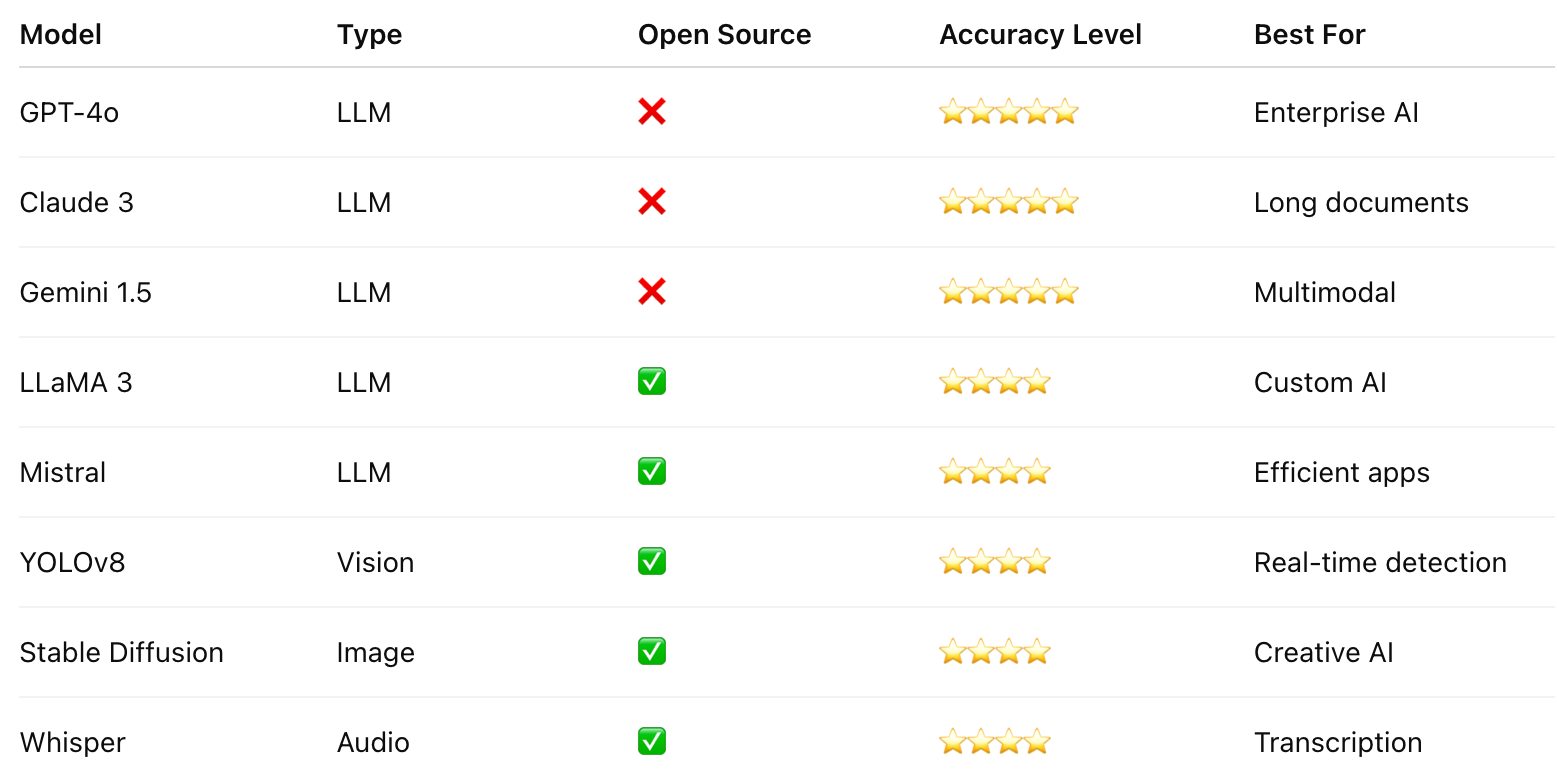
📊 Quick Comparison Table
🎯 How to Choose the Right AI Model?
Ask yourself:
- 🧠 Need deep reasoning? → GPT-4o / Claude
- 📷 Need computer vision? → YOLOv8
- 🎨 Need image generation? → Stable Diffusion
- 🔊 Need audio transcription? → Whisper
- 🔐 Need self-hosting? → LLaMA 3 / Mistral
💡 Final Thoughts
As a developer in 2026:
- AI is your co-pilot 👨💻
- Prompt engineering is a core skill 🎯
- Model selection impacts cost & scalability 💰
- Fine-tuning gives competitive advantage 🚀
Whether you’re building a Ruby on Rails SaaS, React dashboard, DevOps tool, or AI startup — understanding AI models gives you a massive edge.
The future belongs to developers who understand AI architecture, not just APIs.


Comments
Post a Comment