🚀 Automation in Software Development Without Breakdown
🚀 Automation in Software Development Without Breakdown
Build Fast. Ship Smart. Sleep Peacefully. 😌⚙️
In today’s fast-moving tech world, automation is not a luxury — it’s survival. But here’s the catch 👇
Many teams automate too fast, too randomly, and too aggressively… and end up with fragile pipelines, broken deployments, and frustrated developers.
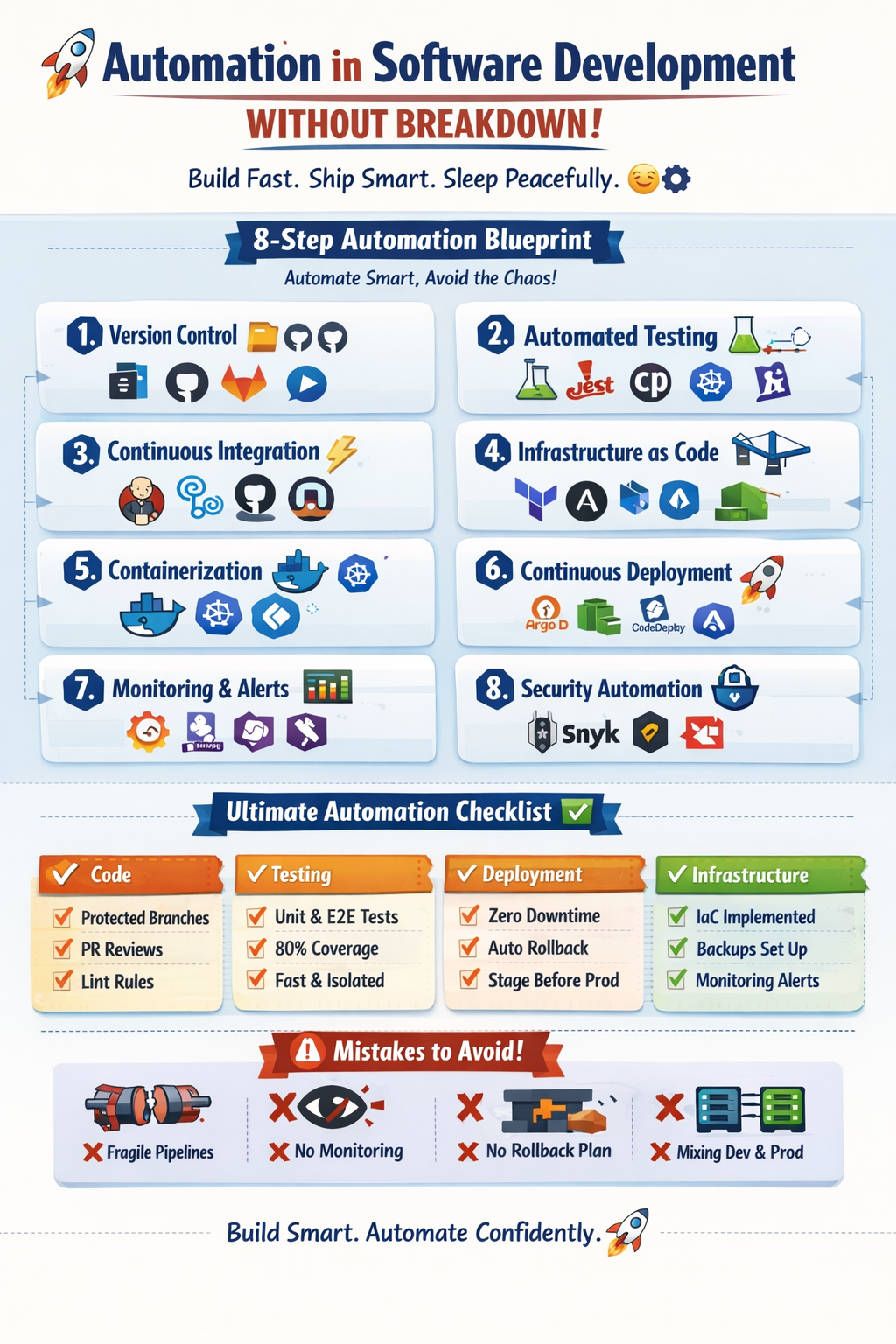
This blog is your complete blueprint to implement Automation in Software Development — without breakdown 💪
🎯 What Does “Automation Without Breakdown” Mean?
It means:
- ✅ Stable CI/CD pipelines
- ✅ Reliable testing layers
- ✅ Zero-downtime deployments
- ✅ Monitoring + rollback ready
- ✅ Reproducible environments
- ✅ Secure automation
Automation should reduce stress — not create it.
🏗 Step-by-Step Automation Blueprint
1️⃣ Version Control Automation (Foundation Layer) 📂
🔧 Tools:
- Git
- GitHub / GitLab / Bitbucket
⚙ Setup:
- Protected branches (main/master)
- Mandatory PR reviews
- PR templates
- Conventional commit messages
- Auto-trigger CI on PR
💡 Pro Tip:
Use branch naming convention:
feature/payment-gateway
bugfix/login-timeout
hotfix/critical-crash
2️⃣ Automated Testing Strategy 🧪
Without tests, automation is dangerous.
🔬 Testing Pyramid:
- Unit Tests
- Integration Tests
- API Tests
- E2E Tests
🔧 Tools:
- RSpec
- Minitest
- Jest
- Cypress
- Postman
⚙ Setup:
- Minimum 80% coverage
- CI fails if tests fail
- Parallel test execution
- Test database isolation
🚨 Mistake to Avoid:
❌ Writing only E2E tests
❌ No mocking strategy
❌ No test data cleanup
3️⃣ Continuous Integration (CI) ⚡
Every commit must be tested automatically.
🔧 Tools:
- GitHub Actions
- GitLab CI/CD
- Jenkins
- CircleCI
⚙ CI Setup Example Flow:
- Install dependencies
- Run lint checks
- Run tests
- Check coverage
- Build artifacts
- Security scan
🔐 Add:
- Dependency scanning
- Secret scanning
- Code quality tools (Rubocop, ESLint)
4️⃣ Infrastructure as Code (IaC) 🏗
Manual servers = disaster waiting to happen.
🔧 Tools:
- Terraform
- Ansible
- AWS CloudFormation
⚙ Setup:
- Define infra in code
- Use remote state management
- Environment separation:
dev
staging
production
🚀 Benefits:
- Reproducibility
- Disaster recovery
- Version-controlled infra
5️⃣ Containerization 🐳
“It works on my machine” should not exist.
🔧 Tools:
- Docker
- Kubernetes
⚙ Setup:
- Multi-stage Docker builds
- .dockerignore optimization
- Health checks
- Resource limits
💡 Smart Practice:
Keep images lightweight (Alpine, slim builds).
6️⃣ Continuous Deployment (CD) 🚀
Deployment should be boring. No drama.
Deployment Strategies:
- Blue-Green
- Rolling
- Canary
🔧 Tools:
- Argo CD
- AWS CodeDeploy
- Capistrano
⚙ Setup:
- Auto deploy to staging
- Manual approval for production
- Automated rollback
7️⃣ Monitoring & Observability 📊
Automation without monitoring = blind flying ✈️
🔧 Tools:
- Prometheus
- Grafana
- Datadog
- New Relic
⚙ Setup:
- Error alerts
- CPU/Memory alerts
- Slow API tracking
- Database monitoring
8️⃣ Security Automation 🔐
DevSecOps is mandatory.
🔧 Tools:
- Snyk
- OWASP ZAP
- OWASP
⚙ Setup:
- Automated vulnerability scan
- Dependency update bot
- Enforce HTTPS
- Secret vault (AWS Secrets Manager)
🧩 Complete Automation Checklist ✅
Code
☐ Protected branches
☐ PR reviews mandatory
☐ Lint rules active
Testing
☐ Unit tests
☐ Integration tests
☐ E2E tests
☐ Coverage check
CI
☐ Pipeline under 10 minutes
☐ Fail fast strategy
☐ Parallel execution
Deployment
☐ Zero-downtime strategy
☐ Rollback ready
☐ Staging before prod
Infrastructure
☐ IaC implemented
☐ Backups configured
☐ Monitoring alerts active
Security
☐ Dependency scan
☐ Secrets management
☐ Access control rules
🚨 Biggest Automation Mistakes to Avoid
❌ Automating unstable processes
❌ No documentation
❌ No monitoring after deployment
❌ Huge CI pipelines (slow feedback)
❌ No rollback strategy
❌ Mixing dev & prod environments
❌ Ignoring cost optimization
🏆 Golden Rules for Automation Without Breakdown
1️⃣ Automate small → then scale
2️⃣ Measure before improving
3️⃣ Keep pipelines simple
4️⃣ Always log everything
5️⃣ Test your rollback
6️⃣ Treat infrastructure like code
7️⃣ Document every automation step
🧠 Final Thoughts
Automation is not about speed.
It’s about confidence.
When done right:
- Developers move faster 🚀
- Bugs reduce drastically 🐞
- Deployments become routine 🔄
- Stress drops significantly 😌
Remember:
“If it breaks often, it’s not automation — it’s chaos.”
Build smart. Automate responsibly. Scale confidently. 💙


Comments
Post a Comment