💎 Craft Your Own Ruby Gem: The Complete Guide to Building Gems in Ruby on Rails 🚀
💎 Craft Your Own Ruby Gem: The Complete Guide to Building Gems in Ruby on Rails 🚀
Ruby is famous for its elegant syntax and powerful ecosystem, and one of the biggest reasons behind this is Ruby Gems. Gems allow developers to package reusable functionality and share it with the world.
Many popular tools in Rails such as Devise, Sidekiq, and RSpec started as gems created by developers solving real problems.
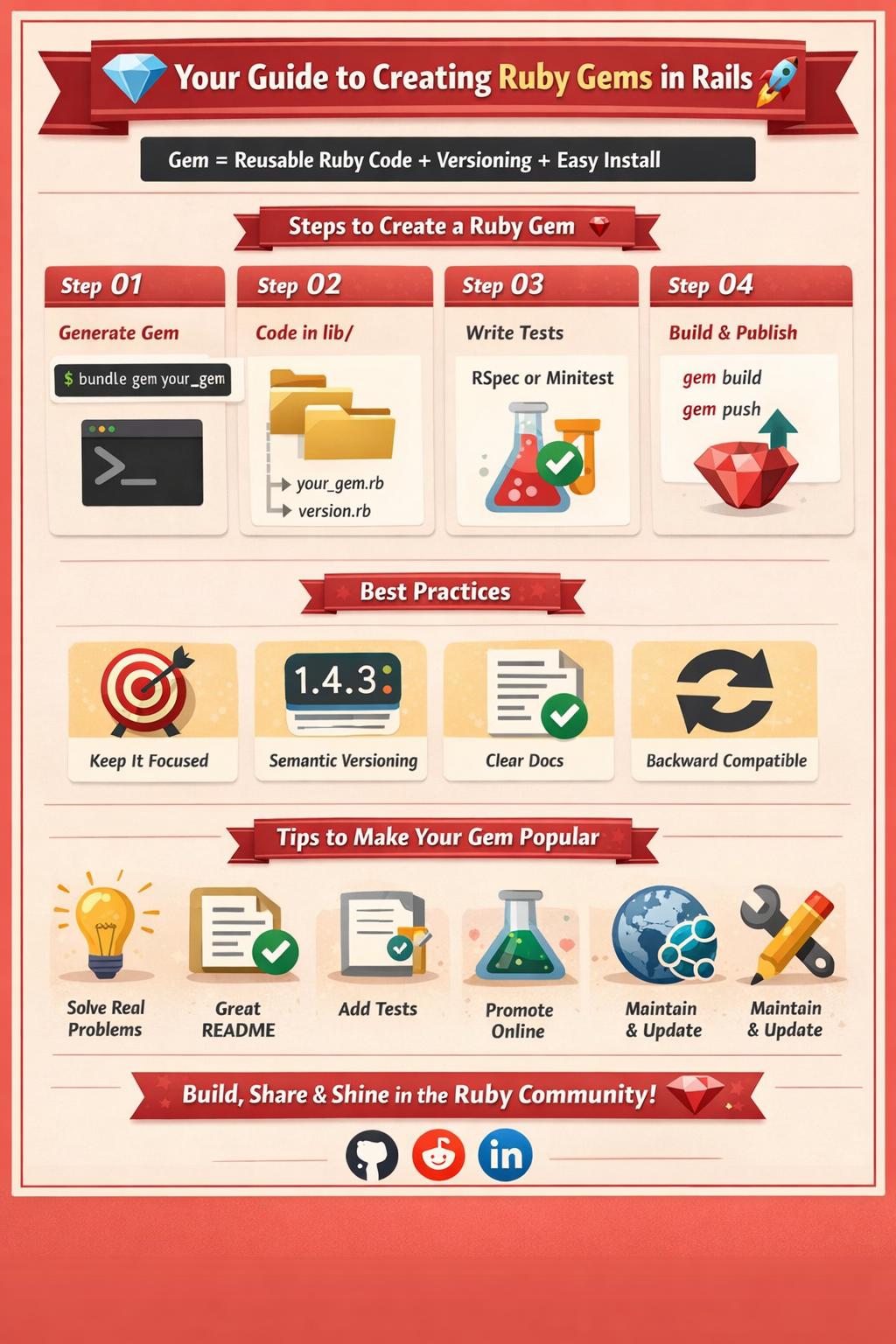
In this guide, you’ll learn how to create your own Ruby Gem step-by-step, including:
- 📦 Folder structure
- ⚙️ Commands and setup
- 🧠 Best principles for gem development
- 💡 Real examples
- 🚀 Tips to make your gem popular
Let’s dive in!
📦 What is a Ruby Gem?
A Ruby Gem is a packaged Ruby library that can be shared and installed using RubyGems.
Simply put:
Gem = Reusable Ruby Code + Versioning + Easy InstallationExample installation:
gem install deviseor in Rails:
gem 'devise'🛠 Prerequisites
Before creating a gem, ensure you have:
✔ Ruby installed
✔ Bundler installed
✔ RubyGems account
Install bundler if needed:
gem install bundler🚀 Step 1: Create a New Gem
Ruby provides a built-in command to generate gem structure.
bundle gem my_awesome_gemYou will see prompts like:
Test framework? (rspec/minitest)
CI setup? (GitHub actions)
License?
After generation, navigate inside:
cd my_awesome_gem📁 Step 2: Understand the Gem Folder Structure
Your generated structure will look like this:
my_awesome_gem/
│
├── lib/
│   ├── my_awesome_gem.rb
│   └── my_awesome_gem/
│       └── version.rb
│
├── bin/
│
├── spec/ or test/
│
├── my_awesome_gem.gemspec
│
├── Gemfile
│
├── README.md
│
└── Rakefile
Let’s understand each part.
📂 lib/ (Core Code)
This is where your gem logic lives.
lib/
 ├── my_awesome_gem.rb
 └── my_awesome_gem/
     └── version.rb
version.rb
module MyAwesomeGem
  VERSION = "0.1.0"
end
Versioning helps track releases.
my_awesome_gem.rb
Main entry point.
require_relative "my_awesome_gem/version"

module MyAwesomeGem
  class Error < StandardError; end

  def self.hello
    "Hello from My Awesome Gem!"
  end
end
⚙️ Step 3: Configure the Gemspec
The .gemspec file defines metadata of your gem.
Example:
Gem::Specification.new do |spec|
  spec.name          = "my_awesome_gem"
  spec.version       = MyAwesomeGem::VERSION
  spec.authors       = ["Lakhveer Singh Rajput"]
  spec.email         = ["your_email@example.com"]

  spec.summary       = "A powerful Ruby gem"
  spec.description   = "This gem provides useful utilities for Rails apps"
  spec.homepage      = "https://github.com/rajputlakhveer/my_awesome_gem"
  spec.required_ruby_version = ">= 2.7"
  spec.files = Dir["lib/**/*"]
end
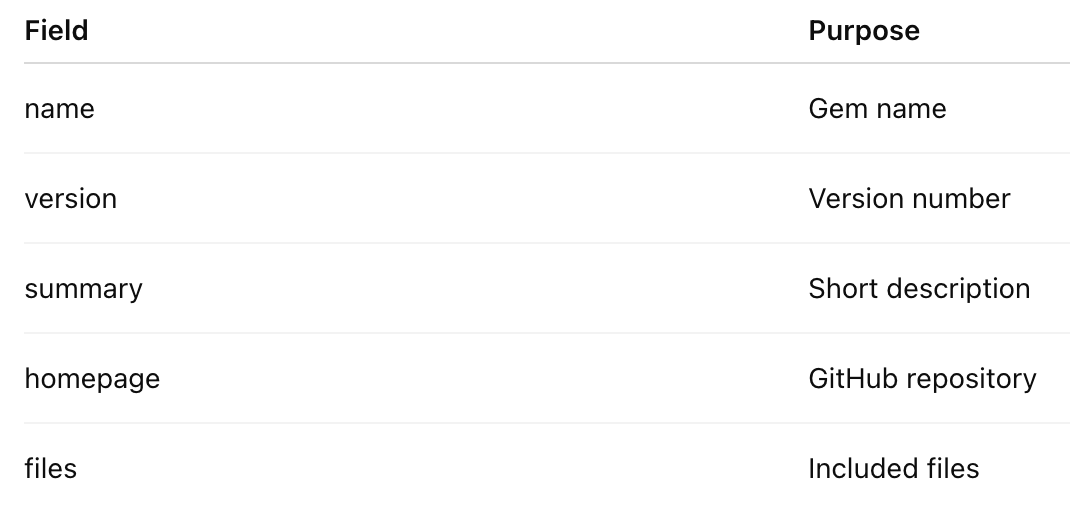
Important fields:
🧪 Step 4: Write Tests
If using RSpec, your structure will be:
spec/
 └── my_awesome_gem_spec.rb
Example test:
require "my_awesome_gem"

RSpec.describe MyAwesomeGem do
  it "returns greeting" do
    expect(MyAwesomeGem.hello).to eq("Hello from My Awesome Gem!")
  end
end
Run tests:
bundle exec rspecTesting ensures your gem is stable and reliable.
🔧 Step 5: Build the Gem
Now build your gem package.
gem build my_awesome_gem.gemspecOutput:
my_awesome_gem-0.1.0.gem📥 Step 6: Install Locally
Test the gem locally.
gem install ./my_awesome_gem-0.1.0.gemNow test it in Ruby console.
require 'my_awesome_gem'

MyAwesomeGem.hello
Output:
Hello from My Awesome Gem!🌍 Step 7: Publish the Gem
Create an account on rubygems.org.
Login from terminal:
gem signinPush your gem:
gem push my_awesome_gem-0.1.0.gemNow anyone can install:
gem install my_awesome_gem🧩 Example: Creating a Rails Utility Gem
Suppose you want a gem that formats currency.
lib/price_formatter.rbExample:
module PriceFormatter
  def self.format(price)
    "$#{'%.2f' % price}"
  end
end
Usage:
PriceFormatter.format(45)Output:
$45.00Now Rails apps can reuse it easily
🧠 Principles to Follow While Creating Gems
1️⃣ Keep Gems Focused
A good gem solves one specific problem.
Bad example ❌
utility_gem (does 50 things)Good example ✅
email_validator
jwt_auth
api_rate_limiter
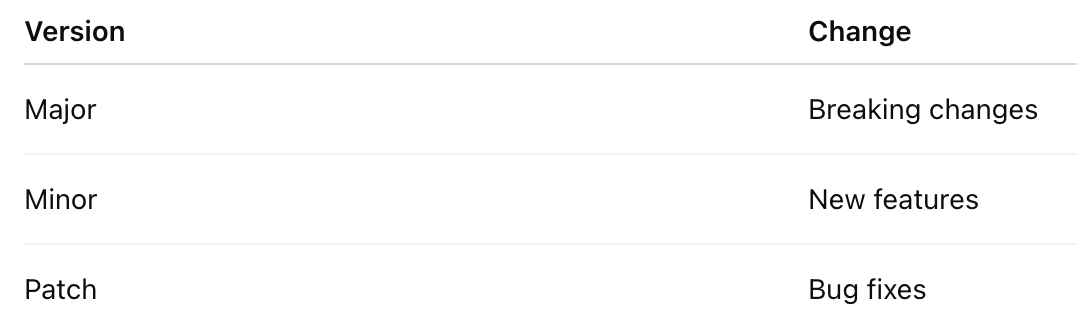
2️⃣ Follow Semantic Versioning
Version format:
MAJOR.MINOR.PATCHExample:
1.4.2Meaning:
3️⃣ Write Clear Documentation
A good README includes:
✔ Installation
✔ Usage
✔ Examples
✔ Contribution guide
Example:
## Installation

gem 'my_awesome_gem'

## Usage
MyAwesomeGem.hello
4️⃣ Maintain Backward Compatibility
Avoid breaking existing APIs unless necessary.
🚀 Tips to Make Your Gem Popular
🌟 1. Solve a Real Developer Problem
Examples of popular gems:
- Authentication
- API tools
- Performance tools
- Dev productivity tools
Ask:
“What problem do developers face daily?”
📚 2. Write an Amazing README
Include:
✔ Code examples
✔ Screenshots
✔ Benchmarks
✔ Use cases
🧪 3. Provide Tests
Developers trust gems that include tests.
Use:
- RSpec
- Minitest
🔧 4. Add CI/CD
Use GitHub Actions for automated testing.
Example:
.github/workflows🌍 5. Promote Your Gem
Share on:
✔ GitHub
✔ Reddit r/ruby
✔ Dev.to
✔ LinkedIn
✔ Ruby Weekly
⭐ 6. Maintain Your Gem
Respond to:
- Issues
- Pull requests
- Feature requests
Active maintainers gain community trust.
💡 Advanced Gem Ideas
Here are some gem ideas you can build:
🚀 rails_api_logger — API performance monitoring
🔒 secure_params — Strong parameter validation
⚡ query_optimizer — Detect slow ActiveRecord queries
📊 rails_metrics — Application performance insights
🧠 smart_cache — Intelligent caching layer
🎯 Final Thoughts
Creating a Ruby Gem is one of the best ways to contribute to the Ruby community.
Benefits include:
✔ Building your developer reputation
✔ Helping other programmers
✔ Improving your design skills
✔ Strengthening your GitHub profile
As the Ruby philosophy says:
“Make the programmer happy.”
So go ahead and build your next amazing gem! 💎🚀
📊 Quick Gem Creation Checklist
✔ Install bundler
✔ Run bundle gem gem_name
✔ Write code in lib/
✔ Configure .gemspec
✔ Write tests
✔ Build gem
✔ Publish on RubyGems


Comments
Post a Comment