📊🚀 Data Analyst Mastery: Must-Know Concepts to Become a Pro!
📊🚀 Data Analyst Mastery: Must-Know Concepts to Become a Pro!
Data is the new oil 💡 — but only if you know how to refine it. Whether you’re just starting or aiming to level up, mastering the core concepts of Data Analytics is the key to unlocking powerful insights and career growth.
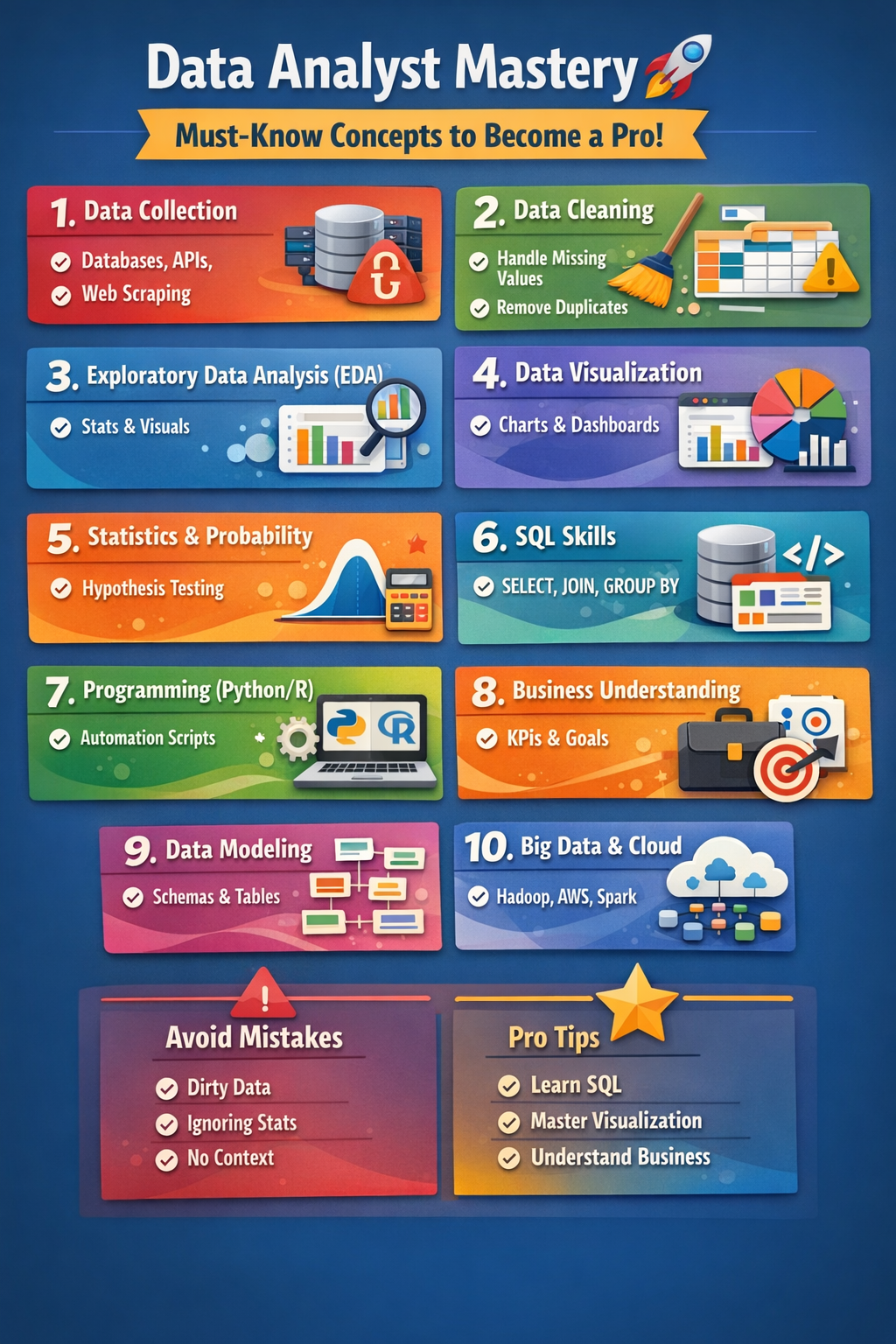
Let’s break down the must-know concepts every Data Analyst should master — with tools, terminologies, and real-world examples 🔥
🧠 1. Data Collection & Sources
💡 Idea:
Before analyzing anything, you need reliable data.
📦 Types of Data Sources:
- Databases (SQL, NoSQL)
- APIs 🌐
- CSV/Excel files 📄
- Web scraping 🌍
🛠 Tools:
- SQL (MySQL, PostgreSQL)
- Python (Requests, BeautifulSoup)
- Excel / Google Sheets
🔑 Terminologies:
- Structured vs Unstructured Data
- Data Pipeline
- ETL (Extract, Transform, Load)
📌 Example:
You collect user purchase data from an e-commerce database to analyze buying behavior.
🧹 2. Data Cleaning (Data Wrangling)
💡 Idea:
Raw data is messy 😵 — clean it before analysis.
🔧 Tasks:
- Handle missing values
- Remove duplicates
- Fix inconsistent formats
🛠 Tools:
- Python (Pandas 🐼)
- Excel (Power Query)
- OpenRefine
🔑 Terminologies:
- Null Values
- Outliers
- Data Imputation
📌 Example:
Replacing missing ages in a dataset with the average age.
📊 3. Exploratory Data Analysis (EDA)
💡 Idea:
Understand your data before drawing conclusions.
🔍 Techniques:
- Summary statistics
- Visualization
- Correlation analysis
🛠 Tools:
- Python (Matplotlib, Seaborn)
- Excel Charts
- Tableau / Power BI
🔑 Terminologies:
- Mean, Median, Mode
- Distribution
- Correlation Coefficient
📌 Example:
Plotting a histogram to see how customer spending is distributed.
📈 4. Data Visualization
💡 Idea:
Tell stories with data 📖✨
📊 Common Charts:
- Bar Chart
- Line Graph
- Pie Chart
- Heatmap
🛠 Tools:
- Tableau
- Power BI
- Python (Plotly)
🔑 Terminologies:
- Dashboard
- KPI (Key Performance Indicator)
- Data Storytelling
📌 Example:
A dashboard showing monthly revenue trends for a company.
🧮 5. Statistics & Probability
💡 Idea:
Data analysis without statistics = guessing 🎯
📚 Key Concepts:
- Probability
- Hypothesis Testing
- Standard Deviation
🛠 Tools:
- Python (SciPy, Statsmodels)
- R
🔑 Terminologies:
- p-value
- Confidence Interval
- Normal Distribution
📌 Example:
Testing if a new marketing campaign increased sales significantly.
🧠 6. SQL & Database Management
💡 Idea:
Most data lives in databases 🗄️
🔍 Key Skills:
- SELECT, JOIN, GROUP BY
- Filtering & Aggregation
🛠 Tools:
- MySQL
- PostgreSQL
- BigQuery
🔑 Terminologies:
- Primary Key
- Foreign Key
- Index
📌 Example:
Joining customer and order tables to analyze total spending per user.
🤖 7. Basic Programming (Python/R)
💡 Idea:
Automation = efficiency ⚡
🔧 What to Learn:
- Data manipulation
- Automation scripts
- Visualization
🛠 Tools:
- Python (Pandas, NumPy)
- Jupyter Notebook
🔑 Terminologies:
- DataFrame
- Functions
- Libraries
📌 Example:
Writing a Python script to clean and analyze a dataset in seconds.
🔮 8. Business Understanding
💡 Idea:
Data is useless without context 💼
🎯 Focus:
- Understand business goals
- Define KPIs
- Ask the right questions
🔑 Terminologies:
- ROI (Return on Investment)
- Business Metrics
- Stakeholders
📌 Example:
Analyzing why sales dropped in a specific region and suggesting solutions.
🔄 9. Data Modeling
💡 Idea:
Structure data for better analysis 🏗️
📊 Types:
- Star Schema ⭐
- Snowflake Schema ❄️
🛠 Tools:
- SQL
- dbt (Data Build Tool)
🔑 Terminologies:
- Fact Table
- Dimension Table
📌 Example:
Designing a sales data model to track performance across regions.
📡 10. Big Data & Cloud Basics
💡 Idea:
Handling large-scale data ☁️
🛠 Tools:
- Hadoop
- Spark
- AWS / Google Cloud
🔑 Terminologies:
- Data Lake
- Data Warehouse
- Distributed Computing
📌 Example:
Processing millions of user logs using cloud-based tools.
⚠️ Mistakes to Avoid as a Data Analyst 🚫
- Ignoring data cleaning ❌
- Misinterpreting statistics 📉
- Overcomplicating visualizations 🎨
- Not understanding business context 💼
- Relying only on tools without concepts ⚙️
💪 Pro Tips to Become a Top Data Analyst 🌟
- Practice SQL daily 🔥
- Build real-world projects 🧩
- Learn storytelling with data 📖
- Master Excel (underrated weapon!) ⚔️
- Stay curious and keep learning 📚
🎯 Final Thoughts
A great Data Analyst is not just someone who works with numbers — but someone who transforms data into decisions 💡
Master these concepts, and you’ll be ahead of 90% of analysts in the industry 🚀


Comments
Post a Comment