🚀 From Raw Data to Powerful Decisions: Mastering the Art of Turning Data into Insights 📊✨
🚀 From Raw Data to Powerful Decisions: Mastering the Art of Turning Data into Insights 📊✨
In today’s data-driven world, data alone is NOT power — 👉 the real power lies in the insights you extract from it.
You can have millions of rows of data, but if you can’t convert them into meaningful decisions, they’re just numbers sitting idle.
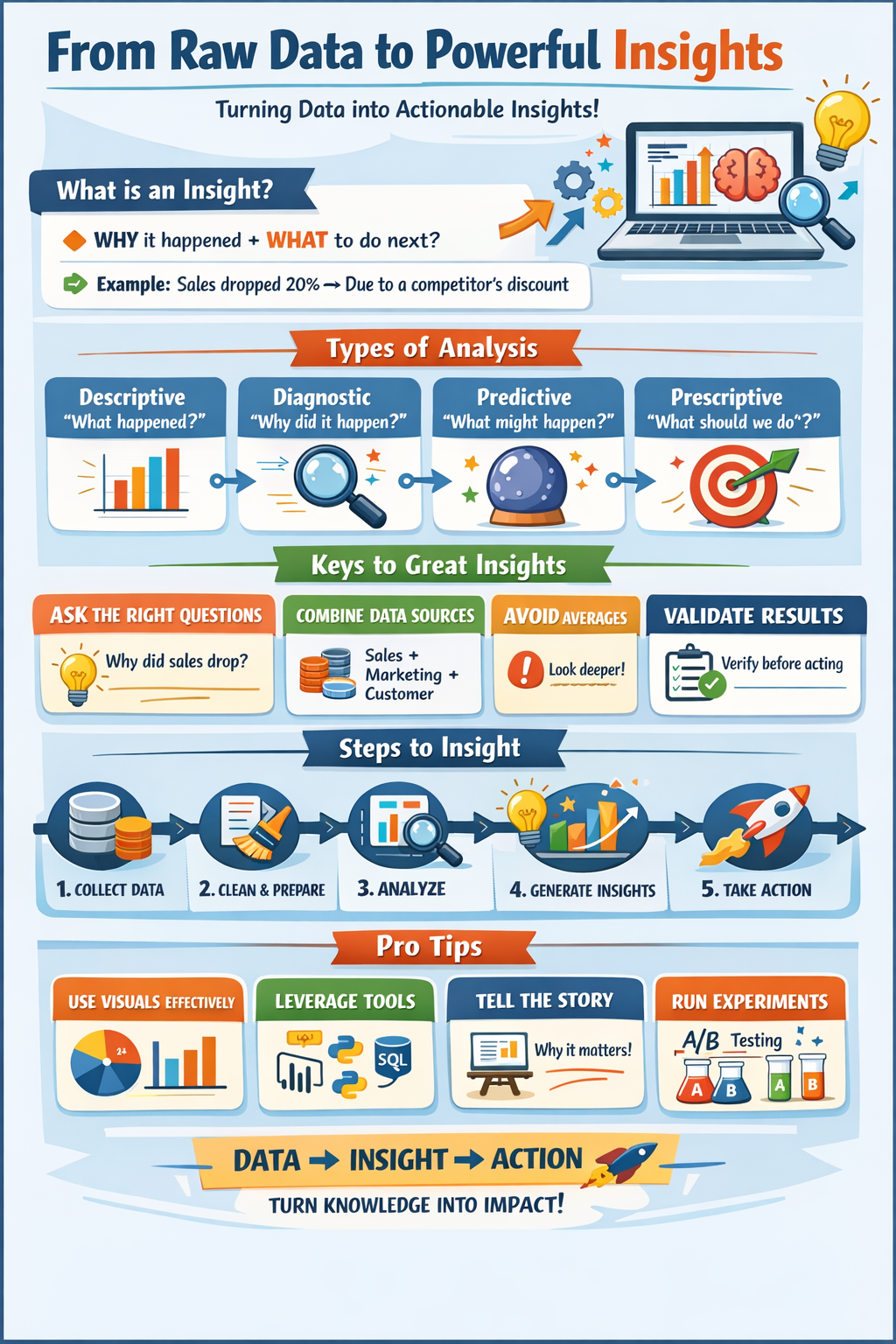
Let’s break down how to transform analyzed data into actionable insights — step by step 🔍👇
🧠 What Are “Insights” in Data?
👉 Data = Raw facts (numbers, logs, entries)
👉 Information = Processed data (organized, structured)
👉 Insights = Actionable understanding derived from information
💡 Insight = “Why it happened + What to do next”
Example:
- Data: Sales dropped by 20% 📉
- Information: Drop occurred in Region X
- Insight: Competitor launched a cheaper product → You should revise pricing or offer discounts
🧩 Types of Data Analysis (Foundation of Insights)
1. 📊 Descriptive Analysis — What happened?
- Summarizes past data
- Uses dashboards, reports
Example:
“Sales were ₹10L last month”
2. 🔍 Diagnostic Analysis — Why did it happen?
- Finds root causes
- Uses drill-down, correlations
Example:
“Sales dropped due to reduced demand in Tier-2 cities”
3. 🔮 Predictive Analysis — What might happen?
- Uses ML models, trends
Example:
“Sales may drop 10% next quarter”
4. 🎯 Prescriptive Analysis — What should we do?
- Suggests actions
Example:
“Offer 15% discount in Tier-2 cities”
🧱 Key Terminologies You Must Know 📚
🔹 KPI (Key Performance Indicator)
Metrics that define success
👉 Example: Revenue, Conversion Rate
🔹 Metrics vs Dimensions
- Metrics = Numbers (Sales, Profit)
- Dimensions = Categories (Region, Time)
🔹 Correlation vs Causation
⚠️ Just because two variables move together doesn’t mean one causes the other!
🔹 Data Cleaning
Removing:
- Duplicates ❌
- Missing values ❌
- Incorrect data ❌
👉 Garbage In = Garbage Out
🔹 Data Visualization
Turning data into charts:
- Bar charts 📊
- Line graphs 📈
- Heatmaps 🔥
🔥 Principles of Generating Powerful Insights
1. 🎯 Focus on Business Objective
👉 Always ask:
- “What problem am I solving?”
Without this → analysis becomes noise.
2. 🔍 Ask the Right Questions
Good insights come from good questions:
- Why did revenue drop?
- Which users churned the most?
3. 📉 Look Beyond Averages
Averages can hide reality!
👉 Example:
- Avg salary = ₹50K
- But most people earn ₹20K
4. 🧠 Think Like a Decision Maker
Insights should answer:
👉 “So what?”
👉 “What action should be taken?”
5. 🔗 Combine Multiple Data Sources
- Sales + Marketing + Customer data
= Deeper insights
6. ⚖️ Validate Before Concluding
- Check sample size
- Avoid bias
- Cross-verify trends
⚙️ Step-by-Step: From Data to Insights
🪜 Step 1: Data Collection
Sources:
- Databases 🗄️
- APIs 🌐
- Logs 📜
🧹 Step 2: Data Cleaning & Preparation
- Remove duplicates
- Handle missing values
- Normalize formats
📊 Step 3: Data Exploration (EDA)
- Identify patterns
- Detect anomalies
- Use visualization tools
🧠 Step 4: Analysis
- Apply statistical methods
- Use tools like:
Python 🐍
SQL 💾
Excel 📗
💡 Step 5: Generate Insights
Ask:
- What changed?
- Why did it change?
- What does it mean?
📢 Step 6: Communicate Insights
👉 Use:
- Dashboards
- Reports
- Storytelling
🎯 Step 7: Take Action
👉 Insights are useless without action!
💎 How to Perfect Your Insights (Pro-Level Tips)
🧩 1. Use Storytelling
Turn data into a story:
👉 “Sales dropped because users faced payment issues after update v2.1”
📊 2. Use Visual Impact
- Keep charts simple
- Highlight key points
🔄 3. Iterate Continuously
- Insights improve with feedback
- Keep refining analysis
🤖 4. Leverage Tools
- Power BI / Tableau 📊
- Python (Pandas, Matplotlib) 🐍
- SQL 💾
🧪 5. Run Experiments (A/B Testing)
👉 Validate insights before full implementation
🧠 6. Build Domain Knowledge
Understanding business context = better insights
⚠️ Common Mistakes to Avoid 🚫
❌ Ignoring data quality
❌ Overcomplicating analysis
❌ Drawing conclusions too quickly
❌ Ignoring outliers
❌ Not aligning with business goals
🌟 Real-Life Example
👉 E-commerce Case
- Data: High cart abandonment 🛒
- Analysis: Most users drop at payment page
- Insight: Payment gateway is slow
- Action: Optimize payment system → Increase conversions 🚀
🏁 Final Thoughts
👉 Data is everywhere…
👉 But insight is rare and valuable
To master this skill:
- Think critically 🧠
- Ask better questions ❓
- Focus on actions 🎯
💡 Remember:
“Good analysts provide data. Great analysts provide decisions.”
🚀 Bonus: Daily Habit to Become a Data Pro
✔️ Analyze one dataset daily
✔️ Practice SQL queries
✔️ Build dashboards
✔️ Read case studies
✔️ Always ask “WHY”


Comments
Post a Comment