🚀 Hadoop Unlocked: The Ultimate Beginner-to-Pro Guide to Big Data Processing 💾📊
🚀 Hadoop Unlocked: The Ultimate Beginner-to-Pro Guide to Big Data Processing 💾📊
In today’s digital world, data is growing faster than ever. From social media and banking to IoT devices and online platforms, organizations generate terabytes and petabytes of data every day.
But the question is:
❓ How do companies store and process such massive data efficiently?
The answer is Hadoop.
Apache Hadoop is one of the most powerful distributed computing frameworks used to store and process large-scale data across clusters of computers.
Companies like Yahoo, Facebook, Amazon, and LinkedIn rely heavily on Hadoop to analyze big data.
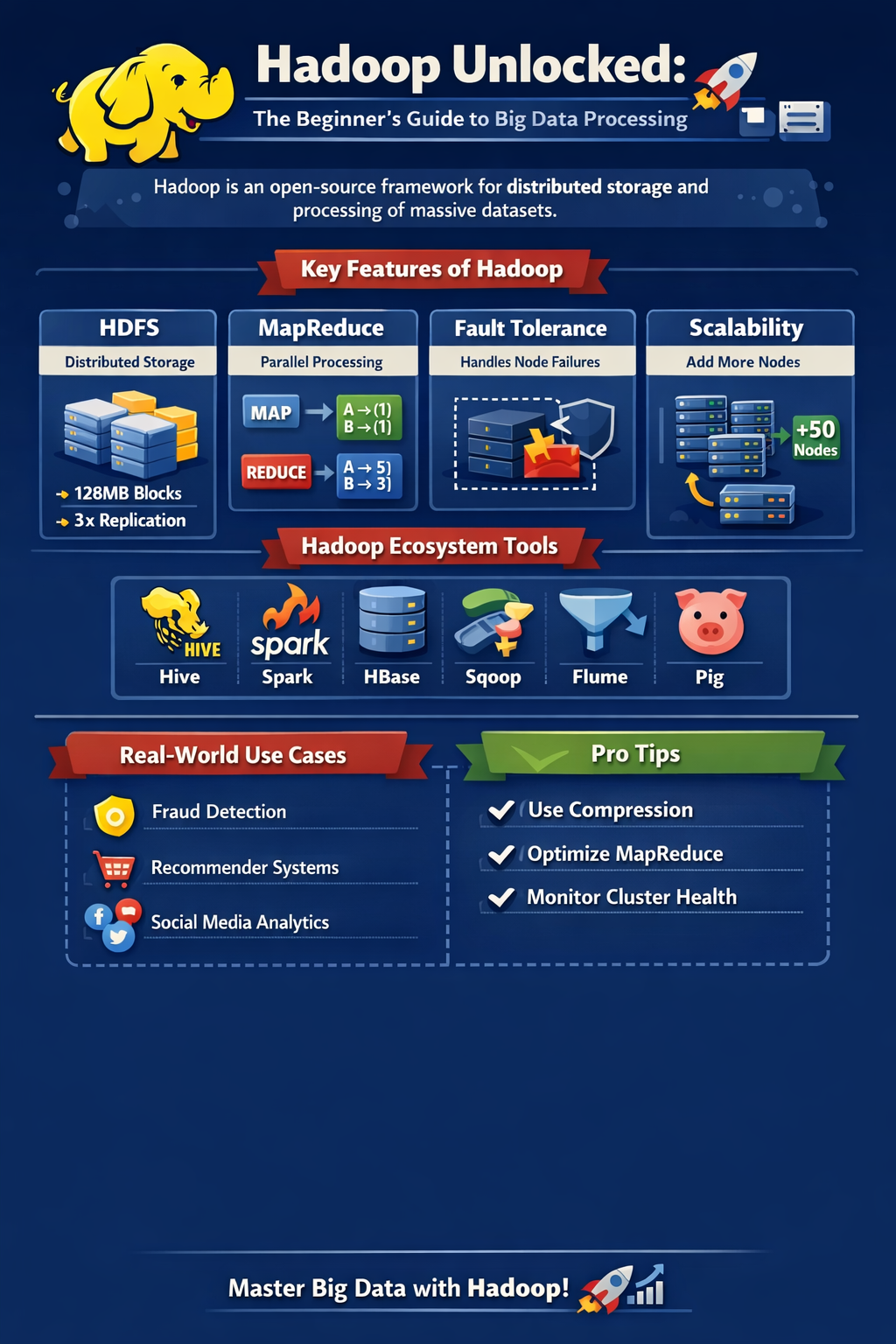
Let’s explore Hadoop in depth! 🧠
📦 What is Hadoop?
Hadoop is an open-source framework that allows distributed storage and processing of massive datasets using clusters of computers.
Instead of storing data on a single machine, Hadoop distributes data across hundreds or thousands of machines, ensuring:
✅ Scalability
✅ Fault tolerance
✅ High performance
✅ Cost efficiency
🧠 Core Features of Hadoop
Let’s explore the major features that make Hadoop powerful, along with examples and practical usage tips.
1️⃣ Distributed Storage with HDFS 📁
One of Hadoop’s most important features is HDFS (Hadoop Distributed File System).
Hadoop Distributed File System
HDFS stores large files across multiple machines in a cluster.
🧩 How it works
Instead of storing a file in one location:
- The file is split into blocks
- Blocks are stored across multiple machines
- Each block is replicated for safety
📊 Example
Suppose you upload a 1 TB dataset.
HDFS will:
- Break it into 128MB blocks
- Store them across different nodes
- Keep 3 copies of each block
Node1 → Block A
Node2 → Block B
Node3 → Block C
Node4 → Block A (Replica)
Node5 → Block B (Replica)
⚡ Effective Usage Tips
✔ Use large block sizes (128MB or 256MB) for big datasets
✔ Keep replication factor 3 for reliability
✔ Use compression (Snappy / Gzip) to save storage
2️⃣ Parallel Processing with MapReduce ⚙️
Hadoop processes data using the MapReduce programming model.
Apache MapReduce
MapReduce divides big tasks into smaller parallel tasks.
🧩 How it works
Two phases:
1️⃣ Map Phase
Processes data chunks.
2️⃣ Reduce Phase
Combines results.
📊 Example: Word Count Program
Suppose we analyze 1 million documents.
Map phase
Input: "Big data is powerful"
Output:
(Big,1)
(data,1)
(is,1)
(powerful,1)
Reduce phase
(Big,10000)
(data,15000)
This counts occurrences across all documents.
⚡ Effective Usage Tips
✔ Design small map tasks for faster execution
✔ Use combiners to reduce network load
✔ Avoid heavy computation in reducers
3️⃣ Fault Tolerance 🛡️
One of Hadoop’s biggest advantages is fault tolerance.
If a node crashes:
- Data is still available
- Tasks are reassigned automatically
📊 Example
If Node 5 fails during processing:
Hadoop automatically:
- Uses replicated data
- Reassigns task to another node
Node5 ❌ Failed
Node3 → Reprocess Task
⚡ Effective Usage Tips
✔ Maintain replication factor ≥ 3
✔ Monitor nodes using Hadoop monitoring tools
✔ Use rack awareness to distribute replicas
4️⃣ Horizontal Scalability 📈
Hadoop allows horizontal scaling.
Instead of upgrading a single server, you simply:
➜ Add more machines to the cluster
📊 Example
Initial setup:
Cluster = 10 nodes
Storage = 100 TB
Scaling:
Cluster = 100 nodes
Storage = 1 PB
No major architecture change required.
⚡ Effective Usage Tips
✔ Use commodity hardware to reduce cost
✔ Add nodes gradually based on workload
✔ Use auto-balancing tools
5️⃣ Data Locality 🚀
Hadoop moves computation to data, not data to computation.
This drastically reduces network traffic.
📊 Example
Traditional system:
Move 1TB data → Processing ServerHadoop:
Run program on the node where data existsResult:
⚡ Faster processing
⚡ Lower network load
⚡ Effective Usage Tips
✔ Keep processing tasks near data nodes
✔ Avoid unnecessary data movement
✔ Optimize cluster network configuration
6️⃣ YARN Resource Management 🎯
Apache Hadoop YARN manages cluster resources and job scheduling.
YARN stands for:
Yet Another Resource Negotiator
It allows multiple applications to run on the same cluster.
📊 Example
Cluster resources:
CPU = 100 cores
RAM = 500GB
YARN distributes resources between:
- MapReduce jobs
- Spark jobs
- Machine learning tasks
⚡ Effective Usage Tips
✔ Configure resource queues
✔ Use capacity scheduler
✔ Monitor usage using ResourceManager UI
7️⃣ Ecosystem Integration 🌐
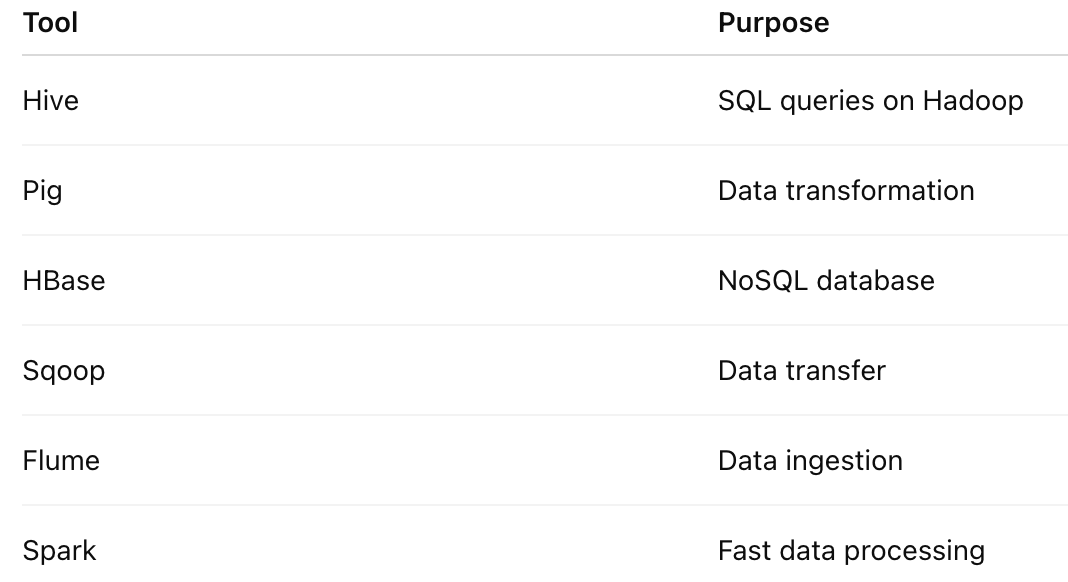
Hadoop is powerful because of its ecosystem tools.
Popular tools include:
Example:
Using Hive SQL query
SELECT country, COUNT(*)
FROM users
GROUP BY country;
This runs on Hadoop clusters automatically.
⚡ Effective Usage Tips
✔ Use Hive for SQL analysts
✔ Use Spark for faster processing
✔ Use Sqoop for database imports
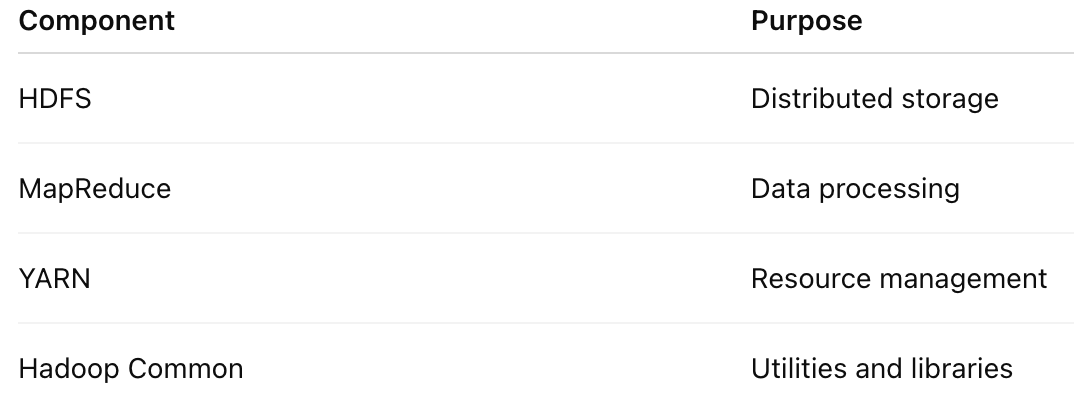
🏗 Hadoop Architecture Overview
Hadoop consists of four main modules:
🔥 Real-World Use Cases
Hadoop is widely used across industries.
📊 Banking
Fraud detection using transaction data.
🛒 E-commerce
Recommendation engines analyzing customer behavior.
📱 Social Media
Analyzing billions of posts and interactions.
🚗 IoT
Processing sensor data from smart devices.
⚠️ Common Mistakes to Avoid
❌ Using Hadoop for small datasets
❌ Poor cluster configuration
❌ Ignoring data compression
❌ Too many small files in HDFS
❌ Inefficient MapReduce jobs
🛠 Best Tools for Hadoop Development
Some popular tools include:
- Apache Hive
- Apache Spark
- Apache Flume
- Apache Sqoop
- Apache Oozie
- Apache Kafka
These tools extend Hadoop’s capabilities.
📚 Final Thoughts
Hadoop revolutionized big data processing by enabling organizations to analyze massive datasets efficiently.
Its strengths include:
✅ Distributed storage
✅ Fault tolerance
✅ Parallel processing
✅ Scalability
✅ Ecosystem integration
In short:
“Hadoop turned Big Data from an impossible challenge into a solvable engineering problem.” 🚀
💡 Pro Tip for Developers
If you are a Data Engineer or Big Data Developer, start learning:
1️⃣ Hadoop fundamentals
2️⃣ Hive & Spark
3️⃣ Distributed systems concepts
These skills are highly valuable in modern data-driven companies.


Comments
Post a Comment