🚀 Mastering OOPs Like a Pro: The Ultimate Guide to Object-Oriented Programming 💡🔥
🚀 Mastering OOPs Like a Pro: The Ultimate Guide to Object-Oriented Programming 💡🔥
Object-Oriented Programming (OOP) is not just a coding style — it’s a mindset 🧠 that helps you build scalable, reusable, and maintainable software. Whether you’re working with Ruby, Java, Python, or C++, mastering OOP can take your development skills to the next level 🚀
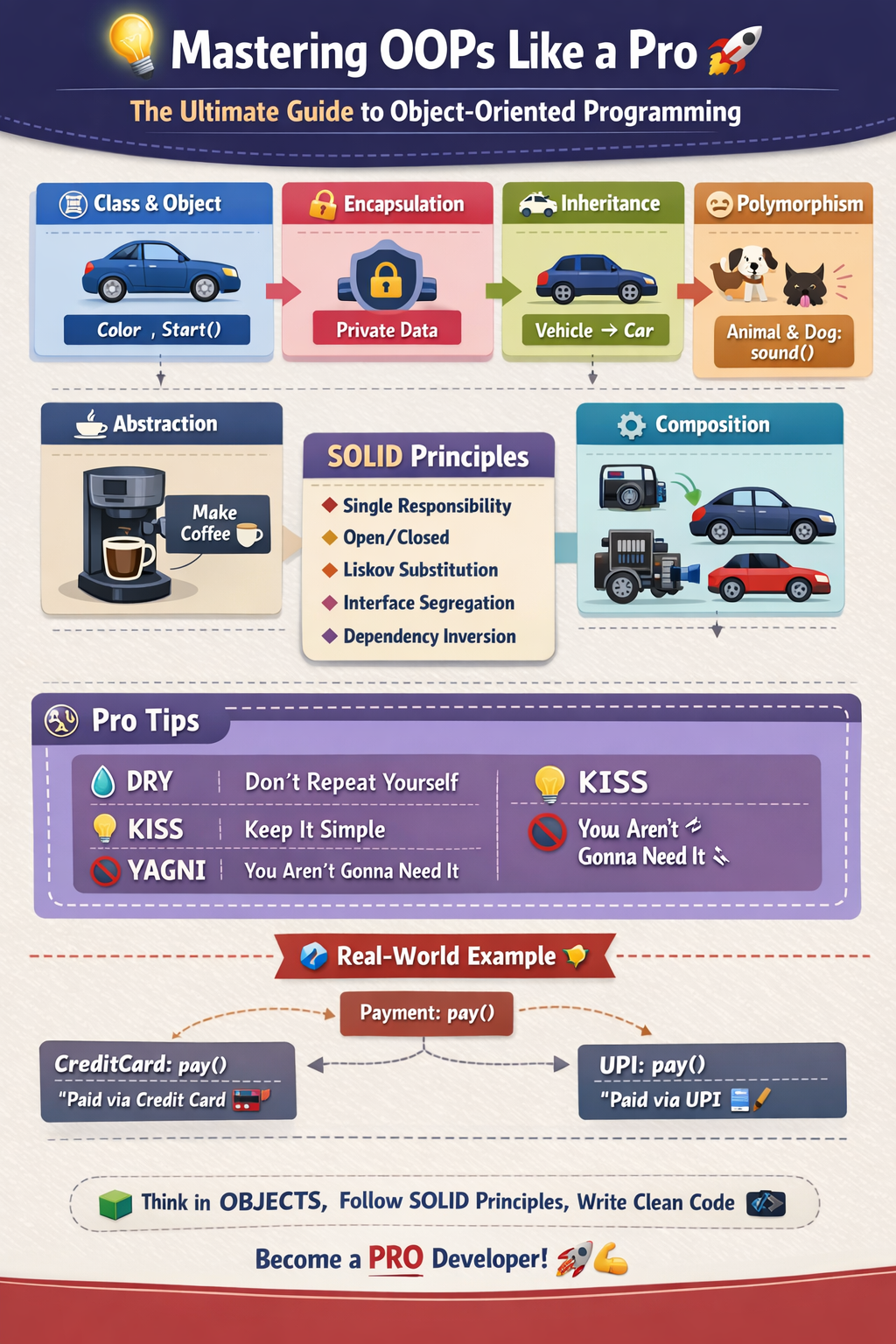
Let’s break down every major OOP concept in depth, with examples and pro-level principles 👇
🧱 What is OOP?
OOP is a programming paradigm based on the concept of objects — which contain:
- Data (attributes/variables) 🧾
- Behavior (methods/functions) ⚙️
👉 Think of an object like a real-world entity:
Car:
  - color
  - speed
  - start_engine()
🧩 Core Pillars of OOP
1. 🧬 Class & Object
🔹 Class
A blueprint for creating objects.
class Car
  def initialize(color)
    @color = color
  end

  def start
    "Car started 🚗"
  end
end
🔹 Object
An instance of a class.
car1 = Car.new("Red")
puts car1.start
2. 🔒 Encapsulation (Data Hiding)
Encapsulation = Wrapping data + methods together and restricting direct access.
🎯 Why?
- Protects data from misuse
- Improves security 🔐
class BankAccount
  def initialize(balance)
    @balance = balance
  end

  def deposit(amount)
    @balance += amount
  end

  def balance
    @balance
  end
end
👉 Direct access like account.@balance is restricted ❌
3. 🧬 Inheritance (Code Reusability)
Inheritance allows one class to inherit properties from another.
class Vehicle
  def start
    "Engine started 🚀"
  end
end

class Car < Vehicle
end

car = Car.new
puts car.start
🎯 Benefits:
- Code reuse ♻️
- Reduces redundancy
4. 🎭 Polymorphism (Many Forms)
Same method name, different behaviors.
🔹 Method Overriding
class Animal
  def sound
    "Some sound"
  end
end

class Dog < Animal
  def sound
    "Bark 🐶"
  end
end
🔹 Duck Typing (Ruby Style 🦆)
def make_sound(animal)
  animal.sound
end
👉 No need for same class, just same method!
5. 🎭 Abstraction (Hiding Complexity)
Show only essential features, hide internal details.
class CoffeeMachine
  def make_coffee
    grind_beans
    boil_water
    mix
    "Coffee ready ☕"
  end

  private
  def grind_beans; end
  def boil_water; end
  def mix; end
end
👉 User only sees make_coffee()
🧠 Advanced OOP Concepts
6. 🧩 Composition (HAS-A Relationship)
Instead of inheritance, use objects inside objects.
class Engine
  def start
    "Engine started"
  end
end

class Car
  def initialize
    @engine = Engine.new
  end

  def start
    @engine.start
  end
end
👉 Preferred over inheritance in many cases!
7. 🔗 Association, Aggregation, Composition

8. 🧪 Method Overloading (Language Dependent)
Ruby doesn’t support true overloading, but:
def greet(name=nil)
  name ? "Hello #{name}" : "Hello Guest"
end
🏆 SOLID Principles (Must for Pro Developers)
🔹 S — Single Responsibility Principle
One class = One responsibility
🔹 O — Open/Closed Principle
Open for extension, closed for modification
🔹 L — Liskov Substitution Principle
Child class should behave like parent
🔹 I — Interface Segregation Principle
Don’t force unused methods
🔹 D — Dependency Inversion Principle
Depend on abstractions, not concrete classes
⚡ Other Important OOP Principles
🧠 DRY (Don’t Repeat Yourself)
Avoid duplicate code ❌
🧠 KISS (Keep It Simple, Stupid)
Simplicity > Complexity 💡
🧠 YAGNI (You Aren’t Gonna Need It)
Don’t over-engineer 🚫
🧠 Law of Demeter
Only talk to direct friends
# Bad ❌
user.address.city.name

# Good ✅
user.city_name
🧰 Design Patterns (Next Level OOP)
🔹 Singleton
Only one instance
🔹 Factory
Object creation logic separated
🔹 Observer
Event-based systems 🔔
🔹 Strategy
Switch behavior dynamically
🔥 Real-World Example (Putting It All Together)
class Payment
  def pay(amount)
    raise "Not implemented"
  end
end

class CreditCard < Payment
  def pay(amount)
    "Paid #{amount} via Credit Card 💳"
  end
end

class UPI < Payment
  def pay(amount)
    "Paid #{amount} via UPI 📱"
  end
end

def process_payment(method, amount)
  method.pay(amount)
end
👉 This uses:
- Abstraction
- Polymorphism
- Open/Closed Principle
🚀 Pro Developer Mindset
To truly master OOP:
✅ Think in objects, not functions
✅ Design before coding 🧠
✅ Prefer composition over inheritance
✅ Follow SOLID principles
✅ Write clean, testable code
🎯 Final Thoughts
OOP is the backbone of modern software development. Mastering it means:
💡 Writing cleaner code
🚀 Building scalable systems
🧠 Thinking like a software architect
📣 Bonus Tip
👉 Next time you code, ask yourself:
“Is my code reusable, maintainable, and scalable?”
If YES — you’re thinking like a PRO 💪🔥


Comments
Post a Comment