🚀 Most Asked Toughest Algorithms in Coding Interviews (Explained with Examples) 💻🔥
🚀 Most Asked Toughest Algorithms in Coding Interviews (Explained with Examples) 💻🔥
In top tech interviews at companies like Google, Amazon, Microsoft, and Meta, candidates are often tested with complex algorithms that evaluate their problem-solving ability, optimization thinking, and coding skills.
These algorithms are not just theoretical — they are used in real-world systems like search engines, social networks, navigation systems, and distributed platforms.

In this guide, we will explore the most asked toughest algorithms in interviews, understand how they work, and see examples of their usage.
Let’s dive in! 🚀
🧠 1. Dijkstra’s Algorithm (Shortest Path Algorithm)
📌 Purpose
Dijkstra’s Algorithm finds the shortest path from one node to all other nodes in a weighted graph.
It is widely used in:
🗺 Google Maps navigation
📡 Network routing
🚚 Logistics optimization
⚙️ How It Works
1️⃣ Start from a source node
2️⃣ Assign distance = 0 to source and ∞ to others
3️⃣ Visit the nearest unvisited node
4️⃣ Update distances of its neighbors
5️⃣ Repeat until all nodes are visited
🧩 Example
Graph:
A --4-- B
|       |
2       5
|       |
C --1-- D
Find shortest path from A
Steps:
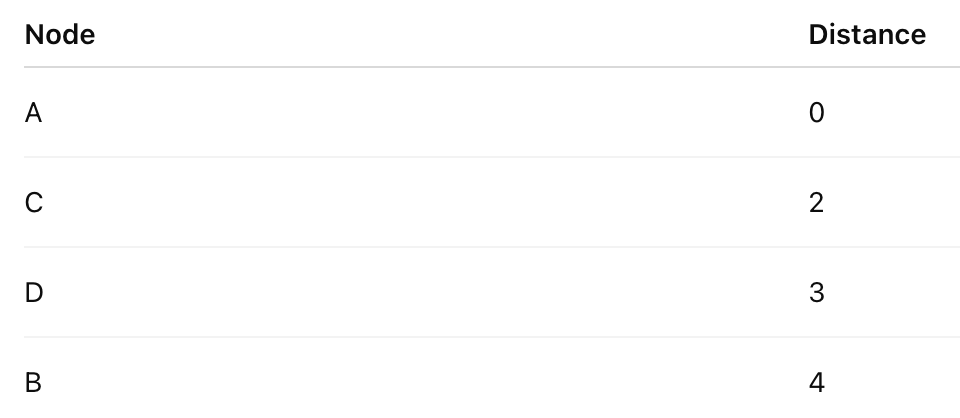
Shortest path:
A → C → D💻 Ruby Example
def dijkstra(graph, start)
  distances = Hash.new(Float::INFINITY)
  distances[start] = 0
  visited = []

  until visited.size == graph.size
    current = distances.reject { |node,_| visited.include?(node) }
                       .min_by { |_,dist| dist }[0]
    visited << current
    graph[current].each do |neighbor, weight|
      new_dist = distances[current] + weight
      distances[neighbor] = new_dist if new_dist < distances[neighbor]
    end
  end
  distances
end
🌐 2. Floyd-Warshall Algorithm (All Pairs Shortest Path)
📌 Purpose
Finds shortest paths between all pairs of nodes.
Used in:
📡 Network routing
📊 Graph analytics
🧠 AI planning systems
⚙️ Concept
It uses Dynamic Programming.
For each node k, check if path:
i → k → jis shorter than
i → j📊 Example
Initial matrix:
A  B  C
A  0  3  ∞
B  2  0  5
C  ∞  1  0
After Floyd-Warshall:
A  B  C
A  0  3  8
B  2  0  5
C  3  1  0
⏱ Complexity
Time Complexity: O(n³)🧩 3. Knuth-Morris-Pratt (KMP) String Matching
📌 Purpose
Efficiently finds a pattern inside a string.
Used in:
🔎 Search engines
🧬 DNA sequence matching
📄 Text editors
❌ Naive Search Problem
If text length = n
Pattern length = m
Worst complexity:
O(n × m)✅ KMP Optimization
KMP uses a Longest Prefix Suffix (LPS) table to avoid re-checking characters.
Example
Text:
ABABDABACDABABCABABPattern:
ABABCABABKMP finds the pattern in:
O(n + m)💻 Ruby Example
def kmp_search(text, pattern)
  return if pattern.empty?

  lps = Array.new(pattern.length, 0)
  j = 0
  (1...pattern.length).each do |i|
    while j > 0 && pattern[i] != pattern[j]
      j = lps[j - 1]
    end
    j += 1 if pattern[i] == pattern[j]
    lps[i] = j
  end
  j = 0
  text.each_char.with_index do |char, i|
    while j > 0 && char != pattern[j]
      j = lps[j - 1]
    end
    j += 1 if char == pattern[j]
    return i - j + 1 if j == pattern.length
  end
end
🌳 4. Union Find (Disjoint Set Algorithm)
📌 Purpose
Used to detect connected components in graphs.
Commonly used in:
🌐 Network connectivity
🗺 Kruskal’s Minimum Spanning Tree
👥 Social network grouping
⚙️ Key Operations
Find(x)   → find root parent
Union(x,y) → merge sets
Example
Initial sets:
{1} {2} {3} {4}Union operations:
Union(1,2)
Union(3,4)
Final sets:
{1,2} {3,4}Optimization Techniques
⚡ Path Compression
⚡ Union by Rank
Time Complexity
Almost constant:
O(α(n))(where α is inverse Ackermann function)
🧭 5. A* (A-Star) Search Algorithm
📌 Purpose
Finds the most efficient path using heuristics.
Used in:
🎮 Game AI navigation
🗺 GPS systems
🤖 Robotics
Formula
f(n) = g(n) + h(n)Where:
g(n) = cost from start
h(n) = heuristic estimate
Example
Grid navigation:
S . . .
. # # .
. . . G
S = Start
G = Goal
= Obstacle
A* finds the optimal route avoiding obstacles.
Why Interviewers Love A*
It combines:
✔ Graph algorithms
✔ Heuristic optimization
✔ Priority queues
🧮 6. Kadane’s Algorithm (Maximum Subarray)
📌 Purpose
Finds the maximum sum subarray.
Classic interview question.
Example
Array:
[-2,1,-3,4,-1,2,1,-5,4]Maximum subarray:
[4,-1,2,1]Sum:
6Idea
At every element:
current_sum = max(num, current_sum + num)Ruby Example
def kadane(arr)
  max_sum = arr[0]
  current = arr[0]

  arr[1..].each do |num|
    current = [num, current + num].max
    max_sum = [max_sum, current].max
  end
  max_sum
end
🧠 7. Topological Sorting (Dependency Resolution)
📌 Purpose
Orders tasks based on dependencies.
Used in:
⚙ Build systems
📦 Package managers
🔧 CI/CD pipelines
Example
Dependencies:
A → B → CValid order:
A → B → CAlgorithms Used
✔ DFS
✔ Kahn’s Algorithm (BFS)
Example in Real Systems
Docker build steps
Compiler dependency resolution
Microservice deployment pipelines
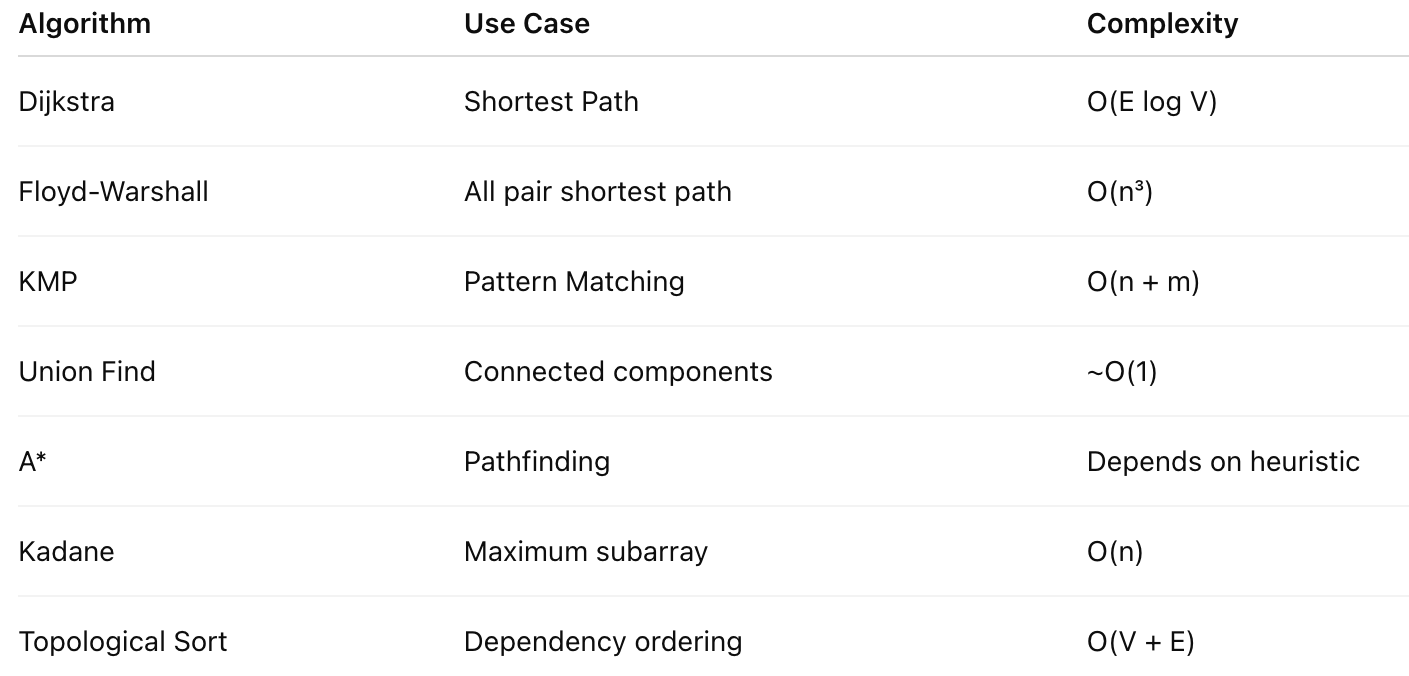
📊 Complexity Comparison
🚀 Pro Tips to Master These Algorithms
1️⃣ Understand the core idea, not just code
Interviewers care about thinking process.
2️⃣ Practice variations
Example:
Dijkstra → Network Delay Time
Kadane → Maximum Circular Subarray
Union Find → Number of Islands
3️⃣ Master Data Structures
Most tough algorithms rely on:
📌 Graphs
📌 Heaps
📌 Dynamic Programming
📌 HashMaps
4️⃣ Practice on platforms
💻 LeetCode
💻 HackerRank
💻 Codeforces
💻 InterviewBit
🎯 Final Thoughts
The toughest algorithms in interviews test more than coding skills — they evaluate:
🧠 Logical thinking
⚙ Optimization ability
📊 Data structure understanding
Mastering these algorithms can significantly increase your chances of cracking top tech interviews.
Remember:
“Algorithms are the language of problem-solving in software engineering.” 💡
✅ If you master these 7 algorithms, you will already be ahead of 80% of interview candidates.
Keep practicing and keep building! 🚀💻


Comments
Post a Comment