🚀 Python Secrets Unlocked: Hidden Tricks & Hacks Every Developer MUST Know 🐍✨
🚀 Python Secrets Unlocked: Hidden Tricks & Hacks Every Developer MUST Know 🐍✨
Python is simple… but mastering it? That’s where the magic happens. 💡
In this blog, you’ll discover hidden Python tricks, pro-level hacks, and best practices that can make your code faster, cleaner, and more powerful. 💪
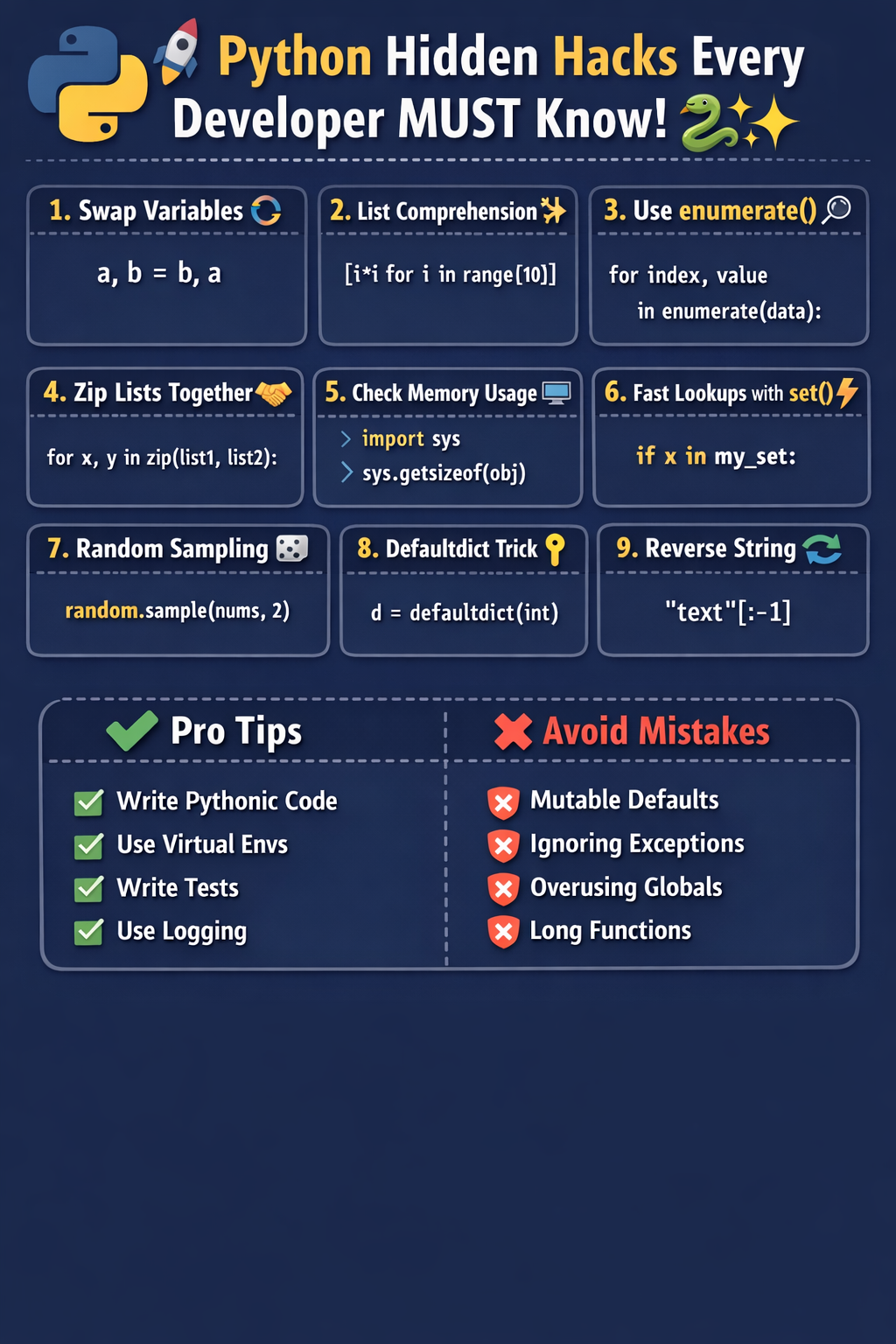
🔥 1. Swap Variables Without a Temp Variable
❌ Traditional Way:
a = 5
b = 10

temp = a
a = b
b = temp
✅ Pythonic Way:
a, b = b, a💡 Python uses tuple unpacking internally → cleaner & faster.
⚡ 2. List Comprehensions (Write Less, Do More)
❌ Normal Loop:
squares = []
for i in range(10):
    squares.append(i*i)
✅ Pythonic Way:
squares = [i*i for i in range(10)]🔥 Cleaner, faster, and readable!
🧠 3. Use enumerate() Instead of Manual Indexing
❌ Bad Practice:
index = 0
for value in data:
    print(index, value)
    index += 1
✅ Better:
for index, value in enumerate(data):
    print(index, value)
💡 Cleaner + avoids bugs.
🎯 4. Multiple Assignments in One Line
a, b, c = 1, 2, 3Or even:
a = b = c = 10⚡ Saves time and improves readability.
🧪 5. Use zip() to Iterate Multiple Lists
names = ["Lakhveer", "Rahul"]
scores = [90, 85]

for name, score in zip(names, scores):
    print(name, score)
💡 Perfect for parallel iteration.
🔍 6. Check Memory Usage with sys.getsizeof()
import sys
print(sys.getsizeof([1,2,3]))
📊 Helps optimize memory-heavy applications.
🧰 7. Use set for Faster Lookups
numbers = [1,2,3,4,5]
if 3 in numbers:  # slower
Better:
numbers = {1,2,3,4,5}
if 3 in numbers:  # faster ⚡
💡 Sets use hashing → O(1) lookup time
🎲 8. Random Sampling Trick
import random

nums = [1,2,3,4,5]
print(random.sample(nums, 2))
🔥 Get random elements without repetition.
📦 9. Use defaultdict to Avoid Key Errors
from collections import defaultdict

d = defaultdict(int)
d['a'] += 1
print(d)  # {'a': 1}
💡 No need to check if key exists!
🔄 10. Flatten a List Using One Line
matrix = [[1,2], [3,4], [5,6]]

flat = [item for sublist in matrix for item in sublist]
🔥 Very useful in data processing.
🧩 11. Lambda Functions for Quick Operations
add = lambda x, y: x + y
print(add(2,3))
⚡ Use for short, one-time functions
🛠️ 12. Use *args and **kwargs for Flexibility
def demo(*args, **kwargs):
    print(args)
    print(kwargs)

demo(1,2,3, name="Lakhveer")
💡 Helps build dynamic & reusable functions
⏱️ 13. Measure Execution Time Quickly
import time

start = time.time()

# your code
end = time.time()
print(end - start)
🔥 Useful for performance optimization.
🎯 14. Use any() and all()
nums = [True, True, False]

print(any(nums))  # True
print(all(nums))  # False
💡 Clean boolean checks in one line.
🧬 15. String Reverse Trick
text = "Python"
print(text[::-1])
⚡ Super fast slicing trick!
🏆 Must-Do Things as a Pro Developer 💼
✅ 1. Write Pythonic Code
- Prefer readability over cleverness
- Follow PEP 8 guidelines
✅ 2. Use Virtual Environments
python -m venv env
source env/bin/activate
💡 Avoid dependency conflicts
✅ 3. Write Tests 🧪
- Use
pytestorunittest - Prevent bugs early
✅ 4. Use Logging Instead of Print
import logging
logging.info("This is info")
💡 Production-ready debugging
✅ 5. Optimize Only When Needed
- First → correct code
- Then → optimize 🔥
🚫 Common Mistakes to Avoid ❌
❌ 1. Using Mutable Default Arguments
def func(a=[]): # BAD✅ Fix:
def func(a=None):
    if a is None:
        a = []
❌ 2. Overusing Global Variables
💥 Makes code messy and hard to debug
❌ 3. Ignoring Exceptions
try:
    risky_code()
except:
    pass  # BAD ❌
💡 Always handle errors properly!
❌ 4. Writing Long Functions
💥 Hard to maintain
✅ Break into smaller functions
❌ 5. Not Using Built-in Functions
💡 Python has powerful built-ins:
map()filter()sorted()
Use them!
🎯 Final Thoughts 💡
Python is not just about writing code…
It’s about writing elegant, efficient, and scalable code 🚀
👉 Master these hidden tricks, and you’ll:
- Write cleaner code ✨
- Debug faster ⚡
- Think like a pro developer 🧠
💬 Pro Tip:
“Code is like poetry — the shorter and clearer, the better.” ✍️


Comments
Post a Comment