🎧💻 Vibe Coding: The Art of Building Software in Flow State
🎧💻 Vibe Coding: The Art of Building Software in Flow State
How Developers Create Powerful Products by Coding with Rhythm, Focus, and Creativity 🚀
In modern software development, productivity is not just about writing more lines of code — it’s about writing better code with clarity and creativity.
This is where Vibe Coding comes in.
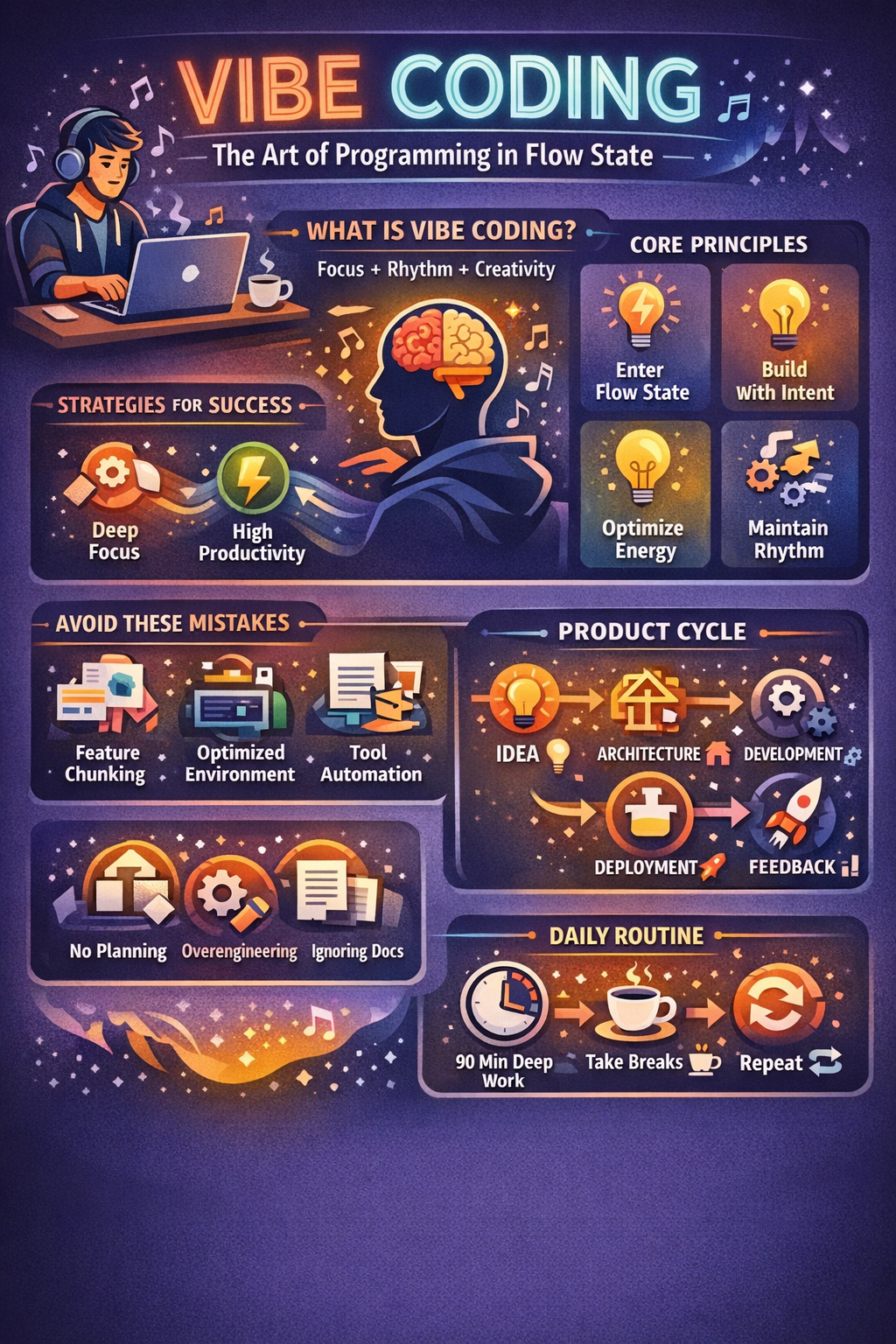
✨ Vibe Coding is a development philosophy where programmers enter a deep flow state, aligning focus, creativity, environment, and tools to produce high-quality software efficiently.
Instead of chaotic coding, vibe coding focuses on:
- 🧠 Mental clarity
- 🎧 Productive environment
- ⚡ Efficient development techniques
- 🎯 Clear product vision
Let’s explore how developers can master this powerful coding approach.
🌊 What is Vibe Coding?
Vibe Coding is the practice of writing software while maintaining a deep cognitive flow state, where:
- distractions disappear
- ideas flow naturally
- code structure becomes intuitive
- productivity increases dramatically
Psychologist Mihaly Csikszentmihalyi introduced the concept of Flow State, which explains how people perform their best when they are fully immersed in a task.
Developers often experience this state when:
- solving complex problems
- building elegant architectures
- debugging challenging systems
🎯 In this state, developers can produce hours of work in minutes of thinking.
🧠 Core Principles of Vibe Coding
1️⃣ Enter the Flow State
Flow happens when:
- task difficulty matches skill level
- distractions are removed
- clear goals exist
💡 Example:
Instead of randomly coding features:
Bad Practice ❌
Start coding without planning.

Vibe Coding ✔
Define feature -> Design solution -> Implement.
2️⃣ Build with Intent
Every line of code should have a purpose.
Ask yourself:
- Why am I writing this?
- Is this scalable?
- Is this readable?
Example in Ruby on Rails:
# Bad
User.where(active: true).map{|u| u.email}

# Better
User.active.pluck(:email)
Benefits:
✅ Cleaner code
✅ Faster queries
✅ Better readability
3️⃣ Optimize Cognitive Energy
Developers lose productivity when they constantly switch tasks.
Strategies:
⚡ Use deep work sessions
⚡ Avoid multitasking
⚡ Keep coding sessions focused
Productivity researcher Cal Newport explains that deep concentration produces elite-level performance.
4️⃣ Maintain Coding Rhythm
Coding rhythm means maintaining continuous development flow.
Best practices:
🎧 Use instrumental music
⌨️ Master keyboard shortcuts
🧠 Keep mental context of code
🧩 Strategies for Effective Vibe Coding
🧠 Strategy 1: Feature Chunking
Break large features into smaller units.
Example:
Instead of:
Build E-commerce PlatformBreak it into:
- Product Model
- Cart Logic
- Payment Gateway
- Checkout API
Each chunk is easier to enter flow state.
⚙️ Strategy 2: Environment Optimization
Your environment directly impacts coding performance.
Ideal setup:
💻 Clean desk
🎧 Focus music
🖥 Dark theme IDE
🚫 Notifications off
Popular IDEs include:
- Visual Studio Code
- JetBrains RubyMine
⚡ Strategy 3: Tool Automation
Automation reduces repetitive tasks.
Examples:
- Git hooks
- CI/CD pipelines
- Linting tools
Tools often used:
- Docker
- Jenkins
- Git
Automation allows developers to focus purely on problem solving.
🛠 Optimized Development Techniques
1️⃣ Code First, Optimize Later
Avoid premature optimization.
Example:
Step 1 → Working code
Step 2 → Refactor
Step 3 → Optimize
2️⃣ Use Clean Code Principles
Software engineer Robert C. Martin introduced many clean coding practices.
Example:
# Bad
def p(u)
 puts u.name
end

# Clean
def print_user_name(user)
  puts user.name
end
3️⃣ Use Reusable Components
Reusable code saves development time.
Example in React:
function Button({label}) {
 return <button>{label}</button>
}
Now used everywhere.
4️⃣ Continuous Refactoring
Refactoring keeps code maintainable.
Example:
Before:
500 line controllerAfter:
Controllers
Services
Helpers
Modules
⚠️ Common Vibe Coding Mistakes
❌ Coding Without Architecture
Jumping into code without planning leads to:
- messy code
- scalability issues
❌ Overengineering
Too many abstractions destroy productivity.
Example:
5 classes for simple logic❌ Ignoring Documentation
Good developers write code that others understand.
Example:
README
API Docs
Architecture Notes
❌ Distraction Addiction
Major distractions include:
📱 Social media
💬 notifications
📧 emails
Solution:
Use focus blocks (90 minutes).
🚀 Product Development Cycle with Vibe Coding
A vibed development process follows this structure:
1️⃣ Idea Phase 💡
Define:
- problem
- target users
- solution
Example:
Idea: AI Blog Generator2️⃣ Architecture Phase 🏗
Design system:
Frontend → React
Backend → Ruby on Rails
Database → PostgreSQL
3️⃣ Development Phase ⚡
Implement features in small chunks.
Example roadmap:
Auth System
Blog Engine
AI Integration
Search
4️⃣ Testing Phase 🧪
Testing tools:
- unit testing
- integration testing
- load testing
5️⃣ Deployment Phase 🚀
Deploy using:
- Docker
- Amazon Web Services
6️⃣ Feedback Phase 📊
Collect:
- user feedback
- performance metrics
- bug reports
🎯 Example of Vibe Coding in Real Development
Suppose you build a Task Manager App.
Flow:
Day 1 → Idea + Architecture
Day 2 → Authentication
Day 3 → Task CRUD APIs
Day 4 → Frontend UI
Day 5 → Testing + Deployment
Because work happens in deep focus blocks, development becomes faster and cleaner.
🌟 Daily Vibe Coding Routine
A productive developer routine:
Morning 🌅
✅ Exercise
✅ Plan coding goals
Work Session ⚡
⏱ 90 minutes deep coding
🎧 Music + Focus
Break ☕
10–15 minutes
Repeat 🔁
4–5 focus sessions per day.
💡 Final Thoughts
Vibe Coding is not just about writing code — it’s about entering a creative state where logic, creativity, and productivity merge.
When developers master this state:
🚀 Code becomes cleaner
🚀 Products launch faster
🚀 Bugs decrease dramatically
🚀 Creativity increases
The best developers are not those who code the longest, but those who code in the deepest focus.
So next time you open your editor…
🎧 Put on your headphones
🚫 Turn off distractions
💻 Enter the flow
And start Vibe Coding.


Comments
Post a Comment