🚀 Mastering SDLC: The Ultimate Guide to Building High-Quality Software Like a Pro 💻🔥
🚀 Mastering SDLC: The Ultimate Guide to Building High-Quality Software Like a Pro 💻🔥
In today’s fast-paced tech world, building software without a structured process is like constructing a house without a blueprint 🏠❌. That’s where SDLC (Software Development Life Cycle) comes into play!
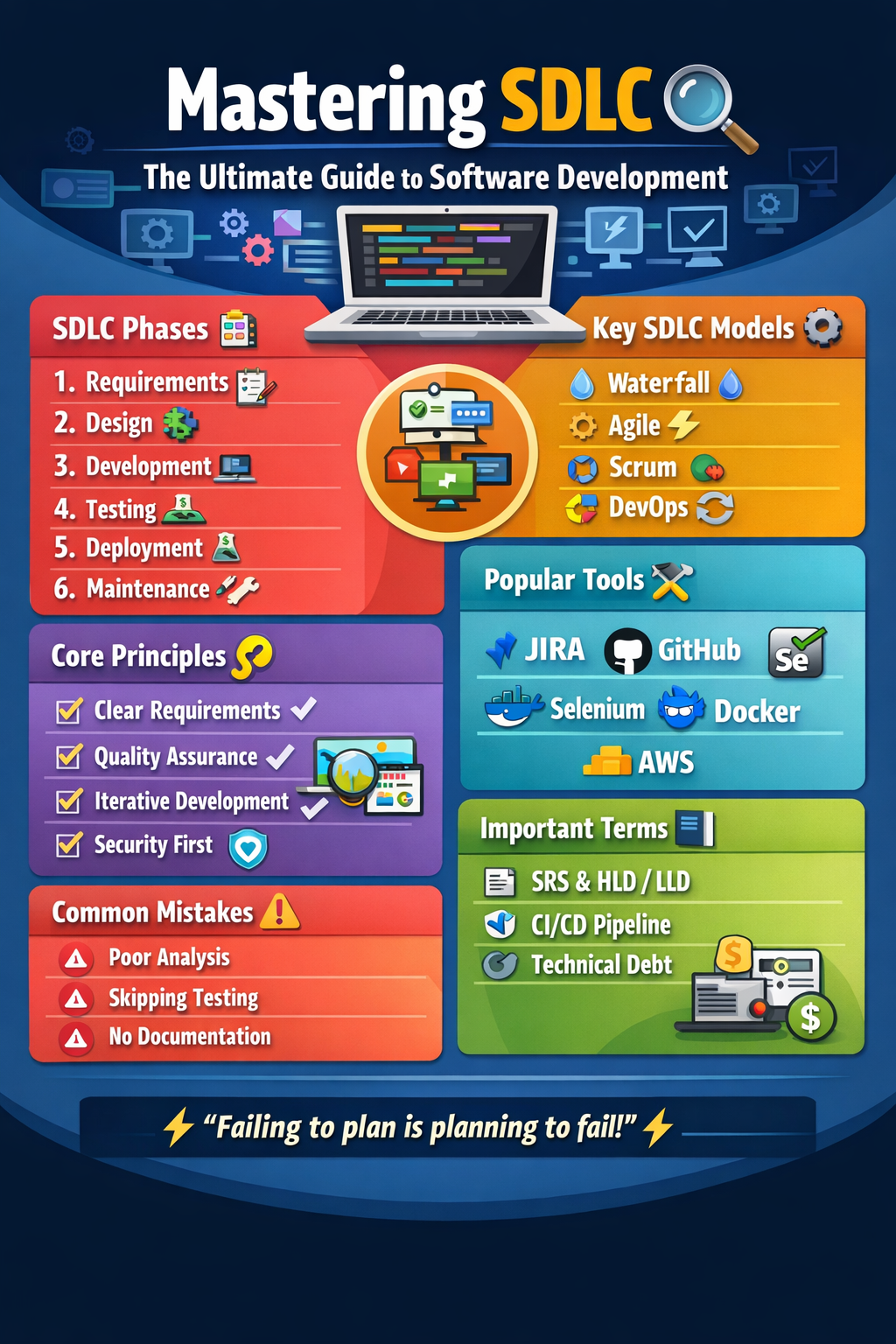
Let’s break down every concept, principle, terminology, tools, and mistakes you need to master SDLC 💡
📌 What is SDLC?
SDLC (Software Development Life Cycle) is a structured process used to design, develop, test, and deploy high-quality software efficiently.
👉 Goal: Deliver reliable, scalable, and maintainable software with minimal cost and time.
🔄 Phases of SDLC (Step-by-Step)
1️⃣ Requirement Gathering & Analysis 📋
Understanding what needs to be built.
Key Activities:
- Stakeholder meetings 🤝
- Business requirement documentation
- Feasibility analysis
Deliverables:
- SRS (Software Requirement Specification)
Tools:
- JIRA 🧩
- Confluence 📚
- Google Docs
2️⃣ System Design 🧠
Planning how the system will work.
Types:
- High-Level Design (HLD)
- Low-Level Design (LLD)
Key Concepts:
- Architecture (Monolith vs Microservices)
- Database Design
- API Design
Tools:
- Draw.io ✏️
- Lucidchart 📊
- Figma 🎨
3️⃣ Development 👨💻
Actual coding begins!
Key Practices:
- Clean Code ✨
- Code Reusability
- Version Control
Tools:
- Git & GitHub 🐙
- VS Code 🧑💻
- Docker 🐳
4️⃣ Testing 🧪
Ensuring software works correctly.
Types of Testing:
- Unit Testing
- Integration Testing
- System Testing
- UAT (User Acceptance Testing)
Tools:
- Selenium 🤖
- RSpec (Ruby) 💎
- Jest (JS)
5️⃣ Deployment 🚀
Releasing the product to users.
Types:
- Blue-Green Deployment
- Rolling Deployment
- Canary Deployment 🐤
Tools:
- AWS 🌩️
- Jenkins ⚙️
- Kubernetes ☸️
6️⃣ Maintenance 🔧
Continuous improvement post-release.
Activities:
- Bug fixes 🐞
- Performance optimization
- Feature updates
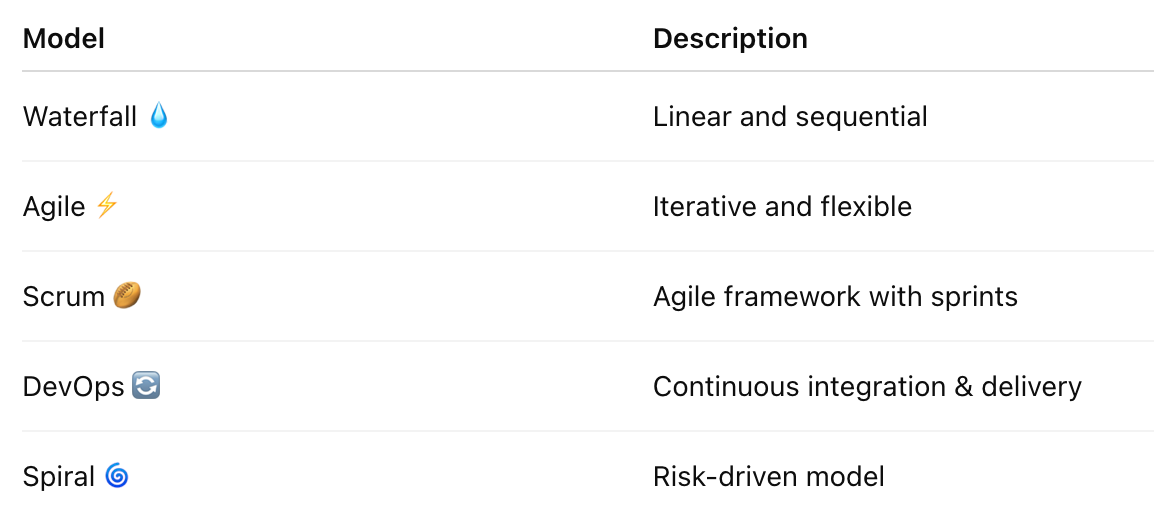
📚 Key SDLC Models
🧠 Core Principles of SDLC
🔹 1. Clear Requirements
👉 Misunderstood requirements = project failure 💥
🔹 2. Documentation First 📄
👉 Good documentation = smoother development
🔹 3. Iterative Development 🔄
👉 Build → Test → Improve → Repeat
🔹 4. Quality Assurance 🎯
👉 Testing is not optional!
🔹 5. Collaboration 🤝
👉 Dev + QA + Business = Success
🔹 6. Security First 🔐
👉 Secure code prevents future disasters
📖 Important SDLC Terminologies
🔸 SRS (Software Requirement Specification)
Defines what system should do.
🔸 HLD & LLD
Architecture and detailed design.
🔸 CI/CD
- Continuous Integration 🔄
- Continuous Deployment 🚀
🔸 Version Control
Tracking code changes (Git)
🔸 Technical Debt 💳
Short-term hacks → long-term problems
🔸 Refactoring 🔧
Improving code without changing functionality
🛠️ Popular Tools Used in SDLC
📌 Project Management
- JIRA
- Trello
- Asana
📌 Development
- GitHub / GitLab
- VS Code
- IntelliJ
📌 Testing
- Selenium
- Postman
- Cypress
📌 DevOps
- Jenkins
- Docker
- Kubernetes
- AWS
⚠️ Common Mistakes to Avoid in SDLC
❌ 1. Poor Requirement Analysis
👉 Leads to rework & delays ⏳
❌ 2. Skipping Documentation
👉 Creates confusion later 🤯
❌ 3. Ignoring Testing
👉 Bugs in production = bad reputation 💔
❌ 4. No Version Control
👉 Code chaos 🧨
❌ 5. Overengineering
👉 Keep it simple (KISS principle) 😌
❌ 6. Lack of Communication
👉 Team misalignment kills productivity 🪓
❌ 7. Ignoring Security
👉 Leads to vulnerabilities 🔓
🚀 Pro Tips to Master SDLC
✨ Use Agile for flexibility
✨ Automate testing & deployment
✨ Follow coding standards
✨ Regular code reviews 👀
✨ Monitor performance continuously
🎯 Final Thoughts
SDLC is not just a process — it’s a mindset for building scalable and high-quality software 💡
If you master SDLC:
👉 You become a better developer
👉 Your projects succeed faster
👉 Your team works smarter
💬 Bonus Quote
“Failing to plan is planning to fail.” — A perfect line for SDLC success 🚀


Comments
Post a Comment