🎨 Mastering Design Patterns: The Secret Blueprint Behind Scalable Software 🚀
🎨 Mastering Design Patterns: The Secret Blueprint Behind Scalable Software 🚀
In the world of software engineering, writing code that works is good… but writing code that is clean, reusable, scalable, and maintainable is what separates a beginner from a professional developer. 💡
That’s where Design Patterns come into play.
Design patterns are proven solutions to common software design problems. They are like architectural blueprints 🏛️ for building software systems efficiently.
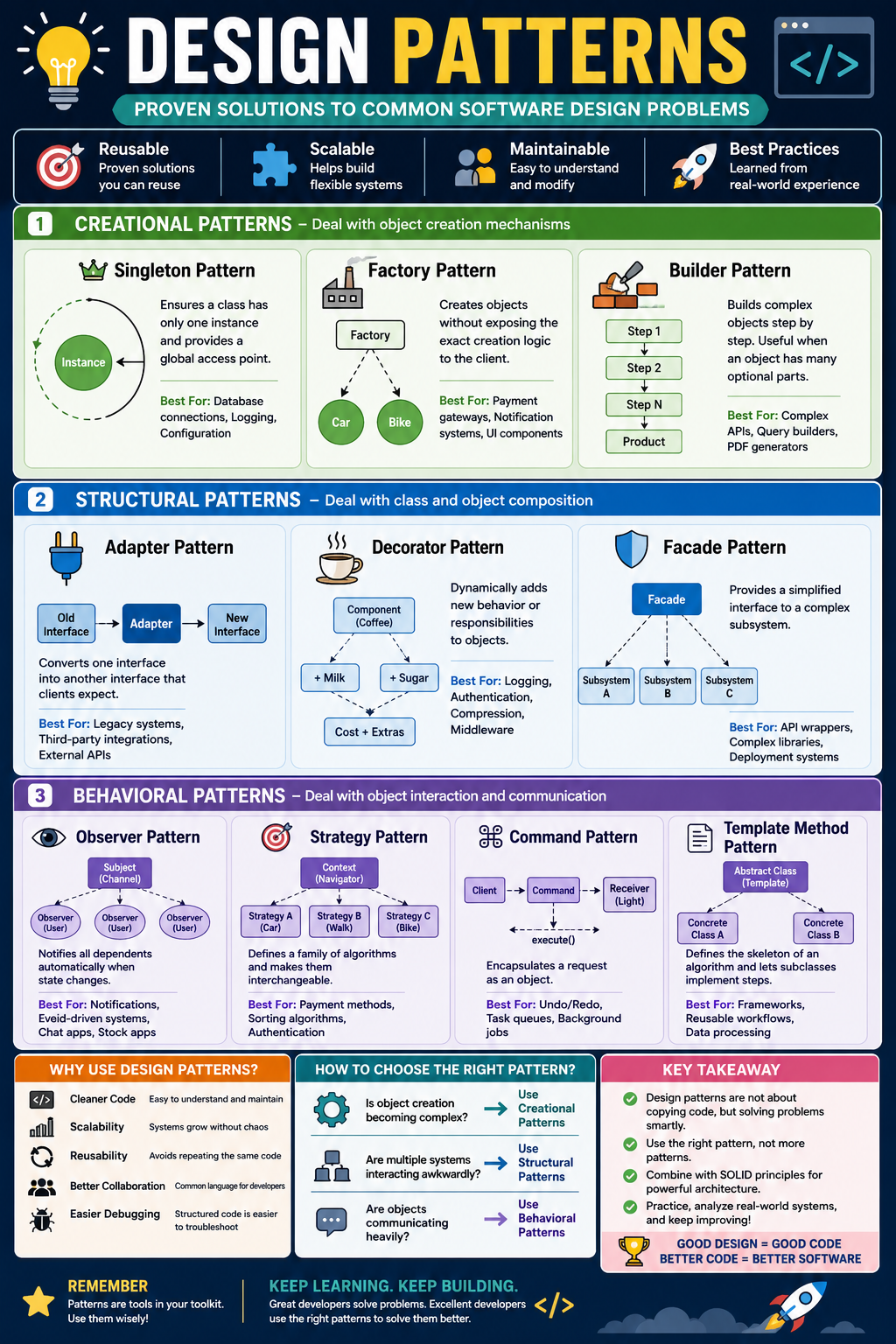
Whether you’re building applications using Ruby on Rails, React, Java, Python, or Microservices — design patterns help you write elegant and professional code.
📌 What Are Design Patterns?
A Design Pattern is a reusable solution to a recurring software design problem.
Think of them as:
- 🧩 Reusable coding templates
- 🏗️ Architectural strategies
- 🧠 Best practices learned from experienced developers
Design patterns are NOT:
- ❌ Ready-made code
- ❌ Libraries
- ❌ Frameworks
They are concepts and structures you adapt according to your needs.
🏛️ Types of Design Patterns
Design patterns are mainly divided into 3 categories:
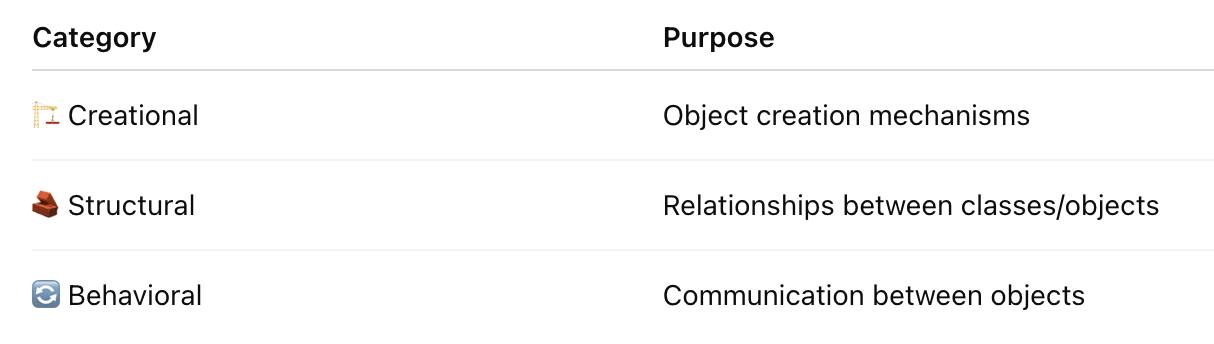
🏗️ 1. Creational Design Patterns
These patterns focus on object creation.
🧩 Singleton Pattern
📖 Concept
Ensures that only one instance of a class exists throughout the application.
🧠 Real-Life Example
🏦 Bank Database Connection
You don’t want multiple database connection managers.
⚙️ Ruby Example
class Database
  @@instance = nil

  def self.instance
    @@instance ||= Database.new
  end

  private_class_method :new
end

db1 = Database.instance
db2 = Database.instance
puts db1 == db2
🔥 How It Works
- Prevents multiple object creation
- Uses a static/shared instance
- Returns the same object every time
✅ Best Use Cases
- Database connections
- Logger services
- Cache managers
- Configuration managers
🏭 Factory Pattern
📖 Concept
Creates objects without exposing the exact creation logic.
🧠 Real-Life Example
🚗 Car Factory
You ask for a “Car”, not how each part is assembled.
⚙️ Ruby Example
class Car
  def drive
    puts "Driving Car 🚗"
  end
end

class Bike
  def drive
    puts "Driving Bike 🏍️"
  end
end

class VehicleFactory
  def self.create(type)
    return Car.new if type == "car"
    return Bike.new if type == "bike"
  end
end

vehicle = VehicleFactory.create("car")
vehicle.drive
🔥 How It Works
- Centralizes object creation
- Removes tight coupling
- Makes code flexible
✅ Best Use Cases
- Payment gateways
- Notification systems
- UI component generators
- Multi-database support
🏗️ Builder Pattern
📖 Concept
Builds complex objects step by step.
🧠 Real-Life Example
🍔 Burger Builder
Choose bread, cheese, sauces, toppings separately.
⚙️ Ruby Example
class Burger
  attr_accessor :bread, :cheese, :sauce
end

class BurgerBuilder
  def initialize
    @burger = Burger.new
  end

  def add_bread
    @burger.bread = "Wheat Bread"
  end

  def add_cheese
    @burger.cheese = "Cheddar"
  end

  def add_sauce
    @burger.sauce = "Mayo"
  end

  def build
    @burger
  end
end

builder = BurgerBuilder.new
builder.add_bread
builder.add_cheese
builder.add_sauce
burger = builder.build
✅ Best Use Cases
- Complex API requests
- PDF generators
- UI builders
- Query builders
🧱 2. Structural Design Patterns
These patterns define relationships between classes and objects.
🔌 Adapter Pattern
📖 Concept
Converts one interface into another compatible interface.
🧠 Real-Life Example
🔌 Mobile Charger Adapter
⚙️ Ruby Example
class OldPaymentGateway
  def make_payment
    puts "Old Payment System"
  end
end

class PaymentAdapter
  def initialize(gateway)
    @gateway = gateway
  end

  def pay
    @gateway.make_payment
  end
end

gateway = OldPaymentGateway.new
adapter = PaymentAdapter.new(gateway)
adapter.pay
✅ Best Use Cases
- Third-party integrations
- Legacy system migration
- External APIs
🎭 Decorator Pattern
📖 Concept
Adds new functionality dynamically without changing original code.
🧠 Real-Life Example
☕ Coffee with Extra Toppings
⚙️ Ruby Example
class Coffee
  def cost
    100
  end
end

class MilkDecorator
  def initialize(coffee)
    @coffee = coffee
  end

  def cost
    @coffee.cost + 20
  end
end

coffee = MilkDecorator.new(Coffee.new)
puts coffee.cost
✅ Best Use Cases
- Authentication layers
- Logging
- Compression
- Middleware systems
🌉 Facade Pattern
📖 Concept
Provides a simplified interface to a complex system.
🧠 Real-Life Example
🎮 Game Console Power Button
One button starts multiple internal systems.
⚙️ Ruby Example
class CPU
  def start
    puts "CPU Started"
  end
end

class Memory
  def load
    puts "Memory Loaded"
  end
end

class ComputerFacade
  def initialize
    @cpu = CPU.new
    @memory = Memory.new
  end

  def start
    @cpu.start
    @memory.load
  end
end

computer = ComputerFacade.new
computer.start
✅ Best Use Cases
- Complex service abstraction
- API wrappers
- Deployment systems
🔄 3. Behavioral Design Patterns
These patterns focus on communication between objects.
👀 Observer Pattern
📖 Concept
Objects subscribe and receive updates automatically.
🧠 Real-Life Example
🔔 YouTube Subscribers Notifications
⚙️ Ruby Example
class Channel
  def initialize
    @subscribers = []
  end

  def subscribe(user)
    @subscribers << user
  end

  def notify
    @subscribers.each(&:update)
  end
end

class User
  def update
    puts "New Video Uploaded 🎥"
  end
end

channel = Channel.new
user = User.new
channel.subscribe(user)
channel.notify
✅ Best Use Cases
- Notification systems
- Event-driven systems
- Chat applications
- Stock market apps
🎯 Strategy Pattern
📖 Concept
Defines interchangeable algorithms dynamically.
🧠 Real-Life Example
🗺️ Google Maps Route Selection
⚙️ Ruby Example
class CarRoute
  def build
    puts "Car Route Selected 🚗"
  end
end

class WalkingRoute
  def build
    puts "Walking Route Selected 🚶"
  end
end

class Navigator
  def initialize(strategy)
    @strategy = strategy
  end

  def route
    @strategy.build
  end
end

Navigator.new(CarRoute.new).route
Navigator.new(WalkingRoute.new).route
✅ Best Use Cases
- Payment methods
- Sorting algorithms
- Authentication mechanisms
📨 Command Pattern
📖 Concept
Encapsulates a request as an object.
🧠 Real-Life Example
📺 TV Remote Control
⚙️ Ruby Example
class Light
  def on
    puts "Light ON 💡"
  end
end

class LightCommand
  def initialize(light)
    @light = light
  end

  def execute
    @light.on
  end
end

light = Light.new
command = LightCommand.new(light)
command.execute
✅ Best Use Cases
- Undo/Redo systems
- Task queues
- Background jobs
⚡ Most Important Design Patterns Used in Modern Applications
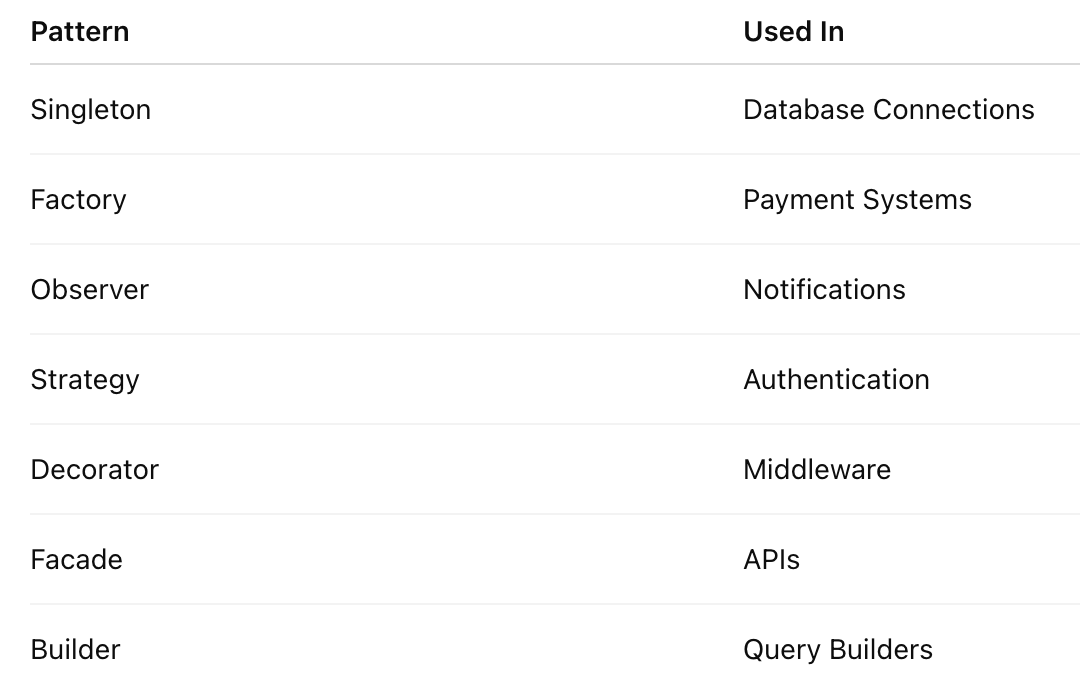
🧠 SOLID Principles + Design Patterns = Powerful Architecture 💪
Design patterns work best when combined with:
- ✅ SOLID Principles
- ✅ Clean Code
- ✅ DRY Principle
- ✅ KISS Principle
🚀 Benefits of Using Design Patterns
✅ Cleaner Code
Easy to understand and maintain.
✅ Scalability
Applications grow without chaos.
✅ Reusability
Reusable components reduce duplication.
✅ Better Team Collaboration
Common architecture language among developers.
✅ Easier Debugging
Structured systems are easier to troubleshoot.
⚠️ Common Mistakes Developers Make
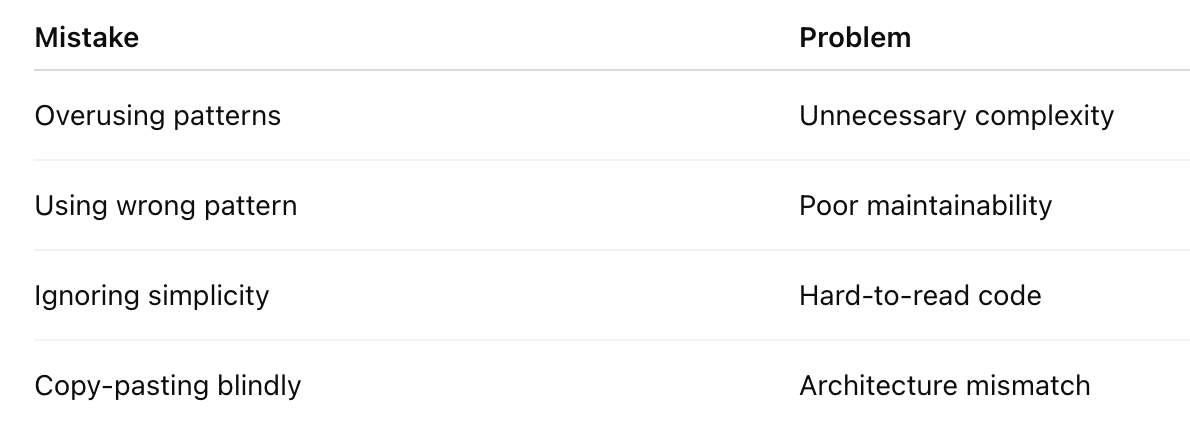
🎯 How to Choose the Right Design Pattern?
Ask yourself:
✅ Is object creation becoming complex?
→ Use Creational Patterns
✅ Are multiple systems interacting awkwardly?
→ Use Structural Patterns
✅ Are objects communicating heavily?
→ Use Behavioral Patterns
🔥 Final Thoughts
Design patterns are the hidden superpower behind professional software engineering. 🧠⚡
The more you understand them, the more:
- scalable your systems become,
- cleaner your code becomes,
- and easier your development journey becomes.
Mastering design patterns can dramatically improve your skills whether you work with:
- Ruby on Rails
- React
- Docker
- Kubernetes
- Microservices
- Cloud Applications ☁️
📚 Recommended Next Topics
- SOLID Principles
- Clean Architecture
- System Design
- Microservices Patterns
- Event-Driven Architecture
- Domain-Driven Design (DDD)
💬 Which Design Pattern Do You Use Most?
Is it:
- Singleton? 🏗️
- Observer? 👀
- Strategy? 🎯
- Factory? 🏭
Share your favorite pattern and real-world usage! 🚀


Comments
Post a Comment