🚀 The Ultimate Guide to SDLC (Software Development Life Cycle) 💻
🚀 The Ultimate Guide to SDLC (Software Development Life Cycle) 💻
Build Software Like Top Tech Companies 🌍
In today’s digital era, every successful application — whether it’s Instagram, Amazon, Banking Apps, Healthcare Systems, or AI Platforms — follows a structured process called SDLC (Software Development Life Cycle).
Without SDLC, software projects become chaotic 😵💫:
- Missed deadlines ⏰
- Security vulnerabilities 🔓
- Poor performance 🐌
- Budget overruns 💸
- Unhappy clients 😡
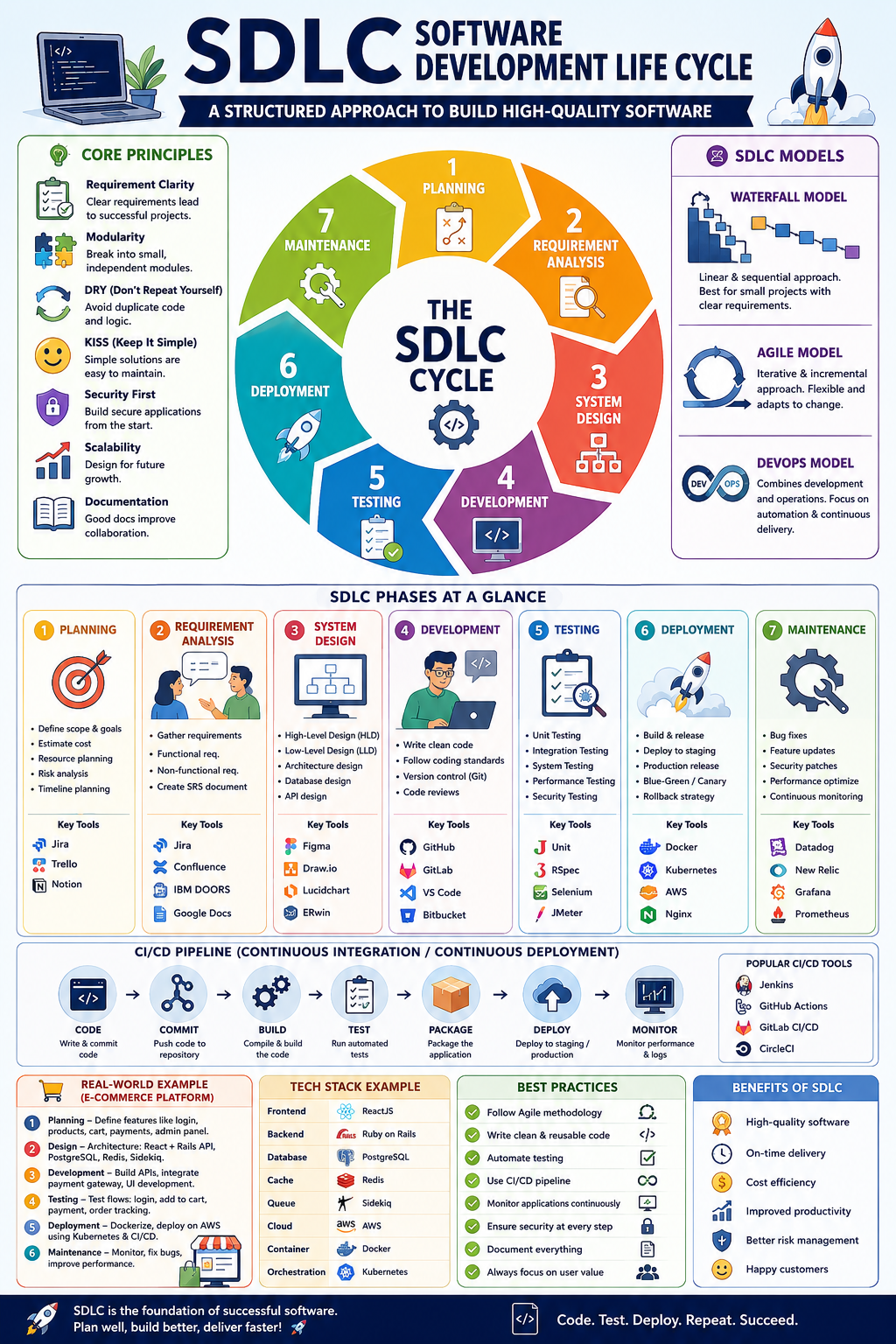
This guide explains every concept, principle, phase, methodology, tool, and real-world example involved in SDLC with a practical industry approach. 🚀
📌 What is SDLC?
The Software Development Life Cycle (SDLC) is a systematic process used to design, develop, test, deploy, and maintain software efficiently and securely.
Think of SDLC as the blueprint of software engineering 🏗️.
🎯 Main Goals of SDLC
✅ Deliver high-quality software
✅ Reduce development cost
✅ Improve productivity
✅ Ensure security & scalability
✅ Maintain proper documentation
✅ Deliver software on time
🧠 Core Principles of SDLC
1️⃣ Requirement Clarity 📋
If requirements are unclear, the entire project can fail.
Example:
❌ “Build an eCommerce website.”
✅ “Build a multi-vendor eCommerce platform with payment gateway, admin dashboard, inventory management, and order tracking.”
2️⃣ Modularity 🧩
Break applications into smaller independent modules.
Example:
A food delivery app may contain:
- Authentication Service
- Restaurant Service
- Payment Service
- Notification Service
This improves:
- Scalability
- Maintainability
- Reusability
3️⃣ DRY Principle (Don’t Repeat Yourself) ♻️
Avoid duplicate code.
Ruby Example:
def calculate_tax(amount)
  amount * 0.18
end
Instead of repeating tax logic everywhere.
4️⃣ KISS Principle 💡
“Keep It Simple, Stupid”
Simple systems are easier to maintain and debug.
5️⃣ Security First 🔐
Security should be integrated from the beginning.
Security Practices:
- Input Validation
- Authentication
- Authorization
- Encryption
- Rate Limiting
- Secure APIs
6️⃣ Scalability 📈
Applications should handle future growth.
Example:
An app supporting 1,000 users today may need to support 10 million tomorrow.
7️⃣ Documentation 📚
Good documentation saves development time and improves team collaboration.
🔄 SDLC Phases Explained
1️⃣ Planning Phase 📝
This is the foundation phase.
Activities:
- Define project scope
- Identify goals
- Estimate cost
- Resource allocation
- Timeline planning
- Risk analysis
Tools Used:
2️⃣ Requirement Analysis 🔍
Business analysts and stakeholders gather requirements.
Types of Requirements:
Functional Requirements
What the system should do.
Example:
- User Login
- Payment Processing
- Order Tracking
Non-Functional Requirements
How the system should perform.
Example:
- Response time < 2 sec
- 99.99% uptime
- High security
3️⃣ System Design 🎨
Architects design the entire software structure.
Types of Design:
High-Level Design (HLD)
Overall architecture.
Low-Level Design (LLD)
Database schema, API structures, class diagrams.
🏗️ Popular Architectures
Monolithic Architecture
Everything in one application.
Pros:
✅ Easy to start
✅ Faster development
Cons:
❌ Hard to scale
❌ Difficult deployment
Microservices Architecture 🌐
Application split into multiple independent services.
Example:
Netflix Architecture:
- User Service
- Recommendation Service
- Billing Service
Benefits:
✅ Independent scaling
✅ Faster deployments
✅ Better fault isolation
🛠️ Design Tools
4️⃣ Development Phase 👨💻
The coding phase begins.
🔥 Best Practices During Development
Version Control with Git 🌳
Tools:
Git Workflow Example:
git checkout -b feature/payment
git commit -m "Added Stripe Integration"
git push origin feature/payment
🧪 Code Review
Every PR should be reviewed before merging.
Benefits:
✅ Better code quality
✅ Knowledge sharing
✅ Fewer bugs
⚡ Coding Standards
Ruby on Rails Example:
class User < ApplicationRecord
  validates :email, presence: true, uniqueness: true
end
🧪 5️⃣ Testing Phase
Testing ensures reliability and quality.
Types of Testing
Unit Testing 🧩
Tests individual functions.
Tools:
Integration Testing 🔗
Tests interaction between modules.
System Testing 🖥️
Tests the complete application.
Performance Testing ⚡
Checks scalability and speed.
Tools:
Security Testing 🔐
Tools:
🚀 6️⃣ Deployment Phase
Application goes live.
Deployment Strategies
Blue-Green Deployment 🔵🟢
Two environments:
- Blue → Current
- Green → New
Switch traffic safely.
Canary Deployment 🐤
Release to a small group first.
☁️ Cloud Platforms
🐳 Containerization with Docker
FROM ruby:3.3
WORKDIR /app
COPY . .
RUN bundle install
CMD ["rails", "server"]
☸️ Kubernetes
Manages container orchestration.
Benefits:
✅ Auto Scaling
✅ Load Balancing
✅ Self Healing
🔄 CI/CD Pipeline
Continuous Integration & Continuous Deployment.
⚙️ CI/CD Workflow
Code → Test → Build → Deploy → MonitorPopular CI/CD Tools
📊 7️⃣ Maintenance Phase
Software requires continuous improvements.
Activities:
- Bug Fixes
- Feature Updates
- Security Patches
- Database Optimization
- Monitoring
📈 Monitoring Tools
🔥 SDLC Models Explained
🌊 Waterfall Model
Linear approach.
Requirements → Design → Development → Testing → DeploymentBest For:
✅ Small projects
✅ Fixed requirements
🔄 Agile Model
Iterative development approach.
Concepts:
- Sprint
- Scrum
- Daily Standup
- Backlog
- Retrospective
Agile Tools:
🚀 DevOps Model
Combines development and operations.
Benefits:
✅ Faster delivery
✅ Automation
✅ Better monitoring
🧠 AI in Modern SDLC
AI is transforming software development massively 🤖
AI Tools Used in SDLC
Code Assistance
AI Testing
- Automated Test Generation
- Bug Detection
- Performance Analysis
AI Monitoring
- Predictive Failure Detection
- Intelligent Alerting
📦 Real-World SDLC Example
Building an eCommerce Platform 🛒
Step 1: Planning
Requirements:
- Login
- Product Catalog
- Cart
- Payments
- Admin Dashboard
Step 2: Design
Architecture:
- Frontend → ReactJS
- Backend → Ruby on Rails APIs
- Database → PostgreSQL
- Cache → Redis
- Queue → Sidekiq
Step 3: Development
Backend APIs:
resources :products
resources :orders
resources :payments
Step 4: Testing
Test Cases:
✅ User Login
✅ Payment Success
✅ Cart Calculation
✅ Inventory Validation
Step 5: Deployment
Infrastructure:
- Docker
- Kubernetes
- AWS EC2
- Nginx
- CI/CD Pipeline
Step 6: Monitoring
Track:
- Server CPU
- API Response Time
- Error Rates
- Database Queries
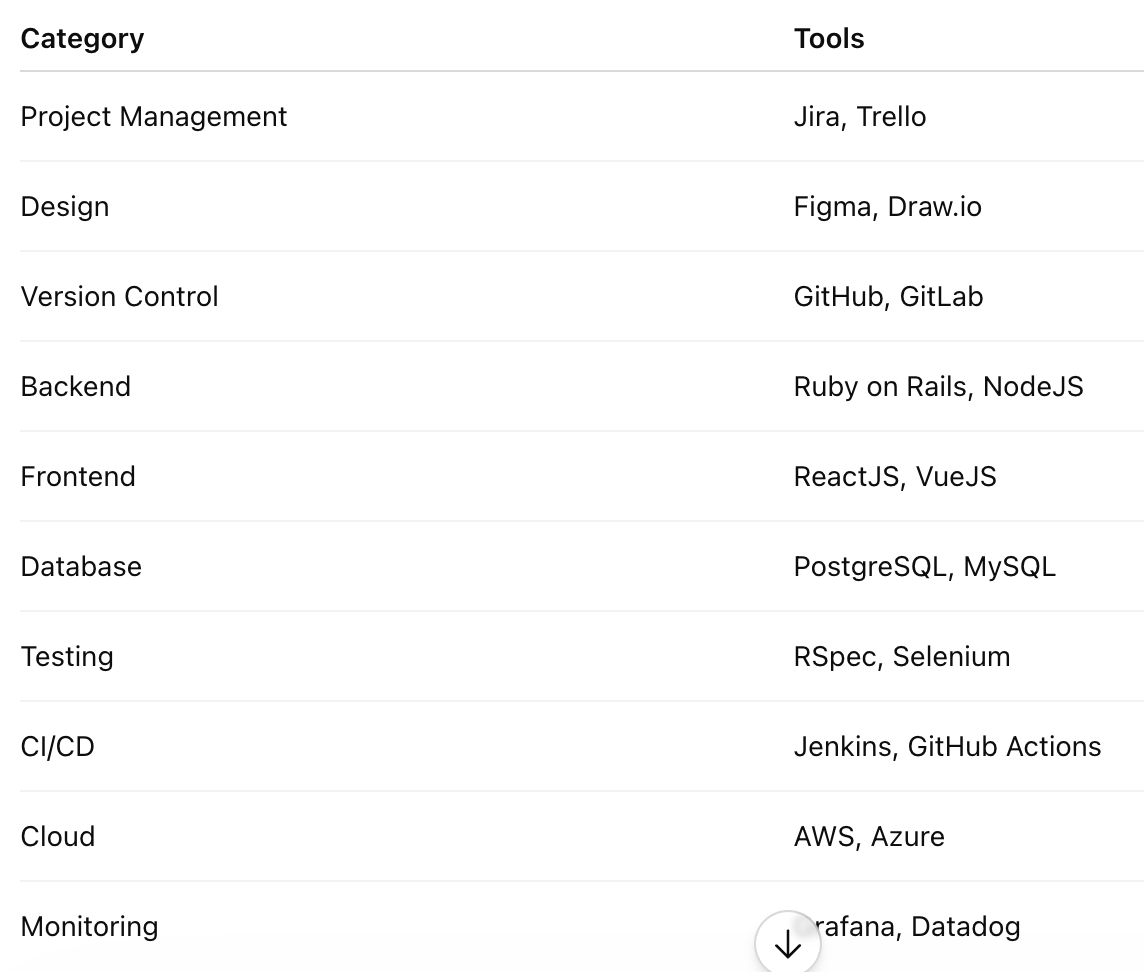
📌 Most Important SDLC Tools by Category
🚨 Common Mistakes in SDLC
❌ Poor Requirement Gathering
❌ Lack of Documentation
❌ No Testing
❌ Ignoring Security
❌ Weak Code Review
❌ No Monitoring
❌ Tight Coupling
❌ Manual Deployments
💡 Pro Tips for Successful SDLC
✅ Automate Everything
✅ Use CI/CD
✅ Write Clean Code
✅ Monitor Continuously
✅ Use Scalable Architecture
✅ Prioritize Security
✅ Follow Agile Practices
✅ Maintain Documentation
🎯 Final Thoughts
SDLC is not just a development process — it is the foundation of successful software engineering. 🏗️
The best companies in the world succeed because they:
- Follow strong SDLC practices
- Automate workflows
- Focus on scalability
- Prioritize testing
- Continuously improve systems
Whether you’re building:
- SaaS Platforms ☁️
- AI Systems 🤖
- Banking Apps 🏦
- Social Media Apps 📱
- Healthcare Systems 🏥
Mastering SDLC will make you a better engineer, architect, and problem solver. 🚀
🔥 Key Takeaway
“Great software is not built by coding alone — it is built through a disciplined SDLC process.” 💡


Comments
Post a Comment