🚀 Becoming a Pro TypeScript Developer: The Ultimate Guide to Writing Bulletproof Code 💙
🚀 Becoming a Pro TypeScript Developer: The Ultimate Guide to Writing Bulletproof Code 💙
“TypeScript doesn’t just help you write code — it helps you write code that survives the future.”
JavaScript is everywhere, but as applications grow larger, maintaining them becomes increasingly difficult. That’s where TypeScript comes in.
TypeScript is a superset of JavaScript developed by Microsoft that adds static typing, better tooling, and powerful language features while compiling into standard JavaScript.
Whether you’re building React applications, Node.js APIs, Angular applications, or enterprise software, mastering TypeScript can significantly improve your development speed and code quality.
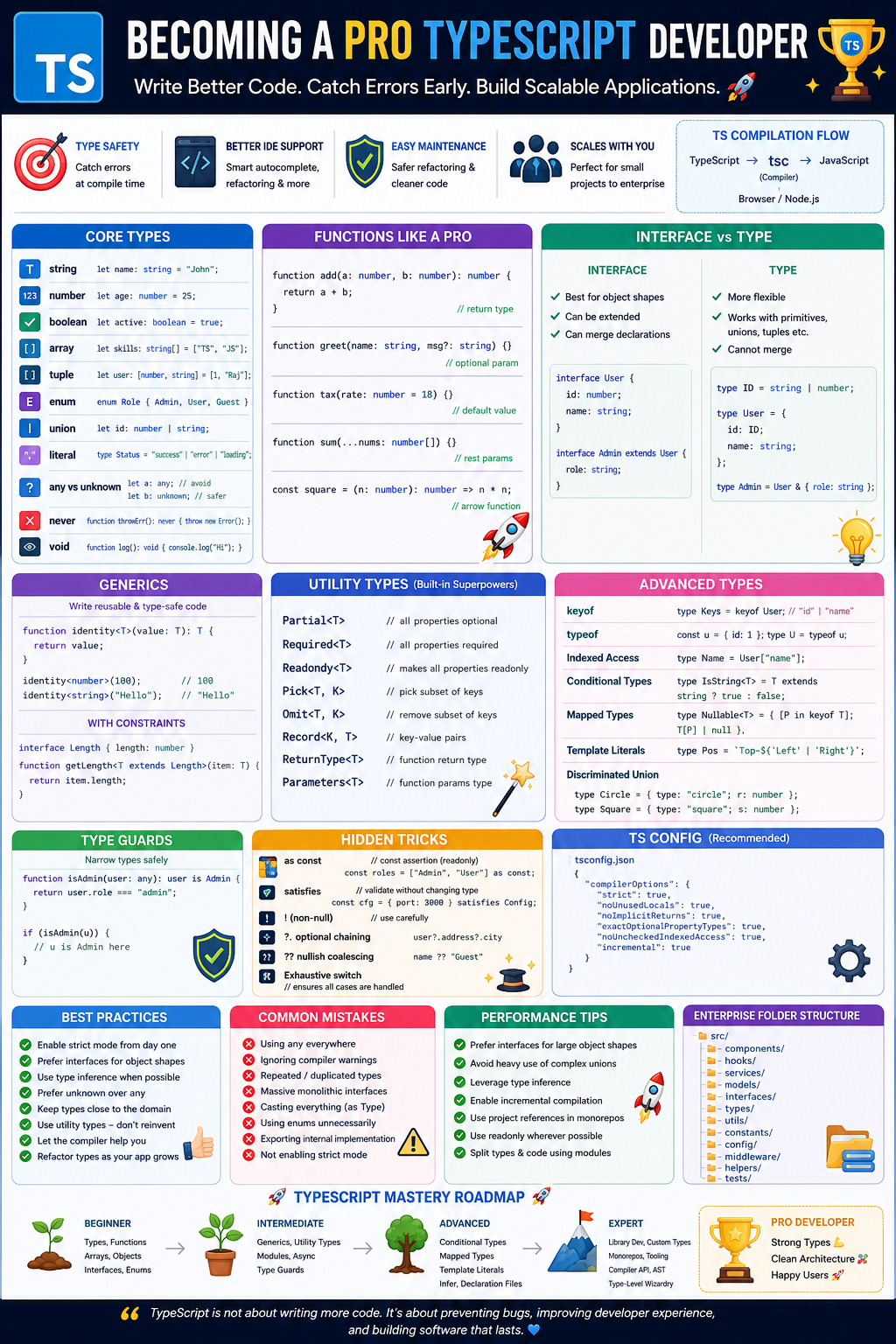
Let’s master it from beginner to professional level. 🚀
📚 Table of Contents
- Why TypeScript?
- TypeScript Fundamentals
- Type System
- Functions Like a Pro
- Interfaces vs Types
- Advanced Types
- Generics
- Utility Types
- Hidden Features
- TypeScript Design Principles
- Performance Optimization
- Project Architecture
- TypeScript Hacks
- Best Practices
- Common Mistakes
- Enterprise Folder Structure
- TypeScript Developer Roadmap
🎯 Why TypeScript?
Without TypeScript:
function add(a, b){
    return a + b;
}

add(10, "20");
Output:
1020Oops! 😅
TypeScript catches this before execution.
function add(a:number, b:number){
    return a+b;
}

add(10,"20");
Compiler:
Argument of type string is not assignable to number.⚡ TypeScript Compilation Flow
TypeScript
  ↓
Compiler (tsc)
  ↓
JavaScript
  ↓
Browser / NodeJS
📦 Installing TypeScript
npm install -g typescriptCheck version
tsc --versionInitialize
tsc --initCompile
tsc index.tsWatch mode
tsc --watch🏗 Type System
Primitive Types
let name:string="Lakhveer";
let age:number=25;
let active:boolean=true;
Array
let skills:string[]=["TS","React","Node"];Tuple
let employee:[number,string];

employee=[101,"Raj"];
Enum
enum Role{
 Admin,
 User,
 Guest
}
Literal Types
type Status="success"|"error"|"loading";Only three values allowed.
Union Types
let value:number|string;|

value=100;
value="Hello";
Intersection Types
type Employee={
 name:string;
}

type Developer={
 language:string;
}

type FullStack=Employee & Developer;
Unknown
Better than any.
let value:unknown;

if(typeof value==="string"){
 console.log(value.toUpperCase());
}
Never
function throwError():never{
 throw new Error();
}
Void
function print():void{
 console.log("Hello");
}
🧠 Type Inference
Instead of
let age:number=25;Simply
let age=25;TypeScript automatically infers the type.
🎯 Type Alias
type User={
 id:number;
 name:string;
}
🔥 Interface
interface User{
 id:number;
 name:string;
}
Extending
interface Employee extends User{
 salary:number;
}
🆚 Interface vs Type
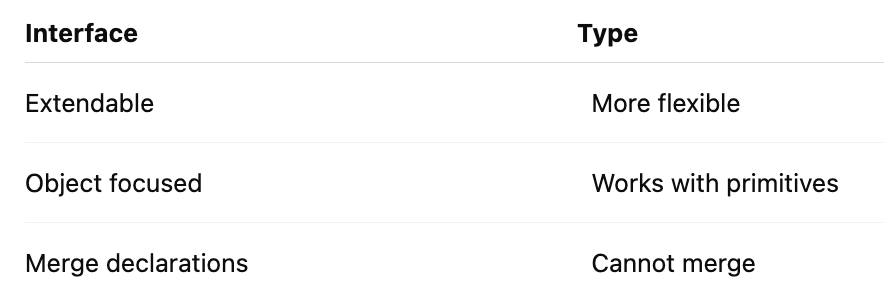
Rule:
✅ Interfaces for object models
✅ Types for everything else
🚀 Functions
function greet(name:string):string{
 return `Hello ${name}`;
}
Optional parameter
function login(user:string,password?:string){}Default value
function tax(rate:number=18){}Rest parameter
function sum(...nums:number[]){
}
💎 Generics
Without Generics
function print(value:any){
 return value;
}
With Generics
function print<T>(value:T):T{
 return value;
}
Usage
print<number>(100);

print<string>("Hello");
🎁 Generic Constraints
interface Length{
 length:number;
}

function count<T extends Length>(item:T){
 return item.length;
}
🏆 Generic Classes
class Box<T>{
  constructor(public value:T){}
}
📚 Utility Types
Partial
type User={
 id:number;
 name:string;
}

type Update=Partial<User>;
Everything optional.
Required
Required<User>Everything mandatory.
Readonly
Readonly<User>Immutable.
Pick
Pick<User,"name">Omit
Omit<User,"id">Record
Record<string,number>ReturnType
type Result=ReturnType<typeof calculate>;Parameters
type Args=Parameters<typeof login>;🧩 Conditional Types
type IsString<T>=T extends string ? true:false;🏹 Mapped Types
type Nullable<T>={
 [P in keyof T]:T[P]|null;
}
⚡ keyof
type User={
 id:number;
 name:string;
}

type Keys=keyof User;
Output
"id" | "name"🔍 typeof
const person={
 name:"Raj"
}

type Person=typeof person;
📌 Indexed Access
type User={
 name:string;
 age:number;
}

type Name=User["name"];
🧠 Template Literal Types
type Position="Top"|"Bottom";

type Align=`${Position}-Left`;
Produces
Top-Left

Bottom-Left
🎯 Discriminated Union
type Circle={
 type:"circle";
 radius:number;
}

type Square={
 type:"square";
 side:number;
}
🚀 Type Guards
if(typeof value==="string"){
}
Custom
function isAdmin(user:any):user is Admin{
 return user.role==="admin";
}
💡 Hidden TypeScript Tricks
1️⃣ const Assertion
const roles=["Admin","User"] as const;Readonly tuple.
2️⃣ satisfies Operator
const config={
 port:3000
} satisfies Config;
Amazing for configuration objects.
3️⃣ Non-null Assertion
user!.nameUse sparingly.
4️⃣ Optional Chaining
user?.address?.city5️⃣ Nullish Coalescing
name ?? "Guest"6️⃣ Exhaustive Switch
switch(shape.type){
 case "circle":
 break;
 default:
 const _:never=shape;
}
Compiler catches missing cases.
⚙ Compiler Optimization
Enable in tsconfig.json
{
 "strict":true,
 "noUnusedLocals":true,
 "noImplicitReturns":true,
 "exactOptionalPropertyTypes":true,
 "noUncheckedIndexedAccess":true,
 "incremental":true
}
🚀 Performance Tips
✅ Prefer interfaces for object shapes.
✅ Avoid excessive use of any.
✅ Use type inference instead of explicit types.
✅ Enable incremental compilation.
✅ Use project references for monorepos.
✅ Use readonly wherever possible.
📁 Enterprise Folder Structure
src/

components/

hooks/

utils/

services/

models/

interfaces/

types/

constants/

config/

middleware/

helpers/

tests/

index.ts
🧠 TypeScript Design Principles
✅ Single Source of Truth
Never duplicate types.
✅ DRY
Use utility types.
✅ Composition
Prefer
User & Employeeinstead of giant interfaces.
✅ Explicit Public APIs
Every exported function should have a return type.
✅ Strong Boundaries
Never expose internal implementation types.
🔥 TypeScript Hacks Professionals Use
Infer from API
type User=Awaited<ReturnType<typeof getUser>>;Freeze Objects
Object.freeze(config);Reuse Existing Types
Instead of rewriting
type Props={
 name:string;
 age:number;
}
Reuse
Pick<User,"name"|"age">Branded Types
type UserId = string & { readonly brand: unique symbol };

function getUser(id: UserId) {
  // ...
}
This prevents accidentally passing a regular string where a UserId is expected.
Strongly Typed Environment Variables
interface Env {
  API_URL: string;
  NODE_ENV: "development" | "production";
}
❌ Common Mistakes
🚫 Using any everywhere
🚫 Ignoring strict mode
🚫 Repeating interfaces
🚫 Massive interfaces
🚫 Casting everything
🚫 Using enums unnecessarily
🚫 Exporting internal types
🚫 Ignoring compiler warnings
🏆 Professional tsconfig Checklist
{
  "compilerOptions": {
    "strict": true,
    "incremental": true,
    "noUnusedLocals": true,
    "noUnusedParameters": true,
    "noImplicitReturns": true,
    "exactOptionalPropertyTypes": true,
    "noUncheckedIndexedAccess": true,
    "forceConsistentCasingInFileNames": true,
    "skipLibCheck": true
  }
}
📅 TypeScript Mastery Roadmap
🌱 Beginner
- Variables
- Types
- Functions
- Arrays
- Objects
- Interfaces
🌿 Intermediate
- Generics
- Utility Types
- Modules
- Async Programming
- Type Guards
- Error Handling
🌳 Advanced
- Conditional Types
- Mapped Types
- Template Literal Types
- Infer Keyword
- Declaration Files
- Compiler Internals
🏢 Expert
- Library Development
- Custom Type Utilities
- Monorepos
- Performance Optimization
- Build Tooling
- Compiler API
- AST Transformations
- Advanced Type-Level Programming
⭐ Golden Rules for Pro TypeScript Developers
🏅 Enable strict mode from day one.
🏅 Prefer unknown over any.
🏅 Let the compiler infer types whenever practical.
🏅 Use generics to eliminate duplication.
🏅 Design reusable types before writing implementation.
🏅 Keep types close to the domain they model.
🏅 Treat compiler warnings as valuable feedback.
🏅 Use utility types instead of rewriting interfaces.
🏅 Write code that is easy for both humans and the compiler to understand.
🏅 Continuously refactor your types as your application evolves.
🎯 Final Thoughts
TypeScript is much more than typed JavaScript — it’s a tool for designing reliable software. The strongest TypeScript developers don’t rely on complex types everywhere; they aim for clarity, maintainability, and safety. By combining solid architecture, strict compiler settings, reusable types, and thoughtful abstractions, you’ll build applications that are easier to scale, refactor, and maintain.
“Write JavaScript that works today. Write TypeScript that still works next year.” 💙🚀


Comments
Post a Comment