🚀 Clean Code Mastery: The Ultimate Practice to Make Your Code Look Professional 💎
🚀 Clean Code Mastery: The Ultimate Practice to Make Your Code Look Professional 💎
“Any fool can write code that a computer can understand. Good programmers write code that humans can understand.” — Martin Fowler
Writing code is easy. Writing professional, maintainable, scalable, and readable code is what separates a junior developer from a software craftsman.
Clean Code is not just about making code work; it’s about making it easy to understand, easy to modify, easy to test, and easy to scale.
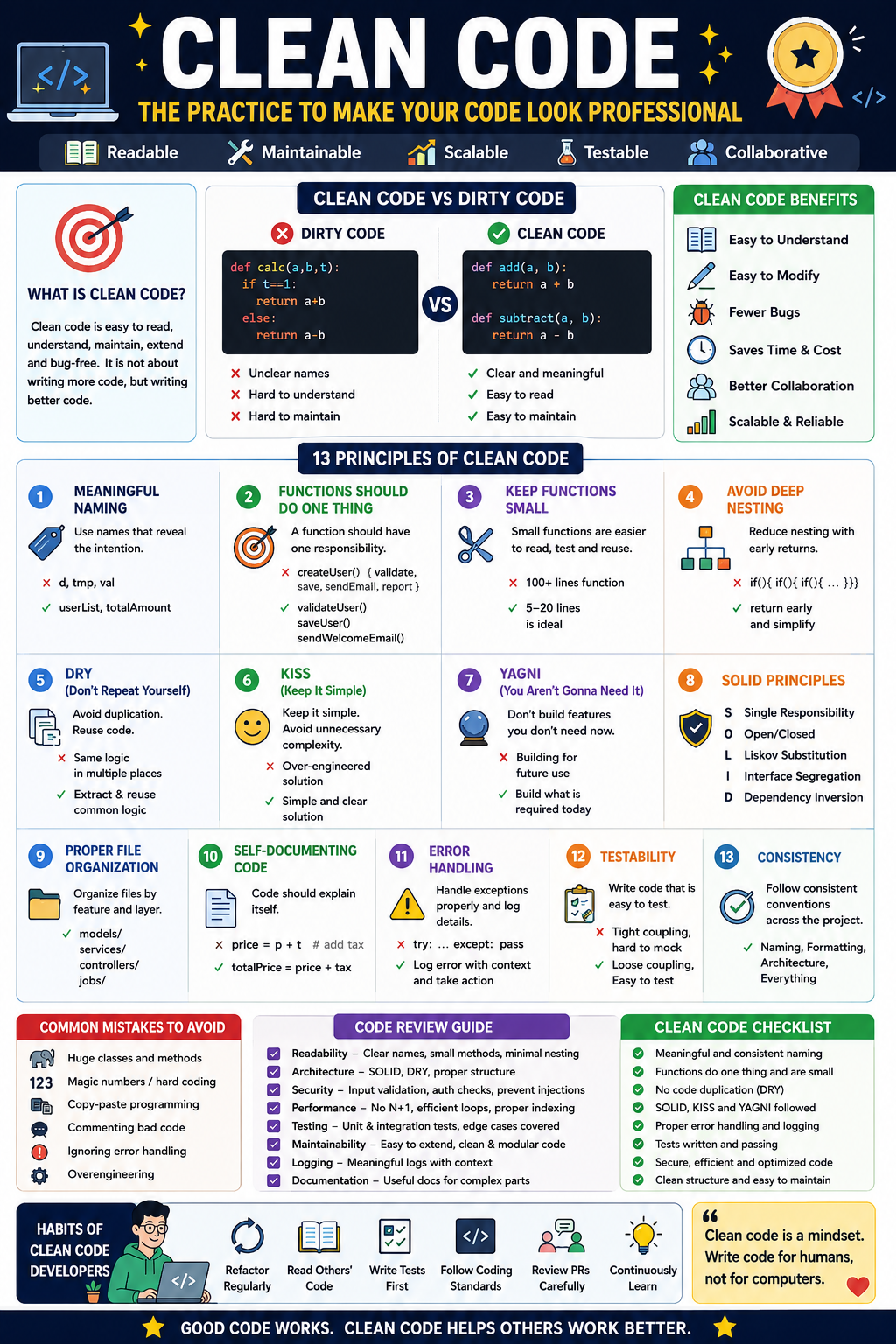
In this guide, you’ll learn:
✅ Clean Code Principles
✅ Naming Conventions
✅ Function Design
✅ SOLID Principles
✅ Error Handling
✅ Code Review Checklist
✅ Common Mistakes to Avoid
✅ Professional Coding Habits
✅ Real Examples
🎯 What is Clean Code?
Clean Code is code that:
- 📖 Is easy to read
- 🔧 Easy to maintain
- 🚀 Easy to extend
- 🧪 Easy to test
- 🤝 Easy for teams to collaborate on
A developer should be able to understand your code after months without needing extensive explanations.
❌ Dirty Code vs ✅ Clean Code
Bad Example
def calc(a,b,t)
  if t == 1
    a+b
  else
    a-b
  end
end
Problems
❌ Unclear names
❌ No documentation
❌ Hard to understand
Better Example
def calculate_total(price, tax)
  price + tax
end

def calculate_discounted_price(price, discount)
  price - discount
end
Benefits
✅ Self-explanatory
✅ Readable
✅ Easy maintenance
🏗 Principle 1: Meaningful Naming
The most important clean code practice.
Bad
u = User.find(1)Good
customer = User.find(1)Bad
def p(d)
end
Good
def print_invoice(invoice_data)
end
Naming Rules
✅ Use intention-revealing names
✅ Avoid abbreviations
✅ Use searchable names
✅ Avoid generic names like:
data
temp
obj
val
test
🧠 Principle 2: Functions Should Do One Thing
A function should have only one responsibility.
Bad
def create_user(params)
  validate(params)
  save_user(params)
  send_email(params)
  generate_report(params)
end
This method does 4 jobs.
Good
def create_user(params)
  validate_user(params)
  save_user(params)
  send_welcome_email(params)
end
Each function focuses on one responsibility.
📏 Principle 3: Keep Functions Small
Ideal function:
5–20 linesLarge functions become difficult to:
- Read
- Debug
- Test
Bad
def process_order
  # 200 lines
end
Good
def process_order(order)
  validate_order(order)
  calculate_total(order)
  generate_invoice(order)
end
🎭 Principle 4: Avoid Deep Nesting
Bad
if user
  if user.active?
    if user.has_subscription?
      perform_action
    end
  end
end
Good
return unless user
return unless user.active?
return unless user.has_subscription?

perform_action
Benefits
✅ Better readability
✅ Easier debugging
🔥 Principle 5: DRY (Don’t Repeat Yourself)
Avoid duplicated logic.
Bad
user.full_name.capitalize
customer.full_name.capitalize
admin.full_name.capitalize
Good
def formatted_name(person)
  person.full_name.capitalize
end
Benefits
✅ Single source of truth
✅ Easier maintenance
🧩 Principle 6: KISS (Keep It Simple, Stupid)
Avoid unnecessary complexity.
Bad
result = users.select { |u| u.active? }.map(&:email)when:
active_emails = User.active.pluck(:email)works better.
Ask Yourself
Can this be simpler?
If yes, simplify it.
🎯 Principle 7: YAGNI (You Aren’t Gonna Need It)
Don’t build future features prematurely.
Bad
class PaymentGateway
  def process_crypto
  end

  def process_ai_payment
  end

  def process_quantum_payment
  end
end
Future requirements don’t exist yet.
Good
class PaymentGateway
  def process_card_payment
  end
end
Build only what’s required today.
🔐 Principle 8: SOLID Principles
The foundation of professional code.
S — Single Responsibility Principle
One class = One responsibility.
Bad
class User
  def save
  end

  def send_email
  end
end
Good
class User
end

class EmailService
end
O — Open Closed Principle
Open for extension.
Closed for modification.
class PaymentProcessor
end

class StripeProcessor < PaymentProcessor
end

class PaypalProcessor < PaymentProcessor
end
L — Liskov Substitution
Child classes should behave like parents.
I — Interface Segregation
Avoid huge interfaces.
Create focused contracts.
D — Dependency Inversion
Depend on abstractions.
class UserService
  def initialize(email_service)
    @email_service = email_service
  end
end
📂 Principle 9: Proper File Organization
Good Structure
app/
├── models/
├── controllers/
├── services/
├── policies/
├── jobs/
├── mailers/
└── serializers/
Benefits
✅ Easier navigation
✅ Better scalability
📝 Principle 10: Write Self-Documenting Code
Code should explain itself.
Bad
# add tax
price = price + tax
Better
total_price = subtotal + tax_amountThe variable itself explains the purpose.
⚠️ Principle 11: Error Handling
Never ignore exceptions.
Bad
begin
  save_record
rescue
end
Good
begin
  save_record
rescue StandardError => e
  Rails.logger.error(e.message)
end
Professional Practice
Log:
- Error
- Context
- User
- Timestamp
🧪 Principle 12: Testability
Clean code is testable code.
Good Example
class TaxCalculator
  def calculate(amount)
    amount * 0.18
  end
end
Easy to test.
Bad Example
class TaxCalculator
  def calculate
    User.last.orders.last.price * 0.18
  end
end
Hard dependency.
Hard testing.
🏛 Principle 13: Consistency
Follow project conventions.
Use Consistent
✅ Naming
✅ Indentation
✅ Folder Structure
✅ API Design
✅ Error Formats
🚨 Common Clean Code Mistakes
1. Huge Classes
UserManagerwith 3000 lines.
2. Huge Methods
process_everything()500 lines.
3. Magic Numbers
Bad
salary * 1.18Good
TAX_RATE = 1.18
salary * TAX_RATE
4. Commenting Bad Code
Don’t do this:
# Fix laterInstead fix it now.
5. Copy-Paste Programming
The enemy of maintainability.
6. Overengineering
Avoid unnecessary:
- Patterns
- Abstractions
- Layers
🔎 Professional Code Review Guide
Before approving any PR, verify:
Readability
- Clear naming
- Small methods
- Small classes
- Minimal nesting
Architecture
- SOLID followed
- DRY maintained
- No duplicated logic
Security
- Input validation
- SQL Injection protection
- Authentication checks
Performance
- No N+1 queries
- Efficient loops
- Proper indexing
Testing
- Unit tests
- Integration tests
- Edge cases covered
Maintainability
- Easy to extend
- Easy to understand
- Proper logging
📋 Ultimate Clean Code Checklist
Naming
- Meaningful names
- No abbreviations
- Consistent conventions
Functions
- One responsibility
- Small size
- Easy to test
Classes
- Single responsibility
- Low coupling
- High cohesion
Architecture
- SOLID followed
- DRY applied
- KISS applied
- YAGNI applied
Quality
- Proper error handling
- Logging implemented
- Tests passing
- Security validated
Performance
- Queries optimized
- Caching considered
- No unnecessary loops
🌟 Habits of Developers Who Write Clean Code
✅ Refactor regularly
✅ Read others’ code
✅ Write tests first
✅ Follow coding standards
✅ Review every PR carefully
✅ Continuously learn design patterns
✅ Prioritize readability over cleverness
✅ Think about future maintainers
🎯 Final Thoughts
Clean Code is not a tool, framework, or language feature — it is a mindset. Professional developers understand that code is read far more often than it is written. Every line should communicate intent clearly, minimize complexity, and make future changes safe and predictable.
Remember this simple formula:
Readable Code + Simple Design + Proper Testing + Consistent Standards = Professional Software Engineering 🚀
The best developers are not those who write the most code; they are the ones who write code that teams can confidently understand, maintain, and scale for years. 💎


Comments
Post a Comment