🐍 Creating the Perfect Python Library: The Ultimate Guide to Professional Package Development 🚀
🐍 Creating the Perfect Python Library: The Ultimate Guide to Professional Package Development 🚀
“Good code solves problems. Great libraries solve them for thousands of developers.”
Python has one of the richest ecosystems in software development because developers continuously create reusable libraries that save time and improve productivity.
Libraries like NumPy, Pandas, Requests, FastAPI, and Django became successful not only because of their functionality but because they followed clean architecture, proper packaging, documentation, testing, and optimization.
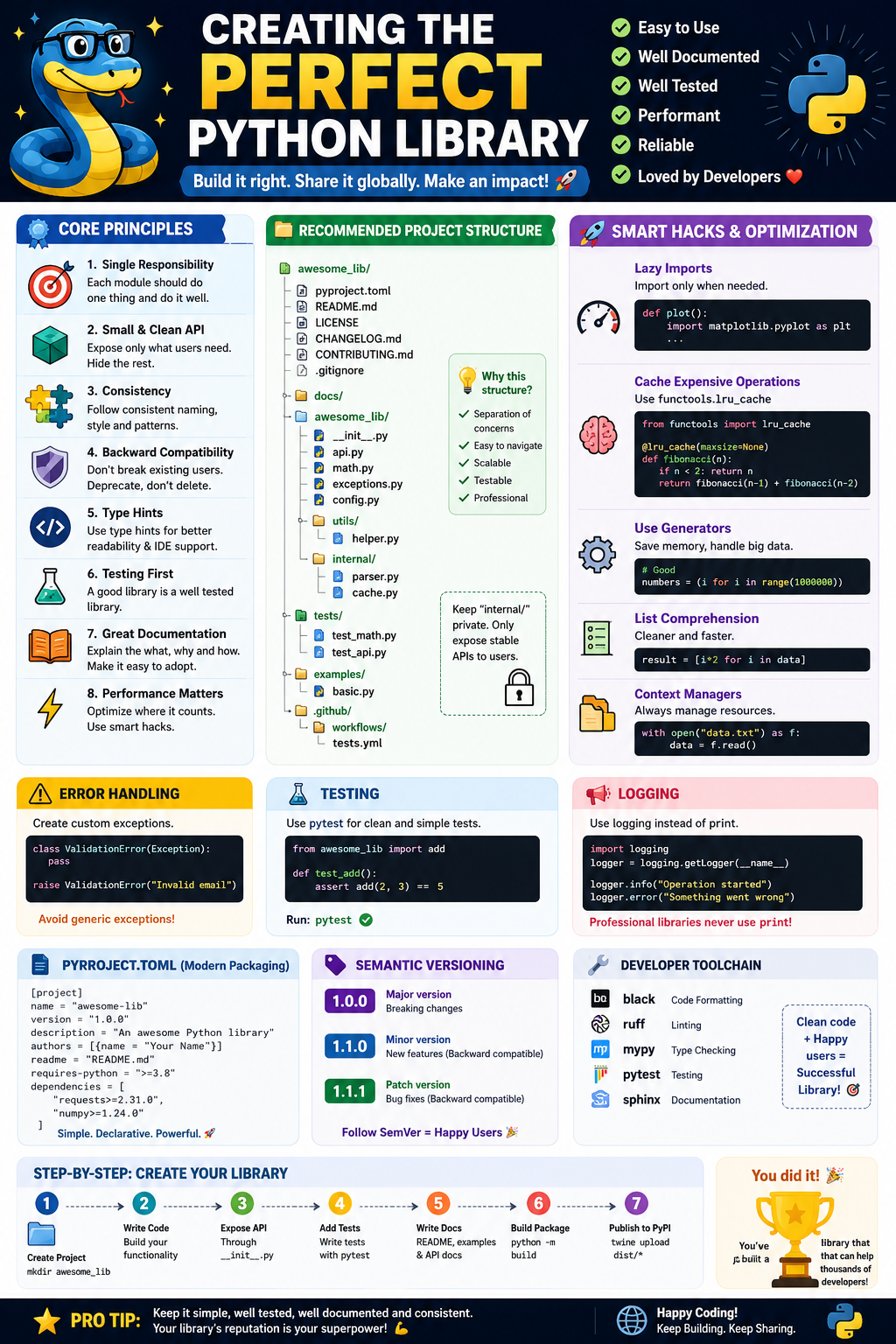
In this guide, you’ll learn how to build a production-ready Python library from scratch following professional engineering practices.
🎯 What Makes a Great Python Library?
A perfect Python library should be:
✅ Easy to Install
✅ Easy to Understand
✅ Easy to Extend
✅ Fast
✅ Well Tested
✅ Well Documented
✅ Secure
✅ Type Safe
✅ Backward Compatible
🏗 Core Principles
1. Single Responsibility Principle (SRP)
Every module should solve one problem.
❌ Bad
utils.pyContains
- API
- Database
- Logger
- Validation
Everything mixed together.
✅ Good
api.py
database.py
logger.py
validators.py
email.py
Each module has one responsibility.
2. Keep Public API Small
Users should interact with only necessary functions.
Instead of
library.internal.helper.calculate()Provide
library.calculate()Hide complexity internally.
3. Explicit is Better Than Implicit
Python’s Zen teaches:
import mylib

def old_function():
    warnings.warn(
        "Use new_function()",
        DeprecationWarning
    )
Avoid confusing APIs.
4. Backward Compatibility
Never break existing users.
Instead of deleting functions
old_function()Mark them deprecated.
import warnings

def old_function():
    warnings.warn(
        "Use new_function()",
        DeprecationWarning
    )
5. Consistent Naming
Good
load_file()
save_file()
delete_file()
Bad
FileLoader()
removeStuff()
SaveData()
Consistency improves readability.
📂 Professional Folder Structure
awesome_lib/
│
├── pyproject.toml
├── README.md
├── LICENSE
├── CHANGELOG.md
├── CONTRIBUTING.md
├── .gitignore
├── .github/
│     workflows/
│         tests.yml
│
├── docs/
│
├── tests/
│     test_math.py
│     test_api.py
│
├── examples/
│     basic.py
│
├── awesome_lib/
│     __init__.py
│     api.py
│     math.py
│     exceptions.py
│     config.py
│
│     utils/
│          helper.py
│
│     internal/
│          parser.py
│          cache.py
│
└── setup.py (optional)
📦 Why Use pyproject.toml?
Modern Python uses
pyproject.tomlExample
[project]

name = "awesome-lib"
version = "1.0.0"
description = "Professional Python Library"
authors = [
    {name="Lakhveer Singh"}
]
dependencies = [
    "requests",
    "numpy"
]
No need for complicated setup scripts.
📚 Package Structure
Example
awesome_lib/
  __init__.py
    math.py
    api.py
    validators.py
Inside
math.py

def square(x):
    return x*x
Inside
__init__.py
from .math import square
Now users can write
import awesome_lib

awesome_lib.square(10)
instead of
awesome_lib.math.square(10)Cleaner API.
🧩 Organize Internal Code
Public
awesome_lib/Private
awesome_lib/internal/Everything inside internal should remain hidden.
⚡ Use Lazy Imports
Instead of
import pandas
import numpy
import matplotlib
Import only when needed.
def plot():
  import matplotlib.pyplot as plt
Startup becomes much faster.
⚡ Cache Expensive Operations
Example
from functools import lru_cache

@lru_cache

def fibonacci(n):
    if n<2:
        return n

    return fibonacci(n-1)+fibonacci(n-2)
Huge speed improvement.
⚡ Avoid Global Variables
Bad
CONFIG={}Good
class Config:
  timeout=30
Cleaner design.
🚀 Logging
Instead of
print("Error")Use
import logging

logger=logging.getLogger(__name__)
logger.info("Started")
Professional libraries never rely on print statements.
🧪 Testing
Create
tests/Install
pytestExample
def test_square():
  assert square(5)==25
Run
pytestAlways test before releasing.
🎯 Type Hints
Bad
def add(a,b):Good
def add(a:int,b:int)->int:
  return a+b
Benefits
- IDE autocomplete
- Static analysis
- Easier maintenance
📄 Documentation
Every function should explain itself.
def square(x:int)->int:
  """
    Returns square of x.
  """
Generate documentation automatically using
- Sphinx
- MkDocs
📦 Semantic Versioning
Use
Major.Minor.PatchExample
1.0.0
1.1.0
1.2.0
2.0.0
Major
Breaking changes
Minor
New features
Patch
Bug fixes
🚀 Performance Hacks
✅ Use Generators
Bad
numbers=[]

for i in range(1000000):
    numbers.append(i)
Good
numbers=(i for i in range(1000000))Lower memory usage.
✅ List Comprehension
Instead of
result=[]

for i in data:
    result.append(i*2)
Use
result=[i*2 for i in data]Cleaner and faster.
✅ Context Managers
Bad
f=open("data.txt")Good
with open("data.txt") as f:
    data=f.read()
Automatically closes resources.
✅ Avoid Duplicate Computations
Instead of
calculate()
calculate()
Store result
result=calculate()🔒 Error Handling
Create
exceptions.py

class ValidationError(Exception):
    pass
Use
raise ValidationError("Invalid Email")Never raise generic exceptions unnecessarily.
📦 Dependency Management
Avoid
50 dependenciesUse only essential packages.
Benefits
- Faster installation
- Fewer security risks
- Smaller package size
🛠 Continuous Integration
GitHub Actions
Push
↓
Run Tests
↓
Lint
↓
Build
↓
Publish
Every commit gets validated automatically.
🎨 Code Formatting
Use
blackFor formatting
Use
ruffFor linting
Use
mypyFor type checking
Together they keep code production-ready.
🚀 Step-by-Step: Build a Simple Python Library
Step 1
Create project
mkdir awesome_mathStep 2
Create structure
awesome_math/
  awesome_math/
        __init__.py
        operations.py
Step 3
Write functionality
# operations.py

def add(a,b):
    return a+b

def multiply(a,b):
    return a*b
Step 4
Expose API
# __init__.py

from .operations import add,multiply
Step 5
Create pyproject.toml
[project]

name="awesome-math"
version="1.0.0"
description="Simple math library"
Step 6
Install locally
pip install -e .Step 7
Use it
import awesome_math

print(awesome_math.add(5,7))
print(awesome_math.multiply(3,4))
Output
12
12
Step 8
Add tests
tests/test_operations.py

from awesome_math import add

  def test_add():
    assert add(2,3)==5
Run
pytestStep 9
Write README
Include:
- Installation
- Features
- Examples
- API Reference
- License
- Contributing
A great README often determines whether developers adopt your library.
Step 10
Publish to PyPI
python -m build
twine upload dist/*
Users can now install it with
pip install awesome-math🧠 Professional Checklist
✔ Clean architecture
✔ Small public API
✔ Type hints
✔ Logging
✔ Testing
✔ Documentation
✔ CI/CD
✔ Semantic versioning
✔ Minimal dependencies
✔ Custom exceptions
✔ Code formatting
✔ Linting
✔ Security scanning
✔ Performance optimization
✔ Examples folder
✔ Changelog
✔ License
✔ GitHub Actions
✔ Package metadata
✔ Stable API
💡 Final Thoughts
Creating a successful Python library is about more than writing useful code — it’s about delivering a polished developer experience. A clear folder structure, thoughtful API design, comprehensive tests, excellent documentation, and automated quality checks transform a simple package into a trusted tool that others enjoy using. Focus on simplicity, maintainability, and performance from day one, and your library will be easier to adopt, contribute to, and scale over time.
“The best libraries don’t just solve problems — they make solving them feel effortless.” 🚀🐍


Comments
Post a Comment