🛡️ Cyber Security Mastery Guide: Protecting the Digital World in 2026 🚀
🛡️ Cyber Security Mastery Guide: Protecting the Digital World in 2026 🚀
“Security is not a product, but a process.” — Bruce Schneier
In today’s interconnected world, cyber attacks occur every few seconds. Whether you’re a developer, business owner, or everyday internet user, understanding Cyber Security is no longer optional — it’s essential.
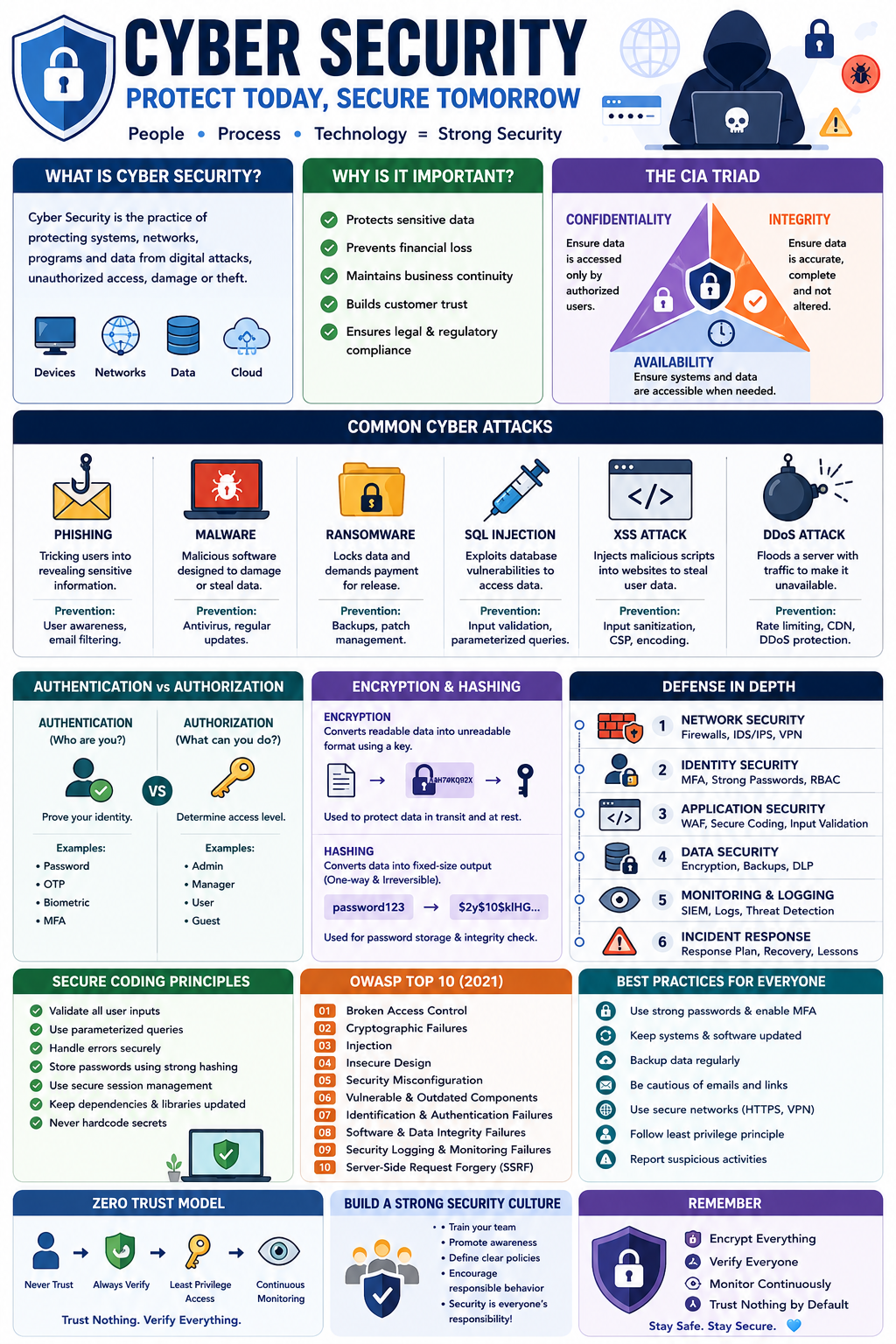
This comprehensive guide covers:
✅ Cyber Security Fundamentals
✅ Important Terminologies
✅ Security Principles
✅ Attack Types
✅ Security Tools
✅ Building a Perfect Security Architecture
✅ Real-World Examples
✅ Best Practices for Developers
🌍 What is Cyber Security?
Cyber Security is the practice of protecting:
- Computers 💻
- Networks 🌐
- Servers 🖥️
- Applications 📱
- Data 📊
- Cloud Infrastructure ☁️
from unauthorized access, theft, damage, and cyber attacks.
Simple Example
Imagine your house:
🏠 House = Computer System
🚪 Door Lock = Authentication
🎥 CCTV = Monitoring
🔐 Safe = Encryption
🚔 Security Guard = Firewall
Cyber Security applies these protections to digital assets.
🎯 Why Cyber Security Matters
According to industry reports:
- Millions of phishing attacks occur yearly
- Ransomware damages cost billions
- Data breaches expose customer information
- Small businesses are frequent targets
A single breach can lead to:
❌ Financial Loss
❌ Reputation Damage
❌ Legal Consequences
❌ Business Shutdown
🏗️ Core Pillars of Cyber Security (CIA Triad)
The foundation of all security systems.
1️⃣ Confidentiality 🔒
Only authorized people can access data.
Example
Bank account details should only be visible to:
- Account holder
- Authorized bank employees
Protection Methods
- Encryption
- Authentication
- Access Controls
2️⃣ Integrity ✅
Data should not be modified without authorization.
Example
A hacker changes:
Salary = ₹50,000to
Salary = ₹5,00,000Integrity controls prevent this.
Protection Methods
- Hashing
- Digital Signatures
- Checksums
3️⃣ Availability ⚡
Systems should remain accessible.
Example
Amazon website should stay available 24/7.
Protection Methods
- Load Balancers
- Backups
- Disaster Recovery
- DDoS Protection
🔑 Important Cyber Security Terminologies
Vulnerability
A weakness in a system.
Example:
Outdated Software
Weak Password
Open Port
Threat
Anything capable of exploiting a vulnerability.
Example:
👨💻 Hacker
🦠 Malware
🎣 Phishing Campaign
Risk
Likelihood of threat exploiting a vulnerability.
Formula:
Risk = Threat × Vulnerability × ImpactExploit
Code or technique used to abuse a vulnerability.
Example:
SQL Injection Script
Payload
Malicious code delivered after exploitation.
Example:
Ransomware Installation
Patch
Security update fixing vulnerabilities.
Example:
Operating System Updates
🎭 Common Types of Cyber Attacks
1️⃣ Phishing Attack 🎣
Fake emails trick users into revealing credentials.
Example:
Your Bank Account Will Be Closed!
Click Here...
User enters password.
Attacker steals credentials.
2️⃣ Malware Attack 🦠
Malicious software infects systems.
Types:
- Virus
- Worm
- Trojan
- Spyware
- Adware
3️⃣ Ransomware 💰
Encrypts files and demands payment.
Example:
Pay $1000
or lose your files forever.
4️⃣ SQL Injection 💉
Targets databases.
Vulnerable query:
SELECT * FROM users
WHERE email='user@example.com'
AND password='123';
Attacker enters:
' OR '1'='1Authentication bypassed.
Prevention
✅ Parameterized Queries
✅ ORM Usage
✅ Input Validation
5️⃣ Cross-Site Scripting (XSS)
Injects malicious JavaScript.
Example:
<script>
alert("Hacked");
</script>
Prevention
- Input Sanitization
- Content Security Policy
- Output Encoding
6️⃣ DDoS Attack 🌊
Thousands of systems flood a server.
Result:
🚫 Website becomes unavailable.
7️⃣ Man-In-The-Middle Attack
Attacker intercepts communication.
Example:
Public WiFi Attack.
Protection:
🔒 HTTPS
🔒 VPN
🔒 TLS Encryption
🔐 Authentication vs Authorization
Authentication
“Who are you?”
Examples:
- Username
- Password
- OTP
- Fingerprint
Authorization
“What can you access?”
Examples:
Admin
Manager
Employee
Guest
🔒 Encryption Explained
Encryption converts readable data into unreadable form.
Plain Text
Hello WorldCipher Text
A8H7#KQ92XOnly authorized users can decrypt it.
Symmetric Encryption
Same key used.
Examples:
- AES
- DES
Fast ⚡
Asymmetric Encryption
Two keys:
🔑 Public Key
🔑 Private Key
Examples:
- RSA
- ECC
Used in HTTPS.
🧾 Hashing
Hashing converts data into fixed-size output.
Example:
password123becomes
482c811da5d5b4bc...Characteristics:
✅ One-way
✅ Irreversible
✅ Fast Verification
Popular Algorithms:
- SHA-256
- SHA-512
- bcrypt
- Argon2
🏰 Defense in Depth
Never rely on one security layer.
Instead:
Firewall
    ↓
WAF
    ↓
Authentication
    ↓
Authorization
    ↓
Encryption
    ↓
Monitoring
Multiple layers increase security.
☁️ Cloud Security
Cloud environments require:
Identity Management
- IAM Roles
- Least Privilege
Storage Security
- Encrypted Buckets
- Secure Databases
Network Security
- Security Groups
- Private Subnets
Monitoring
- Cloud Logs
- Threat Detection
👨💻 Secure Coding Principles
Developers play a major role in security.
Input Validation
Never trust user input.
Bad:
User.find_by_sql(params[:query])Good:
User.where(email: params[:email])Parameterized Queries
Prevent SQL Injection.
User.where(email: email)Password Security
Never store plain passwords.
Use:
bcrypt
argon2
Secure Session Management
Use:
- Secure Cookies
- HttpOnly
- SameSite
Secret Management
Never store secrets in code.
Bad:
API_KEY="123456"Good:
ENV["API_KEY"]🚨 OWASP Top 10 Risks
Every developer should know these.
- Broken Access Control
- Cryptographic Failures
- Injection
- Insecure Design
- Security Misconfiguration
- Vulnerable Components
- Authentication Failures
- Software Integrity Failures
- Logging Failures
- SSRF
🧰 Essential Security Tools
Network Security
- Wireshark
- Nmap
- Burp Suite
Vulnerability Scanning
- Nessus
- OpenVAS
Web Security
- OWASP ZAP
- Burp Suite
Monitoring
- ELK Stack
- Splunk
Container Security
- Trivy
- Clair
Cloud Security
- AWS Security Hub
- GuardDuty
🏗️ Building a Perfect Security System
Layer 1: Network Security 🌐
Implement:
✅ Firewalls
✅ VPN
✅ IDS/IPS
Layer 2: Identity Security 👤
Implement:
✅ MFA
✅ Strong Passwords
✅ RBAC
Layer 3: Application Security 📱
Implement:
✅ Input Validation
✅ Secure APIs
✅ WAF
Layer 4: Data Security 🔐
Implement:
✅ Encryption
✅ Backups
✅ Tokenization
Layer 5: Monitoring 👁️
Implement:
✅ SIEM
✅ Logging
✅ Alerting
Layer 6: Incident Response 🚑
Create:
- Security Playbooks
- Response Procedures
- Recovery Plans
🔄 Secure Software Development Lifecycle (SSDLC)
1️⃣ Planning
Threat Modeling
2️⃣ Design
Security Architecture
3️⃣ Development
Secure Coding
4️⃣ Testing
Penetration Testing
5️⃣ Deployment
Security Hardening
6️⃣ Monitoring
Continuous Security Checks
🏆 Zero Trust Security Model
Traditional Model:
Trust Internal UsersZero Trust:
Trust Nobody
Verify Everyone
Principles:
✅ Verify Explicitly
✅ Least Privilege
✅ Continuous Monitoring
🚀 Cyber Security Roadmap for Developers
Beginner
✅ Networking Basics
✅ Linux
✅ HTTP/HTTPS
✅ Authentication
✅ Encryption
Intermediate
✅ OWASP Top 10
✅ Secure Coding
✅ Docker Security
✅ Cloud Security
Advanced
✅ Penetration Testing
✅ Malware Analysis
✅ Threat Hunting
✅ Incident Response
🎯 Daily Security Checklist
Personal
✅ Use Password Manager
✅ Enable MFA
✅ Update Devices
✅ Backup Data
✅ Avoid Suspicious Links
Developer
✅ Scan Dependencies
✅ Review Logs
✅ Rotate Secrets
✅ Patch Servers
✅ Perform Security Audits
💡 Final Thoughts
Cyber Security is not a one-time task — it is a continuous journey. The strongest organizations combine people, processes, and technology to create multiple layers of defense.
Remember:
🔒 Encrypt Everything
🔑 Verify Everyone
🛡️ Trust Nothing
📊 Monitor Continuously
🚀 Improve Constantly
The safest systems are not those that never get attacked — they are the ones prepared to detect, respond, and recover quickly from attacks.
“Cyber Security is much like a chess game: anticipate moves, protect your assets, and stay several steps ahead.” ♟️🛡️


Comments
Post a Comment