🚀 The End of Procrastination: Master the Art of Having No Pending Tasks ⏳✅
🚀 The End of Procrastination: Master the Art of Having No Pending Tasks ⏳✅
Psychology, Habits, Systems & Daily Framework to Become an Action Machine
“Procrastination is not about managing time. It’s about managing emotions.” — Tim Pychyl
🌟 Introduction
Imagine waking up every morning knowing you have zero pending tasks, your mind is calm, your work is organized, and every day feels productive rather than stressful.
Sounds impossible?
Not really.
The world’s highest performers don’t necessarily have more talent or more hours than everyone else.
They simply master the art of finishing things.
The biggest enemy isn’t laziness.
It’s procrastination.
Most people think procrastination means:
“I’ll do it later.”
Psychology says something very different.
Procrastination is voluntarily delaying an important task despite knowing it will make life worse later.
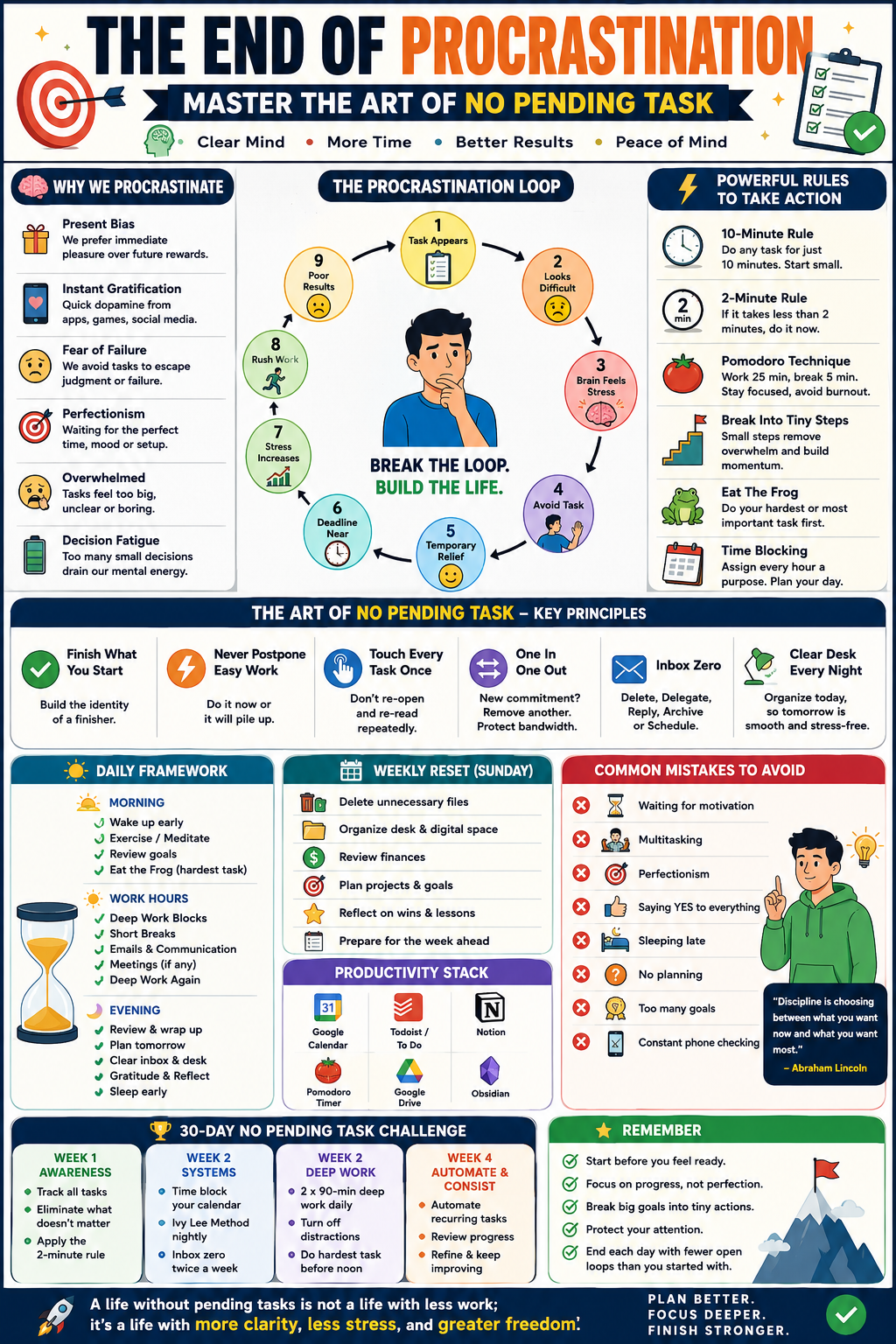
This guide will help you understand:
- 🧠 Why we procrastinate
- 🔥 The psychology behind delay
- ⚡ Scientific methods to overcome it
- 📅 Daily systems for completing every task
- 🎯 The Art of No Pending Task
- 🚀 Becoming someone who finishes everything
🧠 Chapter 1: What Exactly is Procrastination?
Procrastination is emotional avoidance.
Example:
Instead of writing your blog…
You suddenly decide to:
- Check Instagram 📱
- Watch YouTube
- Clean your desk
- Reply to unnecessary messages
- Read random news
You’re not lazy.
You’re escaping discomfort.
🎭 The Procrastination Loop
Task Appears
      ↓
Looks Difficult
      ↓
Brain Feels Stress
      ↓
Avoid Task
      ↓
Temporary Relief
      ↓
Deadline Near
      ↓
Stress Increases
      ↓
Rush Work
      ↓
Poor Results
      ↓
Repeat
🧠 Chapter 2: Psychology Behind Procrastination
1️⃣ Present Bias
Humans naturally prefer:
Immediate pleasure ❤️
instead of
Future rewards.
Example:
Would you rather:
🍕 Eat pizza today
or
🏋️ Get fit after six months?
Your brain chooses today’s happiness.
2️⃣ Instant Gratification
Social media gives:
- Likes ❤️
- Dopamine ⚡
- Entertainment 🎬
within seconds.
Writing a book?
Reward comes after months.
Guess which your brain prefers?
3️⃣ Fear of Failure
People delay because they think:
“What if I’m not good enough?”
Example
Instead of launching a startup…
Someone keeps learning for years.
They aren’t preparing.
They’re hiding.
4️⃣ Fear of Success
Sounds strange?
Success means:
- More responsibility
- More expectations
- Bigger challenges
Your subconscious sometimes avoids success itself.
5️⃣ Perfectionism
Perfectionists often procrastinate more.
Why?
Because they wait for:
- Perfect mood
- Perfect setup
- Perfect idea
Reality:
Done is better than perfect.
6️⃣ Decision Fatigue
Every decision consumes mental energy.
Example
Morning:
“What should I work on?”
10 minutes gone.
“What should I wear?”
“What should I eat?”
“What should I answer?”
By afternoon…
Your brain is exhausted.
7️⃣ Identity Problem
Most people say:
“I need motivation.”
Successful people say:
“I am someone who finishes what I start.”
Identity creates habits.
🧬 Chapter 3: Neuroscience of Procrastination
Two brain regions fight every day.
🧠 Prefrontal Cortex
Responsible for:
- Planning
- Logic
- Discipline
- Long-term thinking
🧠 Limbic System
Responsible for:
- Emotions
- Pleasure
- Comfort
- Avoiding pain
When emotions win…
You procrastinate.
When logic wins…
You act.
⚡ Chapter 4: Dopamine & Productivity
Dopamine is not the reward chemical.
It is the motivation chemical.
Bad dopamine:
📱 Social media
🍔 Junk food
🎮 Games
Good dopamine:
✅ Completing tasks
📚 Learning
🏃 Exercise
Building
Teaching
Creating
🎯 Chapter 5: The Real Reasons We Delay
People don’t delay because tasks are hard.
They delay because tasks feel:
- Confusing
- Unclear
- Boring
- Huge
- Emotionally uncomfortable
🔥 Chapter 6: The 10-Minute Rule
Tell yourself:
“I’ll only do this for 10 minutes.”
Example
Need to write 3000 words?
Write only 100.
Most people continue once they begin.
Starting is the hardest part.
⚙️ Chapter 7: The 2-Minute Rule
If something takes less than:
2 minutes
Do it immediately.
Examples:
✅ Reply email
✅ Wash cup
✅ File document
✅ Pay bill
Small tasks should never become tomorrow’s burden.
🍅 Chapter 8: Pomodoro Technique
Work:
25 Minutes
Break:
5 Minutes
Repeat.
Benefits:
- Less burnout
- Better concentration
- Faster completion
🧩 Chapter 9: Break Everything into Tiny Steps
Don’t write:
❌ Build Website
Write:
✅ Create folder
✅ Install framework
✅ Create homepage
✅ Add navbar
Tiny wins create momentum.
🎯 Chapter 10: Eat the Frog
“Eat the frog first.” — Brian Tracy
Meaning:
Do the hardest task first.
Everything else becomes easier.
Morning energy is priceless.
📋 Chapter 11: Time Blocking
Instead of a to-do list:
Use a calendar.
Example:
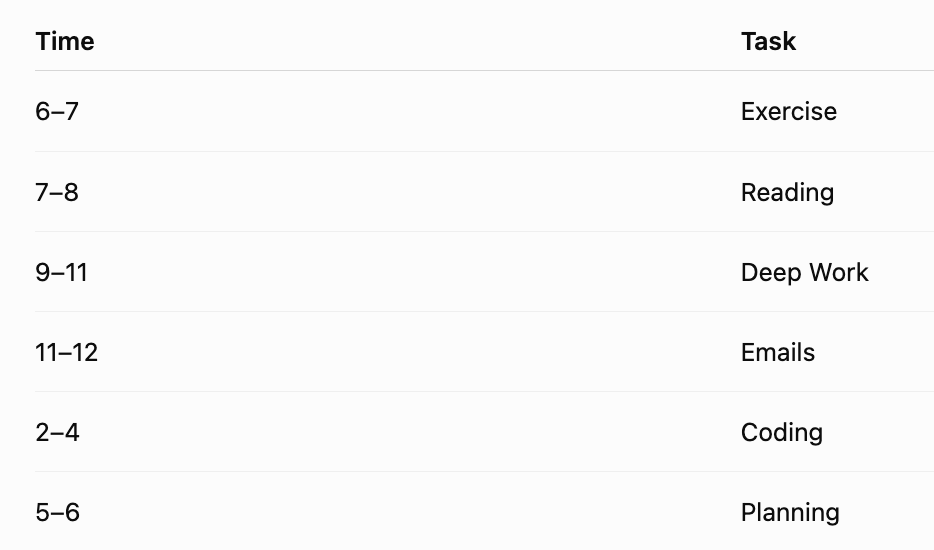
Every hour has a purpose.
🚫 Chapter 12: The Art of Saying NO
Every YES creates another pending task.
Say NO to:
❌ Unnecessary meetings
❌ Random phone calls
❌ Endless scrolling
❌ Low-value work
Protect your attention.
📱 Chapter 13: Digital Minimalism
Turn off:
- Notifications
- Auto-playing videos
- Unnecessary apps
Keep your phone boring.
🏆 Chapter 14: Build Keystone Habits
Some habits improve everything.
Examples:
🏃 Exercise
😴 Sleep
📖 Reading
🧘 Meditation
📅 Daily Planning
These reduce procrastination naturally.
🧠 Chapter 15: The Habit Loop
Every habit has:
Cue
 ↓
Routine
 ↓
Reward
Example:
Morning Coffee ☕
↓
Open Laptop 💻
↓
Write Blog ✍️
↓
Tick Checklist ✅
Repeat daily.
⚡ Chapter 16: Flow State
Flow happens when:
Challenge = Skill
Not too easy.
Not too difficult.
Remove distractions.
Work deeply.
📚 Chapter 17: Parkinson’s Law
“Work expands to fill the time available.”
Example:
Assignment due in:
30 days.
Most people work on Day 29.
Set shorter deadlines.
🎯 Chapter 18: The Ivy Lee Method
Every evening:
Write only:
Top 6 tasks.
Next day:
Finish them one by one.
Simple.
Powerful.
💎 Chapter 19: The Art of No Pending Task
This philosophy is simple:
Never allow today’s work to become tomorrow’s stress.
Rule 1️⃣
Finish what you start.
Rule 2️⃣
Never leave a room empty-handed.
Take something useful.
Small actions prevent clutter.
Rule 3️⃣
Touch every task once.
Instead of:
Read email.
Close.
Read again.
Close.
Reply immediately.
Rule 4️⃣
Never postpone easy work.
If possible:
Do it now.
Rule 5️⃣
One In → One Out
New commitment?
Remove another.
Protect your workload.
Rule 6️⃣
Inbox Zero
Process:
Delete
Delegate
Reply
Archive
Schedule
Never keep unread emails for weeks.
Rule 7️⃣
Clear Desk Rule
Finish today with:
- Clean desk
- Organized files
- Tomorrow planned
Future-you will thank present-you.
📅 Chapter 20: Daily No Pending Task Framework
🌅 Morning
✅ Wake early
✅ Exercise
✅ Review goals
✅ Eat the Frog
☀️ Work Hours
Deep Work
↓
Small Break
↓
Emails
↓
Meetings
↓
Deep Work
🌙 Evening
Review completed work.
Update tomorrow.
Clear inbox.
Organize workspace.
Sleep peacefully.
🧩 Weekly Reset
Every Sunday:
- Delete unnecessary files
- Organize desktop
- Review finances
- Plan projects
- Clean workspace
- Reflect on wins and lessons
🚀 Productivity Stack
- 📅 Google Calendar
- ✅ Todoist / Microsoft To Do
- 📝 Notion
- ⏲️ Pomodoro Timer
- 📂 Google Drive
- 🧠 Obsidian
⚠️ Common Productivity Mistakes
❌ Waiting for motivation
❌ Multitasking
❌ Perfectionism
❌ Saying yes to everything
❌ Sleeping late
❌ No planning
❌ Too many goals
❌ Constant phone checking
🌱 Build the Identity of a Finisher
Instead of saying:
“I need motivation.”
Say:
“I am someone who completes what I start.”
Instead of:
“I have too much work.”
Say:
“I’ll finish one task at a time.”
Identity drives behavior.
🏅 30-Day No Pending Task Challenge
Week 1: Awareness
- Track every unfinished task.
- Eliminate tasks that no longer matter.
- Apply the 2-minute rule.
Week 2: Systems
- Time-block your calendar.
- Use the Ivy Lee Method nightly.
- Process your inbox to zero twice this week.
Week 3: Deep Work
- Schedule two 90-minute distraction-free sessions daily.
- Turn off non-essential notifications.
- Complete the hardest task before noon.
Week 4: Automation & Consistency
- Automate recurring reminders and bill payments.
- Review weekly progress.
- Celebrate completed milestones.
- Refine your workflow for the next month.
💬 Inspirational Quotes
“Action is the foundational key to all success.” — Pablo Picasso
“The secret of getting ahead is getting started.” — Mark Twain
“Success is the sum of small efforts repeated day in and day out.” — Robert Collier
“Amateurs sit and wait for inspiration, the rest of us just get up and go to work.” — Stephen King
“The best way to predict the future is to create it.” — Often attributed to Peter Drucker (though the attribution is debated).
🎯 Final Thoughts
Procrastination isn’t defeated by working harder — it is defeated by working intentionally. Every unfinished task occupies mental space, while every completed task creates momentum and confidence.
The Art of No Pending Task is not about being busy all day. It is about making conscious decisions, simplifying commitments, and consistently finishing what matters most.
Remember:
- 🚀 Start before you feel ready.
- 🎯 Focus on progress, not perfection.
- 🧩 Break big goals into tiny actions.
- ⏳ Protect your attention like your greatest asset.
- ✅ End each day with fewer open loops than you started with.
When you repeatedly choose action over avoidance, productivity transforms from a struggle into a habit — and eventually into your identity.
“A life without pending tasks is not a life with less work; it’s a life with more clarity, less stress, and greater freedom.” 🌟


Comments
Post a Comment