🚀 Habits: The Building Blocks of Success 🌱 and Failure ⚠️
🚀 Habits: The Building Blocks of Success 🌱 and Failure ⚠️
“First we make our habits, then our habits make us.” — John Dryden
Imagine two people starting from the same point in life. They have similar intelligence, similar opportunities, and similar resources. Yet, after 10 years, one becomes highly successful while the other struggles.
What creates this massive difference?
The answer often lies in a single word:
🎯 HABITS
Success is rarely an overnight event. Likewise, failure is rarely caused by one mistake. Both are the result of small actions repeated consistently over time.
Your habits are the invisible architecture of your future.
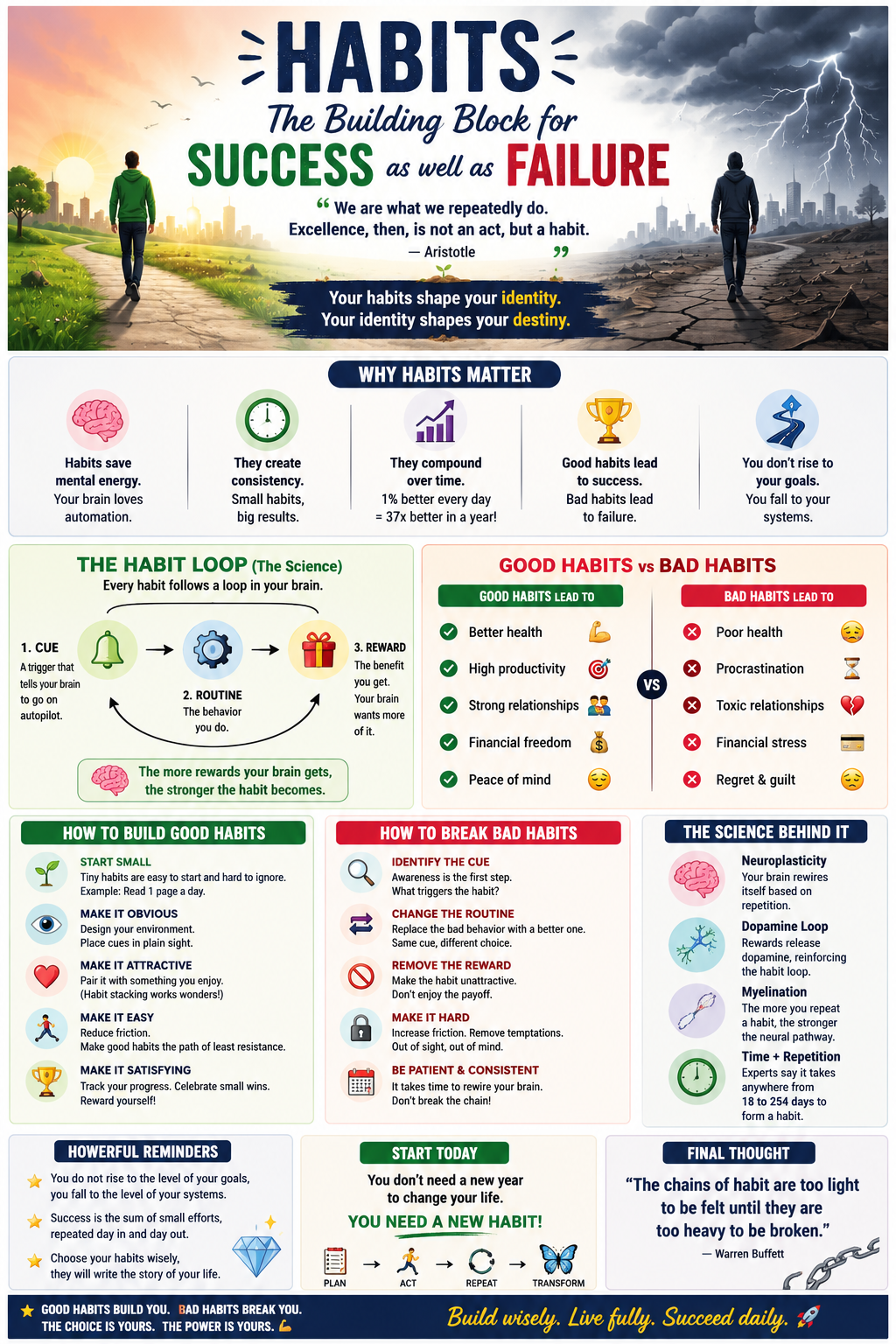
In this guide, we’ll explore:
✅ What habits are
✅ The science behind habit formation
✅ How habits create success and failure
✅ The psychology of behavior change
✅ How to build powerful habits
✅ How to break bad habits permanently
✅ Practical systems for long-term success
Let’s dive in!
🧠 What Are Habits?
A habit is a behavior performed automatically because it has been repeated many times.
Examples:
✅ Brushing teeth
✅ Checking your phone after waking up
✅ Exercising every morning
✅ Reading before sleep
Your brain loves habits because they save energy.
Instead of making thousands of decisions daily, your brain automates recurring actions.
This allows you to focus on more important tasks.
🔬 The Science Behind Habits
According to neuroscience, habits are stored in a part of the brain called the Basal Ganglia.
When we repeat an action frequently:
1️⃣ The brain notices the pattern.
2️⃣ Neural pathways become stronger.
3️⃣ The action becomes automatic.
This process is called:
🧠 Neuroplasticity
The more you repeat a behavior, the stronger the neural pathway becomes.
Think of it like walking through a forest.
- First walk = difficult
- Tenth walk = easier
- Hundredth walk = clear path
Habits work exactly the same way.
🔄 The Habit Loop
Behavior scientist Charles Duhigg introduced the famous Habit Loop.
Every habit consists of:
1️⃣ Cue (Trigger)
Something that initiates behavior.
Examples:
📱 Phone notification
☕ Smell of coffee
⏰ Morning alarm
2️⃣ Routine
The actual behavior.
Examples:
📖 Reading a book
🚶 Walking
🍔 Eating junk food
3️⃣ Reward
The benefit received.
Examples:
😊 Pleasure
😌 Relaxation
🏆 Achievement
Example
Cue ➜ Stress
Routine ➜ Social Media Scrolling
Reward ➜ Temporary Relief
Repeat this enough times and it becomes automatic.
🌟 How Habits Create Success
Successful people are not necessarily more motivated.
They simply have better systems and habits.
Success Formula
Success = Good Decisions × Consistency × Time
Small habits create extraordinary outcomes.
📚 Reading 10 Pages Daily
10 pages/day
= 3650 pages/year
≈ 12–15 books annually
Imagine the knowledge gained after 5 years.
🏋️ Exercising 30 Minutes Daily
30 minutes/day
= 182 hours/year
The benefits:
✅ Better health
✅ Higher energy
✅ Increased confidence
✅ Improved mental health
💰 Investing Small Amounts
₹200 daily invested wisely
can potentially grow into significant wealth over decades through compounding.
Success often comes from tiny actions repeated consistently.
⚠️ How Habits Create Failure
Failure usually happens slowly.
Most people never notice it happening.
Example 1: Financial Failure
Daily Expense:
☕ Coffee = ₹150
🍕 Snacks = ₹150
Total = ₹300/day
Annual cost:
₹300 × 365 = ₹109,500
Small spending habits create large financial consequences.
Example 2: Health Decline
❌ Poor sleep
❌ Junk food
❌ No exercise
❌ Constant stress
One unhealthy day is harmless.
Thousands of unhealthy days create serious problems.
Example 3: Career Stagnation
Not learning:
📖 New technologies
📈 New skills
🤝 Networking
can leave you behind while others improve.
Failure is often a result of neglected habits.
📈 The Compound Effect of Habits
“Small choices + Consistency + Time = Massive Results.”
Imagine improving only 1% every day.
After one year:
You become dramatically better than when you started.
Likewise, becoming 1% worse daily can lead to significant decline.
The power lies in consistency.
🎯 Identity-Based Habits
One of the most powerful concepts from habit psychology:
Focus on who you want to become.
Not what you want to achieve.
Weak Goal
❌ “I want to run a marathon.”
Strong Identity
✅ “I am a runner.”
Weak Goal
❌ “I want to write blogs.”
Strong Identity
✅ “I am a writer.”
When habits become part of your identity, they become easier to maintain.
🏗️ How to Build Good Habits
Rule 1: Start Tiny
Most people fail because they start too big.
Instead:
❌ Read 50 pages
✅ Read 2 pages
❌ Run 5 kilometers
✅ Walk 5 minutes
Small wins build momentum.
Rule 2: Habit Stacking
Attach a new habit to an existing one.
Formula:
After [Current Habit], I will [New Habit]
Examples:
☕ After making coffee, I will read one page.
🪥 After brushing teeth, I will meditate for 2 minutes.
Rule 3: Make It Obvious
Reduce friction.
Want to read?
📚 Keep books visible.
Want to exercise?
👟 Keep shoes ready.
Environment shapes behavior.
Rule 4: Make It Attractive
Pair habits with something enjoyable.
Examples:
🎧 Listen to favorite music while exercising.
☕ Enjoy good coffee while reading.
The brain repeats rewarding experiences.
Rule 5: Track Progress
What gets measured gets improved.
Use:
✅ Habit trackers
✅ Calendars
✅ Mobile apps
Seeing progress motivates consistency.
🚫 How to Break Bad Habits
Many people focus on willpower.
The smarter approach is to redesign the environment.
Step 1: Identify Triggers
Ask:
What causes this habit?
Examples:
😩 Stress
😴 Boredom
📱 Notifications
👥 Certain people
Step 2: Remove Cues
Want less social media?
❌ Keep apps on home screen
✅ Remove shortcuts
✅ Disable notifications
✅ Use app blockers
Step 3: Increase Friction
Make bad habits harder.
Examples:
🍫 Store junk food far away
📱 Log out of social media
💳 Remove saved payment methods
Step 4: Replace, Don’t Remove
Bad habits leave a void.
Replace them.
Instead of:
❌ Smoking
Try:
✅ Walking
✅ Deep breathing
✅ Drinking water
Step 5: Focus on Systems
Do not rely on motivation.
Create systems.
Motivation fades.
Systems survive.
🧬 The Psychology of Habit Change
Humans seek:
🎯 Pleasure
😌 Comfort
⚡ Immediate rewards
The challenge is that:
Good habits offer delayed rewards.
Bad habits offer instant rewards.
Examples:
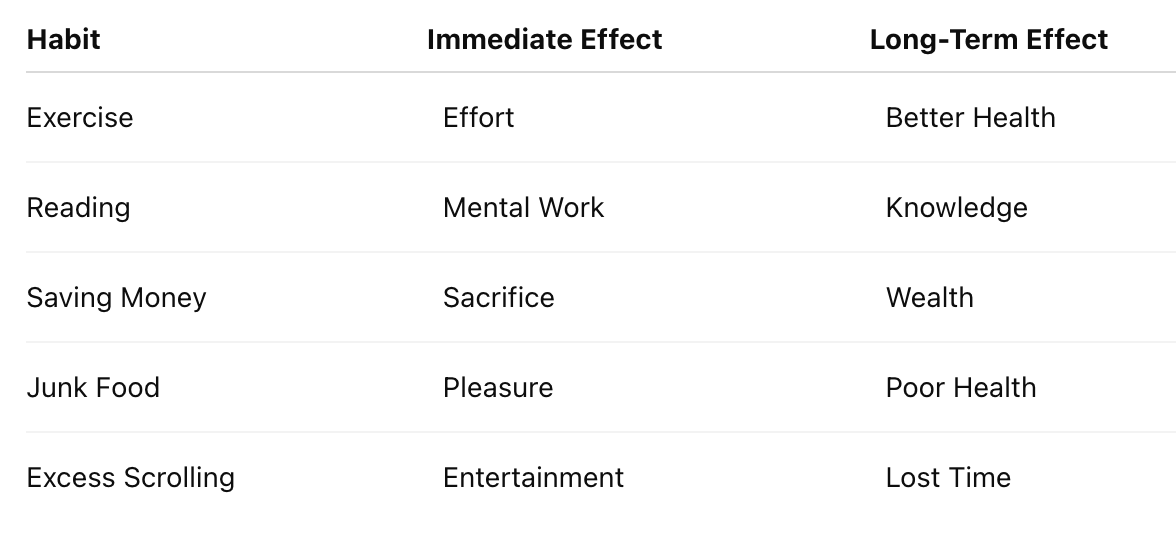
The key is learning to prioritize future rewards.
🔥 Keystone Habits
Some habits create positive chain reactions.
These are called Keystone Habits.
Examples:
🏋️ Exercise
📖 Reading
📝 Planning
💤 Quality Sleep
💰 Budgeting
One keystone habit often improves multiple areas of life.
🌱 Daily Habits of Highly Successful People
Many successful individuals share these habits:
✅ Early planning
✅ Continuous learning
✅ Physical exercise
✅ Goal review
✅ Reading
✅ Networking
✅ Journaling
✅ Deep work
Consistency beats intensity.
🚀 A Simple 30-Day Habit Building Framework
Week 1
Focus on showing up.
Do the habit for just 2 minutes.
Week 2
Increase consistency.
Track daily completion.
Week 3
Increase duration slightly.
Week 4
Automate and optimize.
Refine your environment.
After 30 days, the habit becomes significantly easier to maintain.
💡 Powerful Quotes on Habits
“We are what we repeatedly do. Excellence, then, is not an act but a habit.” — Aristotle
“Success is the product of daily habits — not once-in-a-lifetime transformations.” — James Clear
“Motivation gets you started. Habit keeps you going.”
“Every action you take is a vote for the person you wish to become.”
🎯 Final Thoughts
Success and failure are rarely dramatic events.
They are the result of thousands of small choices made daily.
Every habit is a vote:
📈 For the life you want
or
📉 For the life you don’t want
The good news?
You don’t need a complete life transformation today.
Start with one small habit.
One page.
One push-up.
One walk.
One healthy meal.
One learning session.
Over time, these tiny actions become your identity, and your identity becomes your destiny.
🌟 Your future is hidden in your daily habits. Choose them wisely.


Comments
Post a Comment