👑 Leadership Mastery: The Complete Guide to Becoming an Exceptional Leader 🚀
👑 Leadership Mastery: The Complete Guide to Becoming an Exceptional Leader 🚀
“A leader is one who knows the way, goes the way, and shows the way.” — John C. Maxwell
Leadership is not about authority, titles, or power. It’s about influence, vision, responsibility, and service. Whether you’re leading a company, a software team, a community, or your own family, leadership determines how effectively you inspire people and achieve meaningful results.
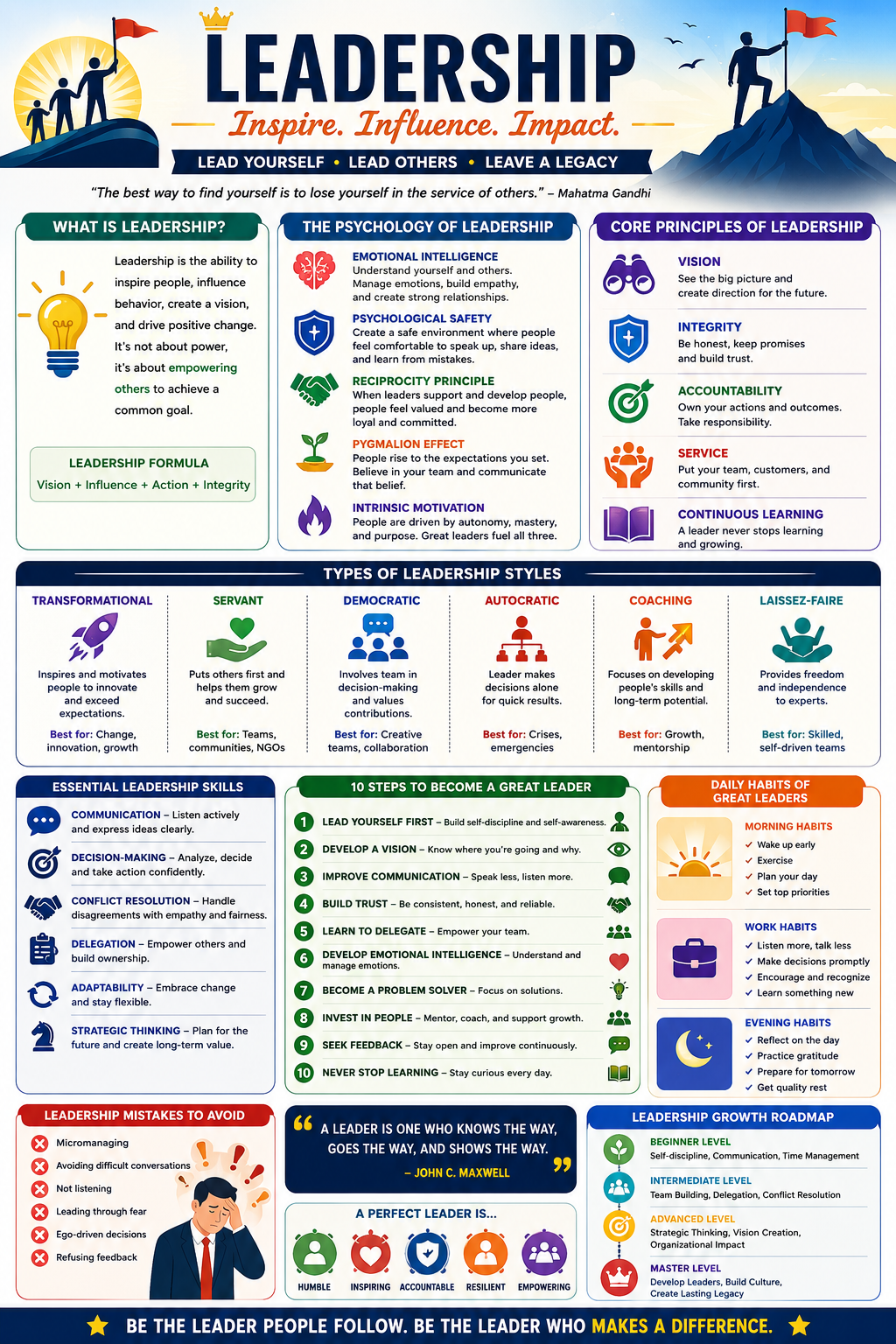
In this comprehensive guide, we’ll explore:
✅ Leadership Fundamentals
✅ Leadership Psychology
✅ Types of Leadership
✅ Essential Leadership Skills
✅ Step-by-Step Leadership Development Plan
✅ Daily Habits of Great Leaders
✅ Common Leadership Mistakes
🌟 What is Leadership?
Leadership is the ability to:
- Inspire people
- Influence behavior
- Create a vision
- Drive positive change
- Help others grow
A true leader doesn’t create followers.
A true leader creates more leaders.
Leadership Formula
Leadership = Vision + Influence + Action + Integrity
🧠 The Psychology Behind Great Leadership
Great leadership is deeply rooted in human psychology.
Understanding people is often more important than understanding business.
1. Emotional Intelligence (EQ) ❤️
Popularized by Daniel Goleman.
EQ includes:
Self-Awareness
Understanding your emotions.
Self-Regulation
Controlling reactions under pressure.
Empathy
Understanding others’ feelings.
Social Skills
Building relationships.
Motivation
Staying committed to long-term goals.
💡 Research consistently shows leaders with high EQ outperform leaders with high IQ alone.
2. Psychological Safety 🛡️
Team members perform better when they feel safe to:
- Share ideas
- Ask questions
- Admit mistakes
- Challenge assumptions
People fear judgment more than failure.
Create an environment where learning is valued over blame.
3. The Reciprocity Principle 🤝
When leaders help people grow, people naturally become more committed.
Examples:
- Coaching employees
- Supporting colleagues
- Recognizing contributions
People remember how leaders made them feel.
4. The Pygmalion Effect 🌱
People tend to rise to expectations.
When leaders genuinely believe in their teams:
- Confidence increases
- Performance improves
- Innovation grows
Great leaders communicate belief.
5. Intrinsic Motivation 🔥
According to motivation research, people are motivated by:
Autonomy
Freedom to make decisions.
Mastery
Improving skills.
Purpose
Meaningful work.
The best leaders provide all three.
🎯 Core Principles of Leadership
1. Vision
Leaders see opportunities before others.
Ask:
“Where do we want to be in 5 years?”
Vision creates direction.
2. Integrity
Integrity means:
- Keeping promises
- Being honest
- Doing the right thing
Trust is the currency of leadership.
Without trust, leadership collapses.
3. Accountability
Leaders own outcomes.
Poor leaders blame others.
Great leaders ask:
“What could I have done better?”
4. Service
Modern leadership is service-oriented.
Serve:
- Customers
- Employees
- Community
- Organization
The more value you create, the greater your influence.
5. Continuous Learning 📚
Leadership is a lifelong skill.
Learn through:
- Books
- Mentors
- Feedback
- Experience
🏆 Types of Leadership Styles
1. Transformational Leadership 🚀
Focus:
- Inspiration
- Innovation
- Growth
Characteristics:
✅ Visionary
✅ Motivational
✅ Future-focused
Best for:
- Startups
- Technology companies
- Change management
Example: Elon Musk
2. Servant Leadership 🤲
Leader serves the team first.
Characteristics:
✅ Empathy
✅ Humility
✅ Supportive mindset
Best for:
- Communities
- Nonprofits
- High-trust organizations
3. Democratic Leadership 🗳️
Team participates in decisions.
Benefits:
- Better ideas
- Higher engagement
- Strong collaboration
Best for:
- Creative teams
- Product development
4. Autocratic Leadership ⚡
Leader makes decisions alone.
Useful during:
- Emergencies
- Crisis situations
- Military operations
Risk:
❌ Reduced creativity
5. Coaching Leadership 🎯
Focuses on developing people.
Characteristics:
- Mentorship
- Feedback
- Long-term growth
One of the most effective modern leadership styles.
6. Laissez-Faire Leadership 🌿
Provides freedom and independence.
Works best with:
- Experts
- Senior professionals
- Self-driven teams
💎 Essential Leadership Skills
Communication 🗣️
Great leaders communicate clearly.
Practice:
- Active listening
- Clear instructions
- Constructive feedback
Decision-Making 🎯
Leaders make decisions despite uncertainty.
Framework:
- Gather information
- Evaluate options
- Make decision
- Review outcome
Conflict Resolution 🤝
Conflicts are inevitable.
Leaders:
- Stay calm
- Understand both sides
- Seek win-win solutions
Delegation 📋
Don’t do everything yourself.
Delegate:
- Tasks
- Ownership
- Responsibility
Empowered teams outperform controlled teams.
Adaptability 🔄
Markets change.
Technology changes.
People change.
Leaders must evolve continuously.
Strategic Thinking ♟️
Think beyond today’s problems.
Ask:
- What are future risks?
- What opportunities exist?
- How can we prepare?
📈 Step-by-Step Guide to Becoming a Great Leader
Step 1: Lead Yourself First
Before leading others:
✅ Build discipline
✅ Manage emotions
✅ Develop confidence
Self-leadership comes first.
Step 2: Develop a Vision
Create clear goals.
Ask:
- Where am I going?
- Why does it matter?
Step 3: Improve Communication
Practice:
- Listening more
- Speaking clearly
- Asking questions
Step 4: Build Trust
Trust grows when:
- Words match actions
- Promises are fulfilled
- Integrity is maintained
Step 5: Learn to Delegate
Move from:
❌ Doing everything
To:
✅ Empowering everyone
Step 6: Develop Emotional Intelligence
Understand:
- Your emotions
- Others’ emotions
EQ is often the difference between managers and leaders.
Step 7: Become a Problem Solver
People naturally follow those who solve problems.
Focus on solutions, not complaints.
Step 8: Invest in People
Teach.
Coach.
Mentor.
Develop future leaders.
Step 9: Seek Feedback
Ask regularly:
“What can I improve?”
Feedback accelerates growth.
Step 10: Never Stop Learning
Read daily.
Attend workshops.
Learn from mistakes.
Stay curious.
🌅 Daily Habits of Highly Effective Leaders
Morning Habits ☀️
1. Wake Up Early
Gain uninterrupted thinking time.
2. Exercise
Improves:
- Focus
- Confidence
- Energy
3. Plan the Day
Identify:
- Top 3 priorities
- Major meetings
- Key outcomes
Work Habits 💼
4. Listen More Than You Speak
Aim for:
70% listening
30% talking
5. Make Decisions Promptly
Avoid analysis paralysis.
6. Encourage Others
Recognize achievements regularly.
7. Learn Something New Daily
Read:
- Leadership books
- Industry news
- Biographies
Evening Habits 🌙
8. Reflect Daily
Ask:
- What went well?
- What didn’t?
- What can improve?
9. Practice Gratitude
Gratitude improves emotional resilience.
10. Prepare Tomorrow Today
Reduce decision fatigue.
❌ Leadership Mistakes to Avoid
Micromanaging
People need guidance, not control.
Avoiding Difficult Conversations
Problems grow when ignored.
Not Listening
Leaders who stop listening stop learning.
Leading Through Fear
Fear creates compliance.
Trust creates commitment.
Ego-Driven Decisions
Put mission before ego.
Refusing Feedback
Growth stops when learning stops.
📚 Recommended Leadership Books
The 7 Habits of Highly Effective People
Focus on personal leadership and effectiveness.
Leaders Eat Last
Explains trust and team culture.
The 21 Irrefutable Laws of Leadership
Practical leadership framework.
Atomic Habits
Build leadership habits effectively.
Good to Great
Insights from world-class organizations.
🎖️ The Leadership Growth Roadmap
Beginner Level
✅ Self-discipline
✅ Communication
✅ Time management
Intermediate Level
✅ Team building
✅ Delegation
✅ Conflict resolution
Advanced Level
✅ Strategic thinking
✅ Vision creation
✅ Organizational transformation
Master Level
✅ Develop leaders
✅ Build culture
✅ Create lasting impact
🚀 Final Thoughts
Leadership is not a destination; it is a continuous journey of growth.
A perfect leader:
✔️ Leads by example
✔️ Serves others
✔️ Communicates clearly
✔️ Learns continuously
✔️ Takes responsibility
✔️ Inspires action
✔️ Builds future leaders
Remember:
“People may forget your words, but they will never forget the impact of your leadership.”
The world doesn’t need more bosses.
🌟 The world needs more leaders who inspire, serve, and elevate others. 🌟


Comments
Post a Comment