🚀 Ruby on Rails Background Jobs Mastery: The Complete Guide to Asynchronous Processing ⚡
🚀 Ruby on Rails Background Jobs Mastery: The Complete Guide to Asynchronous Processing ⚡
“Great applications don’t make users wait. They work smartly in the background.” 💎
Modern web applications need to perform numerous time-consuming tasks such as sending emails, processing images, generating reports, synchronizing third-party APIs, and handling millions of notifications. Running these tasks during the user request can slow down your application significantly.
This is where Background Jobs come to the rescue! 🎯
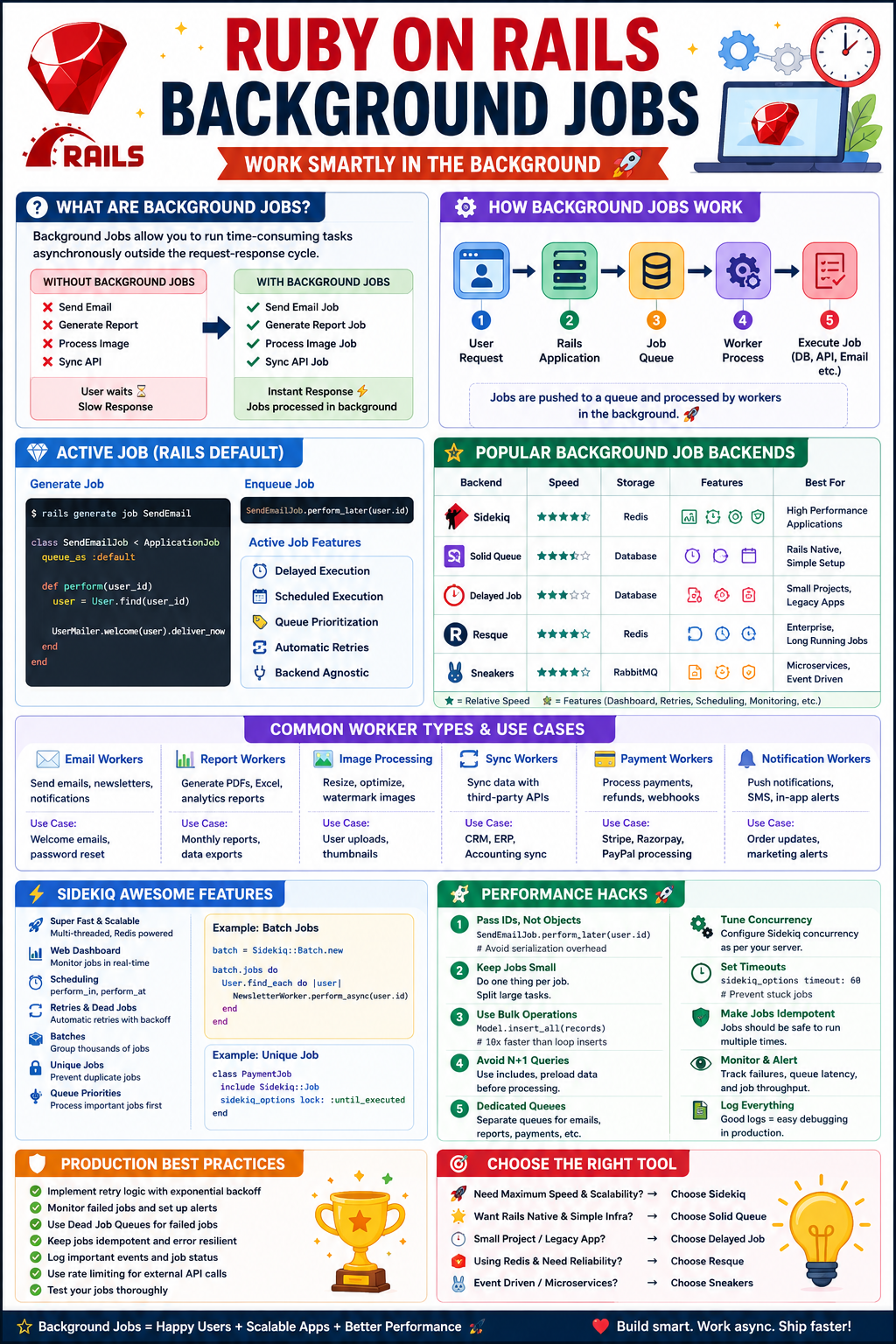
In this comprehensive guide, we’ll explore everything about Ruby on Rails Background Jobs, workers, queues, job processors, optimization techniques, and production-grade best practices.
🎯 What Are Background Jobs?
Background Jobs allow you to execute tasks asynchronously outside the request-response cycle.
❌ Without Background Jobs
def create
  @user = User.create(user_params)

  UserMailer.welcome_email(@user).deliver_now
  GenerateReportService.call(@user)
  UploadAvatarService.call(@user)
  render json: { success: true }
end
User waits until everything completes.
✅ With Background Jobs
def create
  @user = User.create(user_params)

  WelcomeEmailJob.perform_later(@user.id)
  GenerateReportJob.perform_later(@user.id)
  UploadAvatarJob.perform_later(@user.id)
  render json: { success: true }
end
Response returns instantly ⚡
Workers handle tasks in the background.
🏗️ Background Job Architecture
User Request
     ↓
Rails Application
     ↓
Job Queue
     ↓
Worker Process
     ↓
Execute Job
     ↓
Database / API / Email
🚀 Active Job (Rails Default Framework)
Rails provides Active Job as a unified interface.
Generate Job
rails generate job SendEmailCreates:
class SendEmailJob < ApplicationJob
  queue_as :default

  def perform(user_id)
    user = User.find(user_id)
    UserMailer.welcome(user).deliver_now
  end
end
Enqueue Job:
SendEmailJob.perform_later(user.id)🔥 Active Job Features
1️⃣ Delayed Execution
SendEmailJob.set(wait: 10.minutes).perform_later(user.id)Execute after 10 minutes.
2️⃣ Scheduled Execution
SendEmailJob.set(wait_until: Date.tomorrow.noon)
            .perform_later(user.id)
Run at a specific time.
3️⃣ Queue Prioritization
class PaymentJob < ApplicationJob
  queue_as :critical
end
Different queues:
critical
default
mailers
low
reports
4️⃣ Retry Mechanism
class PaymentJob < ApplicationJob
  retry_on StandardError, wait: 5.seconds, attempts: 3
end
Automatic retries.
🎯 Popular Background Job Processors
Rails Active Job needs a backend.
Let’s explore the major options.
1️⃣ Sidekiq 🏆 (Most Popular)
Why Developers Love Sidekiq?
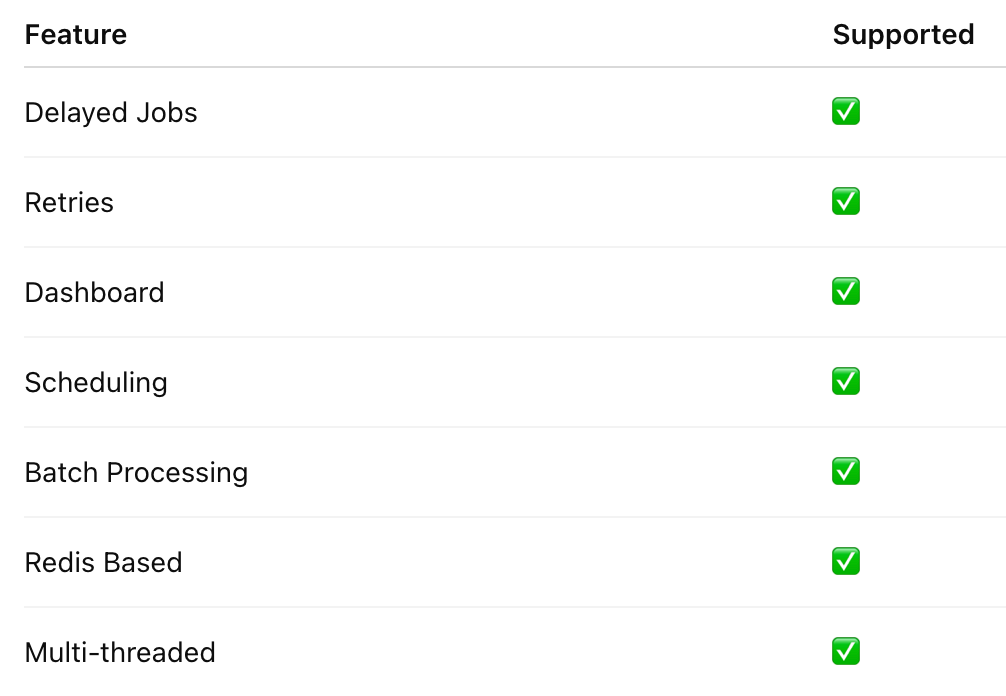
✅ Extremely Fast
✅ Uses Redis
✅ Multi-threaded
✅ Scales Easily
✅ Enterprise Features
Installation
gem 'sidekiq'

bundle install
Configure
config.active_job.queue_adapter = :sidekiqWorker Example
class ReportWorker
  include Sidekiq::Worker

  def perform(user_id)
    GenerateReportService.call(user_id)
  end
end
Enqueue:
ReportWorker.perform_async(user.id)Schedule Job
ReportWorker.perform_in(1.hour, user.id)Features
Best Use Cases
📧 Email Processing
📱 Push Notifications
📊 Report Generation
🖼️ Image Processing
💳 Payment Processing
🚀 High Traffic Applications
2️⃣ Solid Queue (Rails 8 Recommended) 🌟
Introduced as Rails’ modern database-backed queue system.
Why Solid Queue?
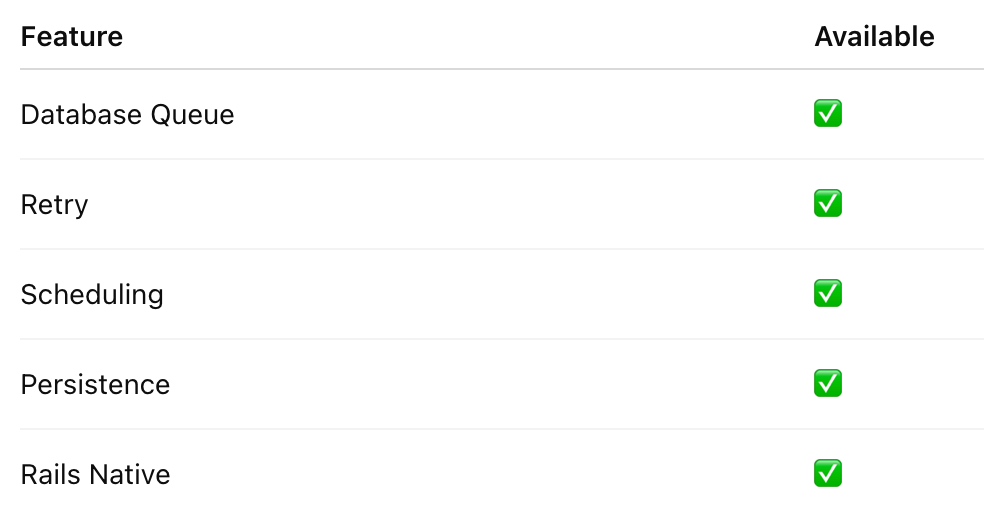
✅ No Redis Required
✅ Database Backed
✅ Simpler Infrastructure
✅ Native Rails Integration
Configuration
config.active_job.queue_adapter = :solid_queueFeatures
Best Use Cases
🏢 Enterprise Applications
📋 Internal Business Tools
💰 Cost-Sensitive Projects
☁️ Simple Deployments
3️⃣ Delayed Job ⏳
Old but reliable.
Uses database tables.
Installation
gem 'delayed_job_active_record'Worker
MyJob.delay.run_taskAdvantages
✅ Easy Setup
✅ No Redis
✅ Database Persistence
Disadvantages
❌ Slower than Sidekiq
❌ Poor scalability
Best Use Cases
Small Applications
Legacy Rails Systems
4️⃣ Resque 📦
Redis-backed queue processor.
Features
✅ Redis Based
✅ Process Isolation
✅ Reliability
Worker Example
class EmailWorker
  @queue = :emails

  def self.perform(user_id)
    UserMailer.welcome(user_id).deliver_now
  end
end
Best Use Cases
Large Enterprise Systems
Long Running Tasks
Heavy Processing
5️⃣ Sneakers 🐰
Uses RabbitMQ.
Features
✅ RabbitMQ
✅ Distributed Processing
✅ Event Driven
Best Use Cases
Microservices
Event Streaming
Real-Time Systems
🎯 Worker Types Every Rails Developer Should Know
📧 Email Workers
class WelcomeEmailJob < ApplicationJob
  def perform(user_id)
    UserMailer.welcome(user_id).deliver_now
  end
end
📊 Report Workers
class GenerateReportJob < ApplicationJob
  def perform(report_id)
    ReportGenerator.call(report_id)
  end
end
🖼️ Image Processing Workers
class ImageResizeJob < ApplicationJob
  def perform(image_id)
    ImageProcessor.resize(image_id)
  end
end
🔄 Sync Workers
class HubspotSyncJob < ApplicationJob
  def perform(contact_id)
    HubspotService.sync(contact_id)
  end
end
💰 Payment Workers
class PaymentJob < ApplicationJob
  def perform(order_id)
    StripeService.process(order_id)
  end
end
📱 Notification Workers
class PushNotificationJob < ApplicationJob
  def perform(user_id)
    NotificationService.send(user_id)
  end
end
🚀 Advanced Sidekiq Features
Batch Jobs
batch = Sidekiq::Batch.new

batch.jobs do
  User.find_each do |user|
    NewsletterWorker.perform_async(user.id)
  end
end
Perfect for:
📧 Newsletter Campaigns
📊 Bulk Reports
🛍️ E-commerce Processing
Unique Jobs
Prevent duplicate jobs.
sidekiq_options lock: :until_executedUseful for:
💳 Payments
📦 Orders
🔄 Synchronizations
Job Priorities
:queues:
  - critical
  - default
  - low
⚡ Performance Optimization Hacks
🎯 1. Pass IDs Instead of Objects
❌ Bad
SendEmailJob.perform_later(user)✅ Good
SendEmailJob.perform_later(user.id)Less serialization overhead.
🎯 2. Keep Jobs Small
❌ Bad
def perform
  send_email
  process_image
  generate_report
  sync_api
end
✅ Good
SendEmailJob.perform_later
ProcessImageJob.perform_later
GenerateReportJob.perform_later
🎯 3. Use Bulk Inserts
Model.insert_all(records)Instead of:
records.each do |record|
  Model.create(record)
end
Huge performance gain 🚀
🎯 4. Avoid N+1 Queries
User.includes(:orders)Before processing jobs.
🎯 5. Dedicated Queues
queue_as :critical
queue_as :reports
queue_as :emails
Separate workloads.
🎯 6. Use Redis Efficiently
Configure Sidekiq:
:concurrency: 25Optimize according to server resources.
🎯 7. Add Job Timeouts
sidekiq_options timeout: 60Prevent stuck jobs.
🎯 8. Implement Idempotency
Jobs should be safe to run multiple times.
return if order.processed?Critical for retries.
🔥 Production Best Practices
✅ Use Retry Logic
retry_on Net::ReadTimeout✅ Monitor Failures
Tools:
✅ Log Everything
Rails.logger.info "Processing User #{user.id}"✅ Use Dead Job Queues
Failed jobs move to dead queues for investigation.
✅ Rate Limiting
Prevent API abuse.
sleep(1)Or use throttling middleware.
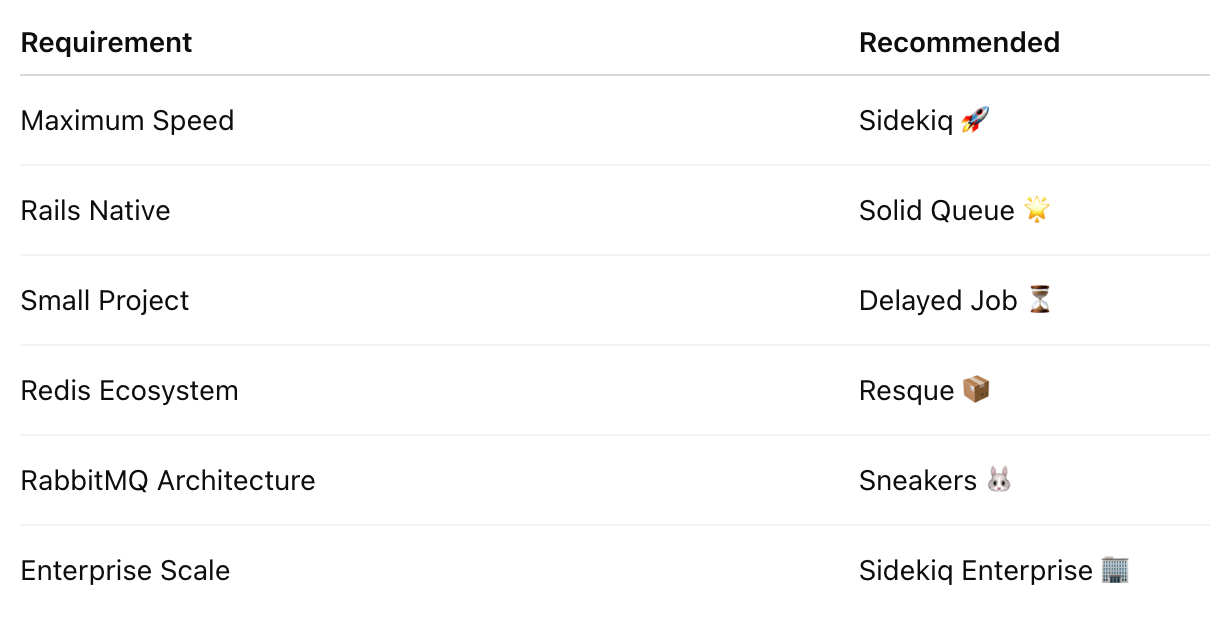
🏆 Which Background Job System Should You Choose?
🎯 Real-World Architecture Example
Imagine an E-commerce Application:
Order Created
      ↓
Payment Job
      ↓
Invoice Job
      ↓
Email Job
      ↓
Inventory Update Job
      ↓
Analytics Job
All executed asynchronously.
User gets immediate response while processing continues behind the scenes. ⚡
💡 Pro Developer Tips
🔥 Prefer Sidekiq for high-scale applications.
🔥 Prefer Solid Queue if you want fewer infrastructure dependencies.
🔥 Keep jobs focused on one responsibility.
🔥 Design jobs to be idempotent.
🔥 Use queue prioritization.
🔥 Monitor queue latency continuously.
🔥 Never perform heavy processing inside controllers.
🔥 Split large jobs into smaller workers.
🔥 Use batching for millions of records.
🎉 Final Thoughts
Background Jobs are one of the most important pillars of scalable Ruby on Rails applications. Whether you’re building a startup MVP, SaaS platform, fintech product, or enterprise application, mastering asynchronous processing can dramatically improve performance, user experience, and scalability.
The winning combination for most modern Rails applications is:
✅ Active Job + Sidekiq + Redis
✅ Proper Queue Design
✅ Retry Strategies
✅ Monitoring & Alerting
✅ Idempotent Workers
Master these concepts, and you’ll be building Rails applications that handle millions of jobs efficiently while keeping response times blazing fast. 🚀🔥
Happy Coding! 💎 Ruby on Rails + Background Jobs = Scalable Applications 🚀


Comments
Post a Comment