🚀 Ruby on Rails + Microservices: The Ultimate Guide to Building Scalable Modern Applications
🚀 Ruby on Rails + Microservices: The Ultimate Guide to Building Scalable Modern Applications
“Monoliths help you start fast. Microservices help you scale smart.” 💡
Ruby on Rails is famous for its rapid development capabilities, developer productivity, and convention-over-configuration philosophy. However, as applications grow in complexity, traffic, and team size, managing a single monolithic Rails application can become challenging.
This is where Microservice Architecture comes into play. 🏗️
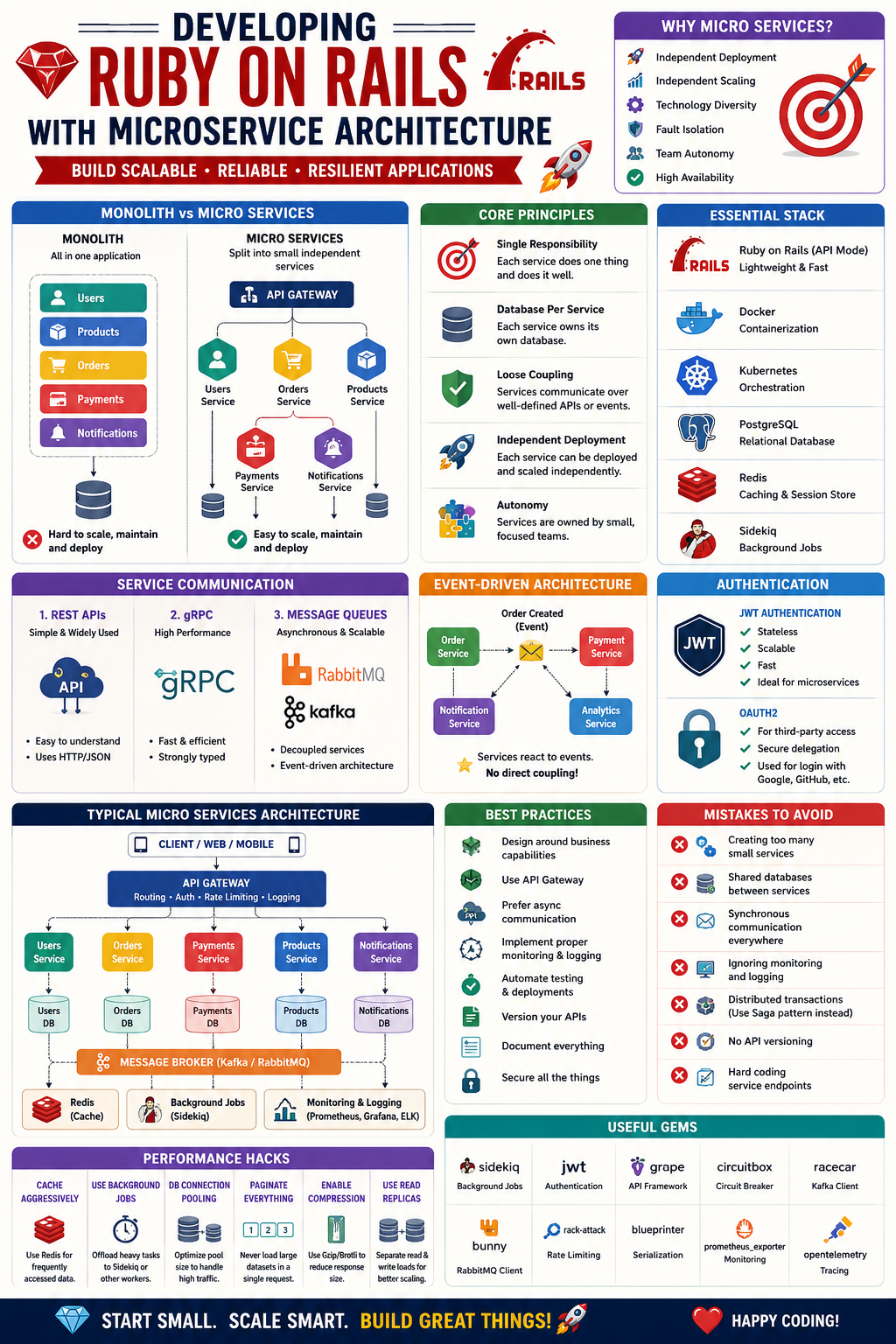
In this comprehensive guide, we’ll explore everything you need to know about developing Ruby on Rails applications using Microservices, including architecture principles, design patterns, communication methods, deployment strategies, performance hacks, and common mistakes to avoid.
🎯 What is a Microservice Architecture?
A Microservice Architecture is an architectural style where an application is broken down into multiple independent services.
Each service:
✅ Has its own business responsibility
✅ Can be deployed independently
✅ Has its own database
✅ Can scale independently
✅ Can be developed by separate teams
🏢 Monolith vs Microservices
Traditional Rails Monolith
┌─────────────────────┐
│   Rails Application │
├─────────────────────┤
│ Users               │
│ Products            │
│ Orders              │
│ Payments            │
│ Notifications       │
└─────────────────────┘
Rails Microservices
   ┌──────────┐
   │ API Gate │
   └────┬─────┘
        │
 ┌──────┼──────┬────────┬───────┐
 │      │      │        │       │
 ▼      ▼      ▼        ▼       ▼
Users Orders Products Payments Notifications
Each service operates independently.
🔥 Why Use Microservices?
1️⃣ Independent Deployment
Deploy payment service without affecting users service.
kubectl deploy payment-serviceNo downtime for the entire application.
2️⃣ Independent Scaling
If payments receive high traffic:
Payment Service = 20 Instances
User Service = 3 Instances
Save infrastructure costs.
3️⃣ Team Ownership
Different teams own different services.
Team A → Users
Team B → Orders
Team C → Payments
No development bottlenecks.
4️⃣ Better Fault Isolation
If Notification Service crashes:
Notification ❌
Orders ✅
Users ✅
Payments ✅
Entire application remains operational.
🏗️ Core Principles of Microservices
🎯 Single Responsibility Principle
Each service should do one thing exceptionally well.
Good
User ServiceHandles:
- Login
- Registration
- Authentication
Bad
User Service
Orders
Payments
Analytics
Notifications
Avoid mixed responsibilities.
🎯 Database Per Service
One database should belong to one service.
Wrong
Shared DatabaseCorrect
Users Service
   ↓
Users DB

Orders Service
   ↓
Orders DB

Payment Service
   ↓
Payments DB
Benefits:
✅ Loose coupling
✅ Better scalability
✅ Independent schema changes
🎯 Autonomous Services
Every service should be deployable independently.
Never create:
Service A cannot run without Service B🛠️ Essential Rails Microservices Stack
API Framework
Rails API Mode
rails new user_service --apiBenefits:
✅ Lightweight
✅ Faster
✅ Less memory
Containerization
Docker
FROM ruby:3.4
WORKDIR /app
COPY . .
RUN bundle install
CMD ["rails", "server"]
Every service should be containerized.
Orchestration
Kubernetes
Benefits:
✅ Auto-scaling
✅ Self-healing
✅ Rolling deployments
Reverse Proxy
Nginx
/api/users
    ↓
User ServiceZ

/api/orders
    ↓
Order Service
🌐 Service Communication
Microservices need communication.
Method 1: REST APIs
Most common.
response = HTTParty.get(
  "http://users-service/users/1"
)
Pros:
✅ Simple
✅ Easy debugging
Cons:
❌ Network latency
Method 2: gRPC
Much faster than REST.
service UserService {
  rpc GetUser(UserRequest)
      returns(UserResponse);
}
Pros:
✅ High performance
✅ Strong typing
Method 3: Message Queues
Most scalable approach.
RabbitMQ
Bunny.new.startApache Kafka
Perfect for:
- Analytics
- Events
- Real-time systems
Example:
Order Created Event
↓
Payment Service
↓
Notification Service
↓
Analytics Service
📩 Event-Driven Architecture
One of the most powerful microservice patterns.
Example
Order Service emits:
{
  "event": "order_created",
  "order_id": 123
}
Consumers:
- Payment Service
- Notification Service
- Analytics Service
No direct coupling.
🔐 Authentication Across Services
One of the biggest challenges.
JWT Authentication
Generate token:
JWT.encode(payload, secret)Validate token in every service.
Benefits:
✅ Stateless
✅ Fast
✅ Scalable
OAuth2
Useful when:
- Multiple clients
- External integrations
Examples:
- Google Login
- GitHub Login
🚪 API Gateway Pattern
Never expose all services publicly.
Use API Gateway.
Client
   ↓
API Gateway
 ↓ ↓ ↓ ↓
Users
Orders
Payments
Responsibilities:
✅ Routing
✅ Authentication
✅ Rate Limiting
✅ Logging
📊 Observability & Monitoring
Microservices without monitoring are a nightmare. 😅
Logging
Use structured logs.
Rails.logger.info({
  service: "payment",
  order_id: 123
})
Tools:
- ELK Stack
- Loki
Metrics
Use:
- Prometheus
- Grafana
Track:
- Request count
- Error rate
- CPU
- Memory
Distributed Tracing
Use:
- OpenTelemetry
- Jaeger
Trace requests across services.
User Request
    ↓
API Gateway
    ↓
Order Service
    ↓
Payment Service
🧩 Design Patterns Every Rails Microservice Developer Should Know
Saga Pattern
Manages distributed transactions.
Example:
Order Created
     ↓
Payment Failed
     ↓
Order Cancelled
Instead of rolling back databases, execute compensating actions.
Circuit Breaker Pattern
Prevent cascading failures.
Circuitbox.circuit(
  :payment_service
).run do
  payment_call
end
Benefits:
✅ Better resilience
CQRS
Separate:
Read Operations

Write Operations
Improves scalability.
Strangler Pattern
Perfect for migrating a Rails Monolith.
Monolith
     ↓
Extract Users Service
Monolith
     ↓
Extract Orders Service
Monolith
     ↓
Retire Monolith
⚡ Performance Optimization Hacks
🚀 Use Redis Aggressively
Caching:
Rails.cache.fetch("user:1") do
  User.find(1)
end
Benefits:
- Faster responses
- Reduced DB load
🚀 Background Jobs
Never perform heavy operations synchronously.
Use:
- Sidekiq
- Solid Queue
SendEmailJob.perform_async(id)🚀 Connection Pooling
production:
  pool: 20
Avoid database bottlenecks.
🚀 Response Compression
Enable GZIP.
gzip on;Smaller payloads.
🚀 Use Read Replicas
Primary DB
    ↓
Read Replicas
Separate reads from writes.
🚀 Pagination Everywhere
Bad:
User.allGood:
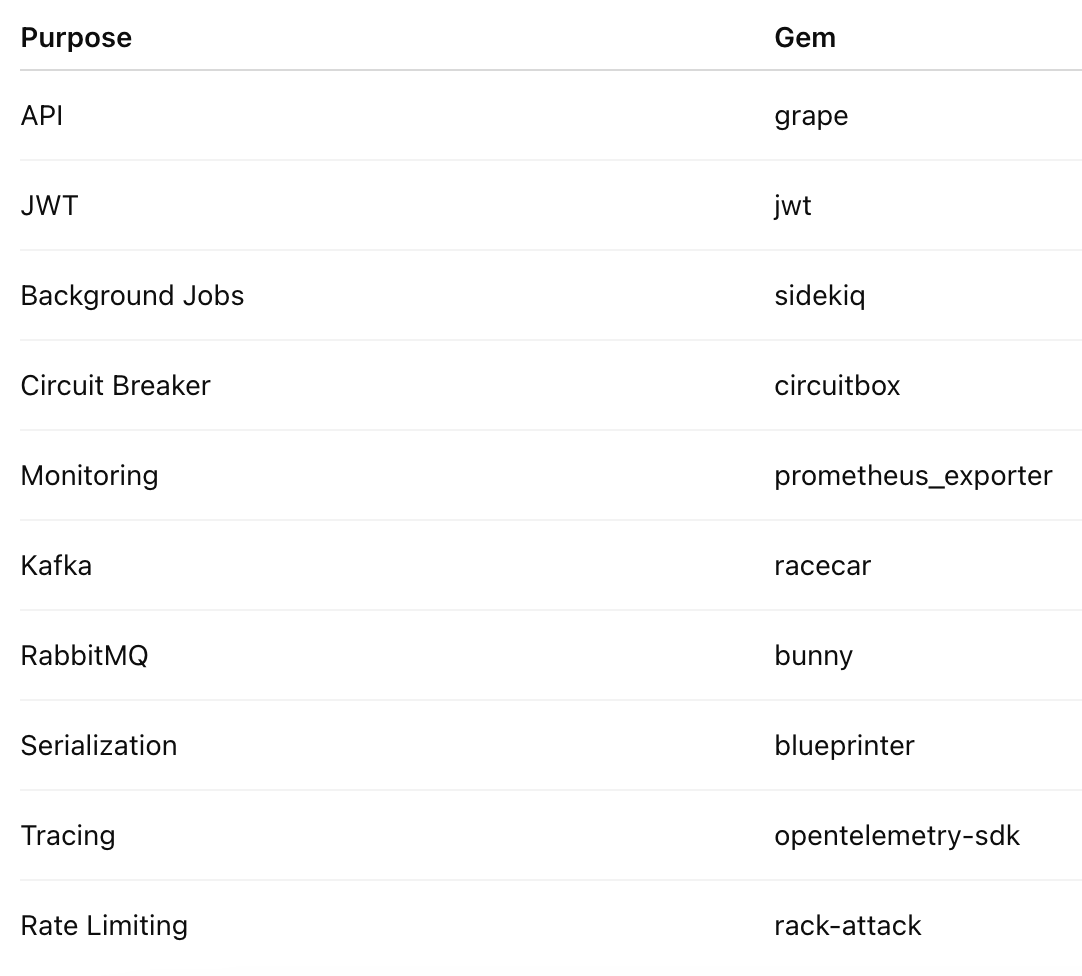
User.page(params[:page])🔥 Recommended Gems
❌ Common Microservice Mistakes
🚫 Creating Too Many Services
Bad:
User Profile Service
User Avatar Service
User Name Service
Good:
User ServiceKeep services meaningful.
🚫 Shared Databases
Creates hidden coupling.
Avoid completely.
🚫 Synchronous Everything
Bad:
Order
 ↓
Payment
 ↓
Notification
 ↓
Analytics
One failure breaks everything.
Prefer event-driven architecture.
🚫 Ignoring Monitoring
You cannot fix what you cannot observe.
Always implement:
✅ Logs
✅ Metrics
✅ Traces
🚫 Distributed Transactions
Avoid:
BEGIN
Service A
Service B
COMMIT
Use Saga Pattern instead.
🏆 Ideal Production Rails Microservice Architecture
                 Internet
                     │
                     ▼
              API Gateway
                     │
 ┌──────────┬──────────┬──────────┐
 ▼          ▼          ▼          ▼
Users     Orders    Payments   Products
Service   Service   Service    Service
 │          │          │          │
 ▼          ▼          ▼          ▼
Postgres  Postgres  Postgres  Postgres
 └─────────────┬───────────────┘
               ▼
          Kafka / RabbitMQ
               ▼
 Analytics  Notifications  Emails
               ▼
      Redis + Sidekiq
               ▼
 Prometheus + Grafana
🎯 Final Thoughts
Ruby on Rails and Microservices are a powerful combination when implemented thoughtfully. Start with a monolith if your product is young, then gradually evolve into microservices as your team, traffic, and business complexity grow.
Golden Rules to Remember 🏆
✅ One service = One responsibility
✅ Database per service
✅ Prefer event-driven communication
✅ Use API Gateway
✅ Monitor everything
✅ Automate deployments
✅ Containerize every service
✅ Cache aggressively
✅ Avoid distributed transactions
✅ Build for observability from Day 1
When designed correctly, a Rails Microservice Architecture can support millions of users, hundreds of deployments per day, and multiple development teams while remaining maintainable, scalable, and resilient. 🚀
Happy Coding! 💎 Ruby + Microservices = Scalable Engineering Excellence!


Comments
Post a Comment