🚀 SQL Optimization Mastery Guide: From Slow Queries to Lightning-Fast Databases ⚡
🚀 SQL Optimization Mastery Guide: From Slow Queries to Lightning-Fast Databases ⚡
“A good query returns data. An optimized query returns data before your user loses patience.”
Databases are the heart ❤️ of modern applications. Whether you’re building applications with Ruby on Rails, Python, Java, Node.js, or any other technology, poor SQL performance can turn a great application into a frustrating experience.
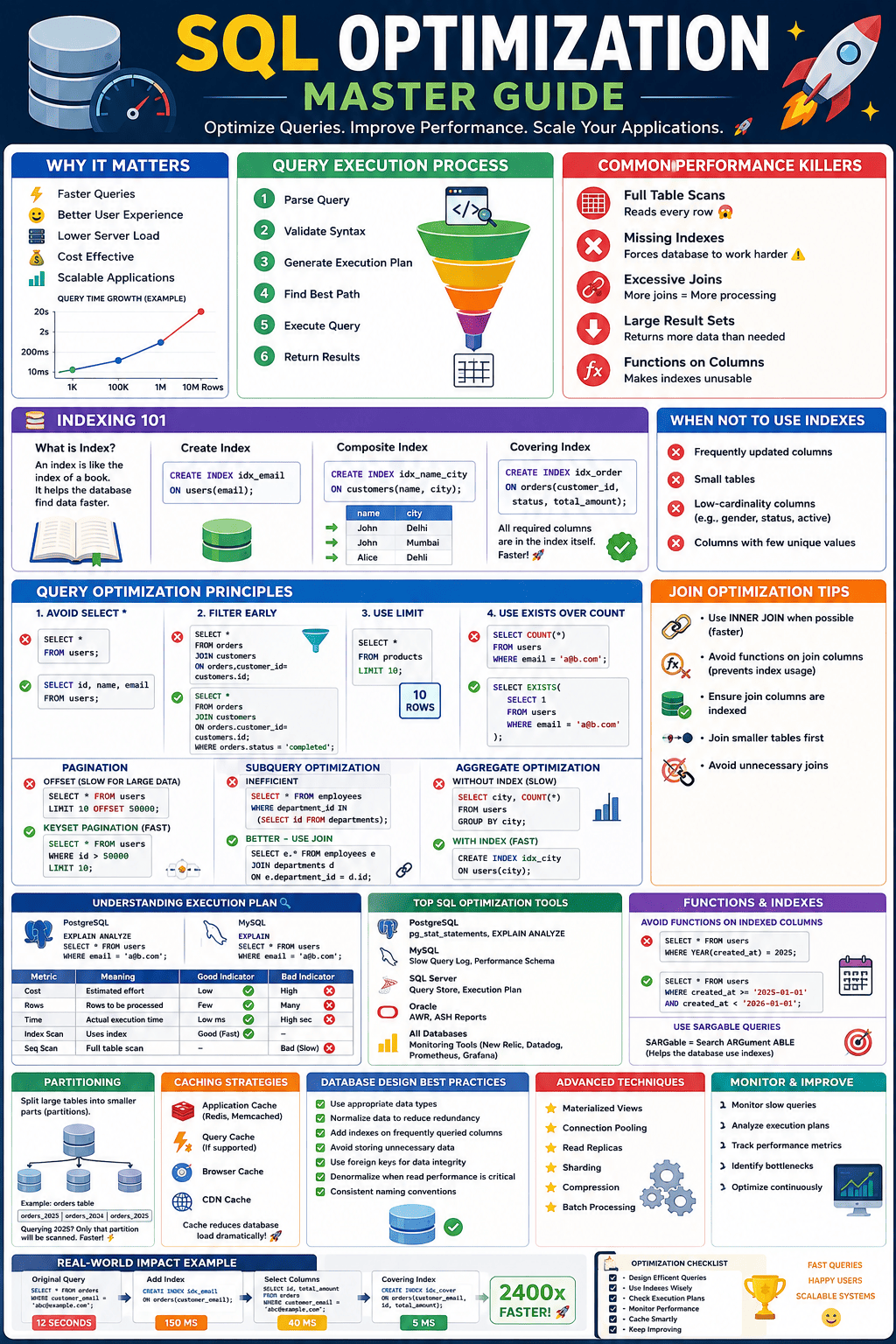
In this comprehensive guide, you’ll learn everything about SQL Optimization, including principles, tools, indexing strategies, query tuning, execution plans, optimization techniques, and real-world examples.
📚 Table of Contents
- What is SQL Optimization?
- Why SQL Optimization Matters
- Understanding Query Execution
- Database Performance Bottlenecks
- Indexing Deep Dive
- Query Optimization Principles
- JOIN Optimization
- Aggregate Function Optimization
- Pagination Optimization
- Subquery Optimization
- Execution Plans
- SQL Optimization Tools
- Database Functions and Performance
- Partitioning
- Caching Strategies
- Database Design Best Practices
- Advanced Optimization Techniques
- Monitoring and Troubleshooting
- Real-world Optimization Examples
- SQL Optimization Checklist
🎯 What is SQL Optimization?
SQL Optimization is the process of improving query performance to:
✅ Reduce execution time
✅ Minimize resource consumption
✅ Improve scalability
✅ Handle larger datasets efficiently
Example
❌ Poor Query
SELECT *
FROM users;
Problem:
- Retrieves unnecessary columns
- Increases memory usage
- Slower network transfer
✅ Optimized Query
SELECT id, name, email
FROM users;
Benefits:
- Less data transfer
- Faster execution
- Lower memory consumption
⚡ Why SQL Optimization Matters
Imagine:
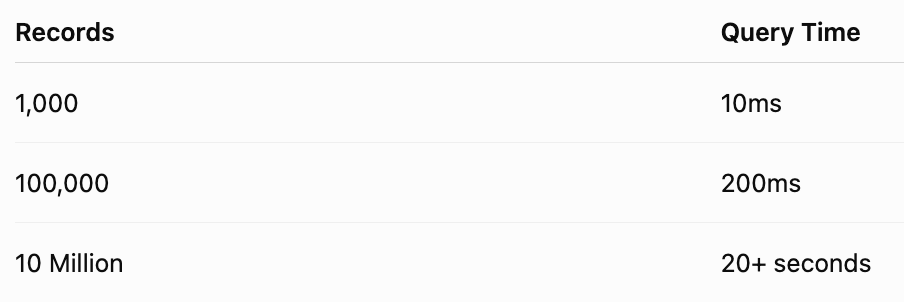
As data grows:
📈 Query complexity increases
📈 CPU usage rises
📈 Memory consumption grows
📈 User experience degrades
🔍 Understanding Query Execution
When SQL executes:
SELECT *
FROM orders
WHERE customer_id = 100;
Database Engine performs:
1️⃣ Parse Query
2️⃣ Validate Syntax
3️⃣ Generate Execution Plan
4️⃣ Find Best Path
5️⃣ Execute Query
6️⃣ Return Results
🧠 Database Performance Bottlenecks
1. Full Table Scans
SELECT *
FROM customers
WHERE email='abc@example.com';
Without index:
Record 1
Record 2
Record 3
...
Record 1,000,000
Database scans everything 😨
2. Excessive Joins
SELECT *
FROM users
JOIN orders
JOIN payments
JOIN products
JOIN reviews;
More joins = More processing
3. Missing Indexes
Most common performance killer ⚠️
4. Large Result Sets
SELECT *
FROM logs;
Millions of rows returned unnecessarily.
🏗️ Indexing Deep Dive
Indexes are like a book’s table of contents.
Without index:
📖 Read entire book.
With index:
📖 Jump directly to page.
Creating Index
CREATE INDEX idx_email
ON users(email);
Composite Index
CREATE INDEX idx_name_city
ON customers(name, city);
Useful:
SELECT *
FROM customers
WHERE name='John'
AND city='Delhi';
Covering Index
CREATE INDEX idx_order
ON orders(customer_id, status, total_amount);
Query:
SELECT status, total_amount
FROM orders
WHERE customer_id=100;
No table lookup required 🚀
Unique Index
CREATE UNIQUE INDEX idx_user_email
ON users(email);
Ensures uniqueness and improves lookups.
When NOT to Use Indexes
Avoid indexing:
❌ Frequently updated columns
❌ Small tables
❌ Low-cardinality columns
Example:
gender
status
active
🎯 Query Optimization Principles
Principle 1: Avoid SELECT *
❌
SELECT *
FROM employees;
✅
SELECT id, name
FROM employees;
Principle 2: Filter Early
❌
SELECT *
FROM orders
JOIN customers
ON orders.customer_id=customers.id;
✅
SELECT *
FROM orders
JOIN customers
ON orders.customer_id=customers.id
WHERE orders.status='completed';
Principle 3: Use LIMIT
SELECT *
FROM products
LIMIT 10;
Principle 4: Use EXISTS Instead of COUNT
❌
SELECT COUNT(*)
FROM users
WHERE email='abc@example.com';
✅
SELECT EXISTS(
SELECT 1
FROM users
WHERE email='abc@example.com'
);
🔗 JOIN Optimization
INNER JOIN
SELECT u.name, o.amount
FROM users u
INNER JOIN orders o
ON u.id=o.user_id;
Fastest join type generally.
Avoid Functions in JOIN
❌
ON LOWER(users.email)=LOWER(customers.email)Index unusable.
Better
ON users.email=customers.email📊 Aggregate Function Optimization
COUNT
SELECT COUNT(*)
FROM users;
GROUP BY
❌
SELECT city, COUNT(*)
FROM users
GROUP BY city;
Without index:
Slow.
✅
CREATE INDEX idx_city
ON users(city);
📑 Pagination Optimization
Traditional Pagination
SELECT *
FROM users
LIMIT 10 OFFSET 50000;
Problem:
Database skips 50,000 rows.
Keyset Pagination
SELECT *
FROM users
WHERE id > 50000
LIMIT 10;
Much faster 🚀
🔄 Subquery Optimization
Inefficient
SELECT *
FROM employees
WHERE department_id IN
(
SELECT id
FROM departments
);
Better JOIN
SELECT e.*
FROM employees e
JOIN departments d
ON e.department_id=d.id;
📈 Understanding Execution Plans
PostgreSQL
EXPLAIN ANALYZE
SELECT *
FROM users
WHERE email='abc@example.com';
MySQL
EXPLAIN
SELECT *
FROM users
WHERE email='abc@example.com';
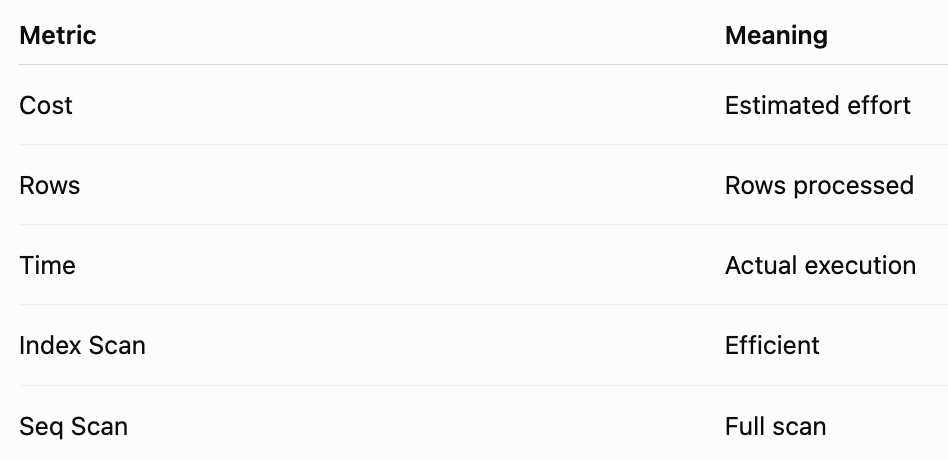
Key Metrics
🛠️ SQL Optimization Tools
PostgreSQL
pg_stat_statements
CREATE EXTENSION pg_stat_statements;Tracks slow queries.
EXPLAIN ANALYZE
Most powerful optimization tool.
MySQL
Slow Query Log
SET GLOBAL slow_query_log = 'ON';Performance Schema
Provides detailed performance metrics.
SQL Server
Query Store
Stores historical query performance.
Oracle
Automatic Workload Repository (AWR)
Captures workload snapshots.
⚙️ Database Functions and Performance
Avoid Functions on Indexed Columns
❌
SELECT *
FROM users
WHERE YEAR(created_at)=2025;
Index ignored.
✅
SELECT *
FROM users
WHERE created_at >= '2025-01-01'
AND created_at < '2026-01-01';
Uses index.
📦 Partitioning
Useful for huge datasets.
Example
Orders table:
orders_2023
orders_2024
orders_2025
Querying 2025:
SELECT *
FROM orders
WHERE order_year=2025;
Database scans only one partition.
🚀 Caching Strategies
Application Cache
Rails.cache.fetch("user_1") do
 User.find(1)
end
Redis Cache
Database -> Redis -> ApplicationReduces database load dramatically.
🏛️ Database Design Best Practices
Proper Data Types
❌
phone VARCHAR(500)✅
phone VARCHAR(15)Normalize Data
Users
Orders
Products
Avoid duplication.
Denormalize When Needed
For reporting systems.
Trade-off:
Storage ↔ Speed
🎯 Advanced Optimization Techniques
Materialized Views
CREATE MATERIALIZED VIEW sales_summary AS
SELECT
month,
SUM(amount)
FROM sales
GROUP BY month;
Precomputed results.
Connection Pooling
Ruby on Rails:
pool: 20Reduces connection overhead.
Read Replicas
Primary DB
     |
     +---- Replica 1
     |
     +---- Replica 2
Read traffic distributed efficiently.
📡 Monitoring Database Health
Track:
✅ Query Time
✅ CPU Usage
✅ Memory Usage
✅ Lock Waits
✅ Deadlocks
✅ Active Connections
🔥 Real-World Optimization Example
Original Query
SELECT *
FROM orders
WHERE customer_email='abc@example.com';
Execution Time:
12 secondsAdd Index
CREATE INDEX idx_email
ON orders(customer_email);
Execution Time:
150 msSelect Needed Columns
SELECT id,total_amount
FROM orders
WHERE customer_email='abc@example.com';
Execution Time:
40 msAdd Covering Index
CREATE INDEX idx_cover
ON orders(customer_email,id,total_amount);
Execution Time:
5 ms🚀 2400x Faster
💡 SQL Optimization Workflow
Step 1
Identify slow query
EXPLAIN ANALYZE⬇️
Step 2
Check execution plan
⬇️
Step 3
Find table scans
⬇️
Step 4
Add proper indexes
⬇️
Step 5
Rewrite query
⬇️
Step 6
Benchmark again
⬇️
Step 7
Monitor continuously
✅ Ultimate SQL Optimization Checklist
Query Design
- Avoid
SELECT * - Use LIMIT
- Filter early
- Avoid unnecessary joins
Indexing
- Index frequently searched columns
- Use composite indexes wisely
- Remove unused indexes
Database Design
- Proper normalization
- Correct data types
- Avoid redundant data
Monitoring
- Use EXPLAIN
- Track slow queries
- Monitor execution plans
Scaling
- Caching
- Read replicas
- Partitioning
- Materialized views
🎉 Conclusion
SQL Optimization is not a one-time activity — it is a continuous process of measuring, analyzing, and improving. The biggest gains usually come from:
🥇 Proper Indexing
🥈 Query Rewriting
🥉 Execution Plan Analysis
🏅 Caching
🏅 Partitioning
🏅 Database Design
A developer who understands SQL optimization can make applications 10x to 1000x faster without changing business logic. Mastering these techniques will help you build scalable systems capable of handling millions of users and billions of records efficiently.
🚀 “First make it work, then make it right, and finally make it fast.”


Comments
Post a Comment