🚀 System Design Mastery: The Ultimate Guide to Designing Scalable Systems Like a Senior Engineer 🏗️
🚀 System Design Mastery: The Ultimate Guide to Designing Scalable Systems Like a Senior Engineer 🏗️
“First solve the problem, then write the code. Before writing the code, design the system.” 💡
In today’s world, software is no longer just about writing code. Applications like Netflix, Amazon, Uber, WhatsApp, Facebook, and Instagram serve millions of users simultaneously. The secret behind their success is Great System Design.
Whether you’re preparing for interviews, building your startup, or becoming a senior engineer, understanding System Design is a superpower. ⚡
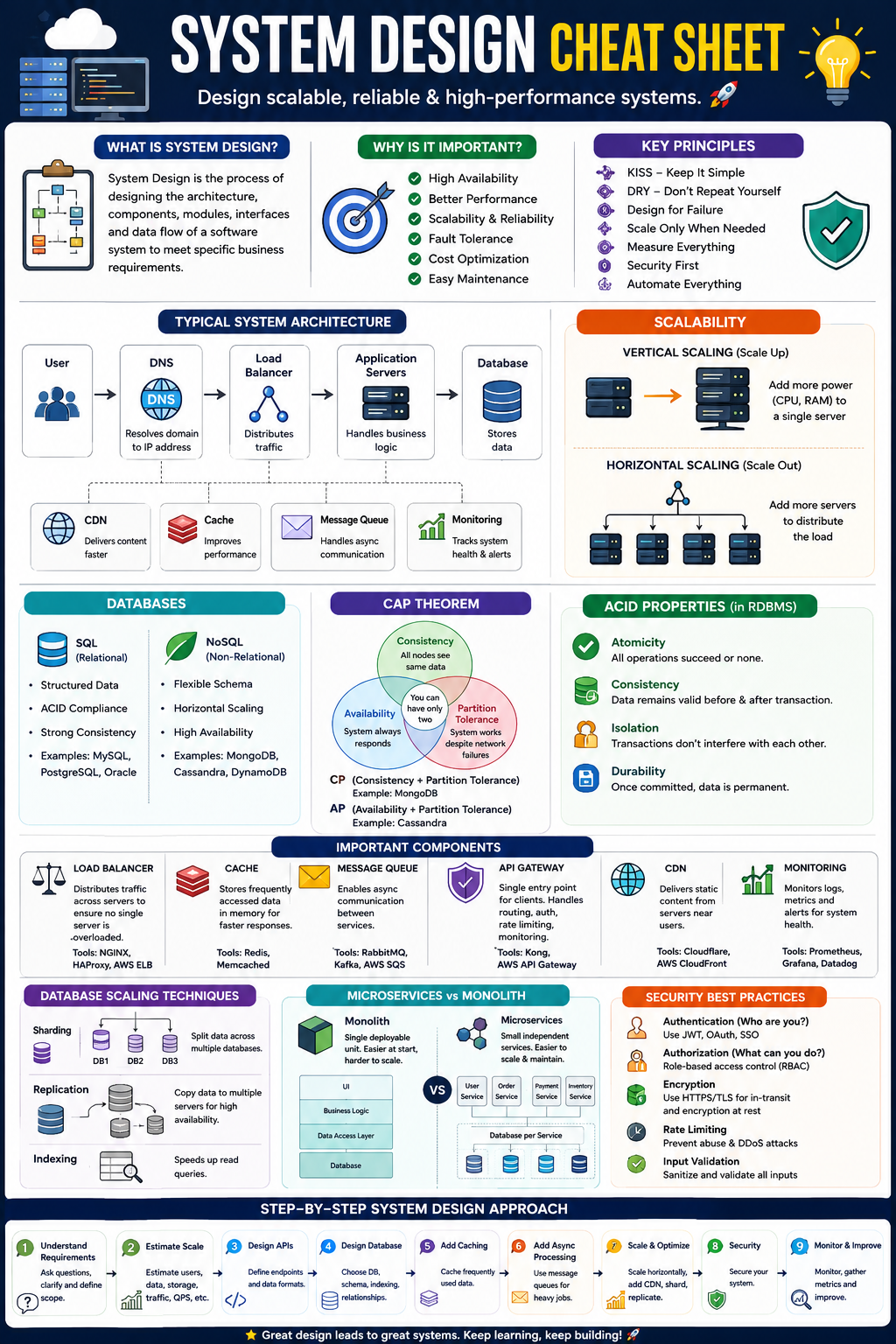
This guide covers:
✅ Core Concepts
✅ Important Terminologies
✅ Architecture Components
✅ Design Principles
✅ Scalability Techniques
✅ Databases & Caching
✅ Load Balancing
✅ Microservices
✅ Security Considerations
✅ System Design Interview Approach
✅ Real-World Examples
🎯 What is System Design?
System Design is the process of defining the architecture, components, modules, interfaces, and data flow of a software system to meet specific business requirements.
Simply put:
👉 System Design is the blueprint of software before coding begins.
Just like architects create building blueprints before construction, software engineers design systems before implementation.
🏗️ Why System Design Matters?
Without proper design:
❌ Slow applications
❌ Frequent crashes
❌ Poor scalability
❌ Security vulnerabilities
❌ Expensive maintenance
With proper design:
✅ High availability
✅ Better performance
✅ Easy maintenance
✅ Fault tolerance
✅ Cost optimization
🧩 Building Blocks of System Design
1️⃣ Client
Users interact through:
📱 Mobile Apps
💻 Web Applications
⌚ IoT Devices
Example:
User → Browser → Request2️⃣ DNS (Domain Name System)
DNS converts:
google.cominto:
142.251.32.14Think of DNS as the Internet’s phonebook. 📖
3️⃣ Load Balancer ⚖️
Distributes traffic across multiple servers.
Without Load Balancer
Users
  |
Server
Server gets overloaded.
With Load Balancer
Users
   |
Load Balancer
 /    \
S1    S2
Benefits:
✅ High Availability
✅ Better Performance
✅ Fault Tolerance
Popular Tools:
- NGINX
- HAProxy
- AWS ELB
- AWS ALB
4️⃣ Application Servers
Contains business logic.
Example:
Login
Payment
Order Processing
Notifications
Technologies:
- Ruby on Rails
- Django
- Spring Boot
- Node.js
- ASP.NET
5️⃣ Database 🗄️
Stores application data.
Example:
Users
Orders
Products
Payments
📚 Types of Databases
SQL Databases
Examples:
- PostgreSQL
- MySQL
- Oracle
Advantages
✅ ACID Compliance
✅ Strong Consistency
✅ Structured Data
Best for:
🏦 Banking
💳 Payments
📈 Financial Systems
NoSQL Databases
Examples:
- MongoDB
- Cassandra
- DynamoDB
Advantages:
✅ Flexible Schema
✅ Horizontal Scaling
✅ Fast Reads/Writes
Best for:
📱 Social Media
📊 Analytics
🌐 Large Scale Applications
🎯 CAP Theorem
A distributed system can provide only two of:
C — Consistency
All nodes show same data.
A — Availability
System always responds.
P — Partition Tolerance
Works despite network failures.
Example:
CP System → MongoDB
AP System → Cassandra
🔥 ACID Properties
Used in relational databases.
Atomicity
All or nothing.
Consistency
Data remains valid.
Isolation
Transactions don’t interfere.
Durability
Committed data never disappears.
⚡ Scalability
Scalability means handling growth efficiently.
Vertical Scaling
Add more power to server.
4 CPU → 32 CPUAdvantages:
✅ Simple
Disadvantages:
❌ Expensive
❌ Hardware limits
Horizontal Scaling
Add more servers.
Server1
Server2
Server3
Server4
Advantages:
✅ Infinite growth potential
✅ Fault tolerance
Preferred by:
Netflix 🚀
Amazon 🚀
Google 🚀
🚀 Caching
Caching stores frequently accessed data in memory.
Example:
User Profile
Popular Products
Trending Videos
Without Cache:
Request → DatabaseWith Cache:
Request → Cache → DatabaseBenefits:
✅ Faster Response
✅ Reduced DB Load
✅ Lower Cost
Popular Cache Systems
Redis
Fast in-memory database.
Memcached
Simple distributed cache.
📨 Message Queues
Used for asynchronous communication.
Example:
User uploads video.
Without Queue:
Upload → Processing → WaitWith Queue:
Upload → Queue → WorkerBenefits:
✅ Faster Response
✅ Decoupling
✅ Reliability
Tools:
- RabbitMQ
- Kafka
- AWS SQS
🔄 Event-Driven Architecture
Components communicate through events.
Example:
Order Created
      ↓
Payment Service
      ↓
Inventory Service
      ↓
Notification Service
Benefits:
✅ Loose Coupling
✅ Scalability
✅ Flexibility
🏢 Monolith vs Microservices
Monolith
Single application.
App
 ├ Users
 ├ Orders
 ├ Payments
Advantages:
✅ Easy Development
✅ Easier Deployment
Disadvantages:
❌ Difficult Scaling
Microservices
Separate services.
User Service
Order Service
Payment Service
Inventory Service
Advantages:
✅ Independent Scaling
✅ Better Maintainability
Disadvantages:
❌ More Complexity
🌐 API Gateway
Acts as a single entry point.
Client
  |
API Gateway
 / | \
User Order Payment
Responsibilities:
✅ Authentication
✅ Rate Limiting
✅ Routing
✅ Monitoring
🔒 Security Principles
Authentication
Who are you?
Examples:
- JWT
- OAuth
- SSO
Authorization
What can you access?
Example:
Admin
User
Manager
Encryption
Protect data.
At Rest
Database encryption
In Transit
HTTPS/TLS
Rate Limiting
Prevent abuse.
Example:
100 Requests / Minute📊 Database Optimization Techniques
Indexing
Without Index:
O(n)With Index:
O(log n)Massive performance improvement.
Sharding
Split data across servers.
User 1-1M → DB1
User 1M-2M → DB2
Benefits:
✅ Massive scalability
Replication
Copy data to multiple servers.
Master
 /   \
R1   R2
Benefits:
✅ High Availability
✅ Faster Reads
🔄 Consistent Hashing
Used for:
- Distributed Cache
- Distributed Databases
Benefits:
✅ Reduced Data Movement
✅ Better Scalability
Popular in:
- Redis Cluster
- Cassandra
🏥 High Availability (HA)
Goal:
99.99%uptime or more.
Strategies:
✅ Replication
✅ Multi-region deployment
✅ Failover mechanisms
🌍 Content Delivery Network (CDN)
Stores content near users.
Example:
User India → India Server
User US → US Server
Benefits:
⚡ Faster Delivery
⚡ Reduced Latency
Examples:
- Cloudflare
- Akamai
- AWS CloudFront
📈 Monitoring & Observability
You can’t improve what you can’t measure.
Metrics:
✅ CPU Usage
✅ Memory Usage
✅ Error Rate
✅ Latency
Monitoring Tools
- Prometheus
- Grafana
- Datadog
- New Relic
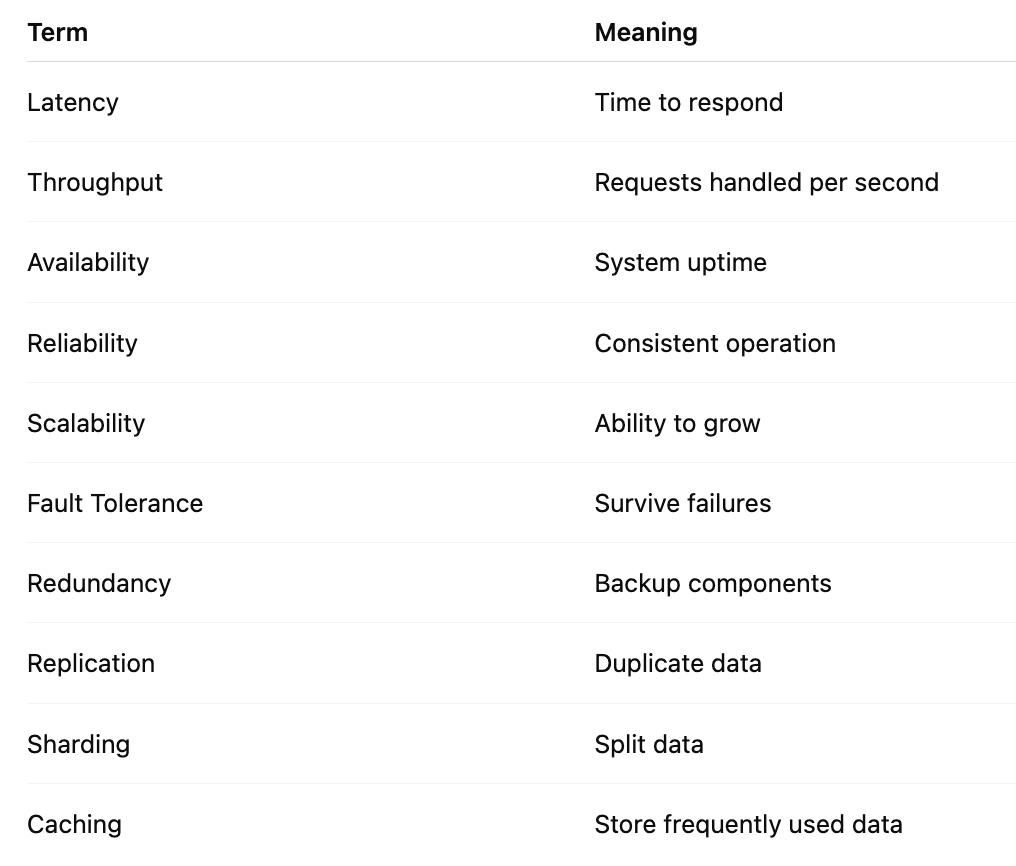
🧠 Important Terminologies
🎯 Golden Principles of Great System Design
1. Keep It Simple (KISS) 💡
Avoid unnecessary complexity.
2. Don’t Repeat Yourself (DRY)
Reuse logic.
3. Design for Failure
Assume servers will fail.
4. Scale Only When Needed
Premature optimization is dangerous.
5. Measure Everything
Use logs and monitoring.
6. Security First
Never treat security as an afterthought.
7. Automate Everything
CI/CD pipelines
Infrastructure as Code
Auto Scaling
🚀 Step-by-Step Framework for Designing Any System
When designing:
Step 1
Understand Requirements
Ask:
- Expected users?
- Read-heavy or write-heavy?
- Availability requirements?
Step 2
Estimate Scale
Example:
10 Million Users
1 Million Daily Active Users
Step 3
Design APIs
POST /users
GET /orders
Step 4
Design Database
SQL or NoSQL?
Step 5
Add Caching
Redis
Step 6
Add Load Balancer
Distribute traffic.
Step 7
Add Message Queue
For asynchronous tasks.
Step 8
Plan Scalability
Horizontal scaling.
Step 9
Plan Security
Authentication + Authorization.
Step 10
Add Monitoring
Metrics, logs, tracing.
🌟 Example: Designing URL Shortener
Requirements
Input:
https://example.com/article

Output:
short.ly/abc123
Architecture
Client
   |
Load Balancer
   |
Application Server
   |
Database
   |
Cache
Features:
✅ Unique URL Generation
✅ Fast Redirects
✅ Analytics
✅ High Availability
🎖️ System Design Interview Strategy
When asked:
“Design Twitter”
Follow:
Requirement Gathering
Capacity Estimation
High-Level Design
Database Design
Scaling Discussion
Bottleneck Analysis
Security Considerations
Monitoring Strategy
This structured approach impresses interviewers. 🚀
🏆 Final Thoughts
System Design is not about memorizing architectures.
It’s about understanding:
✅ Trade-offs
✅ Scalability
✅ Reliability
✅ Availability
✅ Maintainability
✅ Performance
The best engineers don’t just write code — they design systems that continue working when millions of users arrive.
“Code makes software work. System Design makes software survive.” 🚀🏗️
Master these principles, practice real-world design problems (Netflix, WhatsApp, Uber, Amazon, YouTube), and you’ll be well on your way to becoming a Senior Engineer or Software Architect. 🌟


Comments
Post a Comment