🚀 Top 10 Toughest DSA Problems Every Programmer Should Master (With Solutions & Variations)
🚀 Top 10 Toughest DSA Problems Every Programmer Should Master (With Solutions & Variations)
Data Structures and Algorithms (DSA) are the backbone of software engineering interviews at companies like Google, Amazon, Microsoft, and Meta.
While many programmers solve easy and medium problems, only a few master the hardest DSA challenges that test problem-solving, optimization, recursion, graph theory, dynamic programming, and advanced data structures.
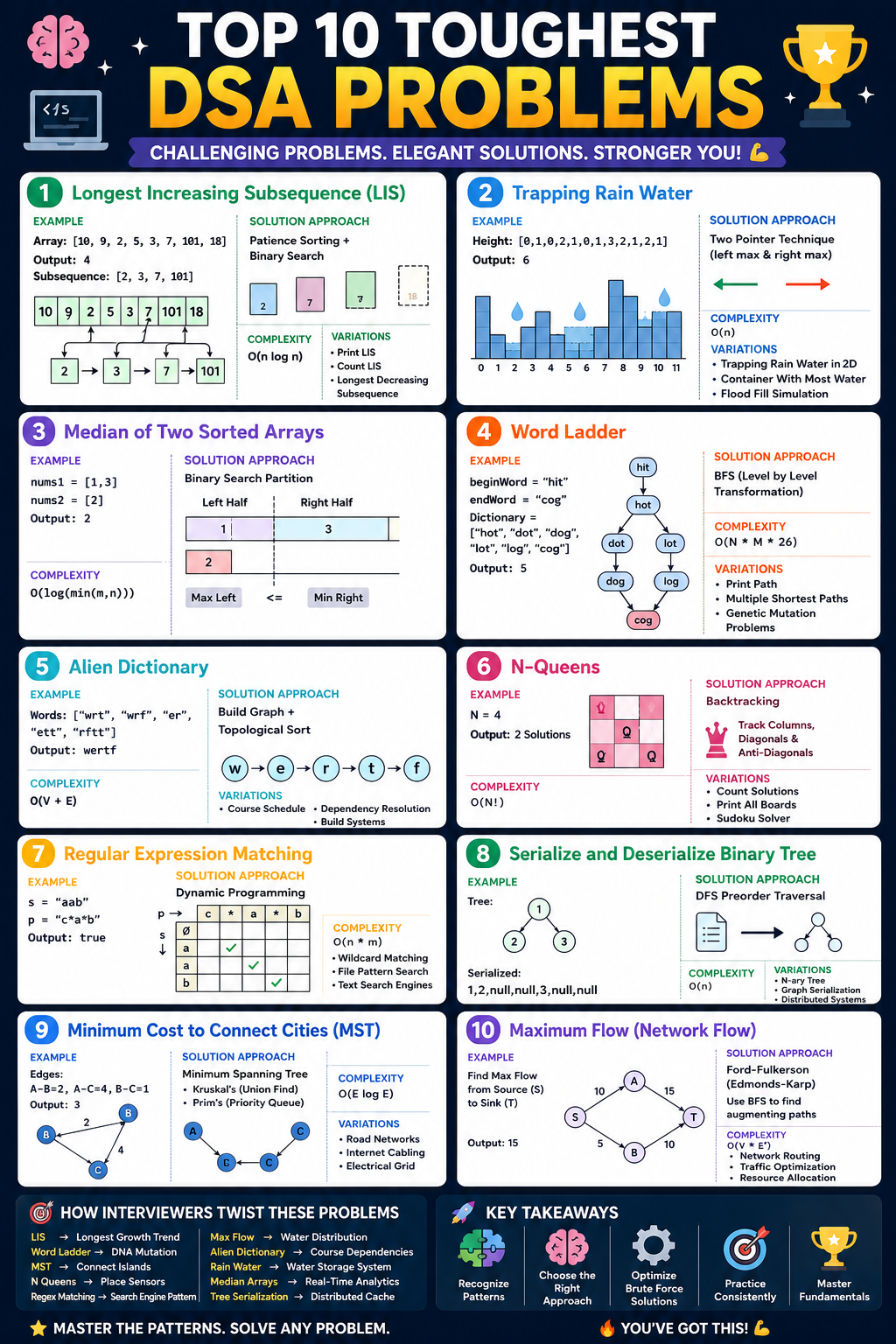
In this article, we’ll explore 10 of the toughest DSA problems, understand their solutions, and learn how interviewers can twist them into different forms.
🎯 1. Longest Increasing Subsequence (LIS)
Problem
Given an array:
[10, 9, 2, 5, 3, 7, 101, 18]Find the length of the longest strictly increasing subsequence.
Output
4Subsequence:
[2, 3, 7, 101]Naive Solution
Generate all subsequences.
Complexity:
O(2^n)Impossible for large inputs.
Optimal Solution
Use Binary Search + Dynamic Array.
def lis(nums)
  tails = []

  nums.each do |num|
    idx = tails.bsearch_index { |x| x >= num } || tails.length
    if idx == tails.length
      tails << num
    else
      tails[idx] = num
    end
  end
  tails.length
end
Complexity
O(n log n)Interview Variations
✅ Print actual LIS
✅ Count number of LIS
✅ Longest decreasing subsequence
✅ Bitonic sequence
🔥 2. Trapping Rain Water
Problem
Given heights:
[0,1,0,2,1,0,1,3,2,1,2,1]Calculate trapped water.
Output
6Optimal Two Pointer Solution
def trap(height)
  left = 0
  right = height.length - 1

  left_max = right_max = 0
  water = 0

  while left < right
    if height[left] < height[right]
      left_max = [left_max, height[left]].max
      water += left_max - height[left]
      left += 1
    else
      right_max = [right_max, height[right]].max
      water += right_max - height[right]
      right -= 1
    end
  end

  water
end
Complexity
O(n)Variations
🌧 Rain water in 2D matrix
🌧 Container with most water
🌧 Flood fill simulation
🧠 3. Median of Two Sorted Arrays
Problem
nums1 = [1,3]
nums2 = [2]
Output:
2Challenge
Required complexity:
O(log(min(m,n)))Not O(n)
Idea
Use Binary Search partitioning.
Left Half | Right HalfFind perfect partition.
Complexity
O(log(min(m,n)))Variations
✅ Kth smallest element
✅ Median in stream
✅ Running median
🌉 4. Word Ladder
Problem
Convert:
hit → cogDictionary:
["hot","dot","dog","lot","log","cog"]Output:
5Path:
hit
hot
dot
dog
cog
Solution
Use BFS.
Each level represents one transformation.
queue = [[begin_word,1]]Complexity
O(N * M * 26)Where:
- N = words
- M = word length
Variations
🔤 Print path
🔤 Multiple shortest paths
🔤 Genetic mutation problems
🕸️ 5. Alien Dictionary
Problem
Given:
["wrt","wrf","er","ett","rftt"]Find character ordering.
Solution
Build Graph + Topological Sort.
w → e
e → r
r → t
t → f
Output:
wertfComplexity
O(V + E)Variations
🌍 Course Schedule
🌍 Dependency Resolution
🌍 Build Systems
⚡ 6. N-Queens
Problem
Place N queens on chessboard.
Example:
N = 4Output:
2 SolutionsBacktracking Solution
Try placing queens row by row.
def solve(row)
  return if row == n
end
Track:
- Columns
- Diagonals
- Anti-diagonals
Complexity
O(N!)Variations
♛ Count solutions
♛ Print all boards
♛ Sudoku Solver
💎 7. Regular Expression Matching
Problem
s = "aab"
p = "c*a*b"
Output:
trueWhy Hard?
Need support:
.
*
Solution
Dynamic Programming.
State:
dp[i][j]Meaning:
Can first i chars match first j chars?Complexity
O(n*m)Variations
🔍 Wildcard Matching
🔍 File Pattern Search
🔍 Text Search Engines
🌲 8. Serialize and Deserialize Binary Tree
Problem
Convert tree to string and back.
Example:
1
     / \
    2   3
Serialize:
1,2,null,null,3,null,nullSolution
DFS Preorder.
serialize(root)
deserialize(data)
Complexity
O(n)Variations
🌳 N-ary Tree
🌳 Graph Serialization
🌳 Distributed Systems
🚦 9. Minimum Cost to Connect Cities
Problem
Given cities and costs.
Find cheapest way to connect all.
Example
A-B = 2
A-C = 4
B-C = 1
Output:
3Solution
Minimum Spanning Tree.
Use:
Kruskal’s Algorithm
Union FindOR
Prim’s Algorithm
Priority QueueComplexity
O(E log E)Variations
🏙 Road Networks
🏙 Internet Cabling
🏙 Electrical Grid
🚀 10. Maximum Flow (Network Flow)
Problem
Find maximum flow from Source → Sink.
Example:
S ----10----> A
S ----5-----> B
A ----15----> T
B ----10----> T
Output:
15Solution
Ford-Fulkerson
Repeatedly find augmenting paths.
Improved Version:
Edmonds-Karp
Uses BFS.
Complexity
O(V * E²)Variations
🌐 Network Routing
🌐 Traffic Optimization
🌐 Resource Allocation
🏆 Bonus Ultra-Hard Problems
If you master these, you’re operating at an elite level:
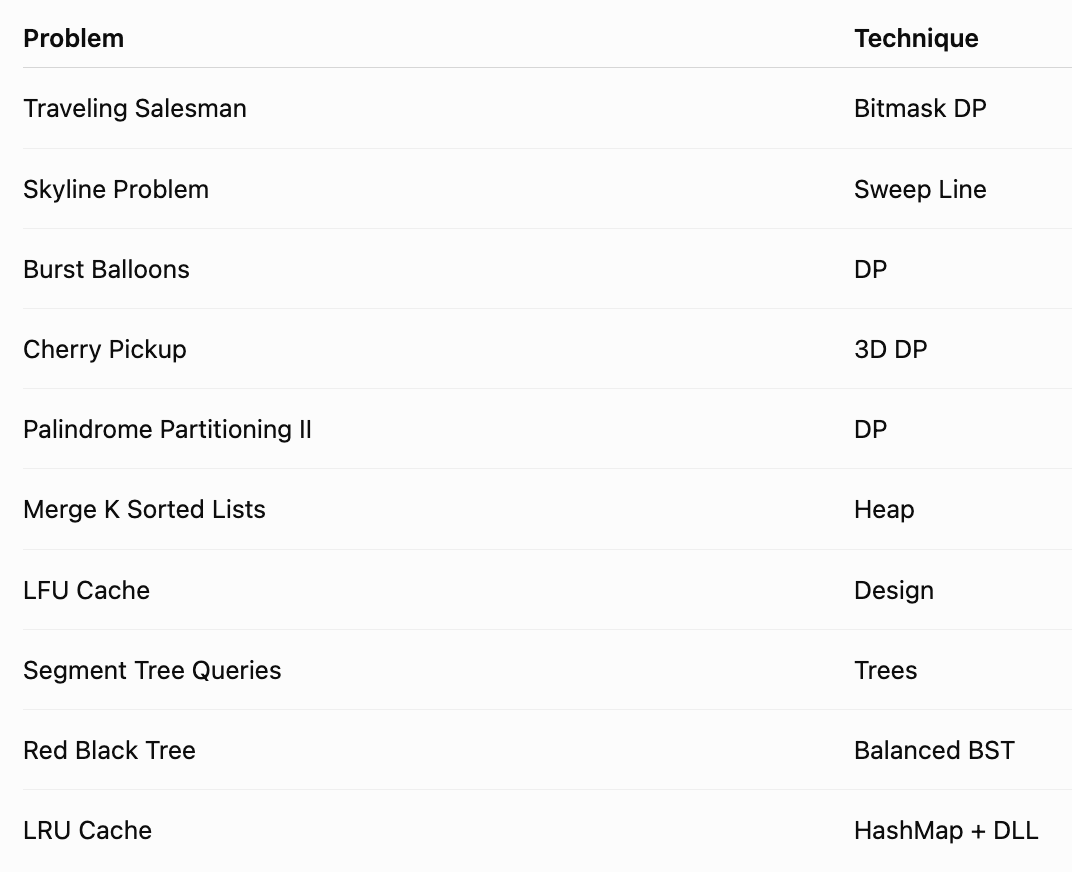
🎯 How Interviewers Twist These Problems
Many candidates memorize solutions. Great interviewers change the story while keeping the same core algorithm.
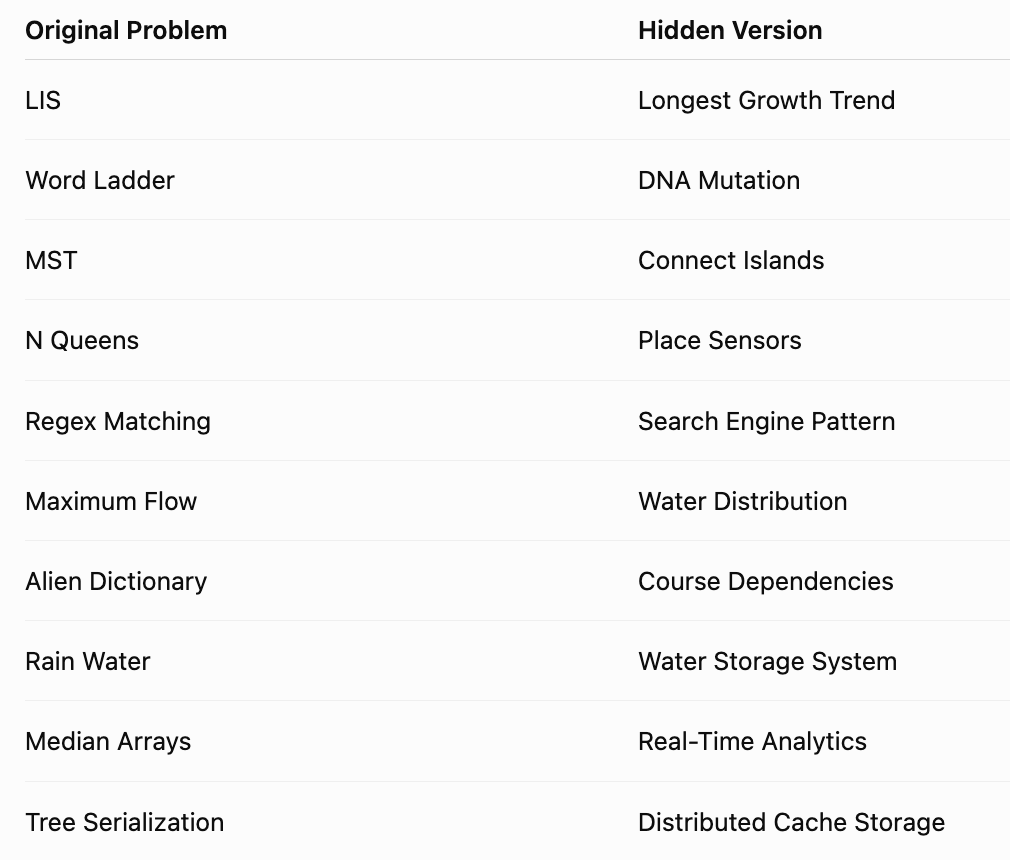
👉 The secret is not memorizing problems but recognizing the underlying pattern.
🌟 Final Thoughts
The toughest DSA problems aren’t difficult because of code — they’re difficult because they require you to identify patterns, choose the right data structure, and optimize brute-force approaches into elegant solutions.
Master these concepts:
✅ Dynamic Programming
✅ Graph Theory
✅ Greedy Algorithms
✅ Backtracking
✅ Trees & Heaps
✅ Union Find
✅ Binary Search
✅ Topological Sorting
✅ Network Flow
✅ Advanced Data Structures
Once you become comfortable with these patterns, even the most intimidating interview questions start looking familiar. 🚀
Remember: Every hard problem is usually a combination of 2–3 fundamental techniques. Learn the patterns, and you’ll solve problems that once seemed impossible. 💪🔥


Comments
Post a Comment