🌍 The World Order: How Power Shifts Shape Nations, Economies, Markets, and Our Future 🚀
🌍 The World Order: How Power Shifts Shape Nations, Economies, Markets, and Our Future 🚀
“History is not just the story of nations. It is the story of power moving from one hand to another.”
From ancient empires to modern superpowers, the world has always operated under a World Order — a system that determines who holds power, who creates rules, who controls trade, and who influences the future.
But history teaches us one thing:
⚡ No World Order lasts forever.
Every dominant power eventually declines, and a new power rises.
Today, we are witnessing one of the biggest geopolitical and economic shifts in modern history.
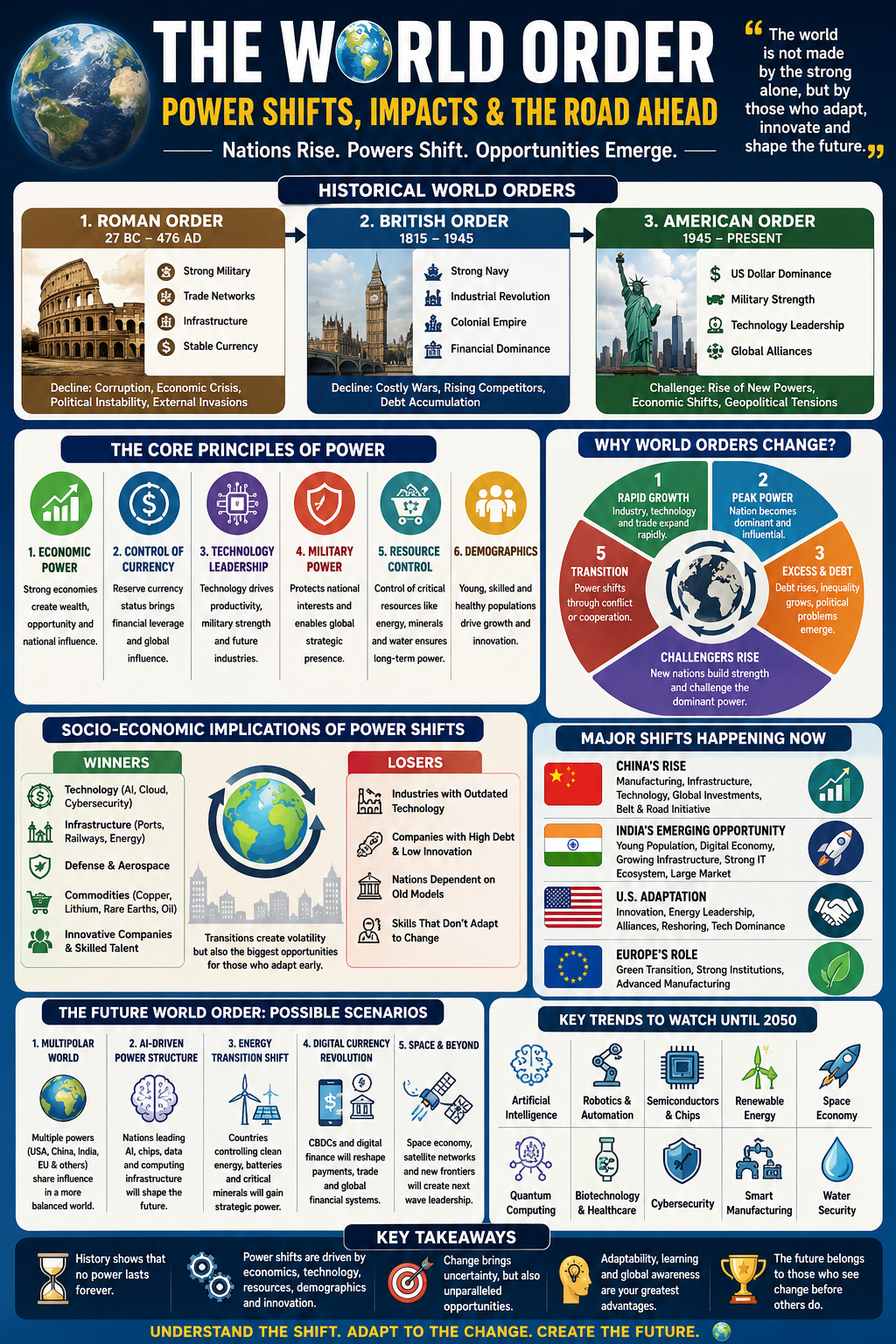
Let’s understand how World Orders work, why they change, and what the future may look like.
🌎 What Is World Order?
World Order refers to the global balance of:
- Political Power 🏛️
- Economic Power 💰
- Military Strength ⚔️
- Technological Leadership 🤖
- Cultural Influence 🎭
- Control of Trade Routes 🚢
The dominant nation often:
✅ Sets global rules
✅ Controls financial systems
✅ Influences international organizations
✅ Determines geopolitical direction
🏺 Historical World Orders
1. Roman World Order (27 BC — 476 AD)
Dominance Factors
- Strong military
- Trade networks
- Infrastructure
- Stable currency
Result
Rome controlled most of Europe and the Mediterranean.
Decline
❌ Corruption
❌ Economic crisis
❌ Political instability
❌ External invasions
Lesson: Internal weakness destroys even the strongest empire.
2. British World Order (1815–1945)
Why Britain Dominated
🚢 World’s strongest navy
🏭 Industrial Revolution
🌍 Massive colonial network
💰 Financial dominance
London became the center of global finance.
Decline
- Costly wars
- Rising competitors
- Debt accumulation
3. American World Order (1945–Present)
After World War II, the United States emerged as the strongest power.
Sources of Power
💵 US Dollar
🪖 Military dominance
💻 Technology leadership
🏢 Global corporations
🎓 Top universities
🌐 International alliances
Institutions like:
- United Nations
- International Monetary Fund
- World Bank
became pillars of the modern order.
🔥 The Core Principles of Power
Power doesn’t come from military strength alone.
Throughout history, successful powers mastered several principles.
1. Economic Power 💰
The strongest economies usually become the strongest nations.
Examples:
- Britain during the Industrial Revolution
- United States after World War II
- China in the 21st century
Economic power enables:
✅ Better military
✅ Innovation
✅ Diplomacy
✅ Infrastructure
2. Control of Currency 💵
Money is power.
The global reserve currency gives enormous advantages.
Today:
💲 US Dollar dominates international trade.
Benefits include:
- Cheaper borrowing
- Greater influence
- Financial leverage
3. Technology Leadership 🤖
Technology creates wealth and military superiority.
Historical examples:
- Steam Engine
- Electricity
- Internet
- Artificial Intelligence
Countries leading AI and semiconductor technology may dominate the next era.
4. Military Power ⚔️
Military strength protects economic interests.
However:
⚠️ Military power without economic power eventually collapses.
Example:
The Soviet Union had military strength but economic weakness.
5. Resource Control ⛽
History repeatedly shows:
Energy equals power.
Examples:
- Oil
- Natural Gas
- Rare Earth Minerals
- Water Resources
The future may revolve around:
🔋 Lithium
🔋 Cobalt
🔋 Copper
🔋 Rare Earth Elements
6. Demographics 👥
Young populations drive growth.
Advantages:
- More workers
- More consumers
- More innovation
Challenges:
- Aging populations
- Pension burdens
- Labor shortages
Countries with demographic advantages may gain power in coming decades.
🔄 Why World Orders Change
Every major shift follows a similar pattern.
Stage 1: Rapid Growth 📈
A nation develops:
- Industry
- Technology
- Trade
Economic growth accelerates.
Stage 2: Peak Power 👑
The nation becomes dominant.
Confidence rises.
Capital flows in.
Military expands.
Stage 3: Excess and Debt 💳
Problems emerge:
❌ High debt
❌ Wealth inequality
❌ Political division
❌ Overexpansion
Stage 4: Challengers Rise ⚡
New competitors emerge.
Examples:
- Germany challenged Britain.
- United States challenged Britain.
- China challenges America.
Stage 5: Transition 🌍
Power shifts gradually.
Sometimes peacefully.
Sometimes through conflict.
🇨🇳 China’s Rise: The Biggest Challenge to Current Order
Over four decades:
China transformed from a developing nation into a global manufacturing giant.
Strengths include:
🏭 Manufacturing
🚄 Infrastructure
📱 Technology
🌐 Global investments
🚢 Trade influence
Projects such as the Belt and Road Initiative increased China’s global reach.
🇮🇳 India’s Emerging Opportunity
Many experts view India as a major future power.
Reasons:
✅ Young population
✅ Growing digital economy
✅ Expanding infrastructure
✅ Large consumer market
✅ Strong IT ecosystem
Potential strengths:
- Manufacturing
- Software
- AI services
- Renewable energy
📊 Economic Consequences of Power Shifts
When power shifts, markets change dramatically.
Winners
Technology
AI
Cloud Computing
Cybersecurity
Automation
Infrastructure
Roads
Ports
Railways
Energy Grids
Defense
Countries increase military spending during transitions.
Commodities
Copper
Lithium
Rare Earths
Energy resources
Losers
Industries dependent on:
❌ Cheap labor
❌ Outdated technology
❌ Excessive debt
❌ Weak innovation
📈 Investment Lessons from History
Major fortunes were created during transitions.
Examples:
Industrial Revolution
Winners:
- Railways
- Steel
- Manufacturing
Internet Revolution
Winners:
- Software
- E-commerce
- Cloud computing
AI Revolution
Potential winners:
🤖 Artificial Intelligence
⚡ Semiconductors
☁️ Cloud Infrastructure
🔒 Cybersecurity
🔋 Energy Infrastructure
🌐 Future World Order: What Could Happen?
No one knows with certainty.
However, several scenarios appear possible.
Scenario 1: Multipolar World 🌍
Instead of one dominant power:
- United States
- China
- India
- European Union
share influence.
Most experts consider this highly likely.
Scenario 2: AI-Driven Power Structure 🤖
Future power may belong to nations controlling:
- AI models
- Computing infrastructure
- Data
- Semiconductor production
AI could become as transformative as electricity.
Scenario 3: Energy Transition Power Shift 🔋
Countries controlling:
- Lithium
- Rare Earths
- Battery Technology
- Renewable Energy
gain strategic advantages.
Scenario 4: Digital Currency Revolution 💳
Central Bank Digital Currencies (CBDCs) may reshape global finance.
Potential effects:
- Faster payments
- Reduced transaction costs
- New geopolitical influence
🚨 Risks That Could Accelerate Change
Geopolitical Conflicts
Regional tensions can speed power transitions.
Debt Crises
High national debt weakens economies.
Climate Change
Resource scarcity creates strategic competition.
Technological Disruption
AI may redefine economic leadership faster than expected.
🎯 Key Trends to Watch Until 2050
Mega Trends
✅ Artificial Intelligence
✅ Robotics
✅ Semiconductor Industry
✅ Renewable Energy
✅ Space Economy
✅ Biotechnology
✅ Quantum Computing
✅ Cybersecurity
✅ Water Infrastructure
✅ Smart Manufacturing
💡 Practical Lessons for Individuals
The same principles that govern nations also apply to people.
Build Economic Power
Invest in skills and assets.
Learn Technology
Technology creates leverage.
Stay Adaptable
Power shifts reward flexibility.
Think Globally
Opportunities increasingly cross borders.
Follow Emerging Trends
The future belongs to those who see change before others do.
🚀 Final Thoughts
World Order is not a fixed structure — it is a constantly evolving competition of economics, technology, resources, demographics, and innovation.
History shows that every dominant power eventually faces challengers.
The coming decades may witness:
🌍 A more multipolar world
🤖 AI-driven competition
🔋 Energy transformation
💻 Digital financial systems
🇮🇳 Rising influence of India
🇨🇳 Continued competition from China
🇺🇸 Ongoing leadership from the United States
For investors, entrepreneurs, professionals, and policymakers, understanding these shifts is no longer optional — it is one of the most important skills for navigating the future.
The greatest opportunities often emerge during the greatest transitions.


Comments
Post a Comment