🚀 Big Data Mastery: The Ultimate Guide to Handling Billions of Records Like Google, Netflix & Amazon 🌍📊
🚀 Big Data Mastery: The Ultimate Guide to Handling Billions of Records Like Google, Netflix & Amazon 🌍📊
“Data is the new oil, but only when it is refined into insights.” 💡
Every second, billions of people generate data.
- 📱 WhatsApp sends millions of messages.
- 🎥 Netflix streams millions of hours of videos.
- 🛒 Amazon records millions of purchases.
- 📸 Instagram uploads millions of photos.
- 🔍 Google processes billions of searches daily.
This enormous amount of information is called Big Data.
But here’s the real challenge:
Collecting data is easy. Understanding it is difficult.
Big Data provides technologies that allow organizations to store, process, analyze, and visualize enormous datasets quickly and efficiently.
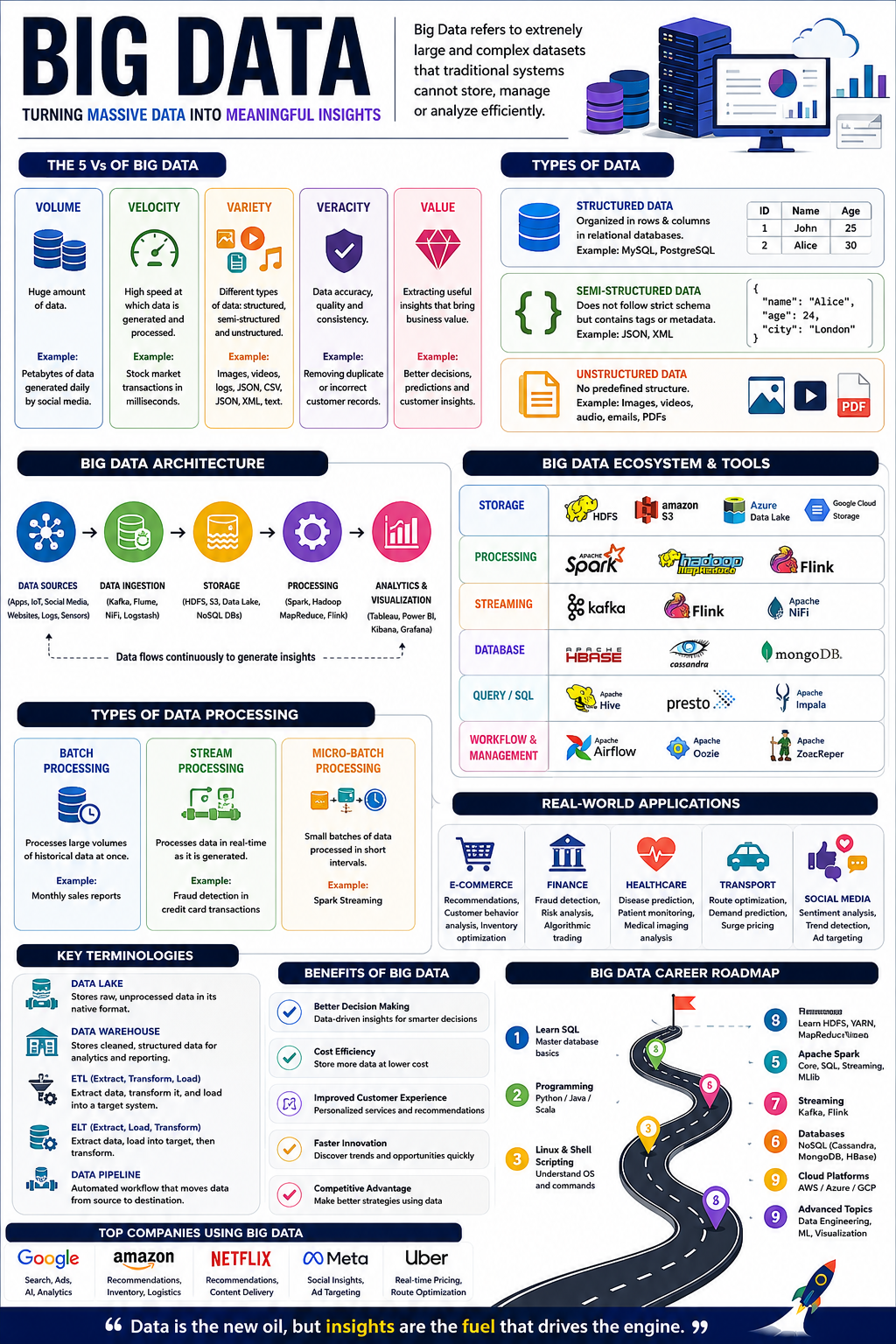
Let’s explore everything about Big Data — from fundamentals to advanced tools — with real-world examples.
🌍 What is Big Data?
Big Data refers to datasets that are too large, too fast, or too complex to be handled efficiently using traditional databases.
Instead of gigabytes, Big Data deals with:
- Terabytes (TB)
- Petabytes (PB)
- Exabytes (EB)
- Zettabytes (ZB)
Example
Imagine Amazon stores:
- Every product
- Customer reviews
- Search history
- Purchases
- Clicks
- Wishlist
- Delivery tracking
For hundreds of millions of users.
A normal SQL database alone cannot efficiently process such massive datasets.
Big Data technologies solve this challenge.
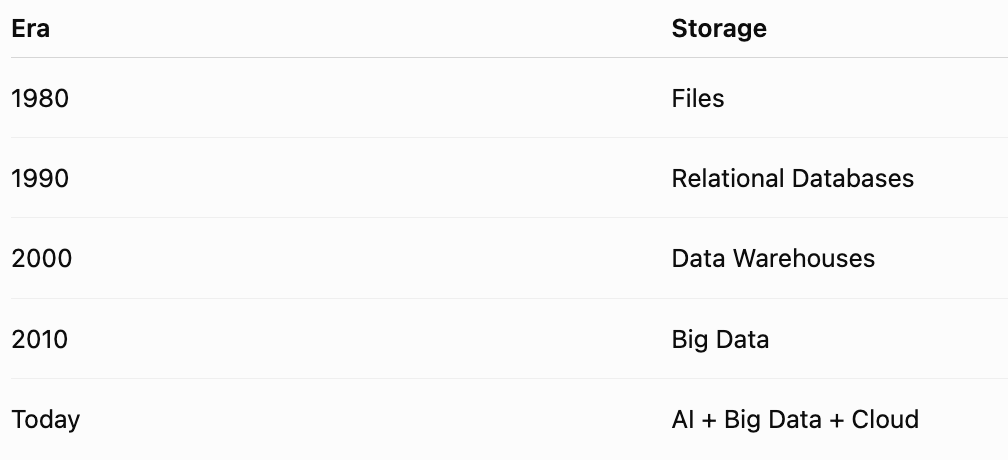
📈 Evolution of Data
⭐ The 5 Vs of Big Data
1️⃣ Volume 📦
Huge amounts of data.
Example:
Netflix stores petabytes of video data.
2️⃣ Velocity ⚡
Speed at which data is generated.
Example:
Stock market transactions occur every millisecond.
3️⃣ Variety 🌈
Different data formats.
- Images
- Audio
- Videos
- PDFs
- JSON
- CSV
- XML
4️⃣ Veracity ✅
Accuracy and trustworthiness.
Example:
Removing duplicate customer records.
5️⃣ Value 💰
Generating useful business insights.
Raw data is useless until analyzed.
Structured vs Semi-Structured vs Unstructured Data
Structured Data
Stored in rows and columns.
Example:
Name — Age
John — 25
Database:
- MySQL
- PostgreSQL
Semi-Structured
Contains tags or metadata.
Examples:
- JSON
- XML
{
 "name":"Alice",
 "age":24
}
Unstructured
No predefined format.
Examples:
- Images
- Videos
- Emails
- Social media posts
Nearly 80–90% of enterprise data is estimated to be unstructured, making technologies beyond traditional relational databases increasingly important.
Big Data Architecture
Data Sources
      │
      ▼
Data Ingestion
      │
      ▼
Storage
      │
      ▼
Processing
      │
      ▼
Analytics
      │
      ▼
Visualization
Components of Big Data
📥 Data Sources
- IoT Devices
- Websites
- Mobile Apps
- Social Media
- Sensors
- ERP Systems
- CRM Systems
📤 Data Ingestion
Moves data into storage.
Tools:
- Apache Kafka
- Apache Flume
- Apache NiFi
- Logstash
🗄 Data Storage
Stores petabytes of information.
Technologies:
- HDFS
- Amazon S3
- Azure Data Lake
- Google Cloud Storage
⚙ Data Processing
Transforms raw data into useful information.
Frameworks:
- Apache Spark
- Hadoop MapReduce
- Apache Flink
📊 Analytics
Business Intelligence:
- SQL
- Spark SQL
- Hive
Machine Learning:
- TensorFlow
- Spark MLlib
- Scikit-Learn
📈 Visualization
Tools:
- Tableau
- Power BI
- Grafana
- Kibana
Big Data Terminologies
Data Lake
Stores raw data.
Supports:
- Images
- Videos
- Logs
- CSV
- JSON
Examples:
Amazon S3
Azure Data Lake
Data Warehouse
Stores cleaned data.
Examples:
Snowflake
Google BigQuery
Amazon Redshift
Data Pipeline
Moves data through different systems.
Example:
Application
↓
Kafka
↓
Spark
↓
Data Lake
↓
Power BI
ETL
Extract
↓
Transform
↓
Load
Example:
CRM
↓
Clean Data
↓
Warehouse
ELT
Extract
↓
Load
↓
Transform
Mostly used with cloud platforms where storage and compute are decoupled.
Hadoop Ecosystem
Hadoop
Open-source framework for distributed storage and processing.
Main modules:
- HDFS
- YARN
- MapReduce
- Hadoop Common
HDFS
Hadoop Distributed File System.
Features:
✔ Fault tolerance
✔ Replication
✔ Distributed storage
MapReduce
Programming model.
Two stages:
Map
↓
Reduce
Example:
Count words in one million books.
YARN
Resource manager.
Allocates memory and CPU.
Apache Spark ⚡
Spark is a distributed data processing engine that performs many workloads significantly faster than traditional disk-based MapReduce because it keeps much of its working data in memory.
Features:
✅ In-memory computing
✅ Fast processing
✅ Machine Learning
✅ Graph Processing
✅ Streaming
Example:
Netflix recommendation engine can leverage Spark to analyze user behavior and generate personalized recommendations quickly.
Spark Components
Spark Core
Basic engine.
Spark SQL
SQL queries.
Example:
SELECT *
FROM sales
WHERE amount > 1000;
Spark Streaming
Processes live streams.
Example:
Twitter feeds.
MLlib
Machine Learning library.
Supports:
- Regression
- Classification
- Clustering
GraphX
Graph processing.
Example:
Facebook friend networks.
Apache Kafka
Distributed messaging platform.
Used for:
- Event streaming
- Logs
- Banking
- IoT
Example:
Payment
↓
Kafka
↓
Fraud Detection
↓
Notification
Apache Flink
Real-time analytics engine.
Best for:
- Fraud detection
- Gaming
- Live dashboards
Apache Hive
SQL layer over Hadoop.
Example:
SELECT customer,
SUM(sales)
FROM orders
GROUP BY customer;
Apache Pig
High-level scripting language.
Used for ETL operations.
Apache HBase
NoSQL database.
Features:
- Random access
- Huge datasets
- Low latency
Apache Cassandra
Distributed NoSQL database.
Used by:
- Messaging platforms
- Large-scale applications
Features:
✔ High availability
✔ No single point of failure
MongoDB
Document-oriented NoSQL database.
Stores:
{
"name":"John",
"city":"London"
}
Elasticsearch
Search engine.
Used for:
- Log analysis
- Website search
- Analytics
Apache Airflow
Workflow scheduler.
Automates pipelines.
Apache NiFi
Visual data flow management.
Supports:
- Routing
- Filtering
- Data movement
Apache ZooKeeper
Coordinates distributed systems.
Used by:
- Kafka
- Hadoop
Apache Oozie
Schedules Hadoop jobs.
Data Processing Types
Batch Processing
Large historical datasets.
Example:
Monthly payroll.
Stream Processing
Real-time processing.
Example:
Credit card fraud detection.
Micro Batch
Small batches every few seconds.
Spark Streaming commonly uses this model.
CAP Theorem
Distributed databases cannot simultaneously guarantee all three under network partitions:
- Consistency
- Availability
- Partition Tolerance
Designs choose trade-offs depending on system requirements.
Big Data Security
Challenges:
🔒 Encryption
🔑 Authentication
🛡 Authorization
📊 Auditing
Big Data in Machine Learning
Applications:
- Recommendation systems
- Fraud detection
- NLP
- Computer Vision
- Forecasting
Real-World Case Studies
🛒 Amazon
Uses Big Data for:
- Recommendations
- Inventory optimization
- Demand forecasting
- Pricing
🎬 Netflix
Analyzes:
- Watch history
- Search behavior
- Pause/rewind actions
- Device usage
To recommend personalized content.
🚗 Uber
Uses:
- GPS
- Traffic
- Driver availability
- Demand prediction
For dynamic pricing and route optimization.
🏥 Healthcare
Applications:
- Disease prediction
- Patient monitoring
- Drug discovery
- Medical imaging
🏦 Banking
Uses:
- Fraud detection
- Credit scoring
- Risk analysis
- Customer segmentation
🛰 Space Research
Processes satellite imagery, telemetry, and scientific observations to support climate studies, planetary exploration, and mission planning.
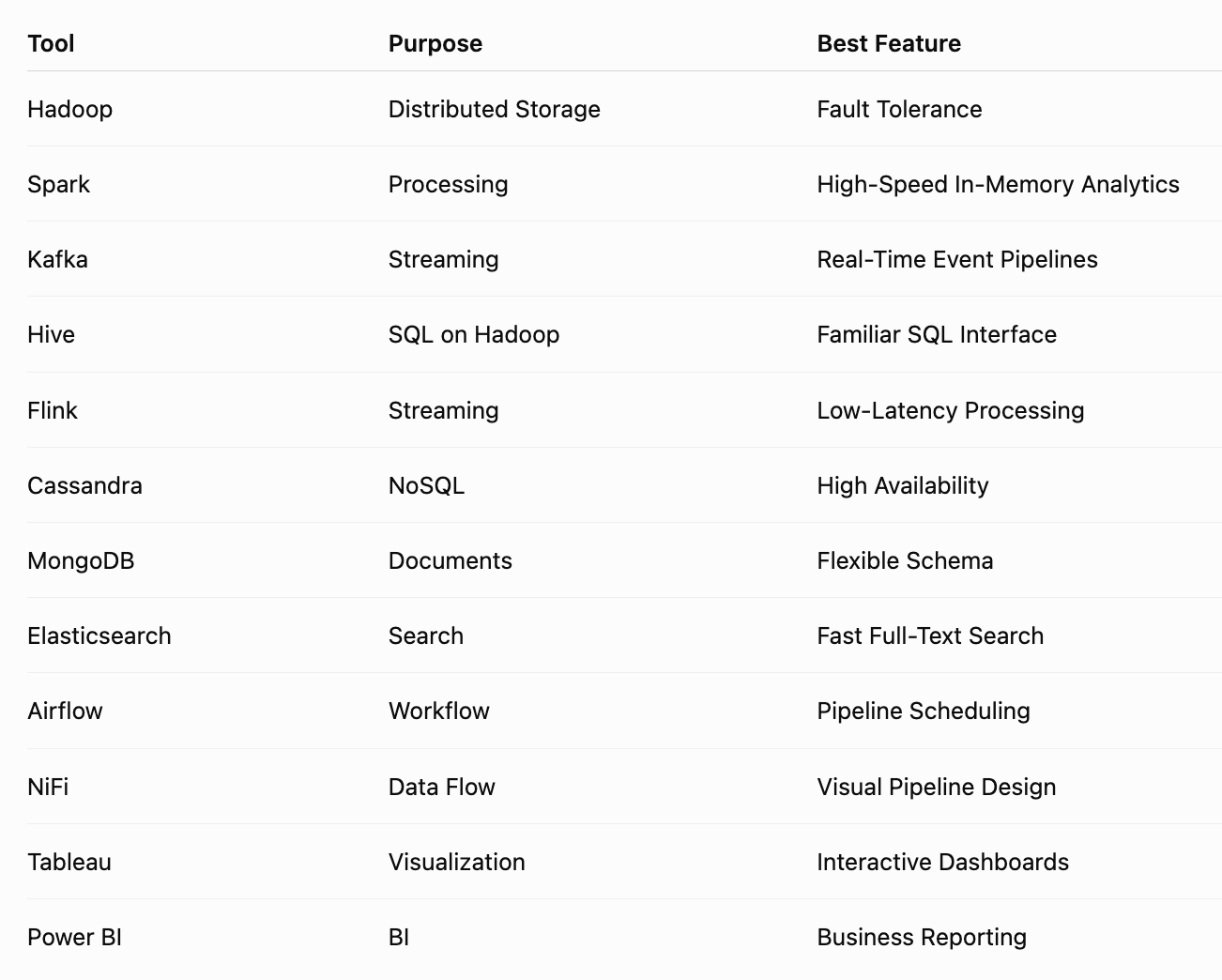
Best Big Data Tools Comparison
Best Practices ✅
- 📂 Choose the right storage (Data Lake vs Data Warehouse).
- ⚡ Use distributed processing for large datasets.
- 🧹 Validate and clean data before analysis.
- 🔐 Encrypt sensitive information at rest and in transit.
- 📈 Monitor pipelines with alerts and logging.
- 💾 Design for scalability and fault tolerance.
- ☁️ Consider cloud-native services for elasticity and managed operations.
- 🤖 Automate repetitive data workflows wherever possible.
Career Roadmap in Big Data 🛣️
- Learn SQL thoroughly.
- Master Python or Java/Scala.
- Understand Linux and shell scripting.
- Study distributed systems fundamentals.
- Learn Hadoop and HDFS.
- Master Apache Spark.
- Learn Kafka and streaming concepts.
- Explore NoSQL databases.
- Learn cloud platforms (AWS, Azure, or Google Cloud).
- Study data engineering, analytics, and machine learning integration.
Final Thoughts 🌟
Big Data is much more than storing massive datasets — it’s about transforming information into actionable insights that drive innovation. From personalized recommendations on streaming platforms to real-time fraud detection in banking and predictive maintenance in manufacturing, Big Data powers many of the intelligent systems we rely on every day.
Mastering Big Data requires understanding not only technologies like Hadoop, Spark, Kafka, Hive, Cassandra, and Elasticsearch, but also the principles of distributed computing, data engineering, cloud platforms, and analytics. Combined with AI and machine learning, Big Data is shaping the future of decision-making across every industry.
Whether you’re a developer, data engineer, analyst, or technology enthusiast, investing in Big Data skills today can open the door to some of the most impactful and in-demand careers in modern technology.
“Data tells a story — but Big Data gives you the power to understand the entire universe of stories.” 🌌📊


Comments
Post a Comment