🚀 Decoding the World’s Most Powerful Algorithms: How Google, Meta, TikTok, YouTube, LinkedIn, X & Amazon Decide What You See (And How to Make Them Work for You)
🚀 Decoding the World’s Most Powerful Algorithms: How Google, Meta, TikTok, YouTube, LinkedIn, X & Amazon Decide What You See (And How to Make Them Work for You)
“Algorithms don’t create success — they amplify what people genuinely value.”
Every second, billions of pieces of content compete for your attention.
- 📱 Instagram decides which Reel appears first.
- 🎥 YouTube predicts which video you’ll watch next.
- 🔍 Google determines which website deserves #1.
- 🛍 Amazon recommends products.
- 💼 LinkedIn chooses whose post goes viral.
- 🎯 Meta Ads determines who sees your advertisement.
Behind all of these lies one thing:
🧠 Algorithms
These aren’t random machines.
They’re massive AI-powered decision systems that analyze billions of signals every day.
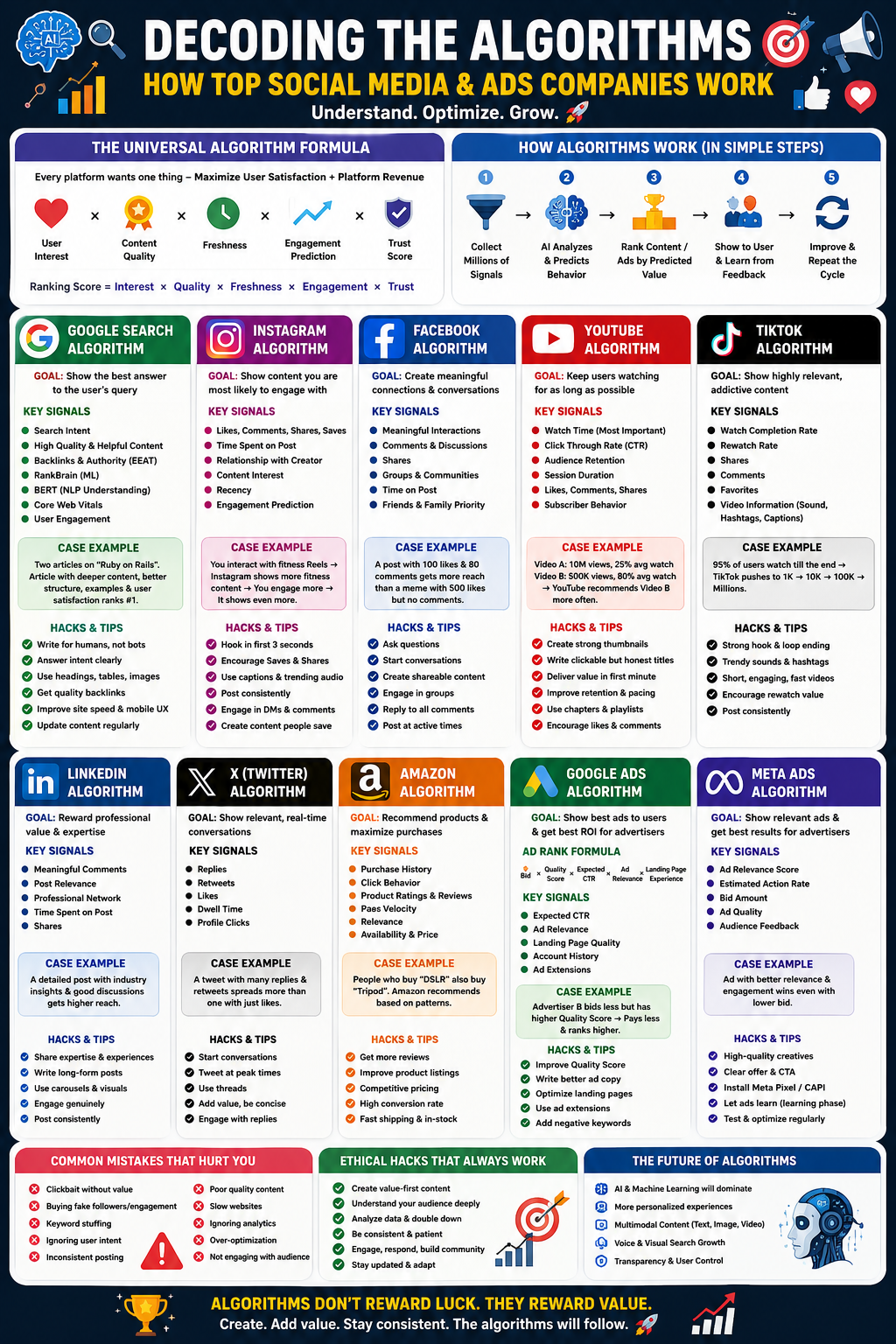
In this article, we’ll reverse-engineer the world’s biggest technology companies and understand:
- ✅ How each algorithm works
- ✅ Real-life case studies
- ✅ Ranking signals
- ✅ AI behind recommendations
- ✅ Advertising algorithms
- ✅ Growth hacks
- ✅ Mistakes to avoid
- ✅ Future of recommendation systems
📊 What is an Algorithm?
An algorithm is simply:
A sequence of rules used to solve a problem.
Social media algorithms answer questions like:
- Which post should appear first?
- Which advertisement should win the auction?
- Which video keeps users engaged?
- Which website deserves the first rank?
The goal isn’t fairness.
The goal is:
Maximize User Satisfaction + Platform Revenue
The Universal Recommendation Formula
Almost every platform calculates something similar to:
Ranking Score =
User Interest
× Content Quality
× Freshness
× Engagement Prediction
× Trust Score
Every company simply changes the weights.
1. 🔍 Google Search Algorithm
Goal
Show the best answer, not the most popular website.
Google uses over 200+ ranking signals.
Major components include:
- PageRank
- RankBrain
- BERT
- Neural Matching
- Helpful Content System
- SpamBrain
- Core Web Vitals
Case Study
Suppose two articles exist.
Article A
"What is Ruby on Rails?"1000 words
Article B
Complete Rails Guide
Examples
Images
Performance
Security
Deployment
Benchmarks
Google prefers Article B because it satisfies more search intent.
Important Signals
🔥 Search Intent
Google first predicts:
What does the user actually want?
Example
Searching
AppleCould mean
- Fruit
- Company
- Store
- Stock Price
Google predicts based on history and popularity.
📖 Helpful Content
Google rewards
✔ Original research
✔ Experience
✔ Practical examples
✔ Updated information
Punishes
❌ AI-generated spam
❌ Keyword stuffing
❌ Thin articles
🧠 RankBrain
Machine Learning system.
Learns from:
- Clicks
- Bounce rate
- Dwell time
- User satisfaction
If people click Result #5 and stay there,
Google slowly moves it upward.
BERT
Understands natural language.
Example
Search
Can I travel to USA without passport?Old search
Focused on
USA
Passport
BERT understands
The meaning of “without.”
Huge improvement.
EEAT
Experience
Expertise
Authority
Trustworthiness
Medical websites need much higher EEAT than recipe blogs.
Google SEO Hacks
✅ Write for humans
✅ Answer questions immediately
✅ Add examples
✅ Use tables
✅ Optimize Core Web Vitals
✅ Internal linking
✅ Backlinks
✅ Update old articles
2. 📱 Instagram Algorithm (Meta)
Instagram has multiple algorithms.
- Feed
- Stories
- Explore
- Reels
Each has different ranking factors.
Feed Algorithm
Signals
- Likes
- Saves
- Shares
- Comments
- Time spent
- Relationship
- Content freshness
Formula
Interest Score
Relationship Score
Recency
Content Quality
Engagement Prediction
Case Study
Person A likes:
- Fitness
- Motivation
Instagram begins showing
- Gym reels
- Protein recipes
- Running tips
Eventually
90% of recommendations become fitness.
Saves > Likes
One save often carries more value than several passive likes because it signals lasting usefulness.
Shares
Shares often indicate content is valuable enough for someone to recommend to another person.
Instagram Growth Hacks
📌 First 3 seconds matter
📌 Use subtitles
📌 Hook instantly
📌 Ask questions
📌 Encourage saves
📌 Reply to comments quickly
📌 Post consistently
3. 📘 Facebook Algorithm
Focuses heavily on meaningful interactions.
Ranks using
- Friends
- Groups
- Communities
- Comments
- Shares
- Long discussions
Example
A meme
500 likes
Educational post
100 likes
80 comments
Facebook often pushes the educational discussion further.
Conversation wins.
Facebook Hacks
Create discussions.
Ask
“What do you think?”
Instead of
“Like this.”
4. 🎥 YouTube Recommendation Algorithm
Perhaps the world’s most sophisticated recommendation engine.
It has two stages.
Stage 1
Candidate Generation
From millions of videos
↓
Chooses a few hundred.
Stage 2
Ranking Network
Ranks every video.
Signals
- Watch time
- Click Through Rate
- Session duration
- Likes
- Comments
- Subscriber behavior
- Viewer satisfaction
Example
Video A
10 million views
Average watch
25%
Video B
500,000 views
Average watch
80%
Video B frequently gets recommended more.
Watch Time
Most important signal.
Not
Views.
Session Time
If your video causes users to continue watching YouTube,
YouTube rewards it.
YouTube Hacks
🎯 Better thumbnails
🎯 Better titles
🎯 Strong first minute
🎯 Remove boring intros
🎯 Storytelling
🎯 Chapters
🎯 Playlists
5. 🎵 TikTok Algorithm
TikTok relies heavily on behavior.
Signals
- Watch completion
- Rewatch
- Shares
- Comments
- Favorites
- Device
- Language
- Location
Interesting Fact
Followers matter less.
A new account can go viral overnight.
Example
100 users
95 watched till end
Algorithm sends
1000 users
Again
90% completion
↓
10000 users
↓
100000 users
↓
Millions.
TikTok Hacks
Loop ending
Strong hooks
Captions
Trending sounds
High retention
6. 💼 LinkedIn Algorithm
LinkedIn rewards expertise.
Signals
- Professional relevance
- Meaningful comments
- Expertise
- Industry engagement
Example
A software engineering post
Read by
100 developers
Receives
20 detailed comments
LinkedIn expands reach.
LinkedIn Hacks
Share
Lessons
Failures
Case studies
Personal experiences
Carousels
7. 🐦 X (Twitter) Algorithm
Signals
- Replies
- Reposts
- Likes
- Dwell time
- Profile clicks
Interesting conversations spread further.
8. 🛍 Amazon Recommendation Algorithm
Uses
Collaborative Filtering
Example
People buying
MacBook
Also buy
Keyboard
Mouse
Monitor
Amazon learns purchasing patterns.
Amazon Search Algorithm (A9 / evolved ranking systems)
Factors include:
- Sales velocity
- Conversion rate
- Reviews
- Price competitiveness
- Relevance
- Availability
Products that convert well often gain more visibility.
9. 🎯 Google Ads Algorithm
Google Ads uses real-time auctions.
Winning isn’t based solely on the highest bid.
Ad Rank ≈
Bid
×
Quality Score
×
Expected CTR
×
Landing Page Experience
×
Ad Relevance
Example
Company A
Bid
₹200
Poor ad
Company B
Bid
₹120
Excellent Quality Score
Company B may win while paying less.
Quality Score
Based on
Expected CTR
Landing page
Keyword relevance
Historical performance
Google Ads Hacks
✅ Improve landing pages
✅ Use negative keywords
✅ Better headlines
✅ Improve CTR
✅ Faster websites
10. 🎯 Meta Ads Algorithm
Meta’s advertising system predicts the probability that a user will complete your desired action.
Examples:
- Purchase
- Lead submission
- App install
- Video view
It balances:
- Advertiser bid
- Estimated action rate
- Ad quality and relevance
The ad with the highest overall value — not just the biggest bid — can win the auction.
Learning Phase
Initially, Meta experiments with different audience segments.
It learns:
Who clicks
Who buys
Who ignores
Performance generally becomes more stable after sufficient optimization events.
Example
You sell shoes.
Initially
10 purchases
Algorithm learns
Age
Location
Income
Interests
Behavior
Then begins narrowing toward similar users.
Meta Ads Hacks
🎯 High-quality creatives
🎯 Clear offers
🎯 Install the Meta Pixel or Conversions API
🎯 Let campaigns exit the learning phase before making major edits
🎯 Test one variable at a time (creative, audience, or copy)
AI Behind Recommendation Systems
Most modern companies use combinations of:
- 🤖 Deep Learning
- 🧠 Neural Networks
- 📊 Reinforcement Learning
- 📈 Gradient Boosting
- 🗂 Collaborative Filtering
- 🧩 Embedding Models
- 🔍 Natural Language Processing
- 👁 Computer Vision
- 🎯 Multi-Armed Bandits for exploration vs. exploitation
The systems constantly balance showing users familiar content with introducing new content they might enjoy.
Common Mistakes That Hurt Performance
❌ Clickbait without delivering value
❌ Buying fake followers
❌ Engagement pods
❌ Keyword stuffing
❌ Duplicate content
❌ Slow websites
❌ Inconsistent posting
❌ Ignoring analytics
❌ Low-quality thumbnails
❌ Poor audience targeting
Ethical “Algorithm Tweaks” That Actually Work
Instead of trying to “game” algorithms, optimize for the signals they already reward:
- ✨ Create content that answers real questions.
- 🎬 Capture attention in the first few seconds.
- 📚 Encourage meaningful saves and shares by being genuinely useful.
- 💬 Reply to comments to extend conversations.
- 📊 Study analytics weekly and double down on high-retention content.
- 🔄 Repurpose successful content across platforms, adapting it to each platform’s format.
- 🎯 Match content to audience intent rather than chasing trends alone.
- 📅 Maintain a consistent publishing schedule.
These strategies are sustainable because they align with what platforms are designed to promote: content that users find valuable.
The Future of Algorithms
The next generation of recommendation systems is moving toward:
- 🤖 AI agents that understand user goals
- 🎯 Hyper-personalized recommendations
- 🧠 Multimodal AI (text, image, audio, and video together)
- 🔍 Semantic search beyond exact keywords
- 🛡 Stronger spam and misinformation detection
- ⚖️ Increased transparency and user controls in some jurisdictions
Creators and businesses that focus on expertise, authenticity, and user satisfaction are likely to benefit most from these changes.
🎯 Final Takeaway
Whether it’s Google Search, Google Ads, Meta, YouTube, TikTok, LinkedIn, Amazon, or X, the core principle remains remarkably consistent:
Algorithms reward content and advertisements that maximize user satisfaction while helping the platform achieve its business goals.
Instead of chasing shortcuts, focus on creating valuable experiences, optimizing for genuine engagement, and continuously learning from analytics. In the long run, that’s the most effective — and durable — way to work with the world’s most powerful algorithms rather than against them.


Comments
Post a Comment