🧠🚀 Mastering LLMs (Large Language Models): The Complete Guide to How AI Thinks, Learns & Creates the Future
🧠🚀 Mastering LLMs (Large Language Models): The Complete Guide to How AI Thinks, Learns & Creates the Future
“AI will not replace humans. Humans who know how to use AI will replace those who don’t.” — A modern technology principle
Artificial Intelligence has entered a new era with Large Language Models (LLMs). From ChatGPT-style assistants to AI coding tools, autonomous agents, search engines, and business automation systems — LLMs are becoming the foundation of modern software.
But what exactly happens behind the scenes when you ask an AI:
“Write me a business plan”
“Explain quantum physics”
“Generate production-ready code”
How does a machine understand language, reason, and generate human-like responses?
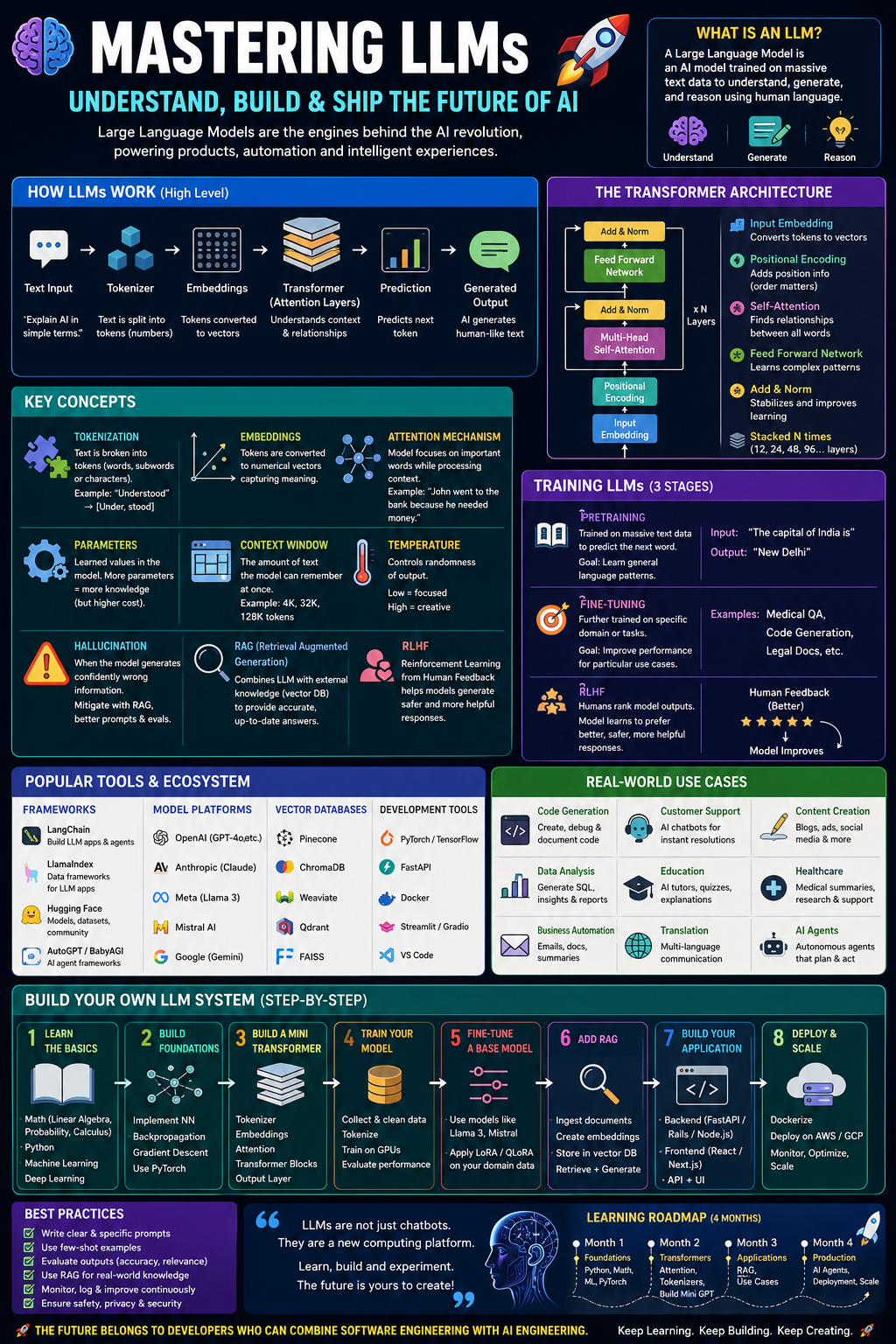
Let’s explore the complete world of LLMs. 🚀
🌎 1. What is an LLM (Large Language Model)?
A Large Language Model (LLM) is an AI model trained on massive amounts of text data to understand, generate, summarize, translate, and reason using human language.
Simply:
LLM = A neural network that learns patterns, relationships, and knowledge from huge amounts of data to generate meaningful text.
Examples of popular LLMs:
- OpenAI GPT models
- Google DeepMind Gemini models
- Anthropic Claude models
- Meta Platforms Llama models
- Mistral AI Mistral models
LLMs power:
🤖 AI assistants
💻 Coding copilots
📚 Education platforms
🏥 Medical assistants
📊 Business analytics
🎨 Content generation
🛒 Customer support automation
🧩 2. How Did We Reach LLMs? (Evolution of AI)
Phase 1: Rule-Based Systems (1950s–1990s)
Early AI worked using manually written rules.
Example:
IF customer says "refund"
THEN show refund policy
Problems:
❌ Cannot handle unknown situations
❌ Requires millions of rules
❌ No learning capability
Phase 2: Machine Learning (1990s–2010)
Machines started learning patterns from data.
Example:
Spam Detection:
Input:
"Congratulations! You won $10,000"Output:
Spam = 98%Algorithms:
- Decision Trees
- SVM
- Random Forest
- Naive Bayes
Phase 3: Deep Learning (2010–2017)
Neural networks changed AI.
Models learned:
- Images
- Speech
- Text
- Patterns
Important architectures:
- CNN
- RNN
- LSTM
However, language understanding remained difficult.
Phase 4: Transformer Revolution (2017–Today)
The breakthrough came with the paper:
“Attention Is All You Need”
Transformers introduced the concept of:
🔥 Attention Mechanism
The model learns:
“Which words are important in relation to other words?”
Example:
Sentence:
“The animal didn’t cross the road because it was tired.”
What does “it” refer to?
Human:
Animal
Traditional models struggled.
Transformers understand relationships.
🏗️ 3. Architecture of an LLM
A modern LLM consists of multiple layers.
Basic flow:
Text
 |
 ↓
Tokenizer
 |
 ↓
Embeddings
 |
 ↓
Transformer Layers
 |
 ↓
Attention Mechanism
 |
 ↓
Prediction
 |
 ↓
Generated Response
🔤 4. Tokenization: How AI Reads Text
Computers do not understand words.
They understand numbers.
Example:
Sentence:
I love AIConverted into tokens:
I → 40
love → 892
AI → 1456
A token can be:
- Word
- Part of a word
- Character
Example:
Understanding

Under
stand
ing
Tokens are the basic language units for LLMs.
Popular tokenizers:
- BPE (Byte Pair Encoding)
- SentencePiece
- WordPiece
🧠 5. Embeddings: Giving Meaning to Words
Words are converted into mathematical vectors.
Example:
King
[0.25, 0.67, -0.43, ...]
Similar meanings create similar vectors.
Example:
King
Queen
Prince
are mathematically closer.
While:
King
Banana
Car
are far apart.
This allows AI to understand relationships.
⚡ 6. Transformer Architecture Explained
A transformer contains:
1. Input Embedding
Converts tokens into vectors.
2. Positional Encoding
Because language has order.
Example:
“I love AI”
is different from:
“AI love I”
The model needs position information.
3. Self Attention Mechanism
The heart of LLMs.
Example:
Sentence:
“John went to the bank because he needed money.”
The model connects:
John → He
Bank → Money
Attention calculates:
“Which words should influence this word?”
4. Feed Forward Network
Processes learned information.
5. Multiple Transformer Layers
Large models contain:
GPT-3:
96 layers
175 billion parameters
Modern models:
Hundreds of billions of parameters🔢 7. What Are Parameters?
Parameters are learned values inside the neural network.
Think:
Human brain:
Neurons = ConnectionsLLM:
Parameters = Artificial connectionsExample:
Small model:
7 billion parametersLarge model:
500+ billion parametersMore parameters generally mean:
✅ Better understanding
✅ Better reasoning
✅ More knowledge
But:
❌ More computing cost
📚 8. How LLMs Learn?
Training happens in multiple stages.
Stage 1: Pretraining
The model reads massive datasets.
Sources:
📖 Books
🌐 Websites
📰 Articles
💻 Code repositories
📄 Documents
Task:
Predict next word.
Example:
Input:
The capital of India isModel predicts:
New DelhiMillions/billions of examples are processed.
Stage 2: Fine-Tuning
The base model learns specific tasks.
Example:
Base model:
Knows languageFine-tuned model:
Knows medical diagnosisor
Knows programmingStage 3: RLHF (Reinforcement Learning From Human Feedback)
Humans rank AI responses.
Example:
Response A:
❌ Incorrect and confusing
Response B:
✅ Helpful and clear
AI learns:
“Generate more responses like B.”
🎯 9. How LLM Generates Responses
When you ask:
“Explain Ruby on Rails”
Process:
Your Prompt
↓
Tokens
↓
Transformer Processing
↓
Probability Calculation
↓
Next Token Selection
↓
Response Generation
Example:
AI predicts:
Ruby (40%)
Rails (30%)
Framework (20%)
Selects the best next token.
This repeats thousands of times.
⚙️ 10. Important LLM Concepts
1. Context Window
The amount of information an AI can remember.
Example:
Small model:
4K tokensLarge model:
1M+ tokensUseful for:
- Long documents
- Codebases
- Research papers
2. Temperature
Controls creativity.
Low temperature:
0.1More predictable.
Example:
Code generation.
High temperature:
1.0More creative.
Example:
Story writing.
3. Hallucination
When AI generates incorrect information confidently.
Example:
User:
“Who invented XYZ?”
AI:
Creates a fake person.
Solutions:
✅ Retrieval Augmented Generation
✅ Better prompts
✅ Fine tuning
🔍 11. RAG (Retrieval Augmented Generation)
RAG combines:
LLM
+
External Knowledge Database
Example:
Company chatbot.
Without RAG:
AI:
“I don’t know your company policy.”
With RAG:
AI searches:
Company documentsThen answers:
“The refund policy is 30 days.”
Architecture:
Documents
↓
Embedding Model
↓
Vector Database
↓
Retriever
↓
LLM
↓
Answer
Tools:
🛠️ 12. Popular LLM Development Tools
Frameworks
LangChain
Used for:
- AI agents
- RAG systems
- Chains
LlamaIndex
Used for:
- Document AI
- Knowledge systems
Model Platforms
Vector Databases
Used for semantic search:
- Pinecone
- FAISS
- ChromaDB
- Weaviate
💼 13. Real-World LLM Use Cases
👨💻 Software Development
AI can:
- Generate code
- Debug errors
- Write tests
- Review pull requests
Example:
Developer:
“Create Rails API authentication.”
AI:
Generates:
- Models
- Controllers
- Tests
- Documentation
🏢 Business Automation
Companies use LLMs for:
Customer support:
Customer Question
↓
AI Agent
↓
Answer
📊 Data Analysis
LLMs can:
- Explain dashboards
- Generate SQL
- Analyze reports
Example:
“Find sales decline reasons.”
AI:
Analyzes:
- Revenue
- Customers
- Trends
🎓 Education
AI tutors:
- Explain concepts
- Generate quizzes
- Personalize learning
🏥 Healthcare
Applications:
- Medical document analysis
- Patient support
- Research assistance
🚀 14. Build Your Own LLM System From Scratch
Building GPT-level models requires millions of dollars, but you can build a practical LLM system.
Phase 1: Learn Foundations
Learn:
Mathematics
- Linear Algebra
- Probability
- Statistics
- Calculus
Programming
Master:
- Python
- NumPy
- PyTorch
Phase 2: Build Neural Network Basics
Create:
✅ Perceptron
✅ Neural network
✅ Backpropagation
✅ Gradient descent
Tools:
- PyTorch
- TensorFlow
Phase 3: Build a Small Transformer
Implement:
Tokenizer
↓
Embedding Layer
↓
Attention
↓
Transformer Blocks
↓
Output Layer
Dataset:
- Tiny Shakespeare
- Wikipedia samples
Phase 4: Train Your Model
Pipeline:
Collect Data
↓
Clean Data
↓
Tokenize
↓
Train Model
↓
Evaluate
↓
Deploy
Tools:
- PyTorch
- CUDA
- GPUs
Phase 5: Fine Tune Existing LLM
Instead of training from zero:
Take:
Llama ModelFine tune with:
Your data:
Company documents
Customer conversations
Domain knowledge
Techniques:
LoRA
Low Rank Adaptation
Benefits:
✅ Cheaper
✅ Faster
✅ Requires less GPU memory
Phase 6: Add RAG
Create production AI:
Architecture:
User
↓
Application
↓
Retriever
↓
Vector Database
↓
LLM
↓
Response
Phase 7: Deploy Your AI System
Backend:
- Python FastAPI
- Ruby on Rails API
- Node.js
Frontend:
- React
- Next.js
Infrastructure:
- Docker
- Kubernetes
- AWS
🏆 15. LLM Engineering Best Practices
Write Better Prompts
Bad:
Write codeGood:
Act as a senior Ruby on Rails engineer.
Create scalable API architecture with PostgreSQL.
Explain design decisions.
Use Evaluation
Measure:
- Accuracy
- Response quality
- Latency
- Cost
Protect Data
Implement:
- Encryption
- Access control
- Privacy policies
Reduce Cost
Techniques:
- Smaller models
- Prompt optimization
- Caching
- RAG
🔮 16. Future of LLMs
The future is moving toward:
🤖 AI Agents
Systems that:
- Plan tasks
- Use tools
- Execute actions
🌐 Multimodal AI
Models understanding:
- Text
- Images
- Audio
- Video
🏢 Enterprise AI
Every company will have:
- AI employees
- AI assistants
- AI automation
🎯 Final Thoughts
Large Language Models are not just chatbots.
They are a new computing platform.
Just like:
Internet changed communication
Smartphones changed computing
LLMs are changing intelligence
The developers who understand:
✅ Transformers
✅ Prompt Engineering
✅ RAG
✅ AI Agents
✅ Model Deployment
will build the next generation of intelligent applications.
🚀 The future belongs to developers who can combine software engineering with AI engineering.
🛣️ Recommended Learning Roadmap
Month 1
- Python + Mathematics
- Neural Networks
- PyTorch
Month 2
- Transformers
- Tokenizers
- Attention Mechanism
Month 3
- Build Mini GPT
- Fine-tuning
- RAG Applications
Month 4
- AI Agents
- LLM Deployment
- Production AI Systems
“The best way to predict the future is to build it.” 🚀


Comments
Post a Comment