🎨 Mastering UI/UX Design: The Ultimate Guide to Building Beautiful, Fast & User-Friendly Digital Products 🚀
🎨 Mastering UI/UX Design: The Ultimate Guide to Building Beautiful, Fast & User-Friendly Digital Products 🚀
“People ignore design that ignores people.” — Frank Chimero
Imagine opening an app where everything feels effortless.
Buttons are exactly where you expect.
Pages load instantly.
Animations feel natural.
Colors make reading comfortable.
Everything simply “feels right.”
That magic is UI/UX Design.
Great products like Airbnb, Spotify, Apple, Notion, Stripe, Netflix, and Figma aren’t successful because they have more features — they succeed because they provide exceptional user experiences.
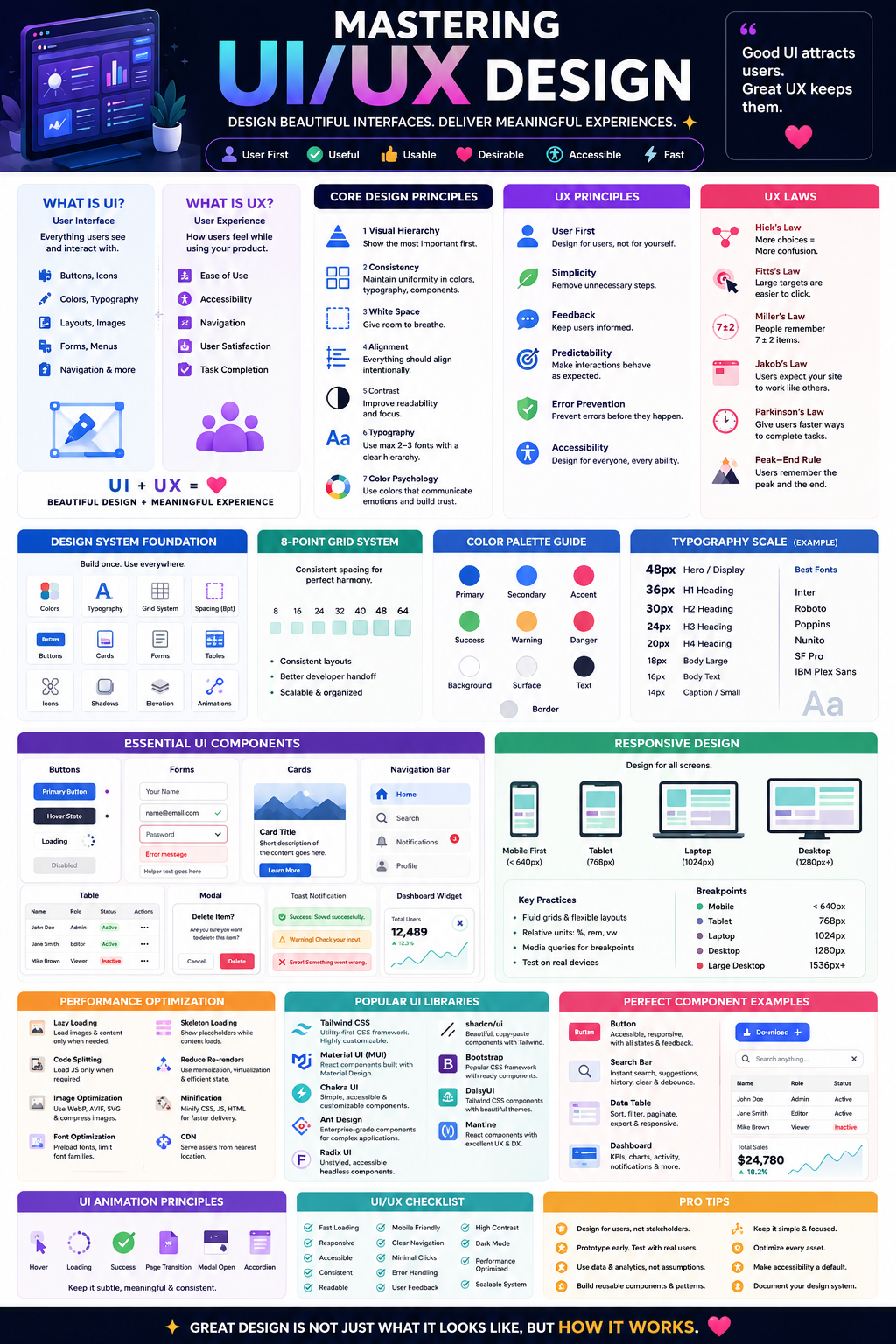
In this guide, we’ll master UI/UX from beginner to advanced concepts.
🌟 What is UI?
UI (User Interface) refers to everything users can see and interact with.
Examples include:
- Buttons
- Forms
- Cards
- Icons
- Navigation bars
- Colors
- Typography
- Layouts
- Images
- Menus
Think of UI as the appearance of your product.
🌟 What is UX?
UX (User Experience) is how users feel while using your product.
It includes:
- Ease of use
- Accessibility
- Navigation
- Speed
- User satisfaction
- Task completion
- Emotional experience
UI = Beauty
UX = Experience
You need both.
🎯 The Golden Rule
Good UI attracts users. Great UX keeps them.
🧠 Core UI Principles
1️⃣ Visual Hierarchy
Show users what’s important first.
Example:
Big Heading
Medium Subheading
Small Description
Primary Button
Never give equal importance to everything.
2️⃣ Consistency
Maintain the same:
- Colors
- Fonts
- Buttons
- Icons
- Shadows
- Animations
Users should never wonder:
“Is this still the same application?”
3️⃣ White Space
White space makes designs breathable.
❌ Bad
Everything cramped together.✅ Good
Enough spacing
Better readability
Professional look
4️⃣ Alignment
Every element should align properly.
Misaligned interfaces look amateur.
5️⃣ Contrast
Good contrast improves readability.
Example
Dark text
on
Light background
Never use
Light Gray Text
On White Background
6️⃣ Typography
Use only 2–3 fonts.
Hierarchy:
H1
H2
Body
Caption
Recommended fonts:
- Inter
- Roboto
- Poppins
- Nunito
- SF Pro
- IBM Plex Sans
7️⃣ Color Psychology 🎨
Blue → Trust
Green → Nature
Red → Danger
Orange → Energy
Purple → Creativity
Black → Premium
White → Simplicity
🧠 UX Principles
User First
Never design for yourself.
Design for users.
Simplicity
Remove unnecessary steps.
Amazon Checkout
Old:
Cart
↓
Address
↓
Payment
↓
Review
↓
Confirm
Modern:
One-click checkout
Feedback
Users must know what is happening.
Example
Loading…
Uploading…
Saved Successfully
Payment Failed
Predictability
Buttons should behave as expected.
Logo → Home
Search Icon → Search
Cart → Shopping Cart
Error Prevention
Instead of
“Wrong Email”
Use
Live validation
✓ Email looks goodAccessibility
Everyone should use your product.
Support:
✔ Keyboard
✔ Screen Readers
✔ High Contrast
✔ Color Blind Users
✔ Larger Text
🎯 UX Laws Every Designer Should Know
Hick’s Law
More options
↓
More confusion
Keep choices minimal.
Fitts’s Law
Large buttons are easier to click.
Example
Tiny Button ❌
Large CTA ✅
Miller’s Law
Humans remember
7 ± 2 items.
Don’t overload menus.
Jakob’s Law
Users expect websites to work similarly.
Don’t reinvent navigation.
Parkinson’s Law
Give users faster ways to finish tasks.
Peak-End Rule
Users remember
- Best moment
- Final moment
- End experiences beautifully.
🏗 UI Design System
Every scalable application needs one.
Include:
✅ Colors
✅ Typography
✅ Grid
✅ Buttons
✅ Cards
✅ Alerts
✅ Forms
✅ Tables
✅ Icons
✅ Animations
✅ Shadows
✅ Elevations
📐 8-Point Grid System
Most professional products use
8px
16px
24px
32px
40px
48px
64px
Benefits
✔ Consistent spacing
✔ Easier development
✔ Cleaner layouts
🎨 Best Color Palette
Primary
Secondary
Accent
Success
Warning
Danger
Background
Surface
Text
Border
🔤 Typography Scale
48px Hero
36px H1
30px H2
24px H3
20px H4
18px Body Large
16px Body
14px Caption
🧩 Essential UI Components
Buttons
Features
✔ Hover
✔ Active
✔ Loading
✔ Disabled
✔ Icons
✔ Ripple
Cards
Should include
Image
Title
Description
CTA
Shadow
Rounded Corners
Hover Animation
Navigation Bar
Responsive
Sticky
Search
Notification
Profile
Dark Mode
Forms
Floating Labels
Validation
Auto Focus
Error Messages
Password Toggle
Helper Text
Tables
Sorting
Filtering
Pagination
Search
Sticky Header
Responsive Scroll
Modal
Escape Key
Outside Click
Focus Trap
Animation
Accessibility
Toast Notification
Auto Close
Manual Close
Action Button
Success/Error Colors
Dashboard Widgets
Charts
Statistics
Recent Activity
Filters
Export
Dark Mode
📱 Responsive Design Mastery
Never design only for desktop.
Mobile First
Design
Mobile
↓
Tablet
↓
Desktop
Flexible Grid
Avoid fixed widths.
Use
%vw
rem
flex
grid
CSS Grid
Perfect for
Dashboards
Cards
Galleries
Flexbox
Perfect for
Navigation
Buttons
Forms
Lists
Breakpoints
Mobile
<640px

Tablet
768px

Laptop
1024px

Desktop
1280px

Large Desktop
1536px
🚀 Performance Optimization
Beautiful UI is useless if it’s slow.
Lazy Loading
Load images only when needed.
Code Splitting
Load JavaScript only when required.
Tree Shaking
Remove unused code.
Image Optimization
Use
WebP
AVIF
SVG
Compress images.
Font Optimization
Preload fonts.
Avoid loading many font families.
Skeleton Loading
Instead of
Blank Screen
Show placeholders.
Reduce Re-renders
React
Memoization
Virtualization
Efficient state management
Minification
Compress
CSS
JS
HTML
CDN
Serve assets from nearby servers.
⚡ UI Libraries
🎨 Tailwind CSS
Features
✔ Utility First
✔ Responsive
✔ Dark Mode
✔ Small Bundle
✔ Fast Development
Bootstrap
Features
✔ Huge Community
✔ Ready Components
✔ Responsive Grid
✔ Easy Learning
Material UI
Features
✔ Google Material Design
✔ Accessibility
✔ Rich Components
✔ Theming
Chakra UI
Features
✔ Accessible
✔ Customizable
✔ Dark Mode
✔ Clean API
Ant Design
Features
✔ Enterprise Components
✔ Tables
✔ Forms
✔ Dashboards
Radix UI
Features
✔ Accessible
✔ Unstyled
✔ Headless Components
✔ High Performance
Shadcn UI
Features
✔ Beautiful Components
✔ Tailwind Based
✔ Easily Customizable
✔ Modern Design
DaisyUI
Features
✔ Tailwind Plugin
✔ Themes
✔ Ready Components
✔ Lightweight
Mantine
Features
✔ Hooks
✔ Rich Components
✔ Charts
✔ Forms
✔ Notifications
🎯 UX Research Tools
- Figma
- FigJam
- Adobe XD
- Maze
- Hotjar
- Google Analytics
- Mixpanel
- FullStory
🎯 Perfect Button Example
Features
✅ Hover Animation
✅ Keyboard Support
✅ Ripple
✅ Loading Spinner
✅ Disabled State
✅ Icon Support
✅ Accessibility Labels
✅ Responsive Padding
🎯 Perfect Search Bar
Features
🔍 Instant Search
⌨ Keyboard Navigation
🕒 Search History
⭐ Suggestions
❌ Clear Button
⚡ Debouncing
📱 Responsive Width
🎯 Perfect Data Table
Features
✔ Infinite Scroll
✔ Search
✔ Export CSV
✔ Sorting
✔ Filtering
✔ Column Resize
✔ Sticky Header
✔ Responsive Layout
✔ Accessibility
🎯 Perfect Dashboard
Contains
📊 Charts
📈 KPIs
📅 Calendar
🔔 Notifications
👥 Users
📂 Activity Feed
🌙 Dark Mode
⚙ Settings
📱 Responsive Sidebar
🌈 UI Animation Principles
Animation should have purpose.
Examples
✔ Hover
✔ Loading
✔ Success
✔ Page Transition
✔ Modal Open
✔ Accordion
Never overuse animations.
🎯 UI/UX Checklist
✅ Fast Loading
✅ Responsive
✅ Accessible
✅ Consistent
✅ Readable
✅ Mobile Friendly
✅ Clear Navigation
✅ Minimal Clicks
✅ Error Handling
✅ User Feedback
✅ High Contrast
✅ Dark Mode
✅ Performance Optimized
✅ Beautiful Typography
✅ Scalable Design System
💡 Pro Tips
🚀 Design for users, not stakeholders.
🚀 Build reusable components.
🚀 Test with real users early and often.
🚀 Measure outcomes using analytics instead of assumptions.
🚀 Keep interfaces uncluttered.
🚀 Optimize every image and asset.
🚀 Make accessibility a default, not an afterthought.
🚀 Document your design system.
🚀 Prototype before implementing.
🚀 Focus on solving user problems rather than adding more features.
🏆 Final Thoughts
Exceptional UI/UX is not about flashy animations or colorful screens — it is about creating products that are intuitive, inclusive, fast, and enjoyable to use. The most successful digital experiences balance aesthetics with usability, ensuring users can achieve their goals effortlessly.
Whether you’re building a startup MVP, an enterprise dashboard, or a personal portfolio, mastering UI/UX means embracing user-centered design, accessibility, responsive layouts, performance optimization, and reusable design systems. Invest in understanding your users, iterate continuously, and let data guide your decisions.
“Design is intelligence made visible.” — Alina Wheeler
Build products that users don’t just use — they love. ❤️


Comments
Post a Comment