🚀 TypeScript Mastery: The Superpower Every JavaScript Developer Needs in 2026 💙
🚀 TypeScript Mastery: The Superpower Every JavaScript Developer Needs in 2026 💙
“JavaScript lets you write code quickly. TypeScript lets you maintain it for years.”
If you’re building React, Angular, Next.js, Node.js, NestJS, Vue, or even AI-powered applications, TypeScript is no longer optional — it’s becoming the industry standard.
Companies like Microsoft, Google, Slack, Airbnb, Stripe, Shopify, Discord, and Asana rely heavily on TypeScript because it catches bugs before they reach production, improves developer productivity, and makes large applications easier to maintain.
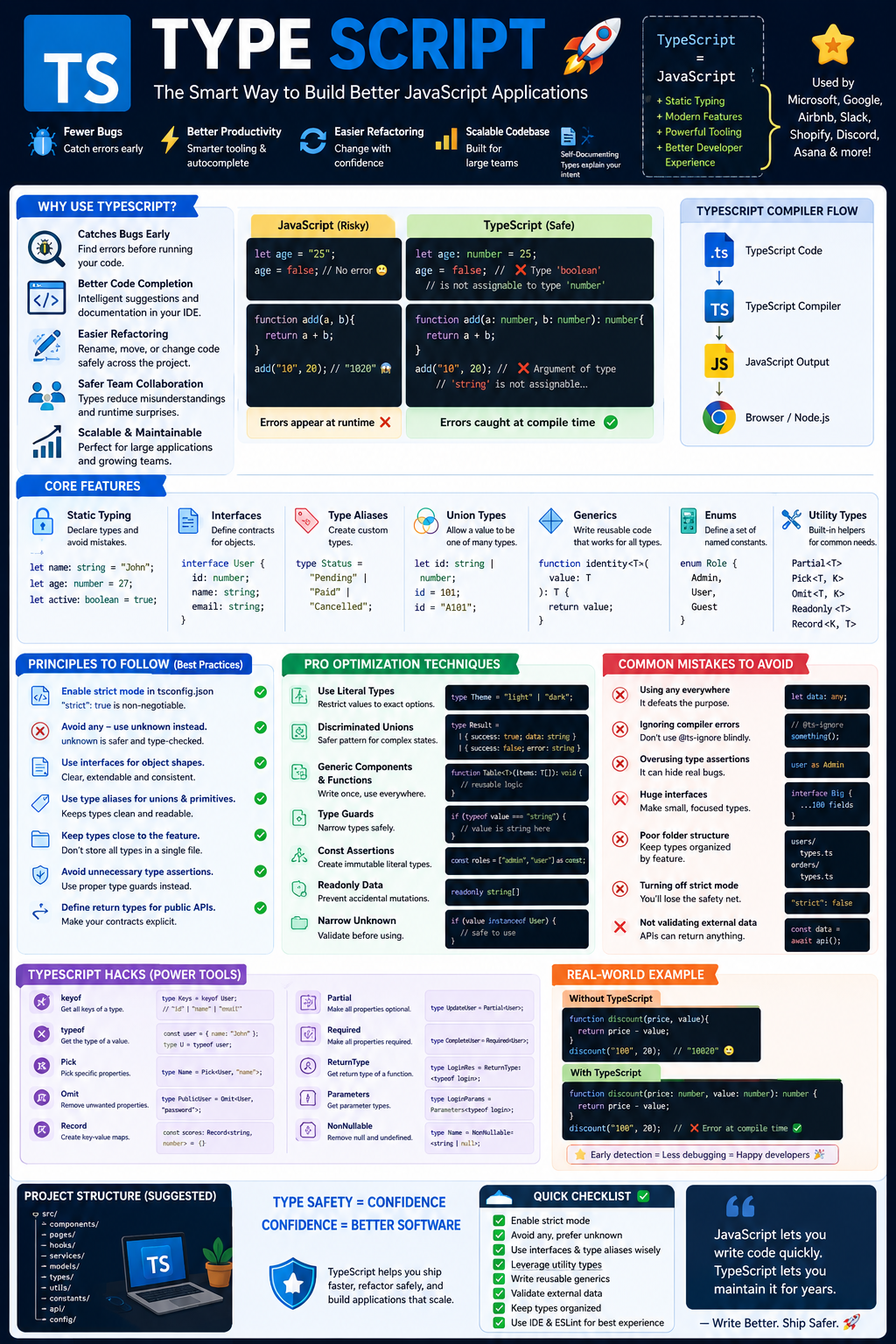
Let’s dive deep into why TypeScript matters, its features, best practices, advanced techniques, and mistakes to avoid.
🤔 What is TypeScript?
TypeScript is an open-source programming language developed by Microsoft.
It is a superset of JavaScript, meaning:
- Every JavaScript program is valid TypeScript.
- TypeScript adds powerful features like:
- Static typing
- Interfaces
- Generics
- Enums
- Better tooling
- Compile-time error checking
TypeScript eventually compiles into plain JavaScript that browsers understand.
TypeScript
      ↓
 Compiler
      ↓
JavaScript
      ↓
Browser / Node.js
🎯 Why Should You Learn TypeScript?
1. Finds Bugs Before Running Code 🐞
JavaScript
let age = "25";
age = false;
No error.
TypeScript
let age: number = 25;
age = false;
Output
Type 'boolean' is not assignable to type 'number'You discover the bug immediately.
2. Better Code Completion ⚡
Your IDE knows:
- object properties
- methods
- parameters
- return values
Instead of guessing…
user.VS Code instantly suggests every available property.
Huge productivity boost.
3. Easier Refactoring 🔥
Imagine renaming:
calculateInvoice()to
calculateOrderInvoice()TypeScript updates every reference safely.
JavaScript often leaves hidden bugs.
4. Excellent Documentation 📚
This
function login(email: string, password: string): Promise<User>already explains:
- parameter types
- return type
- expected values
The code documents itself.
5. Safer Team Collaboration 👨💻
Large teams modify the same code.
Without types:
- unexpected values
- hidden assumptions
- runtime crashes
TypeScript prevents these.
6. Better Scalability 🚀
Small JavaScript projects are manageable.
Large applications become difficult because:
- hundreds of files
- dozens of developers
- changing requirements
TypeScript keeps everything organised.
⭐ Major Features
✅ Static Typing
let name: string = "Lakhveer";
let age: number = 27;
let active: boolean = true;
✅ Type Inference
No need to write everything.
let city = "London";TypeScript automatically knows:
string✅ Interfaces
interface User {
  id: number;
  name: string;
}
Used for:
- APIs
- Components
- Database models
✅ Type Aliases
type Status =
  | "Pending"
  | "Paid"
  | "Cancelled";
✅ Enums
enum Role {
  Admin,
  User,
  Guest
}
✅ Union Types
let id: string | number;Very useful.
✅ Optional Properties
interface User {
    name: string;
    phone?: string;
}
✅ Generics
function identity<T>(value: T): T {
    return value;
}
Works for every data type.
✅ Readonly
readonly id: number;Cannot be modified later.
✅ Utility Types
Powerful helpers.
Partial
Pick
Omit
Required
Readonly
Record
ReturnType
Parameters
💡 Principles Every TypeScript Developer Should Follow
🎯 Principle 1
Always enable
strict: trueNever disable strict mode.
🎯 Principle 2
Avoid
anyUse
unknowninstead.
Bad
let data: any;Better
let data: unknown;🎯 Principle 3
Prefer interfaces for objects.
interface Employee {
    id:number
    name:string
}
🎯 Principle 4
Prefer type aliases for unions.
type Theme =
"light"
|
"dark";
🎯 Principle 5
Keep types close to the feature.
Don’t create one giant
types.tsCreate
users/
products/
orders/
Each module owns its own types.
🎯 Principle 6
Avoid unnecessary casting.
Bad
user as AdminBetter
Use proper type guards.
🎯 Principle 7
Always define return types for public APIs.
function total(): numberinstead of relying only on inference.
⚡ Professional Optimisation Techniques
🚀 1. Use Literal Types
Instead of
status: stringUse
status:
"pending"
|
"paid"
|
"failed";
Safer.
🚀 2. Discriminated Unions
type Success={
 kind:"success"
 data:string
}

type Error={
 kind:"error"
 message:string
}
Switch statements become type-safe.
🚀 3. Generic Components
Instead of writing
UserTable
OrderTable
ProductTable
Build
Table<T>Reusable.
🚀 4. Type Guards
if(typeof value==="string"){
}
or
if("name" in user){
}
Much safer than casting.
🚀 5. Use Const Assertions
const roles =
["admin","user"] as const;
Creates immutable literal types.
🚀 6. Prefer Readonly Arrays
readonly string[]Prevents accidental mutation.
🚀 7. Narrow Unknown Values
if(typeof value==="number"){
}
Never trust external data blindly.
🧠 Advanced TypeScript Hacks
🎯 keyof
type Keys = keyof User;Returns
"id" | "name"🎯 typeof
const user={
 name:"John"
}

type UserType=typeof user
Automatically generates the type.
🎯 Record
Record<string, number>Useful for lookup maps.
🎯 Pick
Pick<User,"name">🎯 Omit
Omit<User,"password">Perfect for API responses.
🎯 Partial
Partial<User>Excellent for update endpoints.
🎯 NonNullable
Removes
null
undefined
from a type.
🎯 ReturnType
ReturnType<typeof login>Keeps your types DRY.
❌ Common Mistakes
🚫 Using Any Everywhere
anyeliminates the benefits of TypeScript.
🚫 Ignoring Compiler Errors
Developers sometimes write
//@ts-ignoreNever ignore errors without understanding them.
🚫 Overusing Type Assertions
Bad
data as UserBetter
Validate first.
🚫 Large Interfaces
Avoid
interface User{
100 fields...
}
Split into smaller interfaces.
🚫 Poor Folder Structure
Bad
types.tsBetter
users/types.ts
orders/types.ts
products/types.ts
🚫 Turning Off Strict Mode
Many beginners disable strict mode because of too many errors.
That’s exactly why you should keep it enabled.
🔥 Real-World Example
Without TypeScript
function discount(price, value){
 return price-value;
}
Someone calls
discount("100",20)Unexpected behaviour.
With TypeScript
function discount(
 price:number,
 value:number
):number{
 return price-value;
}
Problem solved before execution.
🏗️ Suggested Project Structure
src
components/
 pages/
 hooks/
 services/
 models/
 types/
 utils/
 constants/
 config/
 api/
Simple.
Scalable.
Maintainable.
📋 Professional Checklist ✅
- ✅ Enable strict mode
- ✅ Avoid
any - ✅ Prefer
unknown - ✅ Use interfaces for object contracts
- ✅ Use type aliases for unions
- ✅ Write reusable generic functions
- ✅ Use utility types
- ✅ Keep types close to their features
- ✅ Avoid unnecessary assertions
- ✅ Prefer immutable (
readonly) data where possible - ✅ Validate external API responses
- ✅ Use ESLint + Prettier for consistent code
- ✅ Leverage IDE autocomplete and refactoring
- ✅ Keep functions small and strongly typed
🌟 Final Thoughts
TypeScript isn’t about writing more code — it’s about writing more reliable code.
As projects grow, the biggest challenge isn’t building new features; it’s maintaining existing ones without introducing bugs. TypeScript gives you confidence to refactor, collaborate, and scale applications with ease.
Whether you’re developing React frontends, Node.js APIs, Ruby on Rails frontends with TypeScript, AI applications, or enterprise SaaS products, mastering TypeScript will make you a faster, more dependable, and more valuable developer.
💬 “JavaScript teaches you how to build. TypeScript teaches you how to build software that lasts.”
Happy Coding! 🚀💙


Comments
Post a Comment