🚀 Build the Perfect DBMS: The Ultimate Guide to Designing a Database System Like a Pro 🗄️💎
🚀 Build the Perfect DBMS: The Ultimate Guide to Designing a Database System Like a Pro 🗄️💎
“A great application is only as good as the database behind it.”
Whether you’re building a startup, an enterprise ERP, an e-commerce platform, or the next AI-powered application, your Database Management System (DBMS) is the foundation upon which everything rests.
Poor database design leads to:
- 🐌 Slow queries
- 💥 Data corruption
- 🔒 Security vulnerabilities
- 💸 High infrastructure costs
- 😵 Difficult maintenance
This guide explains everything about DBMS — from beginner concepts to advanced architecture — so you can design databases that scale to millions (or even billions) of records.
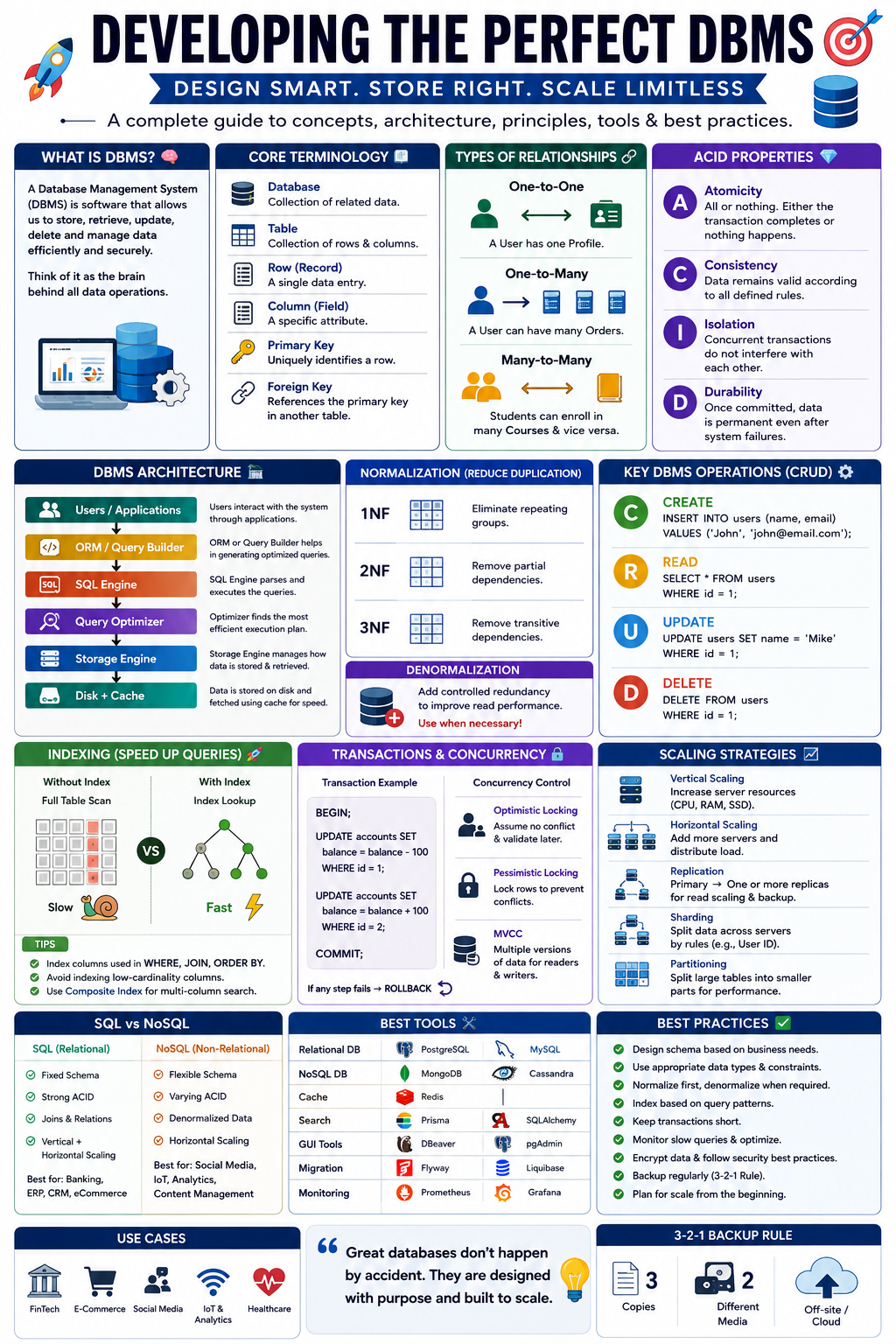
Let’s dive in!
📚 What is DBMS?
A Database Management System (DBMS) is software that allows users and applications to:
- Store data
- Retrieve data
- Update data
- Delete data
- Secure data
- Manage concurrent users
- Recover from failures
Instead of manually handling files, DBMS organizes everything efficiently.
Imagine a library.
Without a DBMS:
- Books are randomly scattered.
With a DBMS:
- Every book has a shelf.
- Every shelf has categories.
- Books can be found instantly.
🌍 Real-World Examples
- Users
- Followers
- Posts
- Likes
- Comments
- Messages
Every interaction goes through a database.
Amazon
- Products
- Inventory
- Orders
- Payments
- Reviews
Netflix
- Movies
- Recommendations
- Watch history
Google Maps
- Locations
- Roads
- Reviews
Every large application depends on a carefully designed DBMS.
🏛 Architecture of a Perfect DBMS
Users
      │
      ▼
Application Layer
      │
      ▼
ORM / Query Builder
      │
      ▼
SQL Engine
      │
      ▼
Optimizer
      │
      ▼
Storage Engine
      │
      ▼
Disk + Cache
Each layer has a unique responsibility.
🧠 Core Terminologies
1. Database
A collection of organized data.
Example
Library DatabaseContains
- Books
- Authors
- Students
- Borrow Records
2. Table
Stores similar records.
Users
ID
Name
Email
Age
3. Row
A single record.
1
John
john@gmail.com
24
4. Column
Represents one property.
Name
Email
Phone
5. Primary Key 🔑
Uniquely identifies every row.
idGood primary keys
- Integer
- UUID
- ULID
Avoid
- Phone Number
6. Foreign Key
Creates relationships.
Orders
user_id
Points to
Users.idDatabase Relationships
One-to-One
User
 │
 ▼
Profile
Example
User → Passport
One-to-Many
User
↓
Orders
One customer
Many orders
Many-to-Many
Students
↓
Courses
Need a junction table.
EnrollmentsACID Properties 💎
Every reliable database follows ACID.
A — Atomicity
Everything succeeds.
Or nothing.
Example
Bank transfer
A
↓
B
Money must never disappear.
C — Consistency
Rules remain valid.
Balance cannot become negative if prohibited.
I — Isolation
Multiple users shouldn’t interfere.
Imagine
100 users booking the last movie ticket.
Only one should succeed.
D — Durability
After committing,
Data survives power failure.
Normalization
Reduces duplication.
First Normal Form (1NF)
No repeating columns.
Bad
Phones
123
456
789
Good
Separate phone table.
Second Normal Form (2NF)
Every column depends on the full key.
Third Normal Form (3NF)
Remove unnecessary dependencies.
Instead of
Employee
Department Name
Manager
Store
Department separately.
Denormalization
Sometimes duplication improves performance.
Example
Store
Customer Nameinside Orders
instead of joining every time.
Trade-off:
More storage
Faster queries.
SQL Operations
CRUD
Create
INSERTRead
SELECTUpdate
UPDATEDelete
DELETEIndexes 🚀
Indexes are like a book’s index page.
Without index
10 million rows
↓
Linear search
With index
Binary Tree
↓
Milliseconds
Best indexed fields
- Username
- Foreign Keys
- Frequently searched columns
Avoid indexing
- Boolean fields
- Low-cardinality columns
- Frequently updated columns unless necessary
Composite Index
Instead of
Name
Age
Use
(Name, Age)Useful for combined searches.
Clustered vs Non-Clustered Index
Clustered
Data stored in index order.
Only one.
Non-clustered
Separate lookup structure.
Many allowed.
Query Optimization ⚡
Bad
SELECT *Better
SELECT name, emailAvoid
Nested loops
Repeated joins
Functions on indexed columns
Use
Pagination
LIMIT
OFFSET
Better yet, use keyset pagination (WHERE id > last_seen_id) for large datasets.
Transactions
Example
BEGIN;UPDATE accounts;
UPDATE balance;
COMMIT;
If anything fails
ROLLBACKLocking
Shared Lock
Many readers.
Exclusive Lock
Single writer.
Avoid long-running transactions because they increase lock contention.
Concurrency Control
Techniques
- Optimistic Locking
- Pessimistic Locking
- MVCC (Multi-Version Concurrency Control)
MVCC lets readers continue without blocking writers in many scenarios and is widely used by modern relational databases.
Database Design Principles
1️⃣ Keep Data Atomic
Store
First Name
Last Name
Instead of
Full Namewhen you need independent querying.
2️⃣ Avoid Duplication
Don’t repeat addresses everywhere.
Reference them.
3️⃣ Use Constraints
Examples
NOT NULL
UNIQUE
CHECK
DEFAULT
4️⃣ Plan Relationships Early
Wrong relationships become expensive later.
5️⃣ Choose Correct Data Types
Don’t store
Age
VARCHAR
Use
INTEGERScaling a Database 📈
Vertical Scaling
Increase
- RAM
- CPU
- SSD
Easy
But expensive.
Horizontal Scaling
Add more servers.
Examples
Shard A
Shard B
Shard C
Harder
But nearly unlimited.
Replication
Primary
↓
Replica
Benefits
- Read scalability
- High availability
- Disaster recovery
Sharding
Split data.
Example
A-H
Server 1
I-P
Server 2
Q-Z
Server 3
Perfect for huge applications.
Partitioning
Split one large table into smaller pieces based on:
- Date
- Region
- Customer ID
Improves maintenance and query performance for very large datasets.
Caching 🧠
Instead of querying the database repeatedly
Use
- Redis
- Memcached
Flow
Application
↓
Cache
↓
Database
Backup Strategy
The 3–2–1 rule is a strong starting point:
- 3 copies of your data
- 2 different storage media
- 1 off-site or cloud backup
Combine full backups with incremental backups and regularly test restores.
Database Security 🔒
Always
✅ Encrypt data at rest
✅ Encrypt data in transit (TLS)
✅ Use least-privilege access
✅ Audit logs
✅ Parameterized queries / prepared statements
✅ Regular security updates
Never
❌ Store passwords in plain text
Instead
Use strong password hashing algorithms like Argon2 or bcrypt with unique salts.
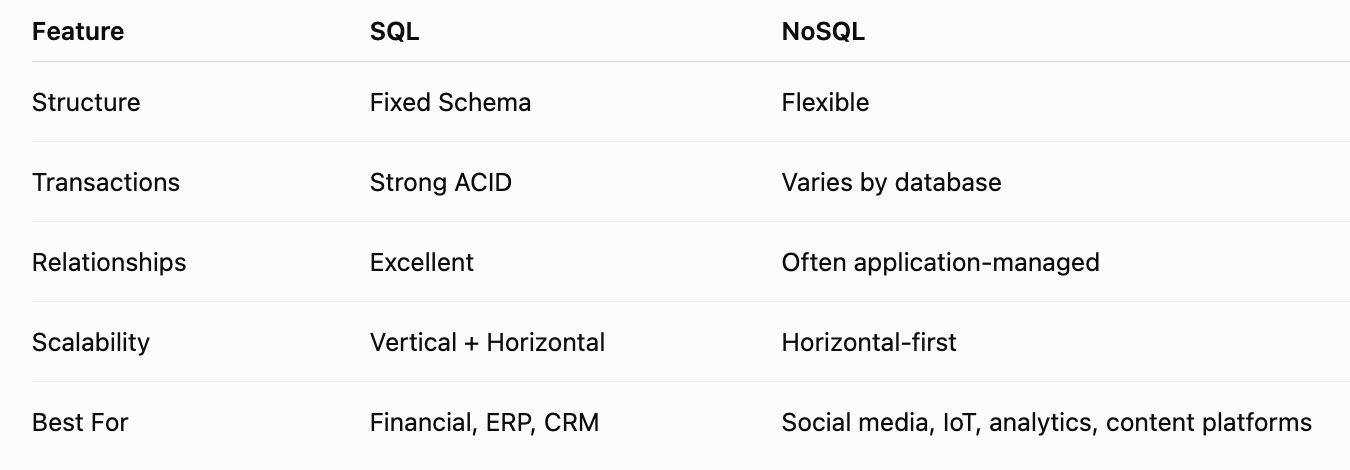
NoSQL vs SQL
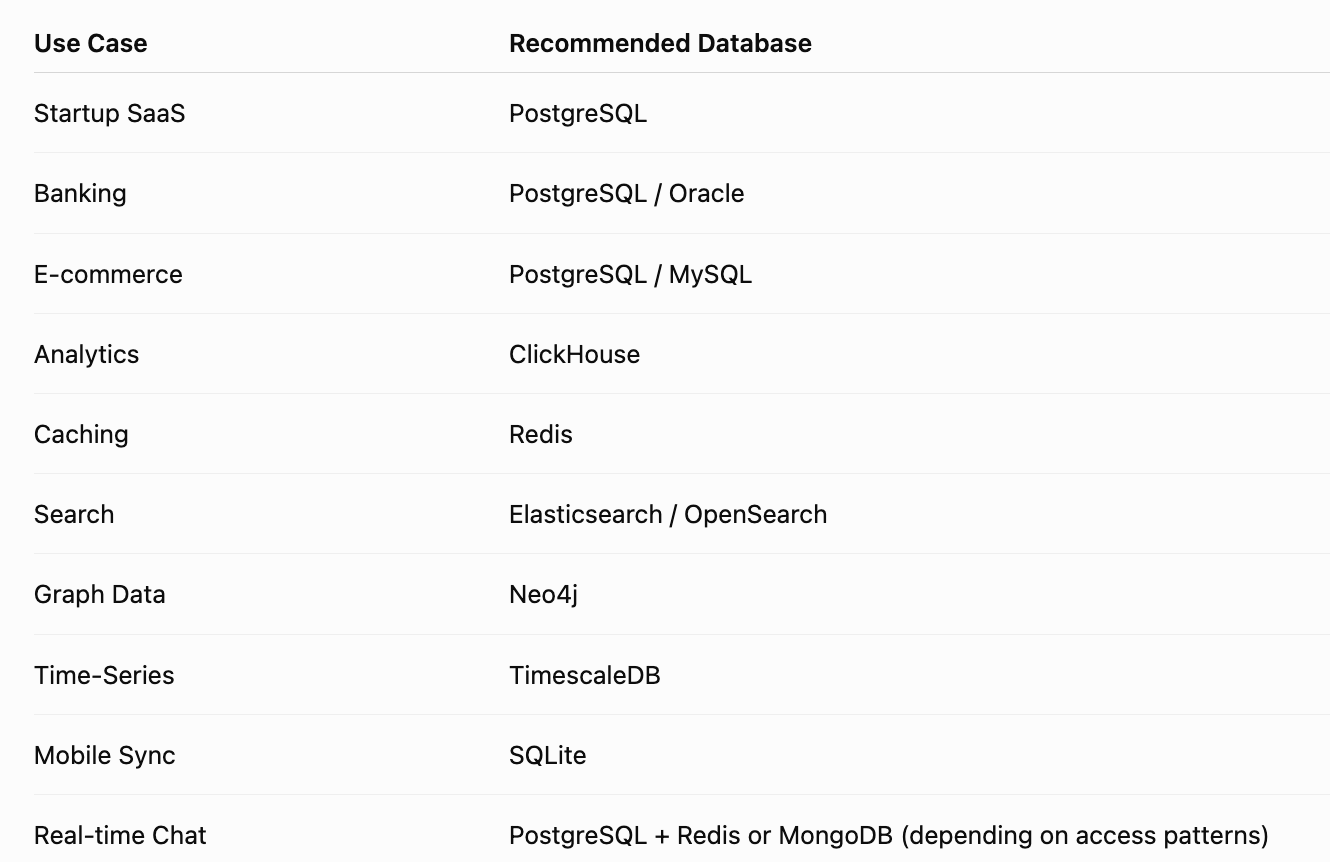
Choosing the Right Database
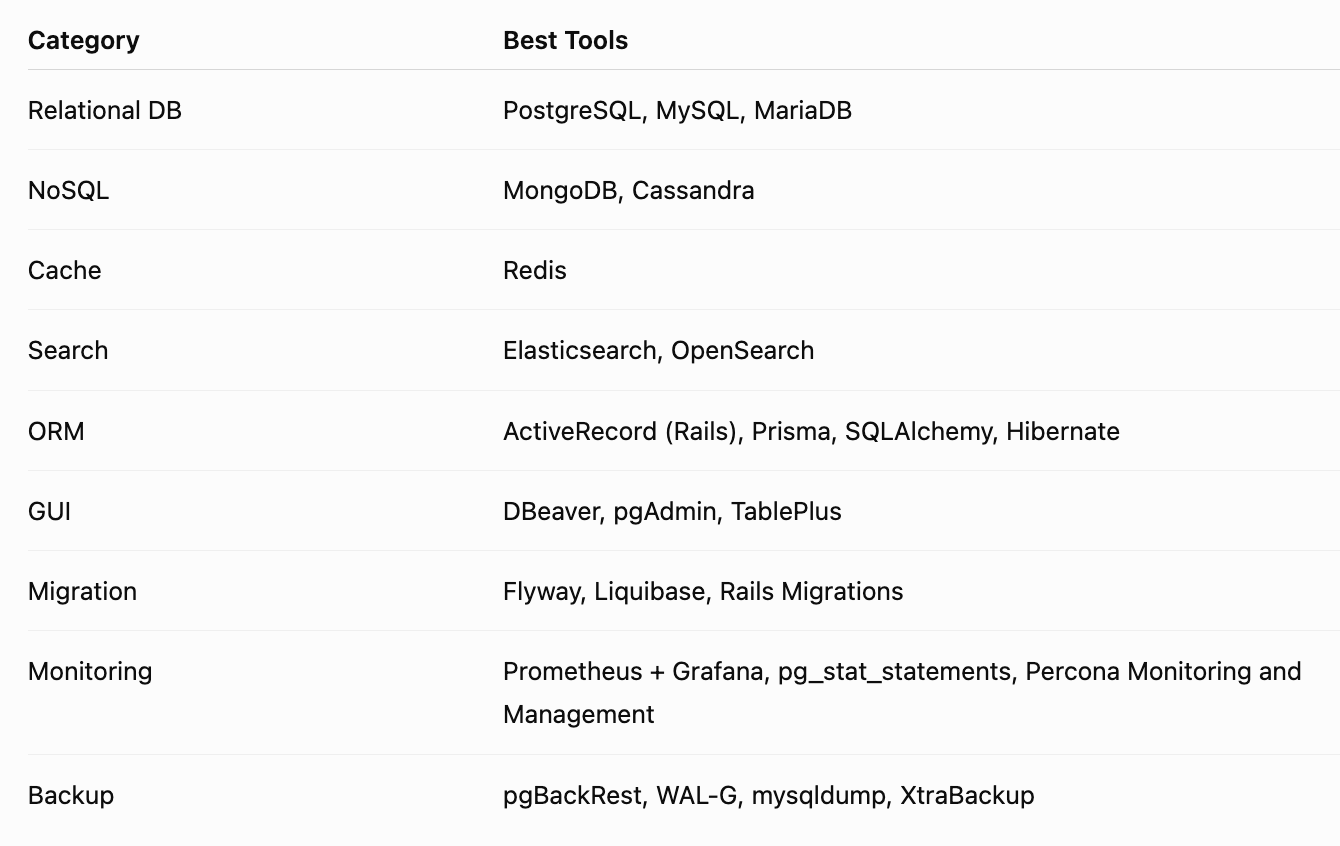
Recommended Tools 🛠️
Designing a Production-Ready DBMS Workflow
Requirements
      ↓
Domain Modeling
      ↓
Entity Relationship Diagram (ERD)
      ↓
Normalization
      ↓
Choose Data Types
      ↓
Primary & Foreign Keys
      ↓
Constraints
      ↓
Indexes
      ↓
Transactions
      ↓
Security
      ↓
Replication
      ↓
Backups
      ↓
Monitoring
      ↓
Performance Tuning
Common Mistakes ❌
- 🚫 Using
SELECT *everywhere - 🚫 Missing indexes on frequently queried columns
- 🚫 Too many indexes slowing writes
- 🚫 No foreign key constraints where integrity matters
- 🚫 Storing blobs in relational tables when object storage is more appropriate
- 🚫 Ignoring backups
- 🚫 Long-running transactions
- 🚫 N+1 query problems in ORMs
- 🚫 Hard deleting important business records without audit requirements
A Practical Example: Online Bookstore
Imagine building an online bookstore.
Core tables:
- Authors
- Books
- Categories
- Customers
- Orders
- OrderItems
- Payments
- Reviews
Workflow:
- A customer registers.
- They browse books by category.
- They add books to the cart.
- An order is created inside a transaction.
- Inventory is reduced.
- Payment is recorded.
- The order status is updated.
- Analytics dashboards read from replicas while Redis caches popular books.
This design separates concerns, maintains data integrity, and scales as traffic grows.
Best Practices Checklist ✅
- ✔️ Model the business domain first
- ✔️ Normalize, then denormalize only when profiling proves it’s beneficial
- ✔️ Use meaningful constraints
- ✔️ Index based on real query patterns
- ✔️ Keep transactions short
- ✔️ Monitor slow queries
- ✔️ Use connection pooling
- ✔️ Automate migrations
- ✔️ Test backup restoration regularly
- ✔️ Plan for growth before you need it
- ✔️ Document your schema and data contracts
🎯 Final Thoughts
A perfect DBMS isn’t defined by choosing the “best” database — it’s defined by good architecture, thoughtful data modeling, reliable transactions, robust security, and continuous performance optimization.
The strongest systems balance correctness, maintainability, performance, and scalability. Whether you’re building a simple blog or a global SaaS platform, the same core principles apply:
- 🧩 Design the schema carefully.
- ⚡ Optimize based on evidence, not assumptions.
- 🔒 Protect your data.
- 📈 Build for future growth.
- 🔄 Continuously monitor and improve.
Master these fundamentals, and you’ll create databases that remain reliable, fast, and maintainable even as your applications grow from hundreds to millions of users. Happy building! 🚀


Comments
Post a Comment