🌌 Does God Exist? — The Question Science Can Explore, but Perhaps Never Fully Answer
🌌 Does God Exist? — The Question Science Can Explore, but Perhaps Never Fully Answer
“If God exists, why can’t we see Him? And if God doesn’t exist, why does the universe exist at all?”
Few questions have followed humanity for as long as this one.
From ancient sages sitting in meditation to modern physicists studying galaxies, black holes, quantum mechanics, and the origins of consciousness, humanity has repeatedly returned to the same mystery:
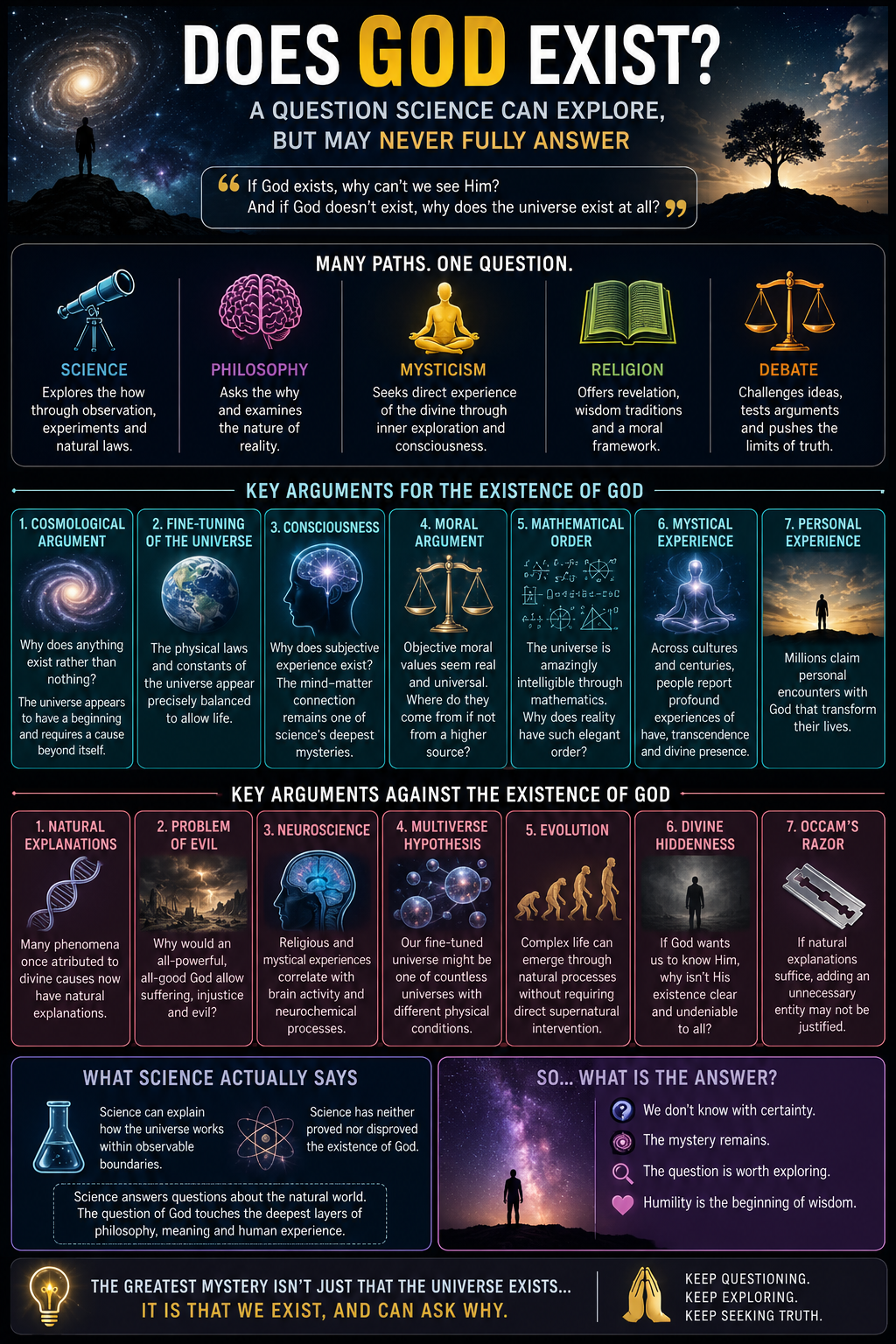
Does God actually exist? 🙏🌌
Some say yes — God is the fundamental reality behind existence.
Some say no — the universe can potentially be explained through natural laws without requiring a divine being.
Others say the question itself may be beyond the tools of science.
And perhaps this is why the debate never truly ends.
Science can investigate how things happen. Philosophy asks why. Mysticism asks about direct experience. Religion interprets existence through revelation and faith.
The fascinating possibility is that these approaches may not necessarily be enemies.
🔬 1. First, What Do We Mean by “God”?
Before debating God’s existence, we need to define what we mean by God.
The traditional image is often:
👤 A supernatural being somewhere outside the universe who created everything.
But philosophical and mystical traditions have proposed very different concepts.
God has been described as:
- 🌌 The creator of the universe
- ⚛️ The fundamental reality underlying existence
- 🧠 Universal consciousness
- ♾️ The necessary cause behind contingent reality
- ❤️ The source of morality and meaning
- ✨ Brahman or ultimate reality
- ☯️ The Tao
- 🕉️ The divine consciousness experienced through spiritual realization
- 🌊 A reality beyond subject-object separation
Therefore, proving or disproving one particular conception of God does not automatically prove or disprove every conception.
This distinction becomes extremely important.
🌠 2. The Cosmological Argument — Why Is There Something Rather Than Nothing?
One of the oldest arguments for God begins with a deceptively simple question:
Why does anything exist at all?
The observable universe contains:
- Galaxies 🌌
- Stars ⭐
- Planets 🪐
- Matter
- Energy
- Space
- Time
- Physical laws
Modern cosmology tells us that our observable universe evolved from an extremely hot, dense early state approximately 13.8 billion years ago.
But this creates another question:
What ultimately explains the existence of the universe?
The classical cosmological argument proposes:
- Things that begin to exist require an explanation.
- The universe appears to have a finite cosmic history.
- Therefore, the universe requires an explanation beyond itself.
- That explanation is proposed to be God.
This is sometimes called the Kalam cosmological argument.
But there is an important scientific caution.
The Big Bang theory does not simply mean “science has proven that the universe came from absolute nothing.”
The Big Bang model describes the evolution of the early universe from an extremely hot and dense state. What happened at the ultimate beginning — or whether “beginning” is even the correct concept — remains an open question.
Some cosmological models propose:
- Quantum cosmological origins
- Inflationary scenarios
- Bounce models
- Cyclic universes
- Multiverse hypotheses
However, these models don’t necessarily eliminate the philosophical question.
They can move it backward:
Why does that physical system, quantum state, mathematical structure, or set of laws exist?
And that leads to a deeper philosophical problem:
Why is there something rather than absolutely nothing?
Science has not provided a universally accepted final answer.
⏳ 3. The “Who Created God?” Objection
A common objection is:
“If God created the universe, who created God?”
The classical theological answer is fascinating.
God isn’t proposed as another object inside the universe that needs a previous cause.
Instead, God is defined as a necessary reality — something whose existence does not depend upon something else.
Everything else may be contingent:
“It exists, but it could have not existed.”
God, under this conception, would be:
“That which must exist.”
This changes the question from:
Who created God?
to:
Can there be a fundamental reality that requires no external explanation?
And interestingly, even non-theistic philosophies have to confront a similar issue.
At some point, an explanation must terminate in something fundamental:
- Fundamental physical laws?
- Quantum fields?
- Mathematical structure?
- An eternal universe?
- A multiverse?
- Consciousness?
- God?
The debate is therefore not simply about whether something needs an explanation.
It is about:
What should be considered fundamental?
🎯 4. The Fine-Tuning Mystery
One of the most fascinating discussions concerns the apparent precision of the physical universe.
Our universe is governed by fundamental parameters and physical laws.
Examples include:
- Strength of gravity
- Electromagnetic interaction
- Strong nuclear interaction
- Weak nuclear interaction
- Particle masses
- Cosmological parameters
If some fundamental parameters were significantly different, the universe might not form stable stars, complex chemistry, planets, or life as we know it.
This produces the fine-tuning argument.
The theistic interpretation says:
Perhaps the universe appears life-permitting because it was intentionally designed.
But science and philosophy offer alternative possibilities.
🌌 The Multiverse
If there are enormous numbers of universes with different physical parameters, then perhaps it isn’t surprising that at least one permits observers.
We would naturally find ourselves in a universe compatible with our existence.
This is related to the anthropic principle.
But here’s the fascinating twist:
The multiverse itself is difficult to directly test observationally in many proposed forms.
So the argument becomes philosophical as well as scientific.
The question shifts from:
“Who fine-tuned this universe?”
to:
“Why does the multiverse — or whatever generates these universes — exist?”
Again, the mystery moves rather than disappears.
🧮 5. The Mathematical Universe
Another extraordinary fact about reality is the effectiveness of mathematics.
Equations developed inside human minds can describe:
- Planetary motion 🪐
- Electromagnetism ⚡
- Quantum mechanics ⚛️
- Relativity
- Gravitational waves
- Black holes 🕳️
- The expansion of the universe
This has led thinkers such as physicist Eugene Wigner to discuss the “unreasonable effectiveness of mathematics.”
Why should abstract mathematical relationships map so effectively onto physical reality?
One interpretation is that mathematics is simply the language humans developed to describe patterns.
Another, more philosophical interpretation is:
Perhaps reality itself has a fundamentally mathematical structure.
And then comes an almost mystical question:
Why does reality possess such elegant order at all?
Order does not automatically prove God.
But for many believers, the mathematical intelligibility of nature is suggestive of a deeper rational foundation.
🧠 6. The Biggest Mystery May Not Be the Universe — It May Be Consciousness
Consider this:
You are not merely a collection of atoms.
You experience:
- Colors 🎨
- Music 🎵
- Love ❤️
- Pain
- Beauty
- Memories
- Dreams
- Self-awareness
- Thoughts
- Meaning
Your brain consists of physical matter.
But why should physical processes produce subjective experience?
This is known as the hard problem of consciousness.
Science can increasingly correlate mental experiences with brain activity.
We can observe neural networks.
We can measure electrical activity.
We can study neurotransmitters.
But the deeper philosophical question remains:
Why does information processing feel like something from the inside?
Why does seeing red feel like seeing red?
Why does pain hurt?
Why does consciousness exist at all?
🧠✨ 7. Could Consciousness Be Fundamental?
Some philosophical traditions reverse the usual assumption.
Instead of:
Matter → consciousness
they propose:
Consciousness → experience of matter
Indian philosophical traditions have explored ideas resembling this for thousands of years.
The concept of Brahman in Advaita Vedanta describes ultimate reality as beyond ordinary distinctions and deeply associated with consciousness.
The famous idea:
“Tat Tvam Asi” — “That Thou Art.”
suggests a profound relationship between individual consciousness and ultimate reality.
This is obviously not equivalent to modern neuroscience.
But it creates an intriguing philosophical parallel:
Materialism:
Consciousness emerges from matter.
Idealism:
Consciousness is fundamental.
Panpsychism:
Some primitive form of experience may be fundamental to reality.
Non-dual traditions:
The apparent separation between observer and reality may itself be an illusion or limited perspective.
None of these positions has been conclusively established.
But consciousness remains one of the deepest unsolved questions in philosophy and science.
⚛️ 8. Quantum Mechanics — Is God Hiding Inside the Quantum World?
Quantum mechanics is frequently invoked in spiritual discussions.
And there is a good reason people find it mysterious.
At quantum scales:
- Particles can behave like waves.
- Measurement plays a special role in quantum descriptions.
- Entanglement produces correlations that have no simple classical explanation.
- Quantum states are described probabilistically.
- Reality behaves very differently from everyday intuition.
Einstein famously disliked some implications of quantum theory, while other physicists embraced its probabilistic nature.
But we should be careful:
Quantum mechanics does NOT scientifically prove God.
Claims such as:
“Quantum consciousness proves God”
or
“The observer creates the entire universe”
go far beyond what established quantum physics demonstrates.
Nevertheless, quantum mechanics teaches us something intellectually valuable:
Reality is much stranger than human intuition suggests.
And that should make us humble when making absolute claims about what reality can or cannot contain.
🕳️ 9. Black Holes and the Limits of Human Knowledge
Black holes are regions where gravity becomes extraordinarily strong.
Inside the event horizon, our ordinary intuition about space and time breaks down.
The center of a classical black hole leads toward a singularity, where current theories of gravity are expected to become incomplete.
We therefore encounter a boundary:
Our mathematical description reaches a place where our existing physical theories cannot fully describe what happens.
This is important because science is not simply a collection of answers.
Science also identifies:
The boundaries of what we currently understand.
Perhaps some questions about God lie beyond those boundaries.
But that doesn’t mean:
“We don’t understand it, therefore God.”
That would be a God-of-the-gaps argument.
Instead, the intellectually honest position is:
We don’t yet know.
🌌 10. The Argument From Design
Look at nature.
The extraordinary structure of:
- DNA 🧬
- Cells
- Ecosystems
- Galaxies
- Planetary systems
- Evolution
- Physical laws
can appear incredibly ordered.
Historically, this inspired the argument from design.
Modern biology, however, provides a powerful natural mechanism for biological complexity:
Evolution by natural selection.
Complex biological structures can emerge through cumulative processes over enormous timescales.
Therefore:
Biological complexity alone is not scientific proof of supernatural design.
But the broader philosophical question survives:
Why does a universe containing laws capable of producing complexity and life exist in the first place?
Evolution explains enormous amounts about how life diversifies.
It does not, by itself, settle the ultimate metaphysical question of why there is a universe governed by discoverable laws.
❤️ 11. The Moral Argument
Humans frequently experience moral intuitions.
We tend to believe things such as:
- Torturing innocent people is wrong.
- Helping vulnerable people is good.
- Betrayal is wrong.
- Justice matters.
- Compassion matters.
But where does morality come from?
One argument proposes:
If objective moral values genuinely exist, perhaps they require a transcendent foundation.
Otherwise, morality could ultimately be:
- Evolutionary adaptation
- Social convention
- Cultural conditioning
- Psychological preference
Evolution can potentially explain why humans developed cooperative tendencies.
But another philosophical question remains:
Does explaining why humans believe something is moral explain whether it is actually moral?
For example:
If every human society decided tomorrow that torturing innocent children was acceptable, would it become morally good?
Many people instinctively answer:
No.
That intuition motivates the argument for objective morality.
But again, it doesn’t constitute scientific proof of God.
It is a philosophical argument.
🌊 12. The Problem of Evil — Perhaps the Strongest Argument Against God
If God is:
- All-powerful
- All-knowing
- Perfectly good
then why does suffering exist?
Why do:
- Children suffer?
- Natural disasters kill?
- Diseases destroy lives?
- Innocent people experience tragedy?
- Animals suffer?
- Wars happen?
This is known as the problem of evil.
It represents perhaps the strongest challenge to traditional belief in an all-powerful, perfectly good God.
Various philosophical responses exist.
Free Will
Some suffering results from human choices.
Soul-Making
Difficulty may contribute to moral development.
Natural-law universe
A stable universe governed by consistent physical laws inevitably allows both beneficial and harmful events.
Human epistemic limitation
Perhaps humans cannot know all the consequences or purposes behind events.
But none of these explanations completely dissolves the emotional and philosophical force of suffering.
The question remains deeply uncomfortable:
If God exists, why is the universe so full of suffering?
And perhaps that question deserves humility rather than easy answers.
🧘 13. Mystical Experiences — The Inner Laboratory
Now we enter a completely different domain.
Across cultures and centuries, people have reported experiences involving:
- Profound unity
- Loss of ordinary ego boundaries
- Extraordinary peace
- Timelessness
- Intense love
- A sense of divine presence
- Expanded awareness
- Experiences interpreted as union with ultimate reality
Hindu mystics call some experiences samadhi.
Buddhist traditions describe profound states of meditative awareness.
Christian mystics have described union with God.
Sufi traditions describe divine love and closeness to God.
Different traditions use different languages.
Yet descriptions sometimes contain striking similarities.
This raises a fascinating question:
Are mystical experiences merely neurological phenomena, or do they provide access to something beyond ordinary consciousness?
Science can study the brain during meditation and altered states.
But brain activity alone doesn’t necessarily answer the metaphysical interpretation.
If someone sees a red apple, neuroscience can describe the neural activity associated with seeing it.
But neuroscience doesn’t automatically determine whether the apple exists independently of the observer.
Likewise:
Explaining the neurological mechanism of a mystical experience does not automatically establish whether the experience has or lacks metaphysical significance.
🧬 14. Near-Death Experiences
Another controversial area is near-death experiences (NDEs).
Some people who come close to death report:
- A feeling of leaving the body
- Bright lights
- Encounters with deceased relatives
- Profound peace
- Life reviews
- A sense of entering another realm
These experiences are real experiences in the sense that people genuinely report them.
But their interpretation remains controversial.
Possible explanations include:
- Brain activity during extreme physiological stress
- Changes in oxygen and carbon dioxide levels
- Neurochemical processes
- Memory reconstruction
- Psychological mechanisms
- Or, according to some interpretations, consciousness existing independently of ordinary brain function
Current evidence does not establish NDEs as scientific proof of an afterlife.
But they remain an interesting frontier where neuroscience, philosophy, psychology, and spirituality intersect.
🧘♂️ 15. Ancient Mysticism and Modern Science
One of the most intriguing observations is that ancient philosophical traditions sometimes asked questions that resemble modern scientific mysteries.
For example:
Ancient question:
What is the ultimate nature of reality?
Modern question:
What are the fundamental constituents of the universe?
Ancient question:
Who is the observer?
Modern question:
What is consciousness and how does observation relate to physical reality?
Ancient question:
Is the world as we perceive it ultimately real?
Modern question:
How accurately does human perception represent objective reality?
Ancient question:
What existed before creation?
Modern question:
What happened in the earliest universe, and is “before the Big Bang” even physically meaningful?
These similarities are fascinating.
But we should avoid claiming:
“Ancient scriptures predicted quantum physics.”
Such claims are usually exaggerated.
Ancient philosophy and modern science operate through very different methods.
The meaningful connection is that both are attempts to confront fundamental questions about reality.
👁️ 16. The Observer Problem
Human beings never experience the universe completely directly.
We experience it through:
Reality → sensory organs → nervous system → brain → conscious experience
Your brain constructs your experienced world.
You don’t directly experience electromagnetic wavelengths.
Your brain interprets certain wavelengths as colors.
You don’t directly experience air-pressure oscillations.
Your brain interprets them as sound.
This means our everyday experience is a model of reality, not necessarily reality in its entirety.
The universe may be profoundly different from how human consciousness experiences it.
That creates an astonishing possibility:
Perhaps what we call “reality” is only a tiny slice of a much larger structure.
This doesn’t prove God.
But it gives us a powerful reason to remain intellectually humble.
🧠 17. The Simulation Hypothesis
Modern technology has produced another strange philosophical possibility:
What if reality is a simulation?
The argument is associated particularly with philosopher Nick Bostrom’s simulation argument.
If advanced civilizations eventually become capable of creating enormous numbers of conscious simulated worlds, then statistically one might wonder whether we could ourselves inhabit such a simulation.
But even if we were simulated…
we haven’t solved the God question.
We would simply ask:
Who created the simulator?
And then:
Who created their universe?
Eventually we reach the same foundational question again.
🔥 18. The Infinite Regress Problem
Imagine:
Universe A was created by God.
Who created God?
God’s creator was created by another entity.
Who created that entity?
And so on forever.
This creates an infinite regress.
The philosophical response is that an infinite chain of contingent explanations may never provide an ultimate explanation.
Therefore, some philosophers argue that reality must ultimately rest upon something that is:
Necessary rather than contingent.
Theists call this God.
Others may call it:
- Fundamental reality
- Necessary existence
- Mathematical structure
- Physical law
- Quantum reality
The disagreement is therefore partly about terminology and metaphysics.
🌌 19. Could God Be the Universe?
Some philosophical positions resemble pantheism, where God and the universe are identified.
Others propose panentheism, where the universe exists within God but God is greater than the universe.
This is very different from imagining God as a person sitting somewhere in space.
Under such perspectives:
God isn’t another object inside reality.
Instead:
God is the ground of reality itself.
This idea has appeared in different forms across philosophical and mystical traditions.
And it creates an interesting challenge:
If God is the foundation of existence itself, then looking through a telescope for God may be like using a thermometer to measure mathematics.
Perhaps the wrong instrument is being used for the question.
🔬 20. What Does Science Actually Say?
This is where intellectual honesty becomes essential.
Science has discovered extraordinary things about:
- Cosmic evolution
- Galaxies
- Stars
- Planet formation
- Biology
- Genetics
- Evolution
- Neuroscience
- Quantum mechanics
- Relativity
But science has not established that God exists.
Science also has not established that God does not exist.
Why?
Because the scientific method works primarily with hypotheses that generate testable predictions and observable consequences.
If someone defines God as an entity that produces measurable physical effects, scientific investigation may potentially address specific claims.
But if God is defined as:
the metaphysical ground of existence
then the question becomes partly philosophical rather than a conventional laboratory hypothesis.
Therefore:
❌ “Science proved God.”
is too strong.
And:
❌ “Science disproved God.”
is also too strong.
The more defensible statement is:
Science has dramatically expanded our understanding of nature, but the ultimate metaphysical question of God remains unresolved.
🧩 21. Why the Debate Will Probably Never End
Think about the structure of the question.
If science explains one level:
How did life emerge?
we ask:
Why does life-producing chemistry exist?
If physics explains that:
Why do these physical laws exist?
If cosmology explains the universe:
Why does the underlying reality exist?
If neuroscience explains consciousness:
Why does subjective experience exist at all?
Every explanation can potentially generate another question.
This is why the God debate is so persistent.
Because ultimately, we’re not simply asking:
“Is there a supernatural person?”
We’re asking:
“What is the ultimate nature of reality?”
⚖️ 22. The Strongest Arguments FOR God
Let’s summarize.
🌌 1. Cosmological Argument
Why does anything exist rather than nothing?
🎯 2. Fine-Tuning
Why does the universe have conditions compatible with complex structures and life?
🧠 3. Consciousness
Why does subjective experience exist?
❤️ 4. Objective Morality
Why do humans experience some moral truths as objectively binding?
🧮 5. Mathematical Order
Why is reality so mathematically intelligible?
🧘 6. Mystical Experience
Why do people across cultures report profound experiences of unity and transcendence?
🌟 7. Personal Religious Experience
Millions of people report experiences they interpret as encounters with God.
None individually constitutes a universally accepted proof.
Together, however, they form a powerful philosophical case for believers.
⚔️ 23. The Strongest Arguments AGAINST God
🔬 1. Natural Explanations
Many phenomena once attributed to supernatural forces now have natural explanations.
🌋 2. Problem of Evil
Why would a perfectly good and powerful God permit enormous suffering?
🧠 3. Neuroscience
Religious and mystical experiences correlate with brain activity.
🌌 4. Multiverse
Fine-tuning may potentially be explained without intentional design.
🧬 5. Evolution
Biological complexity does not require direct supernatural intervention.
🤔 6. Divine Hiddenness
If God wants humans to know Him, why isn’t His existence universally obvious?
🪒 7. Occam’s Razor
If natural explanations are sufficient, adding another entity may be unnecessary.
These arguments are also serious.
🕯️ 24. The Most Interesting Possibility: We May Be Asking the Wrong Question
Perhaps the ultimate question isn’t:
“Does God exist?”
Maybe it is:
“What do we mean by existence?”
A rock exists.
A mathematical equation exists in a different sense.
A thought exists differently.
A law of physics exists differently.
Consciousness exists differently.
Does a mathematical object exist independently of human minds?
Does information exist physically or abstractly?
Does consciousness exist independently of matter?
These questions reveal something profound:
“Existence” itself is mysterious.
And if we don’t fully understand what existence means, confidently declaring what can or cannot exist may be premature.
🕉️ 25. The Mystical Answer: Search Within
Many spiritual traditions don’t begin with:
“Believe.”
They begin with:
“Experience.”
Meditate.
Observe the mind.
Question the ego.
Watch thoughts arise and disappear.
Ask:
Who is aware of my thoughts?
When you say:
“I am thinking.”
Who is observing the thinking?
When you say:
“I am aware.”
What is this awareness?
Mystical traditions often argue that the deepest investigation isn’t outward.
It is inward.
Science points a telescope toward the universe.
Meditation points attention toward consciousness.
Both are forms of investigation — but their instruments are radically different.
🔭 26. Science and Mysticism May Be Looking at Different Layers
Imagine reality as a giant ocean.
Science studies:
🌊 Waves
🌊 Currents
🌊 Temperature
🌊 Pressure
🌊 Chemistry
🌊 Marine ecosystems
Mysticism asks:
What is the nature of the ocean itself?
Science can become increasingly precise about measurable phenomena.
Mysticism can explore subjective experience and the transformation of consciousness.
The mistake is assuming that one automatically replaces the other.
Science should not be used to manufacture supernatural conclusions.
And spirituality should not be used to reject established scientific evidence.
A mature worldview can hold both:
“I don’t know.”
and
“I am willing to investigate.”
🌌 27. So… Does God Exist?
Perhaps the most honest answer is:
We don’t know with scientific certainty.
But the fact that we don’t know does not make the question meaningless.
Quite the opposite.
The question forces us to confront:
- The origin of the universe 🌌
- The nature of consciousness 🧠
- The existence of mathematical order 🧮
- The foundations of morality ❤️
- The nature of reality 🔬
- The mystery of subjective experience 🧘
- The existence of suffering ⚖️
- The limits of human knowledge 🔭
And perhaps that’s why this debate has survived thousands of years.
Because every generation discovers new knowledge — and then encounters an even deeper mystery.
🙏 28. The Final Paradox
There is an extraordinary paradox at the heart of this debate.
If God exists, perhaps our inability to completely understand God is exactly what we should expect from finite human minds trying to comprehend ultimate reality.
But if God does not exist, we are still left with an astonishing mystery:
Why does anything exist at all?
Why is there a universe?
Why are there laws?
Why is mathematics so effective?
Why does consciousness exist?
Why can the universe understand itself through conscious beings?
Think about that last question for a moment.
You are made from elements forged in ancient stars. ⭐
Those atoms came together through billions of years of cosmic evolution.
And now those atoms are organized into a brain capable of looking at the universe and asking:
“Why am I here?”
Perhaps that is the strangest fact of all.
🌠 The Answer May Be Bigger Than “Yes” or “No”
Maybe the ultimate purpose of the God question isn’t simply to arrive at YES or NO.
Maybe it is to make us humble enough to realize how little we truly understand.
Science teaches us to say:
“Show me the evidence.”
Philosophy teaches us:
“Examine your assumptions.”
Mysticism teaches:
“Know yourself.”
And spirituality teaches:
“Look beyond yourself.”
Perhaps the deepest position isn’t blind belief.
And it isn’t blind disbelief.
It is curiosity.
Because somewhere between the first atom, the first star, the emergence of life, the birth of consciousness, and the human search for meaning lies one of existence’s greatest mysteries:
🌌 Are we merely observers of the universe… or is the universe, through us, beginning to observe itself?
And maybe that is why the debate about God will never truly end.
Because as long as conscious beings exist, humanity will continue looking upward at the stars, inward at consciousness, and beyond both toward the possibility of something greater.
The question remains open.
And perhaps the mystery itself is part of the answer. 🙏✨


Comments
Post a Comment